
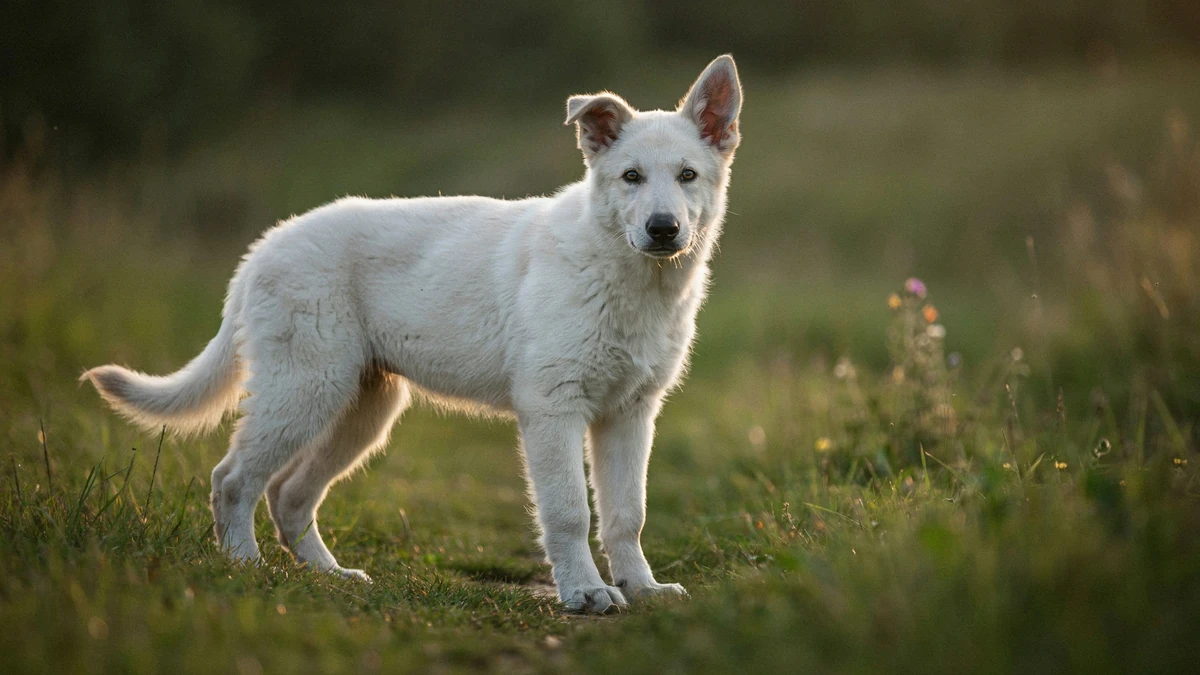
A white German Shepherd puppy is a German Shepherd Dog whose inherited pigment pattern produces a white or pale cream coat. It is not automatically albino, mixed breed, unhealthy, deaf, or a White Swiss Shepherd. In the United States, white appears as an AKC registration color, although the AKC German Shepherd breed standard disqualifies white dogs from conformation competition. (American Kennel Club)
The coat color changes how the puppy looks, but it does not create a separate size, temperament, exercise requirement, or health-testing standard. Responsible selection should focus on the parents, pedigree, health records, temperament, puppy raising, and lifestyle fit—not the novelty of the white coat.
Quick Answer: What Is a White German Shepherd Puppy?
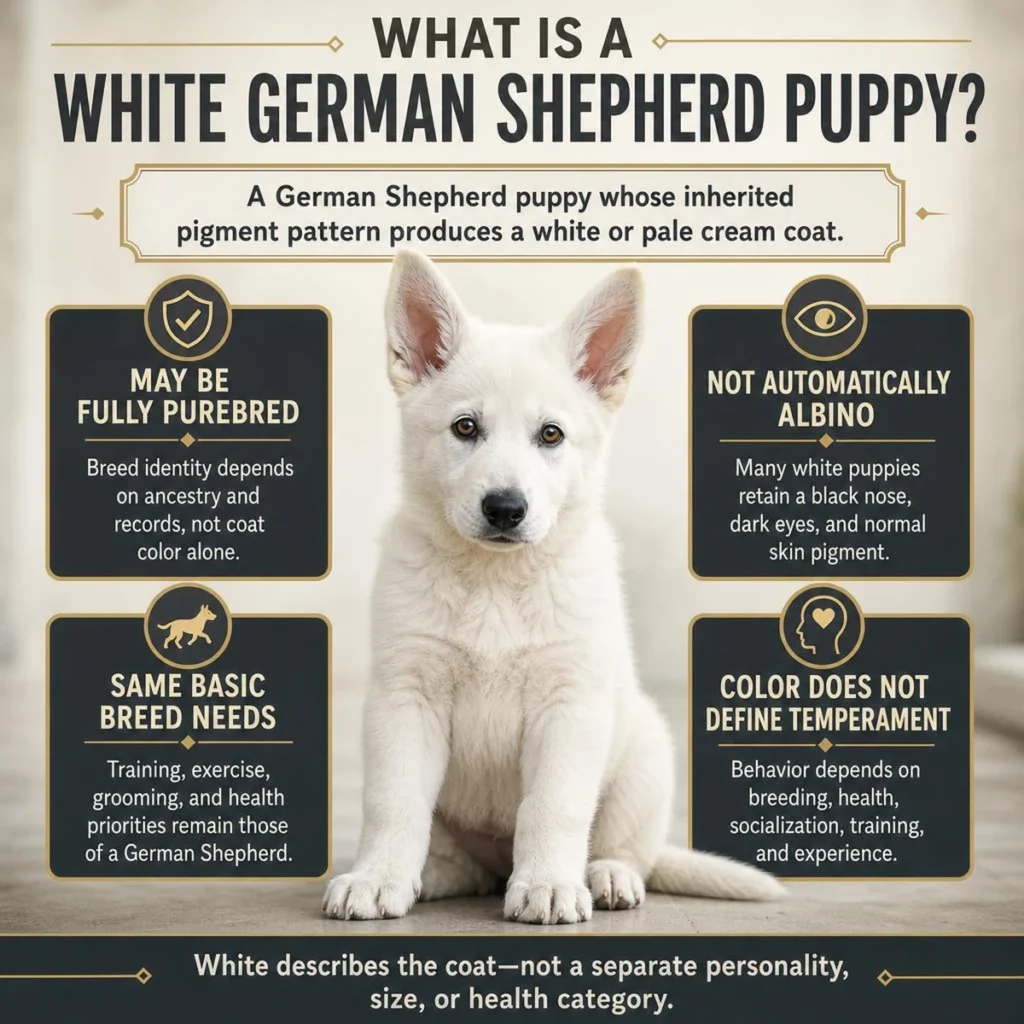
A white German Shepherd puppy is a German Shepherd Dog that inherits a recessive coat-color combination that prevents dark pigment from appearing in its hair. The puppy may still have a black nose, dark eye rims, dark eyes, and pigmented skin. White describes the coat, not a separate personality or health category. (PMC)
| Feature | What owners should know |
| Breed identity | May be a purebred German Shepherd Dog |
| Coat genetics | Commonly associated with recessive MC1R variants |
| AKC registration | White is listed as a registration color |
| AKC conformation | White is a disqualification in the breed ring |
| FCI German Shepherd standard | White is not allowed |
| White Swiss Shepherd | A separately recognized FCI breed |
| Albinism | A white coat alone does not mean albinism |
| Temperament | Not determined by coat color |
| Grooming | Regular double-coat brushing and seasonal shedding care |
| Health screening | Same core German Shepherd screening priorities |
Why Is the Coat White?
A white German Shepherd puppy usually inherits two recessive copies of a variant at the MC1R gene, also called the E locus. Research involving German Shepherd Dogs identifies white coat color as a recessive trait associated with the e allele of MC1R. (PMC)
MC1R helps control whether hair-producing pigment cells make:
- Eumelanin, which produces black or brown pigment
- Phaeomelanin, which produces red, yellow, cream, or very pale pigment
When a dog inherits the recessive e/e combination, it cannot place eumelanin into the coat hairs. Other genes influence how intense the remaining phaeomelanin appears, so the coat may look bright white, ivory, cream, or slightly biscuit-colored. (Veterinary Genetics Laboratory)
This genetic effect applies mainly to the hair. A puppy may still have:
- A black nose
- Dark lips
- Dark eye rims
- Brown eyes
- Dark paw pads
- Pigmented skin
That visible dark pigmentation is one reason a normally pigmented white German Shepherd should not be casually labeled albino.
Can Two Colored German Shepherds Produce a White Puppy?
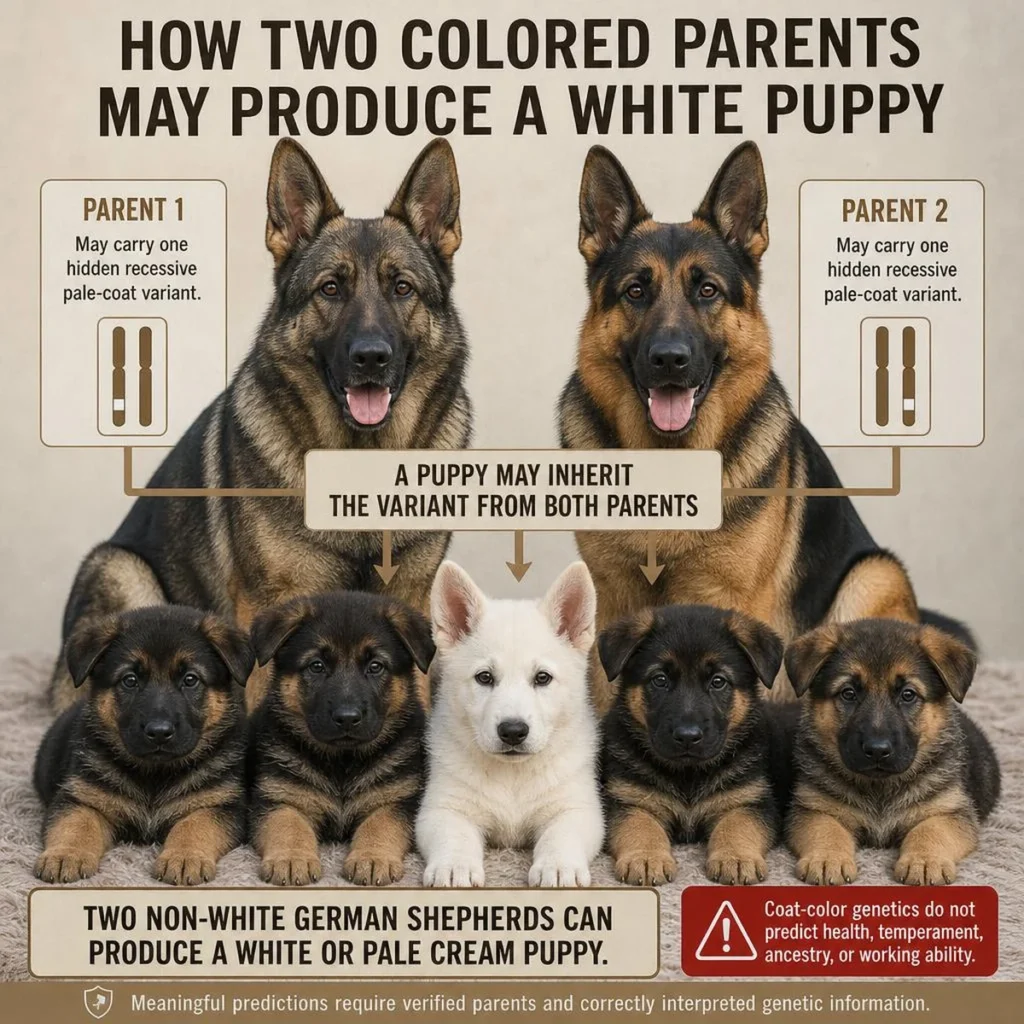
Yes. Two non-white German Shepherds may produce white puppies when both parents carry a recessive white-associated MC1R variant.
A carrier can display sable, black and tan, black, bi-color, or another pattern because one functional copy can allow darker coat pigment to appear. If a puppy inherits the recessive variant from both parents, its coat can be white or pale cream. (Veterinary Genetics Laboratory)
Coat-color testing may help predict possible colors, but it cannot prove:
- Breed quality
- Stable temperament
- Sound hips or elbows
- Working ability
- Purebred ancestry by itself
- Suitability for a particular home
A pigment result should never replace pedigree research or health screening.
Is a White German Shepherd Puppy Albino?
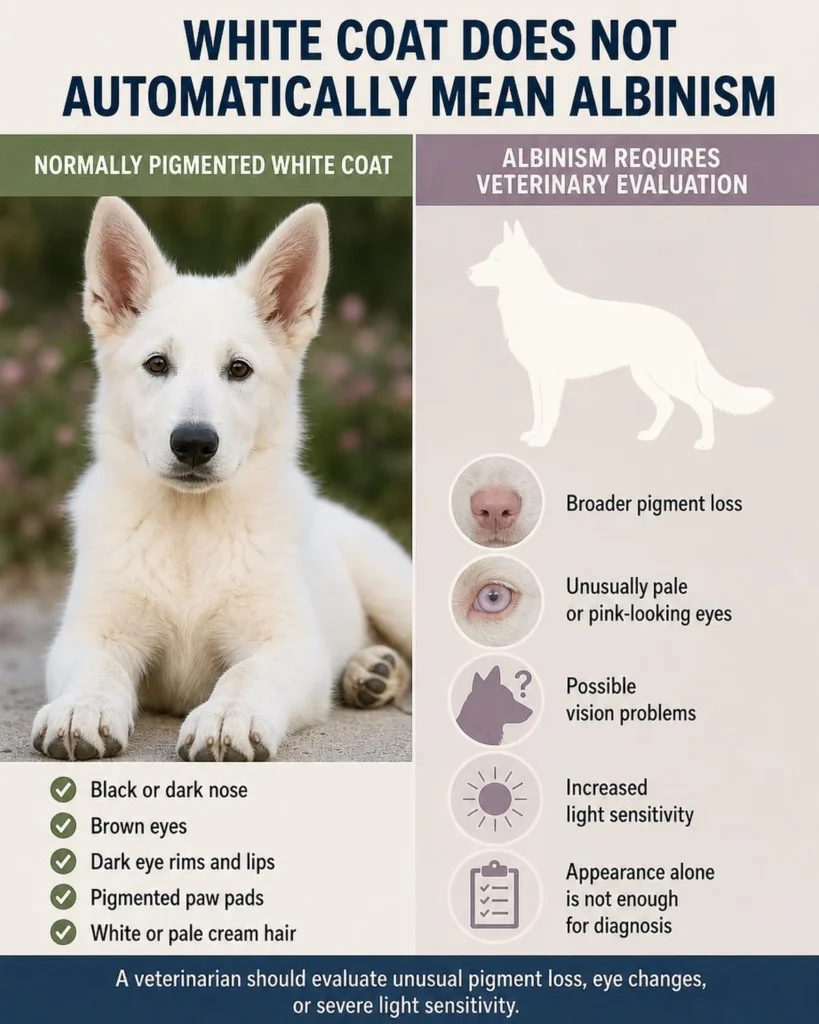
No—not simply because its coat is white.
True albinism is a rare pigment disorder associated with a much broader loss of pigment. Merck Veterinary Manual explains that true albinism is linked with pale or pink irises, visual defects, and increased sensitivity to solar damage. It must be distinguished from other causes of white or pale coat color. (Merck Veterinary Manual)
A normally pigmented white German Shepherd commonly has:
- Brown eyes rather than pale pink irises
- A black nose
- Dark eye rims
- Dark lips
- Pigmented paw pads
These features are consistent with a pale coat in which eumelanin is absent from the hair but remains visible in other tissues.
Ask a veterinarian to evaluate a puppy with:
- Pink or unusually pale eyes
- Significant vision problems
- Severe light sensitivity
- Extensive loss of nose or eye-rim pigment
- Recurrent skin damage after ordinary sun exposure
Appearance alone cannot confirm or exclude a pigment disorder.
Is a White German Shepherd Purebred?
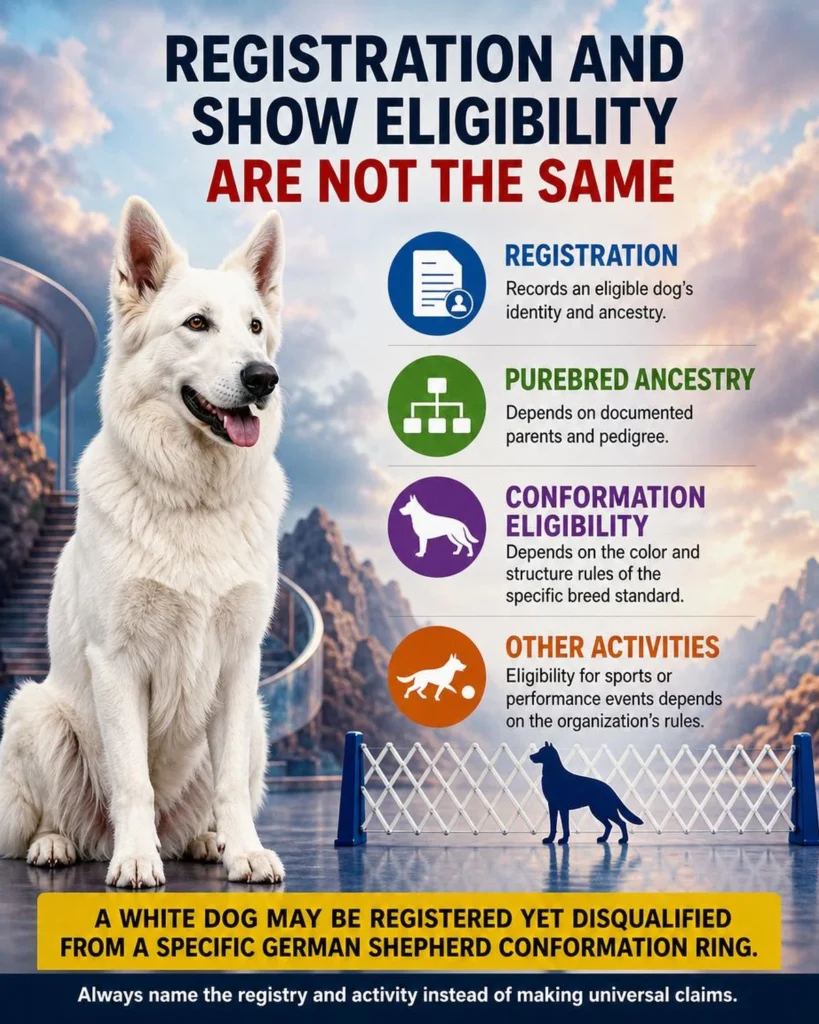
A white German Shepherd puppy can be fully purebred. Coat color by itself neither proves nor disproves ancestry.
The AKC’s German Shepherd breed page includes white with registration code 199. However, the official AKC German Shepherd standard states that a white dog must be disqualified from conformation competition. AKC also explains that a color disqualification does not necessarily prevent a dog from being registered. (American Kennel Club)
This creates an important distinction:
- Registration records an eligible dog’s identity and ancestry.
- Conformation eligibility determines whether the dog may compete in the breed ring under that standard.
- Purebred ancestry depends on the dog’s parents and pedigree.
- Quality depends on the whole dog, not simply registration or coat color.
A white AKC-registered German Shepherd may be ineligible for the German Shepherd conformation ring because of color, yet this does not automatically make the dog mixed breed.
Registry Rules Are Not Universal
Different organizations use different standards.
The FCI German Shepherd standard states that white is not allowed. The United Kennel Club’s German Shepherd standard, by contrast, includes pure white among accepted colors. (FCI)
Therefore, avoid broad claims such as:
- “White is recognized everywhere.”
- “No registry recognizes white.”
- “White cannot be registered.”
- “White is a standard show color in every country.”
Always identify the specific organization and activity being discussed.
White German Shepherd vs. White Swiss Shepherd
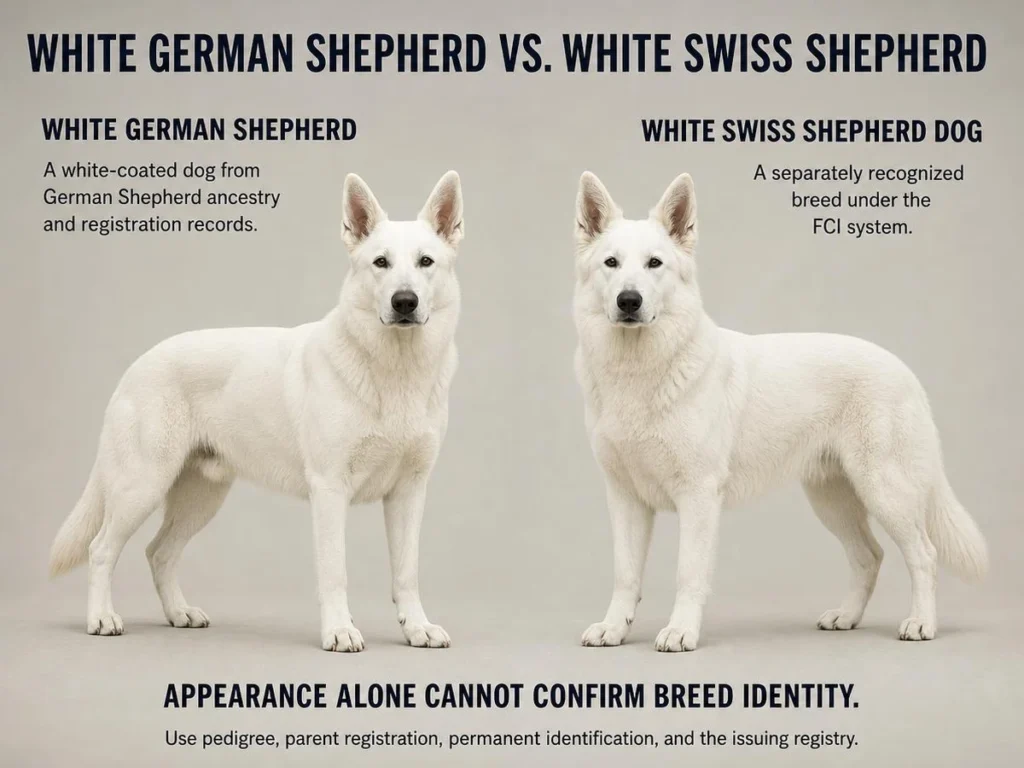
A white German Shepherd and a White Swiss Shepherd Dog may look similar, but the names should not automatically be treated as interchangeable.
The FCI recognizes the Berger Blanc Suisse, or White Swiss Shepherd Dog, under its own breed standard number 347. The FCI German Shepherd Dog is listed separately under standard number 166, where white is not allowed. (FCI)
| Question | White German Shepherd | White Swiss Shepherd Dog |
| Main identity | Color variation within German Shepherd lines | Separately recognized FCI breed |
| AKC context | May be registered as a German Shepherd | Not simply registered as a German Shepherd based on appearance |
| FCI context | White is not allowed under the GSD standard | Recognized under its own standard |
| Appearance | White or cream double coat | White double coat |
| Proof of identity | Pedigree and registration | Pedigree and registration |
| Visual identification alone | Not reliable | Not reliable |
A photograph cannot reliably establish which breed or registration system applies. Ask for:
- Registered names
- Parent registration
- Pedigree documents
- Breed designation
- Issuing registry
- Microchip or permanent identification
Do not rely only on a seller saying “Swiss type,” “European white,” or “rare white shepherd.”
Will a White German Shepherd Puppy Stay White?
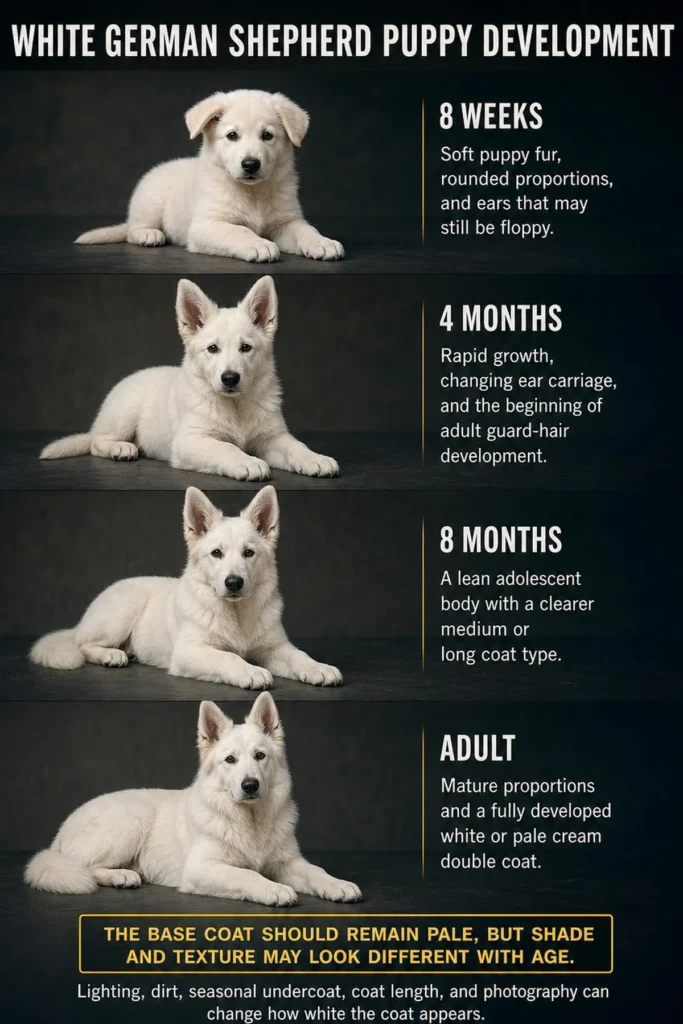
A white German Shepherd puppy should retain its genetically pale base coat, but the visible shade and texture may change as it matures.
Puppy fur is often softer and fluffier than the adult coat. As adult guard hairs and undercoat develop, the dog may appear:
- Brighter white
- Warmer cream
- Slightly biscuit around the ears or back
- Less fluffy during adolescence
- Fuller after the mature double coat develops
- Different under indoor and outdoor lighting
Dirt, saliva staining, wet fur, shedding, camera exposure, and seasonal undercoat can also change the coat’s appearance without changing its genetic color.
A breeder can estimate the likely mature shade by studying parents and older relatives, but should not guarantee:
- A perfectly snow-white adult coat
- No cream shading
- Exact adult coat length
- Exact ear timing
- Exact adult size
- Identical appearance to an edited photograph
Do White German Shepherd Puppies Have Different Temperaments?
A white German Shepherd puppy does not have a separate temperament because of its coat.
The official German Shepherd standard describes the breed as confident, approachable, alert, willing to work, and not hostile without cause. It does not provide one temperament standard for white dogs and another for colored dogs. (AKC Images)
Behavior is shaped by:
- The parents and wider pedigree
- Early development
- Breeder selection
- Socialization
- Training
- Exercise
- Pain and health
- Household management
- Past experiences
White coloring does not automatically make a dog:
- Calmer
- Softer
- More aggressive
- More protective
- Easier to train
- Better with children
- Less suitable for work
- More suitable for first-time owners
A breeder producing mainly companion dogs may select for different behavioral traits than a breeder producing high-drive sport dogs. The difference comes from breeding goals and pedigree, not the white hair itself.
Read Furbivo’s German Shepherd temperament guide for a deeper explanation of confidence, fear, protection, reactivity, and aggression.
Socialization and Training

Every white German Shepherd puppy needs controlled socialization and reward-based training.
The American Veterinary Society of Animal Behavior identifies the first three months as the primary period when puppies are especially prepared to learn about people, animals, environments, and normal experiences. Poor or incomplete exposure during this period can increase later fear and avoidance. (American Veterinary Society)
Useful experiences include:
- Calm adults with different appearances
- Supervised, respectful children
- Household sounds
- Car travel
- Different safe surfaces
- Gentle grooming
- Veterinary-style handling
- Calm, healthy dogs
- Brief periods alone
- Quiet observation of public places
- Rewarded settling
Socialization does not mean forcing the puppy to interact with everyone. A puppy that freezes, hides, refuses food, tries to escape, or becomes frantic needs more distance and an easier experience.
AVSAB recommends reward-based methods and warns that pain- and fear-based tools can increase welfare and behavior risks. (American Veterinary Society)
Useful Furbivo resources include:
- German Shepherd Puppy Socialization Guide
- How to Train a German Shepherd
- German Shepherd Puppy Daily Routine
- Crate Training a German Shepherd Puppy
Size and Growth
White coat genetics do not create a miniature, giant, or separate-sized German Shepherd.
Under the AKC standard, adult males are generally 24–26 inches at the shoulder, while females are generally 22–24 inches. The FCI standard lists males at 60–65 centimeters and 30–40 kilograms, and females at 55–60 centimeters and 22–32 kilograms. (AKC Images)
Puppies often grow rapidly during their first six months, then continue developing height, chest depth, muscle, and adult proportions over a longer period.
Focus on:
- Controlled growth
- Appropriate body condition
- Large-breed puppy nutrition
- Age-appropriate activity
- Secure footing
- Adequate sleep
- Veterinary growth monitoring
Avoid choosing the heaviest puppy merely because a seller calls it:
- Giant white
- King-size white shepherd
- Oversized European white
- Wolf-sized shepherd
- Extra-heavy-boned white
Extreme size is not a recognized white color category.
Use Furbivo’s German Shepherd growth chart and German Shepherd height and weight guide for age-based development context.
When Should the Ears Stand Up?
White coloring does not change normal German Shepherd ear development.
A young puppy may have:
- Two floppy ears
- One ear standing before the other
- Ears that rise and fall
- Uneven ear carriage during growth
- Temporary changes during teething
Avoid taping, gluing, supplementing, or manipulating the ears based only on an arbitrary online deadline.
Contact a veterinarian when the puppy has:
- Ear pain
- Swelling
- Discharge
- Bad odor
- Persistent scratching
- A sudden change after injury
Furbivo’s guide on when German Shepherd ears stand up explains the normal range and warning signs.
Feeding a White German Shepherd Puppy
Coat color does not create a unique nutritional requirement.
Choose a complete and balanced food intended for large-breed puppy growth. Feed measured portions based on the food’s calorie density, the puppy’s body condition, growth pattern, activity, and veterinary guidance.
Do not add calcium, bone meal, or multiple growth supplements without professional advice. More nutrition is not always safer for a rapidly growing large-breed puppy.
A sensible feeding routine includes:
- Three or four small meals for young puppies
- Gradual meal-frequency reduction with age
- Regular weight and body-condition checks
- Slow food transitions
- Fresh water
- Limited high-calorie extras
- No attempts to force maximum growth
Use Furbivo’s German Shepherd puppy feeding chart for meal-frequency guidance.
Coat Type, Grooming, and Shedding
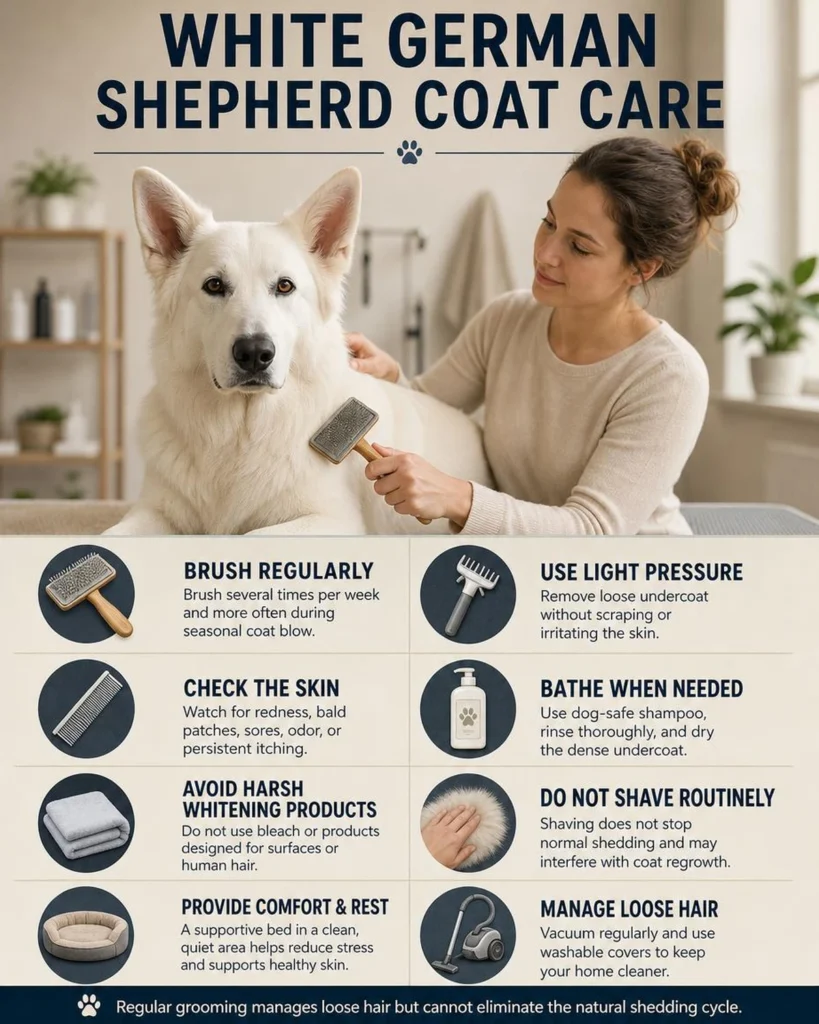
A white German Shepherd may have a medium double coat or a long double coat. Coat color and coat length are separate inherited traits.
The dense undercoat and protective guard hairs produce regular shedding throughout the year, with heavier undercoat loss during seasonal coat changes.
White hair may be especially noticeable on:
- Dark furniture
- Black clothing
- Car interiors
- Colored rugs
- Bedding
A practical routine includes:
- Brushing several times per week
- Daily or near-daily brushing during coat blow
- Gentle use of a slicker brush or undercoat rake
- Comb checks behind the ears and around feathering
- Bathing when needed
- Thorough rinsing
- Complete undercoat drying
- Regular skin checks
Do not bleach the coat or use harsh whitening products intended for surfaces or human hair. Choose dog-safe grooming products and stop using anything that causes redness, itching, or dryness.
Do not shave a healthy double coat simply to control shedding. Shaving changes hair length but does not stop the natural growth cycle.
Read:
- How Much Does a German Shepherd Shed?
- Can You Shave a German Shepherd?
- German Shepherd Puppy Grooming Guide
- Long-Haired German Shepherd
Are White German Shepherds Deaf?
A white coat alone does not confirm that a puppy is deaf, and apparent responses to household sounds do not reliably prove normal hearing in both ears.
Congenital deafness has several possible causes and may occur in one or both ears. A puppy with hearing in only one ear can appear normal during casual observation. Merck Veterinary Manual identifies the brainstem auditory evoked response, commonly called a BAER test, as the most definitive test for hearing. (Merck Veterinary Manual)
Ask about BAER testing when:
- The breeder claims the litter is hearing tested
- A puppy fails to wake for sound
- The puppy does not orient toward noises
- The puppy startles mainly when touched
- Hearing seems inconsistent
- There is a known hearing concern in the line
A BAER test evaluates each ear separately and produces a recorded waveform. (LSU)
Do not diagnose hearing through clapping, banging objects, or deliberately frightening the puppy.
Health Considerations
White coat color should not replace normal German Shepherd health screening.
The current tests recommended by the German Shepherd Dog’s AKC-recognized national breed club are:
- Hip evaluation
- Elbow evaluation
- Temperament test (American Kennel Club)
The Orthopedic Foundation for Animals explains that CHIC protocols are developed with parent clubs and provide public screening information. A CHIC number confirms that required tests were completed and published; it does not guarantee that every result was normal or that the dog will never develop disease. (OFA)
Ask breeders for registered names or numbers so you can verify results independently.
Be cautious of statements such as:
- “White dogs do not get hip dysplasia.”
- “Our line is genetically perfect.”
- “The puppy is DNA clear for everything.”
- “A veterinary check replaces hip screening.”
- “White dogs are healthier because the color is recessive.”
- “The parents have never shown symptoms, so testing is unnecessary.”
A coat-color DNA test cannot replace orthopedic evaluation or temperament assessment.
For wider health education, read:
- Common Diseases in German Shepherds
- German Shepherd Hip Dysplasia
- German Shepherd Puppy Vaccination Schedule
- German Shepherd Puppy Deworming Schedule
How to Choose a White German Shepherd Puppy
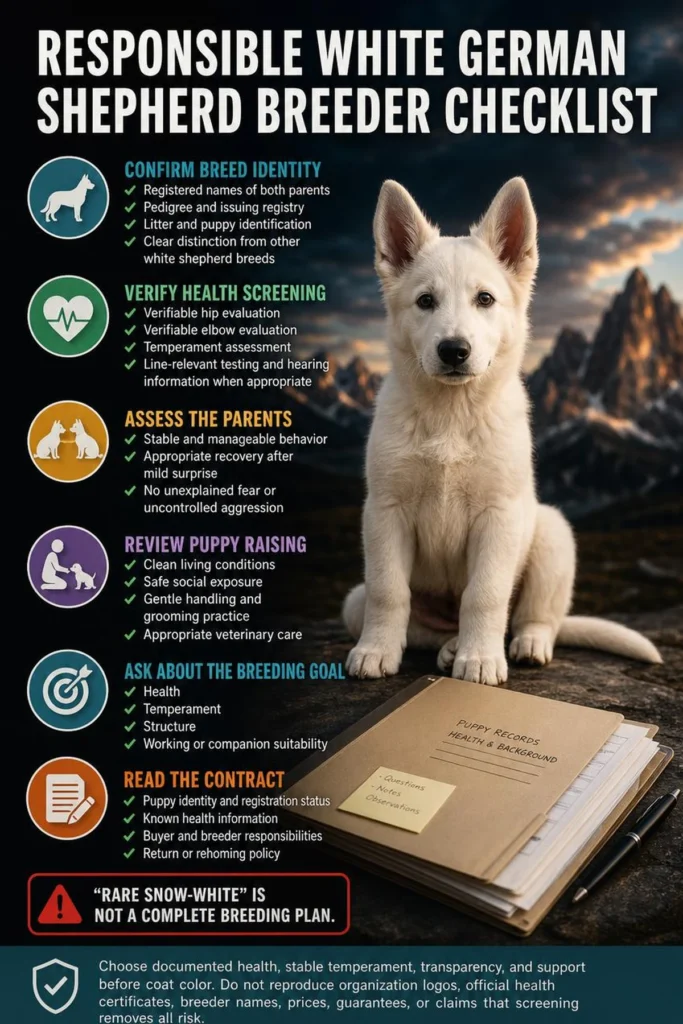
Selecting a white German Shepherd puppy should begin with evidence about the parents and breeder—not the brightest coat in the litter.
1. Confirm the Breed and Registry
Ask for:
- Registered names of both parents
- Registration numbers
- Pedigree documents
- Registry name
- Litter registration information
- Puppy identification
- Microchip details when available
Clarify whether the puppy is being sold as:
- A German Shepherd Dog
- A White Swiss Shepherd Dog
- Another white shepherd breed
- An unregistered companion dog
Do not assume identity based on appearance.
2. Verify Health Testing
Request independently verifiable results for:
- Hips
- Elbows
- Temperament
- Any other tests relevant to the line
A screenshot without the parent’s registered name is weak evidence.
3. Assess the Parents’ Temperament
Look for dogs that can:
- Recover after a mild surprise
- Remain manageable around people
- Accept ordinary handling
- Engage with their handler
- Settle after activity
- Explore without panic
- Show confidence without uncontrolled aggression
Reserve is different from fear. Protection ability is different from instability.
4. Ask Why the Pairing Was Chosen
A responsible answer should discuss:
- Health
- Temperament
- Structure
- Working or companion goals
- Strengths and weaknesses
- Compatibility between the parents
“We wanted very white puppies” is not a complete breeding plan.
5. Observe How the Litter Is Raised
Look for:
- Clean housing
- Time with the mother
- Safe human interaction
- Age-appropriate play
- Household exposure
- Gentle handling
- Grooming introduction
- Veterinary care
- Appropriate feeding
- Opportunities to rest
6. Review the Contract
The contract should identify:
- The puppy
- Registration status
- Known health information
- Buyer responsibilities
- Breeder responsibilities
- Breeding restrictions, when applicable
- Return or rehoming arrangements
- Support after purchase
7. Do Not Pay for Color Alone
When you evaluate a white German Shepherd puppy, compare evidence rather than marketing labels.
| Appearance question | Evidence question |
| Is the coat bright white? | Are hip and elbow results verifiable? |
| Is the puppy long-haired? | Are the parents temperamentally stable? |
| Is white uncommon locally? | Is the pedigree transparent? |
| Will the ears stand soon? | How was the litter raised? |
| Does the puppy photograph well? | Does the breeder provide lifetime support? |
| Is the puppy advertised as rare? | Is the contract fair and clear? |
The evidence column should remain convincing even if the puppy had a common coat color.
White German Shepherd Price
There is no responsible universal price for white puppies.
Cost changes according to:
- Location
- Pedigree
- Registration
- Parent health screening
- Breeder expenses
- Puppy raising
- Training
- Age
- Import costs
- Demand
- Breeder support
A higher price does not prove better health or breeding. A lower price may become expensive if the puppy lacks veterinary care, stable temperament, or responsible breeder support.
Treat these phrases cautiously:
- Rare snow-white puppy
- Premium arctic shepherd
- Exclusive Swiss-white German Shepherd
- Wolf-white bloodline
- Pure military white
- One-of-a-kind white coat
- Guaranteed snow-white adult
Common Myths
Myth 1: Every White German Shepherd Is Albino
False. A normally pigmented white dog often has a black nose, dark eyes, and dark eye rims. True albinism involves a broader pigment disorder and may include pale irises and visual abnormalities. (Merck Veterinary Manual)
Myth 2: A White Dog Cannot Be Purebred
False. Purebred status depends on ancestry and registration records, not color alone.
Myth 3: AKC Registration Means the Dog Can Enter the Breed Ring
False. White appears as an AKC registration color, but the German Shepherd breed standard disqualifies white dogs from conformation competition. (American Kennel Club)
Myth 4: White German Shepherds Are Automatically Deaf
False. Coat color alone cannot diagnose hearing. BAER testing provides an objective assessment of each ear. (LSU)
Myth 5: White Dogs Have a Special Gentle Temperament
False. Temperament depends on the individual dog’s breeding, health, socialization, training, and environment.
Myth 6: White German Shepherds Do Not Shed
False. They have the same double-coat shedding cycle as German Shepherds with comparable coat length.
Myth 7: White German Shepherd and White Swiss Shepherd Are Always the Same
False. Registry and pedigree determine breed identity. The FCI recognizes the White Swiss Shepherd separately while excluding white from its German Shepherd standard. (FCI)
What Most Articles Miss
The most misunderstood point is that the words registered, recognized, standard, and eligible do not all mean the same thing.
A puppy may be:
- Registered as a German Shepherd
- Purebred by documented ancestry
- White in coat color
- Ineligible for AKC German Shepherd conformation
- Eligible for other activities depending on the organization
- Different from an FCI-registered White Swiss Shepherd
These statements can all be true at the same time.
The second missed point is that “white” describes the visible coat, not the quality of the breeding program. A breeder who understands MC1R genetics may still neglect hips, elbows, temperament, socialization, or structure.
Use this decision order:
- Confirm which breed suits your life.
- Verify the parents and pedigree.
- Review health screening.
- Assess temperament.
- Examine puppy-raising practices.
- Read the contract.
- Consider the individual puppy.
- Choose your preferred coat color last.
Frequently Asked Questions
Is a white German Shepherd puppy albino?
No, not usually. A normally pigmented white German Shepherd puppy often has brown eyes, a black nose, dark eye rims, and pigmented skin. True albinism is a separate and rare pigment disorder associated with much wider pigment loss. (Merck Veterinary Manual)
Can a white German Shepherd be AKC registered?
White appears on the AKC German Shepherd breed page with registration code 199. However, white is a disqualification under the AKC conformation breed standard. Registration and breed-ring eligibility are separate matters. (American Kennel Club)
Will a white puppy stay white?
The genetically pale base coat should remain, but the visible shade may range from white to ivory or light cream. Coat texture, seasonal undercoat, dirt, lighting, and maturity can change how the color appears.
Are white German Shepherds rare?
Availability varies by region and breeding program, and there is no reliable universal rarity percentage. Rarity claims should not replace pedigree, health, temperament, and breeder evaluation.
Are white German Shepherds aggressive?
Coat color does not determine aggression. Evaluate the puppy’s parents, pedigree, early socialization, training, health, and individual behavior.
Is a White Swiss Shepherd the same as a white German Shepherd?
Not automatically. The FCI recognizes the White Swiss Shepherd Dog as a separate breed, while its German Shepherd standard does not allow white. Pedigree and registration determine identity. (FCI)
Do white German Shepherds have hearing problems?
A white coat alone does not diagnose hearing loss. If hearing status is uncertain, BAER testing can objectively assess each ear. (LSU)
Can white German Shepherds have long hair?
Yes. White coat color and long hair are separate traits. A white dog may have either a medium double coat or a long double coat.
Final Thoughts
A white German Shepherd puppy can be a purebred German Shepherd with normal dark pigmentation, a white or cream double coat, and the same basic care needs as other German Shepherd puppies.
The most important distinctions are that white is an AKC registration color, a disqualification in the AKC German Shepherd conformation standard, and separate from the FCI-recognized White Swiss Shepherd Dog. Those registry details do not determine whether an individual puppy is healthy, stable, or suitable for your household.
Choose the whole dog behind the coat. Verify ancestry, hips, elbows, temperament, hearing when relevant, puppy raising, and breeder support before paying a premium for color.
Have questions about your dog’s health, nutrition, grooming, or daily care? Visit our Contact Us page to reach the Furbivo team. For any medical symptoms, diagnosis, or treatment advice, always consult a qualified veterinarian.
