
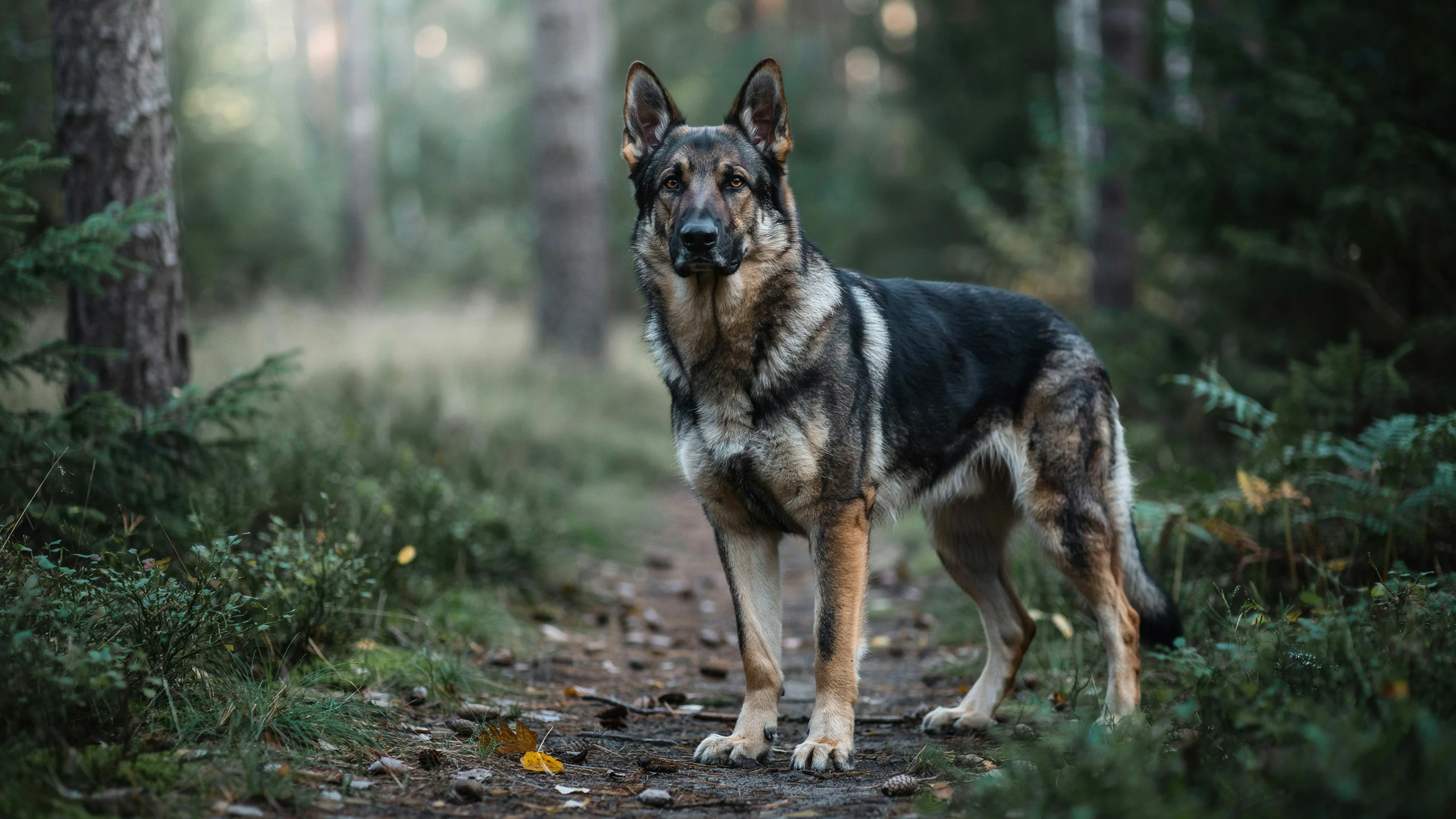
A DDR German Shepherd is a German Shepherd Dog connected through pedigree to dogs developed in the former German Democratic Republic, commonly known as East Germany. DDR stands for Deutsche Demokratische Republik, the German name for the state that existed from 1949 until German reunification in 1990. Modern specialty organizations use the term for East German bloodlines rather than a separate dog breed. (DDRDCA)
A puppy born today was not produced by the historical East German government breeding system. It may descend from dogs recorded in those lines. That distinction matters because modern advertisements often use appearance, dark color, or working-dog language as substitutes for pedigree evidence.
Searches for DDR dogs German Shepherds often lead to claims about massive heads, heavy bone, straight backs, exceptional health, intense protection ability, and military ancestry. Some of these characteristics may appear in individual East German pedigrees, but none can prove the bloodline or predict the whole dog.
Quick Answer: What Is a DDR German Shepherd?
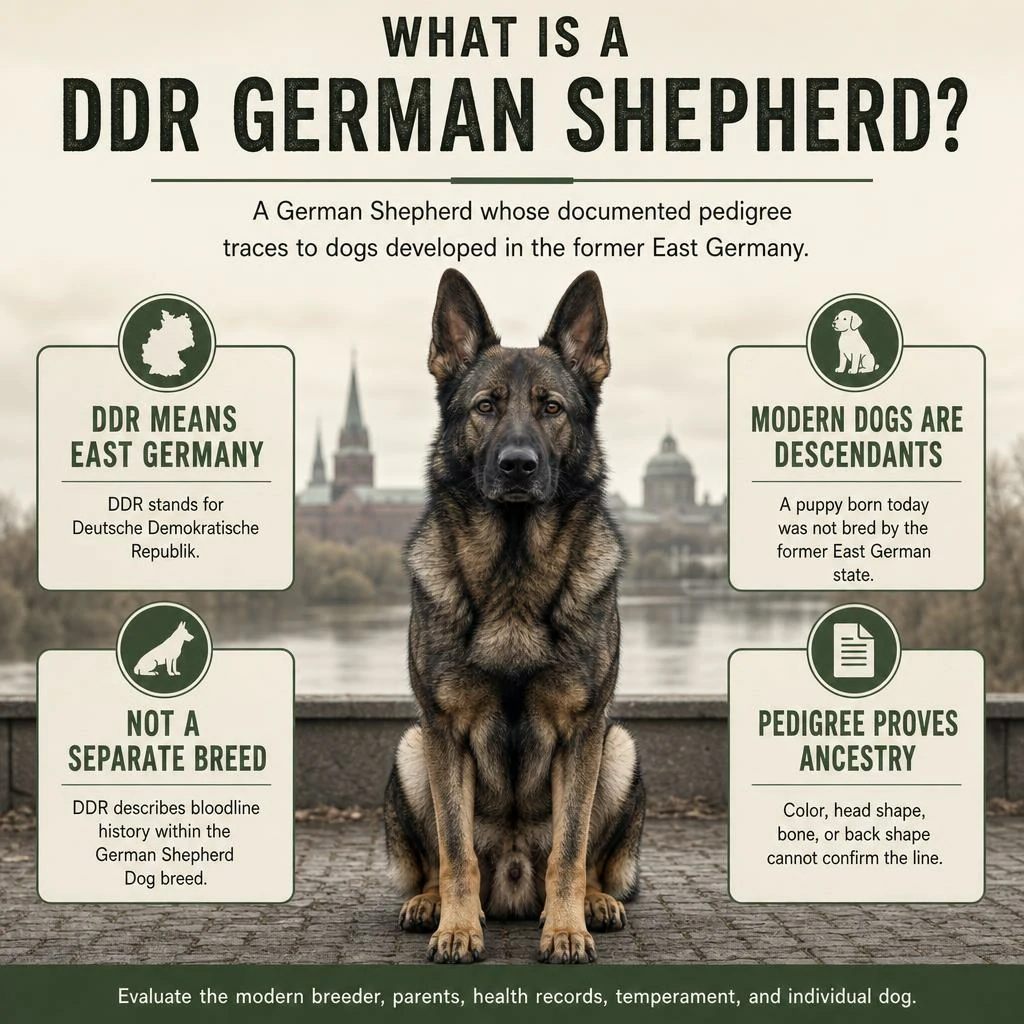
A DDR German Shepherd is not a separate breed or officially recognized size category. It is a bloodline description used for German Shepherds whose pedigrees trace to dogs bred in the former East Germany.
The FCI recognizes one German Shepherd Dog breed standard. It describes the breed as a versatile working, herding, and service dog with defined character, structure, size, coat, and color expectations. The standard does not create separate DDR, Czech, West German, American, or show-line breeds. (FCI)
| Question | Practical answer |
| Is DDR a separate breed? | No, it is a German Shepherd bloodline description |
| What does DDR mean? | Deutsche Demokratische Republik, or East Germany |
| Can a modern puppy be historical DDR-bred? | No; it may descend from documented East German lines |
| Does appearance prove ancestry? | No; pedigree records are required |
| Are all DDR-line dogs highly aggressive? | No; temperament varies by family, selection, development, and training |
| Are they all dark sable? | No, although dark sable, bi-color, and black coats are commonly associated with these lines |
| Are they automatically healthier? | No; modern health screening is still necessary |
| Are they suitable for beginners? | Some may be, but many working-line dogs require experienced management |
What Does DDR Stand For?
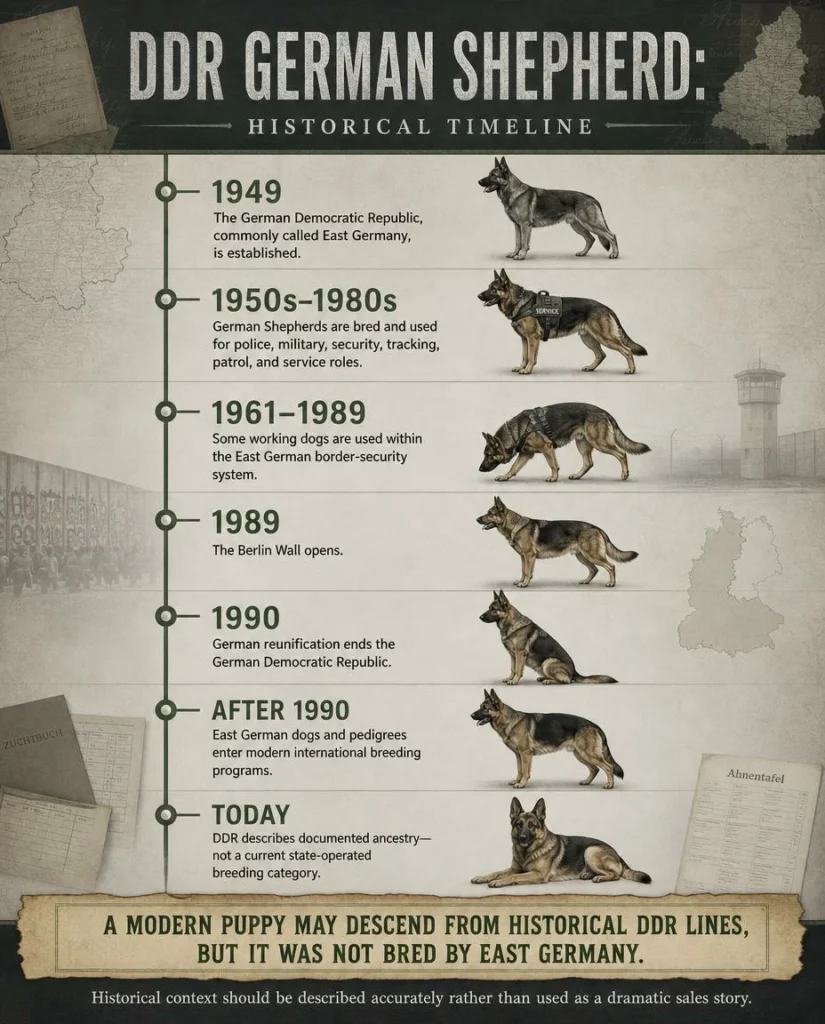
DDR is the abbreviation for Deutsche Demokratische Republik, translated as the German Democratic Republic or East Germany.
East Germany existed from 1949 until reunification in 1990. Specialty DDR bloodline organizations describe East German Shepherds as dogs developed within breeding and service programs during that period, including dogs used for police, military, security, tracking, and border work. (DDRDCA)
Historical claims should still be handled carefully. Much of the detailed English-language history available online is preserved by specialty clubs and modern breeders rather than one centralized public canine archive.
For a modern buyer, the most useful conclusion is simple:
The pedigree matters more than the story.
Is a DDR German Shepherd a Separate Breed?
No. A DDR dog remains a German Shepherd Dog.
The official FCI standard identifies the German Shepherd as a medium-sized, powerful, well-muscled working breed. It sets one overall standard for character, size, movement, structure, coat, and color. It does not list East German or DDR as a separate breed variety. (FCI)
The same principle applies to commonly discussed lines such as:
- East German or DDR working line
- Czech working line
- West German working line
- West German show line
- American show line
These labels may provide useful historical or breeding context, but they are not separate breeds.
A dog’s registration may simply identify it as a German Shepherd Dog even when breeders describe its pedigree as DDR or East German.
Can a Modern Puppy Be a “True DDR Dog”?
A modern puppy can descend from historical East German bloodlines, but it cannot have been bred within the former East German state because that state ceased to exist in 1990. This is a straightforward inference from the historical dates attached to the DDR label. (DDRDCA)
More accurate modern descriptions include:
- DDR-line German Shepherd
- East German-line German Shepherd
- German Shepherd with documented DDR ancestry
- Predominantly East German working-line pedigree
- German Shepherd carrying specific East German ancestors
The phrase “100% DDR” may be meaningful only when the breeder defines it clearly and supplies a pedigree showing how every relevant ancestral branch is classified.
Ask:
- How many generations are being reviewed?
- Which ancestors were registered in East Germany?
- Are later outcrosses present?
- Which pedigree database or registry records support the claim?
- Does “DDR” mean every branch or only one notable ancestor?
- Is the description historical, genetic, or merely promotional?
A dog can have one famous East German ancestor without representing an exclusively East German pedigree.
How to Verify DDR German Shepherd Bloodlines
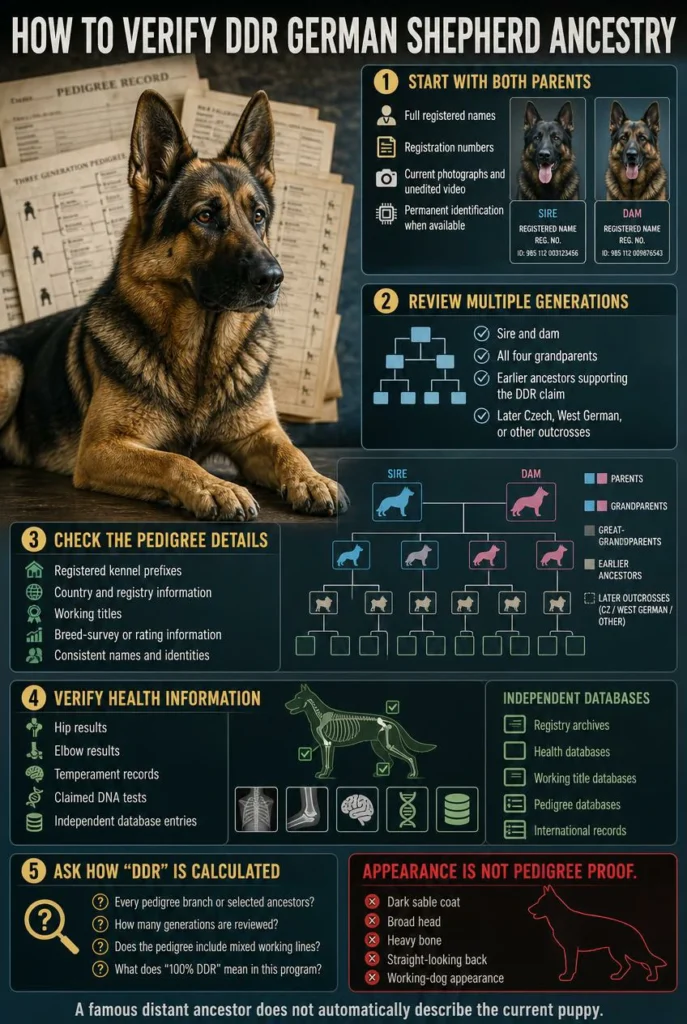
Appearance cannot verify lineage.
A broad head, dark sable coat, thick bone, muscular frame, or modest rear angulation may be associated with some DDR dogs, but these features can occur in other German Shepherd lines as well.
Ask for the Registered Names
Obtain the full registered names of:
- The sire
- The dam
- All four grandparents
- Earlier ancestors used to support the DDR claim
Informal call names are not enough.
Request a Complete Pedigree
A useful pedigree should include:
- Registered names
- Registration numbers when available
- Titles
- Hip and elbow records
- Country or registry information
- Breeder or kennel prefixes
- Multiple generations
Specialty DDR organizations maintain information on historical bloodlines and older East German pedigree-rating systems, but buyers should still confirm records through independent registration and health databases where possible. (DDRDCA)
Verify Advertised Titles
Letters and abbreviations may refer to:
- Working tests
- Breed surveys
- Conformation ratings
- Temperament evaluations
- Tracking or obedience qualifications
- Police or service certification
Ask the breeder to explain:
- What the title means
- Which organization issued it
- Which dog earned it
- Whether the record can be independently confirmed
A title held by a distant ancestor does not automatically describe the current puppy.
Do Not Accept Appearance as Documentation
These statements are not pedigree proof:
- “You can tell by the head.”
- “The dark sable coat proves it.”
- “DDR dogs all have straight backs.”
- “The puppy looks military.”
- “The parents have East German personalities.”
- “Our dogs are old-world type.”
- “The breeder told us the line is pure.”
Historical Working Roles
Specialty histories describe East German dogs as being selected for practical service roles, including patrol, tracking, sentry, police, and border-related work. Dogs were used along sections of the East German border and the Berlin Wall under state security systems. (DDRDCA)
This history should not be romanticized without context. The border system was part of an authoritarian state that restricted movement and attempted to prevent people from leaving East Germany. The dogs were working animals within that political and security system, not fictional symbols of uncomplicated heroism. (The New Yorker)
After reunification, breeding populations, individual dogs, and pedigrees spread into other countries and breeding programs. Modern breeders may preserve parts of those lines, combine them with other working lines, or use the historical label more loosely.
DDR German Shepherd Appearance
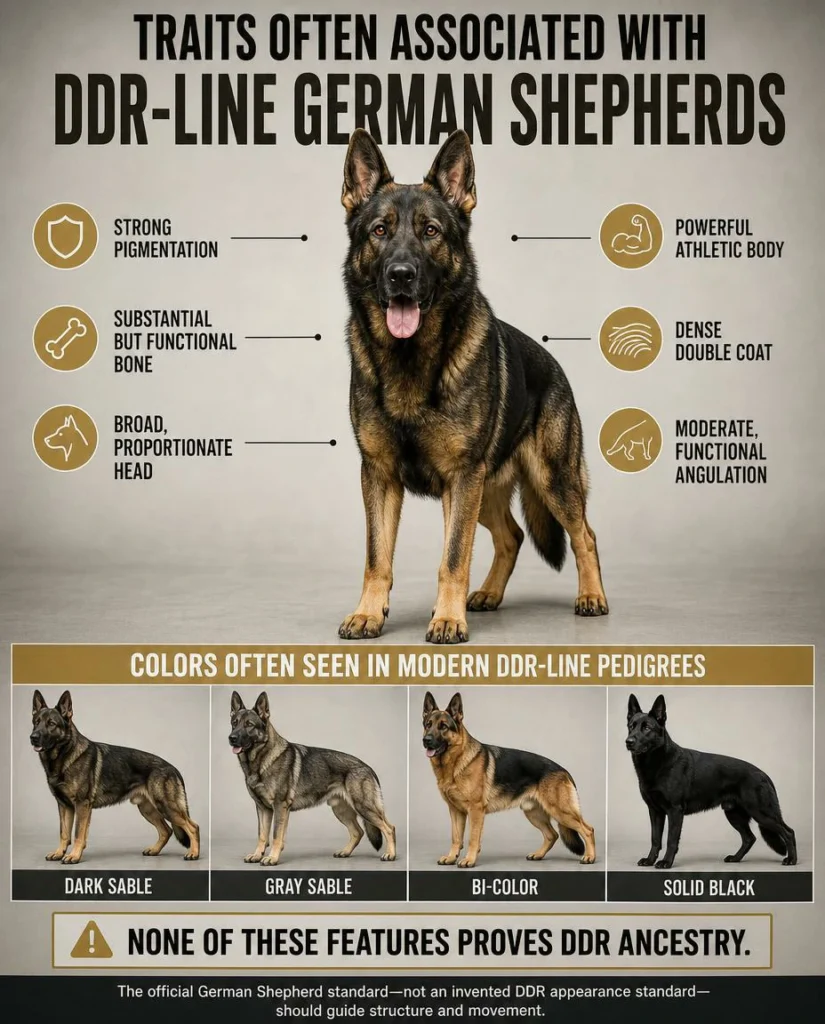
There is no separate official DDR appearance standard.
Modern descriptions often associate East German lines with:
- Dark sable coats
- Bi-color coats
- Solid-black coats
- Strong pigmentation
- Broad or substantial heads
- Powerful necks
- Dense bone
- Deep chests
- Muscular bodies
- Less exaggerated rear angulation than some show dogs
- Dense double coats
These traits should be treated as tendencies reported by specialty-line sources, not diagnostic features or guarantees. (DDR Guard Dogs)
The official German Shepherd standard requires a medium-sized, slightly elongated, powerful, well-muscled dog with firm overall structure. It describes a straight back leading to a slightly sloping croup and warns that over-angulation can reduce stability, stamina, and working ability. (FCI)
Common Colors
DDR-line dogs are often advertised in:
- Dark sable
- Black sable
- Gray sable
- Bi-color
- Solid black
- Black and tan
- Black and red
Color cannot confirm the line.
For coat-specific guidance, read:
DDR German Shepherd Size
A DDR German Shepherd should still be evaluated as a German Shepherd Dog rather than against an invented East German size chart.
The FCI standard lists:
- Males: 60–65 centimeters and 30–40 kilograms
- Females: 55–60 centimeters and 22–32 kilograms
The breed standard also emphasizes functional proportions, sound movement, firm structure, and working ability. (FCI)
Some East German-line dogs may appear broad, heavy-boned, or substantial, but “bigger” does not automatically mean more authentic or better bred.
Be cautious of advertisements claiming:
- Giant DDR Shepherd
- Oversized border-patrol type
- Massive military head
- Extra-heavy East German bone
- 120-pound pure DDR male
- King-size DDR bloodline
Extreme size can increase stress on movement and joints and is not proof of historical ancestry.
Use Furbivo’s German Shepherd Growth Chart and German Shepherd Height and Weight guide for broader development context.
DDR German Shepherd Temperament
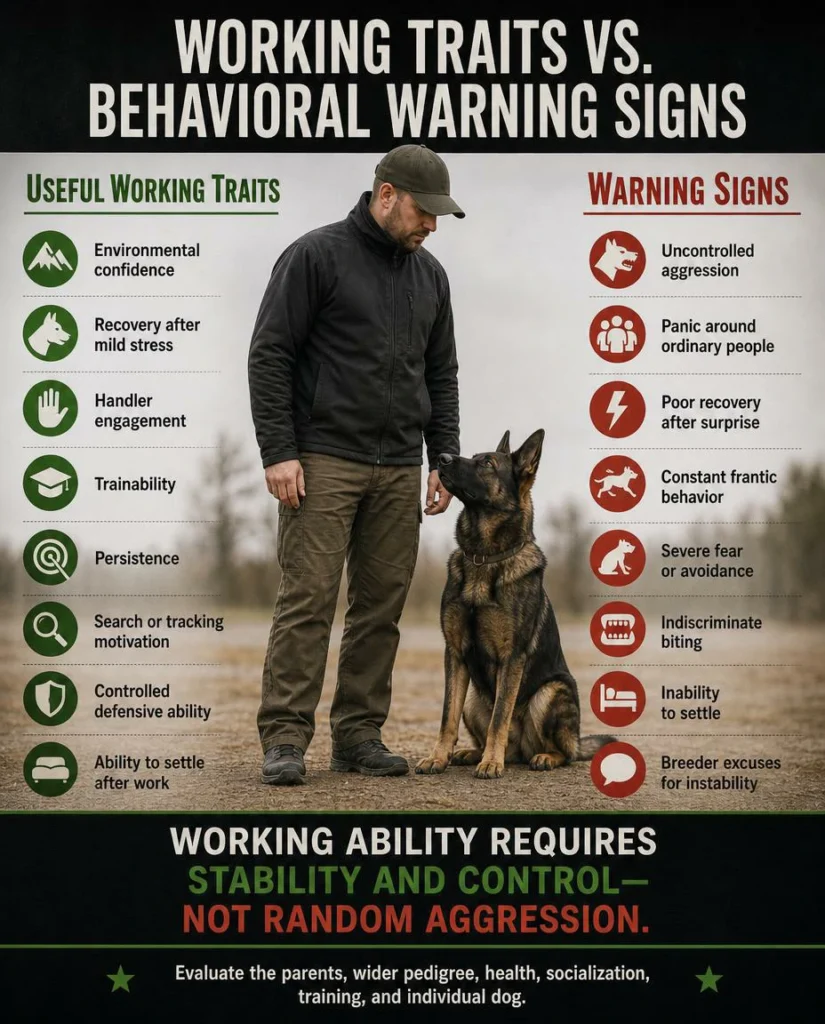
There is no single DDR German Shepherd temperament shared by every dog carrying East German ancestors.
Working-line breeders may select for traits such as:
- Confidence
- Environmental stability
- Persistence
- Trainability
- Strong engagement with a handler
- Search or tracking motivation
- Prey drive
- Defensive ability
- Recovery after stress
- Physical endurance
The official German Shepherd standard calls for a well-balanced, self-assured, attentive, good-natured dog with resilience, willingness to please, and suitability for companion, guard, protection, service, and herding work. (FCI)
A breeder should not use “DDR temperament” as an excuse for:
- Uncontrolled aggression
- Panic around strangers
- Inability to recover after surprise
- Constant frantic behavior
- Severe resource guarding
- Unmanageable suspicion
- Unsafe behavior around the household
- Poor socialization
- Biting without control or cause
The FCI standard specifically treats weak nerves, weak character, and dogs that bite as disqualifying faults. (FCI)
Working Ability Does Not Mean Random Aggression
A capable working dog needs control.
Useful working traits may include focus, persistence, confidence, and the ability to respond under pressure. Random reactivity, fear-driven lunging, poor recovery, and indiscriminate aggression are not signs of superior working genetics.
For a fuller behavior explanation, read Furbivo’s German Shepherd Temperament guide.
Are DDR Dogs Good Family Dogs?
Some can be excellent family dogs in suitable homes. Others may be too intense, active, defensive, or environmentally alert for an inexperienced household.
Suitability depends on:
- The exact pedigree
- Parent temperament
- Breeder goals
- Individual puppy traits
- Early socialization
- Training
- Exercise
- Household structure
- Children’s ages and behavior
- Other pets
- Owner experience
- Access to qualified training help
A dog bred for demanding working traits may require more than neighborhood walks and basic obedience.
Before choosing a puppy, ask whether previous dogs from the same family have successfully lived as:
- Family companions
- Sport dogs
- Police or security dogs
- Search-and-rescue dogs
- Tracking dogs
- Farm dogs
- Multi-dog household pets
The answer should describe specific dogs, not broad promises about the bloodline.
Socialization and Training
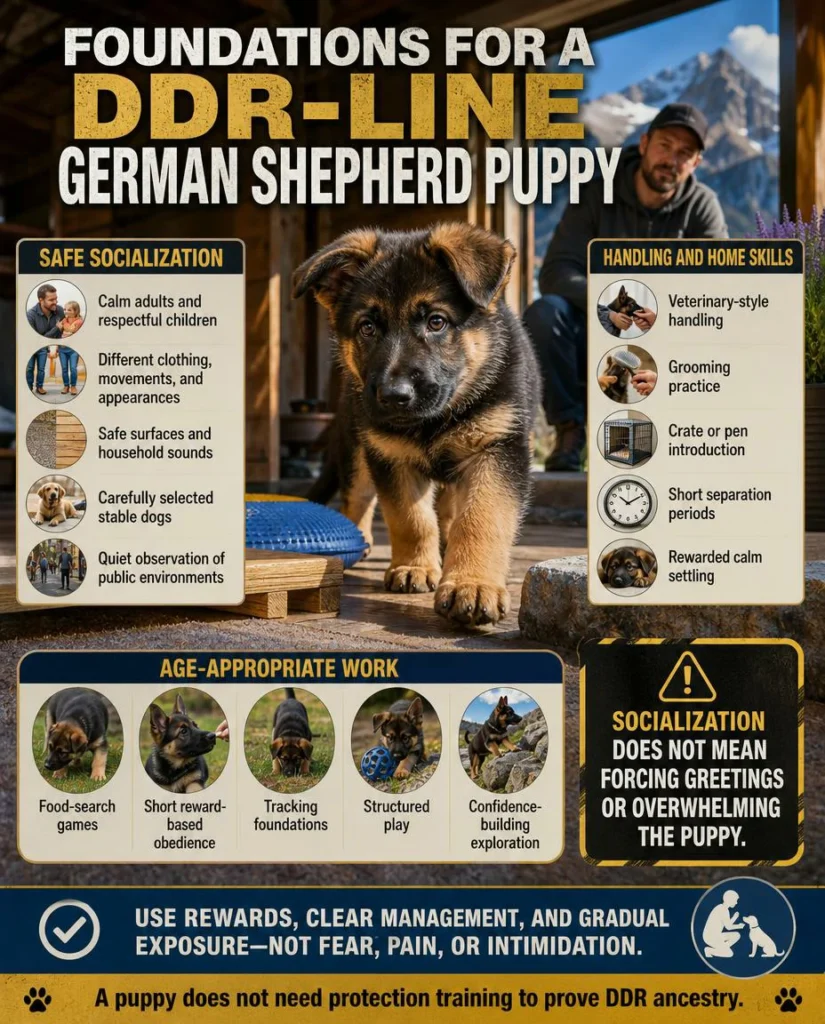
A DDR-line puppy needs the same careful developmental foundation as any powerful working-line German Shepherd.
The first three months are an important socialization period. Puppies should experience safe, controlled exposure to people, animals, environments, surfaces, sounds, handling, and normal household life without being overwhelmed or forced. (AVSAB)
Useful experiences include:
- Calm adults
- Respectful supervised children
- People wearing hats, coats, or uniforms
- Household sounds
- Car travel
- Different safe surfaces
- Veterinary-style handling
- Grooming
- Carefully selected stable dogs
- Quiet public observation
- Calm crate or pen time
- Short periods of separation
- Rewarded settling
Socialization does not mean encouraging every stranger to touch the puppy or taking an under-vaccinated puppy into uncontrolled dog parks.
Training should use rewards, clear management, and gradual exposure. AVSAB reports that reward-based methods provide better welfare and long-term outcomes than aversive methods relying on fear, pain, or intimidation. (AVSAB)
Avoid:
- Alpha rolls
- Hitting
- Hanging or choking
- Severe leash corrections
- Shock-based punishment
- Forced confrontation
- Punishing growls
- Flooding the dog with feared situations
Useful Furbivo guides include:
- How to Train a German Shepherd
- German Shepherd Puppy Socialization Guide
- German Shepherd Puppy Daily Routine
- Crate Training a German Shepherd Puppy
Exercise and Mental Work
Working-line ancestry can increase the importance of structured activity, but the correct amount depends on the dog’s age, health, temperament, and conditioning.
Suitable activities may include:
- Sniffing walks
- Reward-based obedience
- Tracking foundations
- Scent work
- Food-search games
- Tug with clear rules
- Retrieve games
- Hiking after physical maturity
- Rally
- Herding
- Search-and-rescue foundations
- IGP-style training with qualified instruction
- Calm settling practice
Protection training should not be used as a shortcut for confidence or obedience. It requires a stable dog, skilled decoy work, experienced supervision, legal awareness, and strong control.
A dog does not need bite work to prove its DDR ancestry.
Health and Lifespan
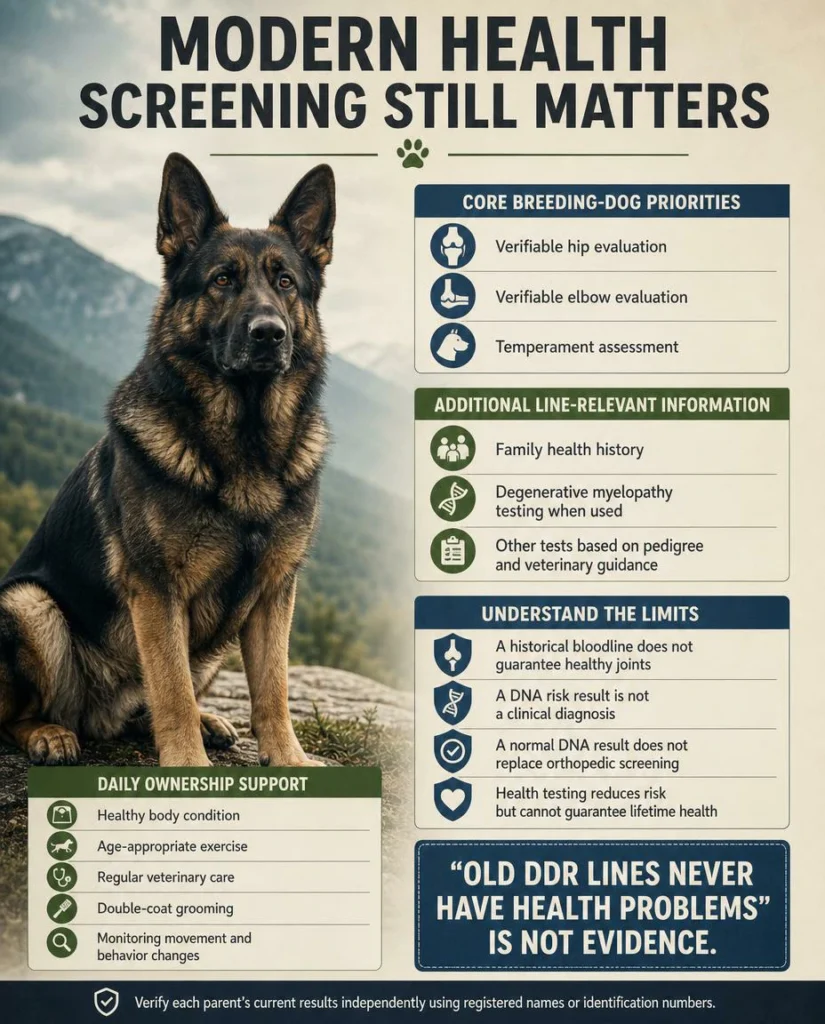
Historical bloodline reputation does not replace modern screening.
The German Shepherd Dog Club of America’s current core health requirements include:
- Hip evaluation
- Elbow evaluation
- Temperament testing (American Kennel Club)
A responsible breeder may also use additional testing based on the pedigree, known family history, location, and veterinary advice.
Degenerative Myelopathy
Degenerative myelopathy is associated with a common SOD1 mutation in German Shepherds and other breeds. However, an at-risk DNA result does not guarantee that a dog will develop clinical disease, and a normal result does not replace orthopedic or neurologic evaluation. (OFA)
A breeder should explain:
- Which dogs were tested
- Which laboratory performed the test
- The actual genotype
- How the result affected the mating decision
- Why the result does not guarantee lifetime health
Verify Results Independently
Ask for:
- Registered names
- Registration numbers
- Hip results
- Elbow results
- Temperament records
- DNA reports when claimed
- The database where results can be checked
Do not accept “old DDR lines never have hip problems” as evidence.
Read:
Grooming and Shedding
DDR lineage does not create a different shedding cycle.
The German Shepherd standard recognizes:
- Double coat
- Long double coat
Both include undercoat and require regular grooming. (FCI)
Expect:
- Year-round shedding
- Heavier seasonal undercoat release
- Loose hair on furniture and clothing
- Regular brushing
- More frequent grooming during coat blow
- Extra combing in long coats
A practical routine includes:
- Brushing several times each week
- Increasing frequency during seasonal shedding
- Using light pressure
- Checking the skin during grooming
- Bathing when needed
- Rinsing shampoo thoroughly
- Drying the dense undercoat
- Avoiding routine shaving
Read:
DDR vs. Czech German Shepherd
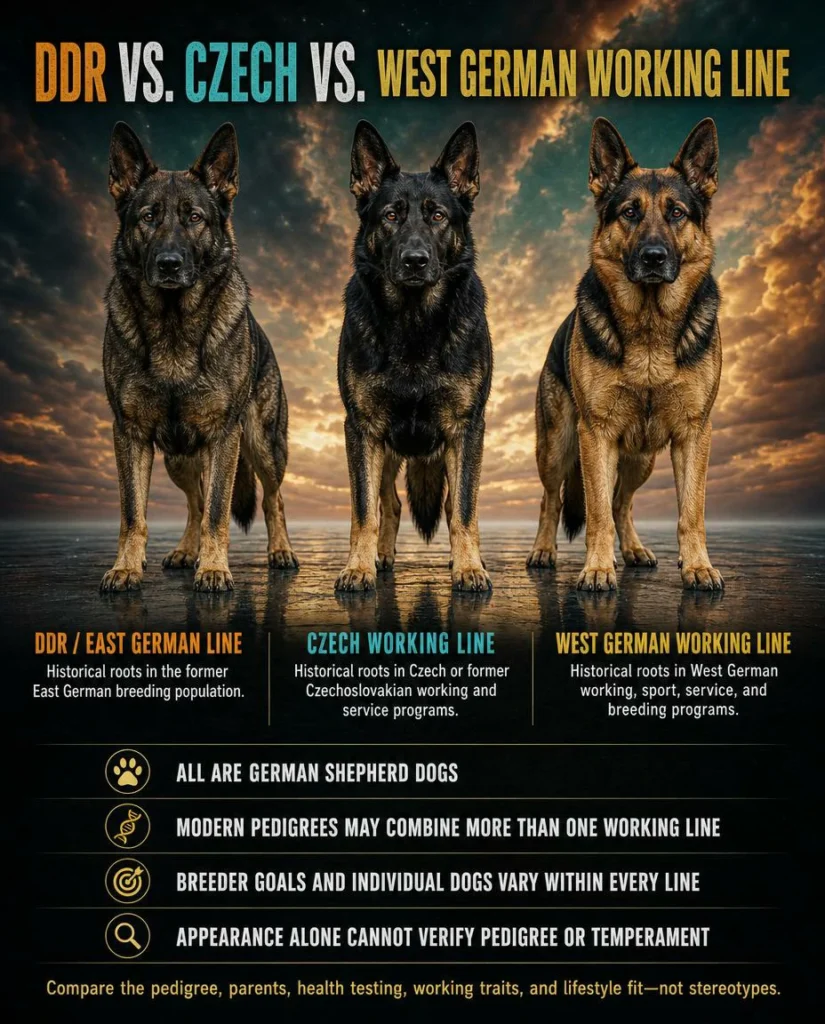
DDR and Czech are commonly grouped as Eastern European working lines, but they are not interchangeable terms.
DDR refers to East German ancestry. Czech working-line descriptions generally refer to dogs developed through Czech or former Czechoslovakian breeding and service programs.
Modern pedigrees may combine:
- DDR and Czech lines
- East and West German working lines
- Czech and West German lines
- Several working-line populations
A dark sable working dog cannot be classified accurately by appearance alone.
A future dedicated comparison page should examine:
- Pedigree origin
- Historical programs
- Modern breeding goals
- Structure
- working traits
- Health screening
- Lifestyle suitability
DDR vs. West German Working Line
Both remain German Shepherd Dogs and may be bred for demanding work, sport, service, or active companionship.
Differences are not absolute because modern programs vary. Breeders may emphasize different combinations of:
- Prey drive
- Defensive drive
- Tracking ability
- Handler engagement
- Social behavior
- Environmental confidence
- Structure
- Movement
- Color
- Working titles
The pedigree and current breeding program are more useful than stereotypes such as:
- DDR dogs are always harder.
- West German dogs are always more social.
- DDR dogs are always larger.
- West German dogs are always faster.
- East German dogs are always healthier.
How to Choose a DDR German Shepherd Breeder
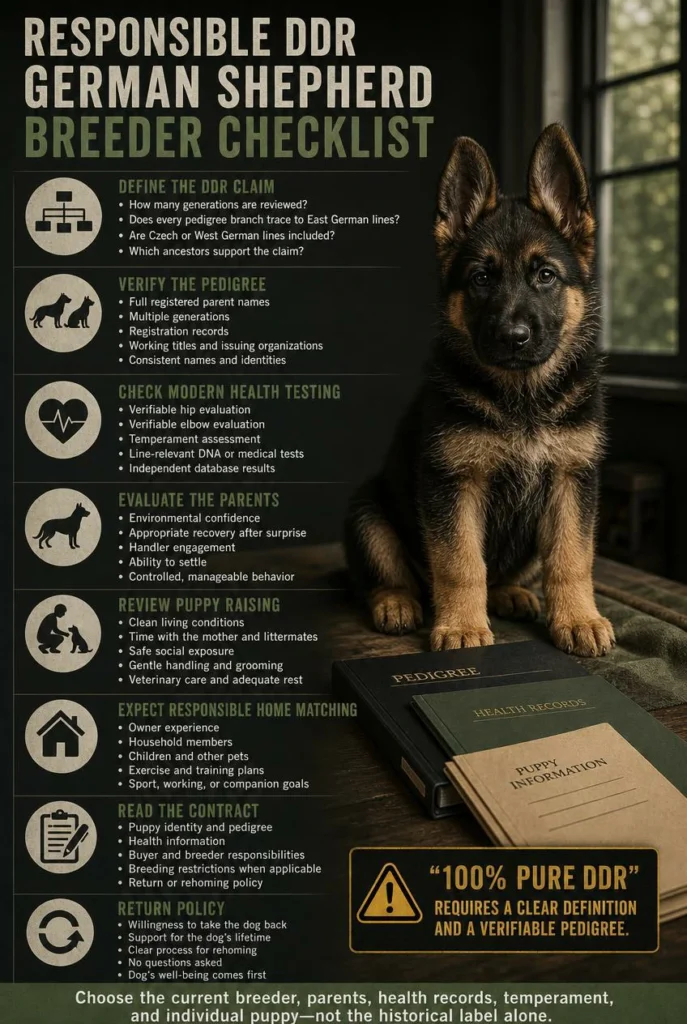
1. Ask What “DDR” Means in That Program
The breeder should define:
- How many generations are considered
- Whether every branch is East German
- Whether Czech or West German lines are included
- Which historical dogs support the claim
- Whether DDR is the main line or one component
2. Review the Pedigree Yourself
Do not rely only on a highlighted screenshot.
Look for:
- Full registered names
- Multiple generations
- Consistent identities
- Registration records
- Working titles
- Hip and elbow results
- Countries and kennel prefixes
- Evidence for every claimed branch
3. Verify Modern Health Testing
Historical reputation is not enough.
Request current results for:
- Hips
- Elbows
- Temperament
- Any line-relevant DNA or medical tests
The recommended German Shepherd core remains hips, elbows, and temperament. (American Kennel Club)
4. Evaluate the Parents’ Real Temperament
Look for adults that can:
- Recover after mild surprise
- Engage with the handler
- Work without becoming chaotic
- Remain manageable around neutral people
- Settle after activity
- Accept normal handling
- Move confidently through new environments
- Show controlled rather than indiscriminate behavior
5. Ask About the Intended Home
A responsible breeder should ask about:
- Your dog experience
- Household members
- Children
- Other pets
- Work schedule
- Training plans
- Exercise access
- Sport or working goals
- Living environment
- Ability to manage adolescence
A breeder who says every puppy suits every home is not matching dogs carefully.
6. Ask How Puppies Are Raised
Look for:
- Clean living conditions
- Time with the mother and littermates
- Safe human interaction
- Household exposure
- Different surfaces
- Gentle handling
- Crate or pen introduction
- Grooming practice
- Veterinary care
- Rest
- Thoughtful temperament observation
7. Review the Contract
The contract should identify:
- The puppy
- Both parents
- Registration status
- Pedigree
- Health information
- Buyer responsibilities
- Breeder responsibilities
- Breeding restrictions when applicable
- Return or rehoming arrangements
- Support after purchase
Price and Value
There is no reliable universal price for a DDR German Shepherd.
Cost can vary according to:
- Country
- Pedigree
- Titles
- Parent health screening
- Breeder expenses
- Puppy raising
- Training
- Importation
- Age
- Demand
- Breeder support
A higher price does not prove pure East German ancestry. A lower price does not automatically mean poor quality.
Treat these phrases cautiously:
- 100% pure DDR
- Last true DDR bloodline
- Rare border-patrol genetics
- Military-grade puppy
- Original Berlin Wall type
- Guaranteed protection temperament
- Naturally perfect hips
- No training needed
- Straight-back DDR guarantee
Common Myths
Myth 1: DDR German Shepherds Are a Separate Breed
False. They are German Shepherd Dogs described by bloodline or ancestry.
Myth 2: Every Dark Sable German Shepherd Is DDR
False. Dark sable appears in multiple German Shepherd populations. Pedigree, not color, establishes ancestry.
Myth 3: A Modern Puppy Was Bred by East Germany
False. East Germany ceased to exist in 1990. A modern puppy may descend from dogs recorded in East German lines. (DDRDCA)
Myth 4: DDR Dogs Are Naturally Aggressive
False. Working ability requires stability and control. Uncontrolled fear, reactivity, or biting is not proof of quality.
Myth 5: Every DDR Dog Has a Straight Back
Misleading. German Shepherd toplines and angulation vary among individuals and breeding programs. The official standard describes a straight back leading to a slightly sloping croup—not a completely level body from shoulders to tail. (FCI)
Myth 6: Historical DDR Breeding Guarantees Healthy Hips
False. Every modern breeding dog still needs verifiable orthopedic screening.
Myth 7: DDR Dogs Are Too Hard for Families
Not always. Some fit experienced active families well, while others may have more drive or defensive intensity than a household wants.
Myth 8: Bite Work Proves DDR Quality
False. Training activity does not establish pedigree. A stable German Shepherd may participate in many activities without protection work.
What Most Articles Miss
The first missed point is that DDR is now a pedigree claim, not a current national breeding category.
East Germany ended in 1990. Modern puppies are descendants of historical dogs, and every generation since reunification gives breeders opportunities to preserve, combine, narrow, or alter those lines.
The second missed point is that percentages can be misleading.
A breeder may say a dog is:
- 100% DDR
- Mostly DDR
- Half DDR
- DDR/Czech
- East German type
Those phrases are meaningful only when the calculation method and pedigree branches are shown.
The third missed point is that lineage does not replace individual evaluation.
Two littermates can differ in:
- Confidence
- Drive
- social behavior
- recovery
- sensitivity
- persistence
- environmental stability
- handler focus
- family suitability
The fourth missed point is historical context. Border-patrol ancestry may sound impressive in advertising, but it came from a security system used to restrict human movement. The history should be described accurately rather than turned into a simplistic sales story. (The New Yorker)
Use this decision order:
- Decide whether a working-line German Shepherd suits your life.
- Review the breeder’s current goals.
- Verify both parents.
- Study the pedigree.
- Confirm health results.
- Evaluate parent temperament.
- Review how puppies are raised.
- Discuss the individual puppy.
- Read the contract.
- Treat the DDR label as supporting context—not the entire decision.
Frequently Asked Questions
What is a DDR German Shepherd?
A DDR German Shepherd is a German Shepherd whose pedigree is described as tracing to dogs from the former East German breeding population. DDR is a bloodline term, not a separate breed.
What does DDR stand for in German Shepherds?
DDR stands for Deutsche Demokratische Republik, the German name for East Germany, which existed from 1949 to 1990. (DDRDCA)
Are DDR dogs German Shepherds good family pets?
Some DDR dogs German Shepherds can live successfully as family companions, but suitability depends on the individual pedigree, parent temperament, working drive, socialization, training, and household experience.
How can I tell whether a German Shepherd is truly DDR?
You cannot confirm the line from appearance. Request a multi-generation pedigree, registered parent names, health records, titles, and documentation connecting the ancestry to East German dogs.
Are DDR German Shepherds larger?
Not necessarily. They follow the same German Shepherd breed standard. Some lines may appear heavier-boned or more substantial, but extreme size is not proof of DDR ancestry.
Are DDR German Shepherds aggressive?
The bloodline label does not guarantee aggression. Stable working dogs require control, confidence, resilience, and appropriate recovery. Fearful or indiscriminate aggression is not desirable.
What colors do DDR German Shepherds have?
Dark sable, black sable, bi-color, and solid black are frequently associated with modern DDR-line advertising, but color cannot prove pedigree.
What health tests should a DDR breeder provide?
At minimum, request verifiable hip and elbow evaluations and temperament testing for both parents. Additional tests may be appropriate based on pedigree and veterinary guidance. (American Kennel Club)
Final Thoughts
A DDR German Shepherd is a German Shepherd associated through pedigree with East German working lines. It is not a separate breed, guaranteed temperament, specific coat color, or official modern size category.
The phrase DDR dogs German Shepherds should direct buyers toward pedigree research rather than visual stereotypes. Dark pigmentation, broad heads, heavy bone, and working-dog appearance cannot verify ancestry.
A modern puppy can descend from historical DDR lines, but it was not bred by the former East German state. Choose the current breeder, parents, health records, temperament, puppy raising, and individual dog—not simply the historical label.
Have questions about your dog’s health, nutrition, grooming, or daily care? Visit our Contact Us page to reach the Furbivo team. For any medical symptoms, diagnosis, or treatment advice, always consult a qualified veterinarian.
