
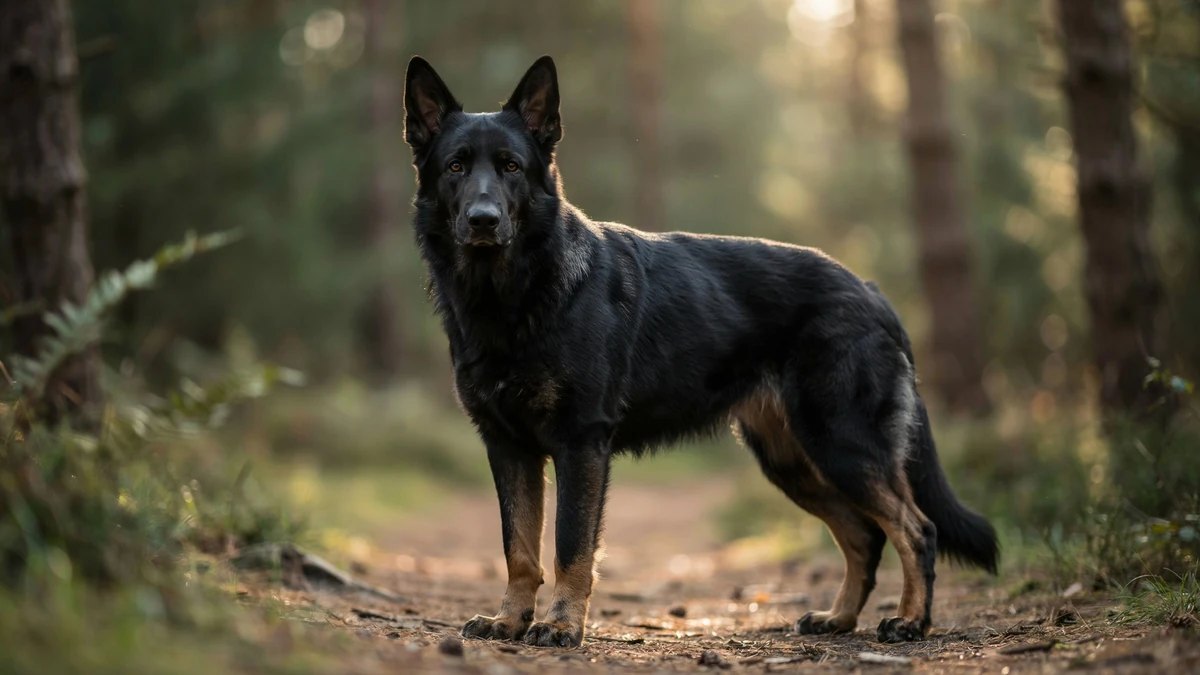
A black German Shepherd is a German Shepherd Dog with a solid-black base coat. It is not a separate breed, wolf hybrid, or automatic sign of a special working line. Black is a recognized German Shepherd color, and a properly documented black German Shepherd puppy can be just as purebred as a sable, black-and-tan, or bi-color puppy. (American Kennel Club)
The dark coat changes appearance, not the breed’s basic needs. Health, temperament, adult size, trainability, exercise requirements, and family suitability depend far more on genetics beyond color, responsible breeding, socialization, training, health, and environment.
Quick Answer: What Is a Black German Shepherd?
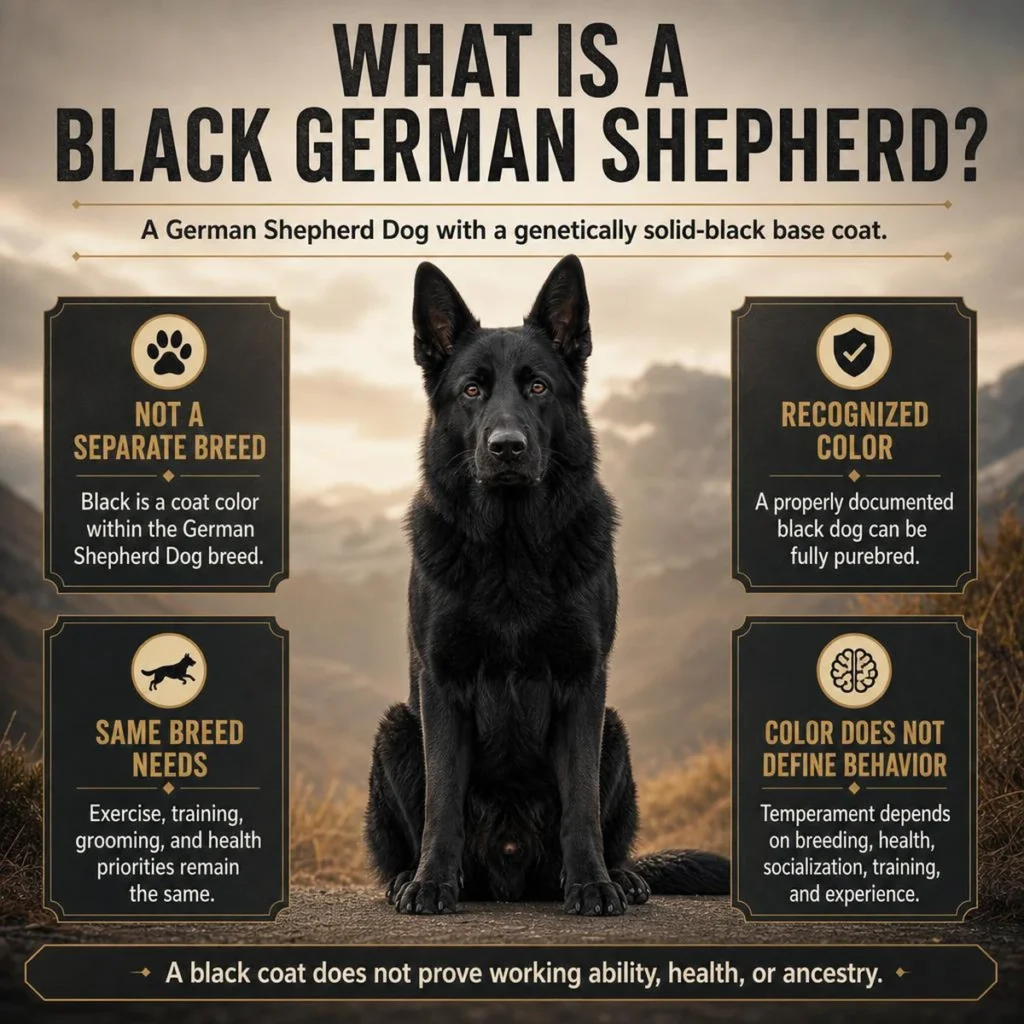
A black German Shepherd is a German Shepherd Dog whose base coat appears solid black because of inherited pigment-pattern variants. Black is an accepted breed color. These dogs follow the same general size, structure, temperament, health-screening, training, grooming, and exercise expectations as German Shepherds of other recognized colors. (Veterinary Genetics Laboratory)
| Feature | What owners should know |
| Breed status | A color variation within the German Shepherd Dog breed |
| Genetic basis | Commonly associated with recessive black at the ASIP locus |
| Recognition | Black is listed as a German Shepherd color by the AKC and FCI |
| Coat type | Medium double coat or long double coat |
| Temperament | Not determined by coat color |
| Adult size | Follows the same breed standards as other German Shepherds |
| Shedding | Regular year-round shedding with heavier seasonal periods |
| Health priorities | Hip, elbow, temperament, and line-appropriate health evaluation |
| Puppy selection | Choose by breeder evidence, not darkness or rarity claims |
What Makes a German Shepherd Completely Black?
A solid-black dog produces dark eumelanin across most or all of the visible coat instead of displaying a sable pattern, black saddle, or tan-point pattern.
The UC Davis Veterinary Genetics Laboratory identifies recessive black as an ASIP variant. Dogs with two copies of the recessive-black version, written as ASIPᵃ/ASIPᵃ, develop an all-black base coat, although their complete visible appearance can still be influenced by genes at other pigment locations. (Veterinary Genetics Laboratory)
This means that “black” is more than simply having a heavy dark overlay. In a genetically solid-black dog, the base pattern is black rather than sable or black and tan.
What Are Eumelanin and the ASIP Gene?
Eumelanin is the pigment responsible for black or brown coloration in a dog’s coat, nose, and other pigmented areas.
The ASIP gene helps regulate how dark eumelanin and lighter phaeomelanin are distributed. Some ASIP combinations produce banded sable hairs, some produce saddle or black-back patterns, and the recessive-black combination can produce an all-black base coat. (Veterinary Genetics Laboratory)
This is why the black coat should not be explained as a mysterious mutation unique to one kennel. It is part of known canine coat-color inheritance.
Can Two Non-Black German Shepherds Produce a Black Puppy?
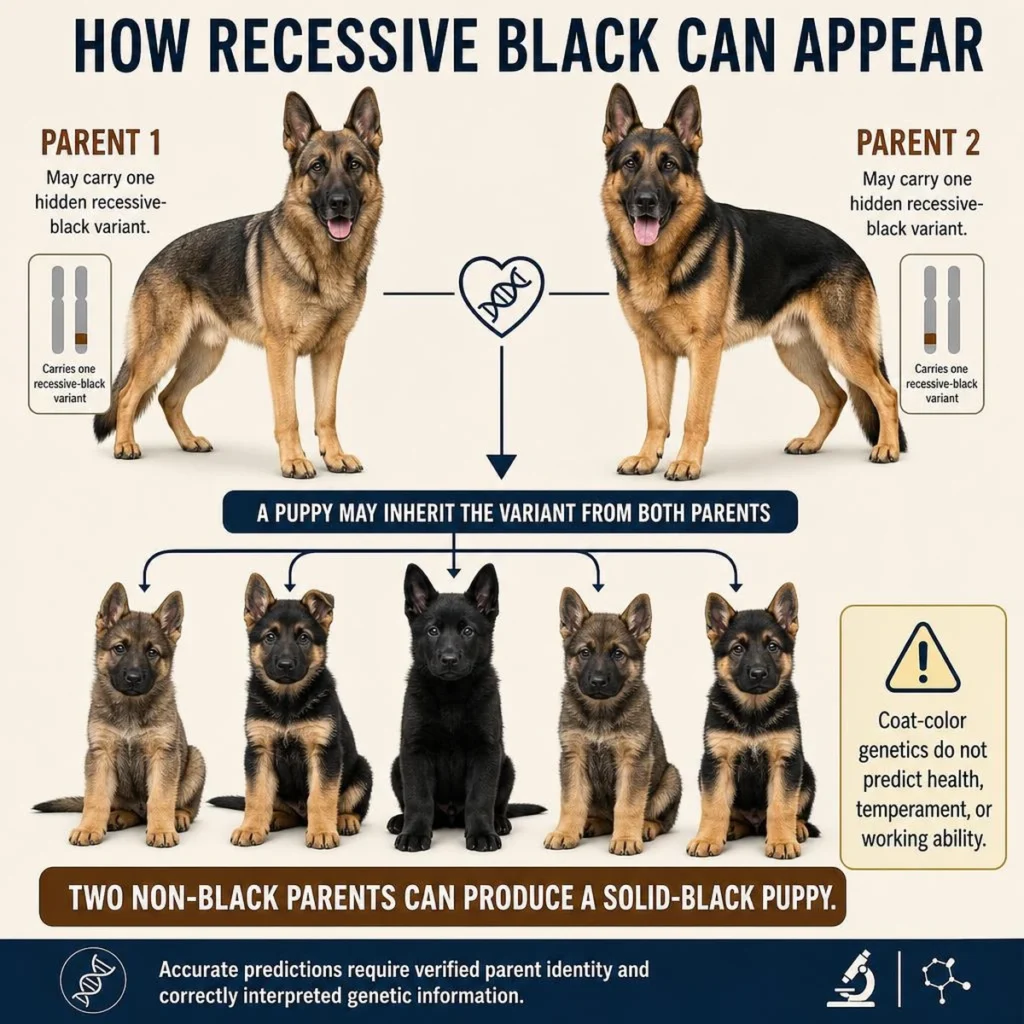
Yes. Two German Shepherds that do not look black may produce black puppies when both parents carry the recessive-black ASIP variant.
Each parent can display another coat pattern while carrying one hidden copy of recessive black. A puppy that inherits the recessive-black variant from both parents can have an all-black base coat. This is an inference from the recessive inheritance pattern documented by UC Davis. (Veterinary Genetics Laboratory)
A breeder should not promise litter colors based only on visual appearance. Accurate predictions may require:
- Verified parent identity
- Pedigree information
- Knowledge of previous offspring
- Genetic coat-color testing
- Correct interpretation of all relevant pigment genes
Even then, a color prediction says nothing about the puppy’s future health, behavior, or working ability.
Will Two Black Parents Always Produce Black Puppies?
When both parents are genetically recessive black at the ASIP locus, their puppies are expected to inherit the recessive-black variant from each parent at that location. Other genes can still influence the dog’s complete pigmentation and visible coat details. (Veterinary Genetics Laboratory)
Breeders should explain the limits of testing instead of turning one coat-color result into a guarantee about the whole dog.
Is a Black German Shepherd Purebred and Recognized?
Yes. A black German Shepherd can be fully purebred and registered.
The AKC lists black as a German Shepherd Dog breed-standard color. Its official breed standard also states that most German Shepherd colors are permissible, with strong, rich pigmentation preferred. The FCI standard specifically includes single-colored black among the accepted color descriptions. (American Kennel Club)
Purebred status depends on verified ancestry, not coat color alone.
Useful evidence includes:
- Registration documents from a recognized registry
- Registered names and numbers of both parents
- A traceable pedigree
- Parentage verification when needed
- Breeder records
- Accurate identification of the puppy
A photograph of a black dog does not prove that it is a German Shepherd. Coat-color DNA testing also cannot prove purebred ancestry by itself. It only reports specific pigment-related variants covered by that test.
Does a Small White Mark Mean the Dog Is Mixed?
Not automatically.
The FCI standard permits small, unobtrusive white marks on the chest, although it describes them as undesirable. Therefore, a small chest mark alone does not establish mixed ancestry. (FCI)
Pedigree, registration, parentage, structure, and the dog’s complete background provide far better evidence than one small patch of hair.
Black German Shepherd Genetics vs. Dark Sable and Bi-Color
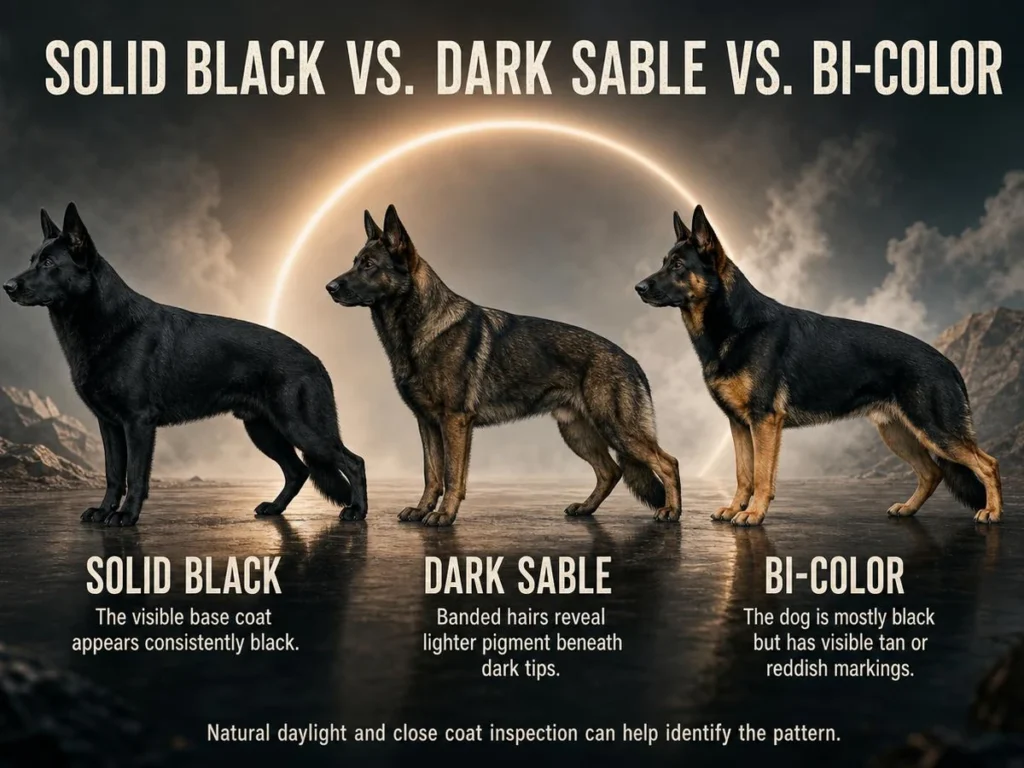
A very dark sable or heavily pigmented bi-color German Shepherd may look almost black in poor lighting. However, these patterns are genetically and visually different from a solid-black coat.
| Coat pattern | Main visual feature |
| Solid black | The visible base coat appears consistently black |
| Dark sable | Banded hairs reveal lighter pigment beneath or between dark tips |
| Bi-color | The dog is mostly black but has tan or reddish markings, often on the legs, feet, face, or underside |
| Black and tan | A clearer black saddle or blanket appears over tan areas |
| Black and red | Dark saddle or blanket with richer reddish pigment |
A solid-black dog should not develop widespread tan-point markings simply because it matures. A puppy that develops clear tan or red areas may have been incorrectly identified in an early photograph.
Dark sable hairs usually reveal lighter bands when separated or examined in bright natural light. For a full explanation of banded hairs and agouti coloring, read Furbivo’s sable German Shepherd guide.
For a broader comparison, use the German Shepherd colors guide.
Black German Shepherd Puppy Development
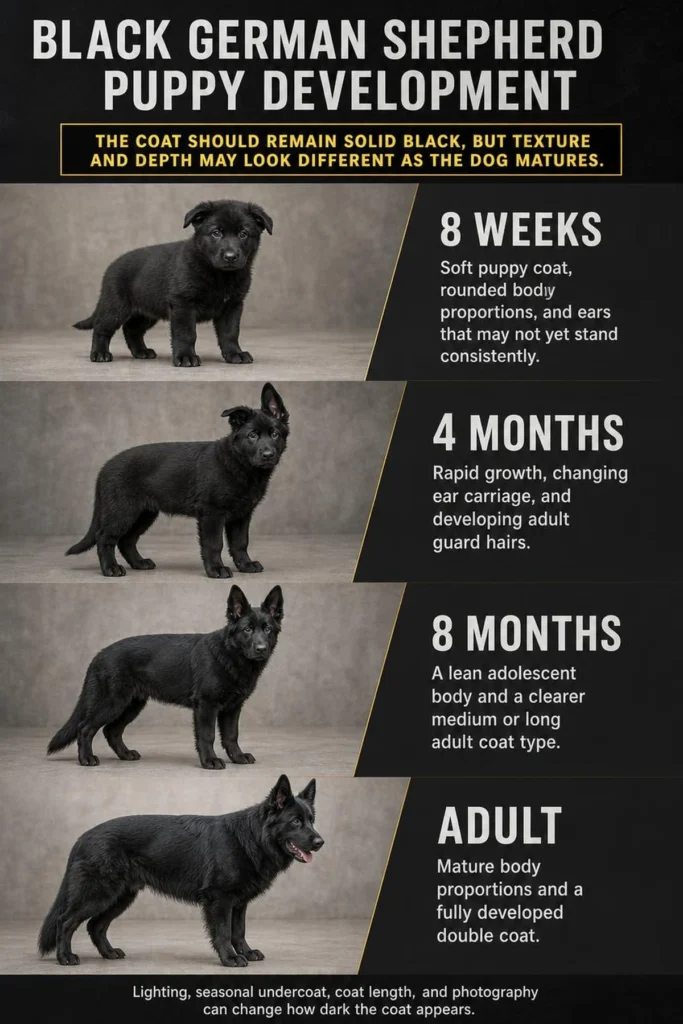
A black German Shepherd puppy is usually born with an obviously dark coat, but early photographs can still be misleading. Indoor lighting, camera exposure, soft puppy fluff, seasonal undercoat, and image editing can change how intense or uniform the black appears.
The genetic base pattern does not switch from recessive black into sable as the puppy grows. However, the visible coat may look different as:
- Soft puppy fur is replaced
- Adult guard hairs develop
- Undercoat becomes denser
- Seasonal shedding begins
- Coat length becomes clearer
- Lighting changes
- Old or loose coat is removed
A puppy may look fluffy and charcoal-black at eight weeks, sleeker during adolescence, and fuller again after the adult double coat develops.
When Do the Ears Stand Up?
Black coloring does not change German Shepherd ear development. Some puppies begin carrying their ears upright early, while others go through uneven stages during growth and teething.
One ear may stand before the other, both may rise and fall, or the ears may temporarily soften during development. The color of the puppy is not the cause.
For age-based guidance, read when German Shepherd ears stand up.
Can a Black Puppy Have a Long Coat?
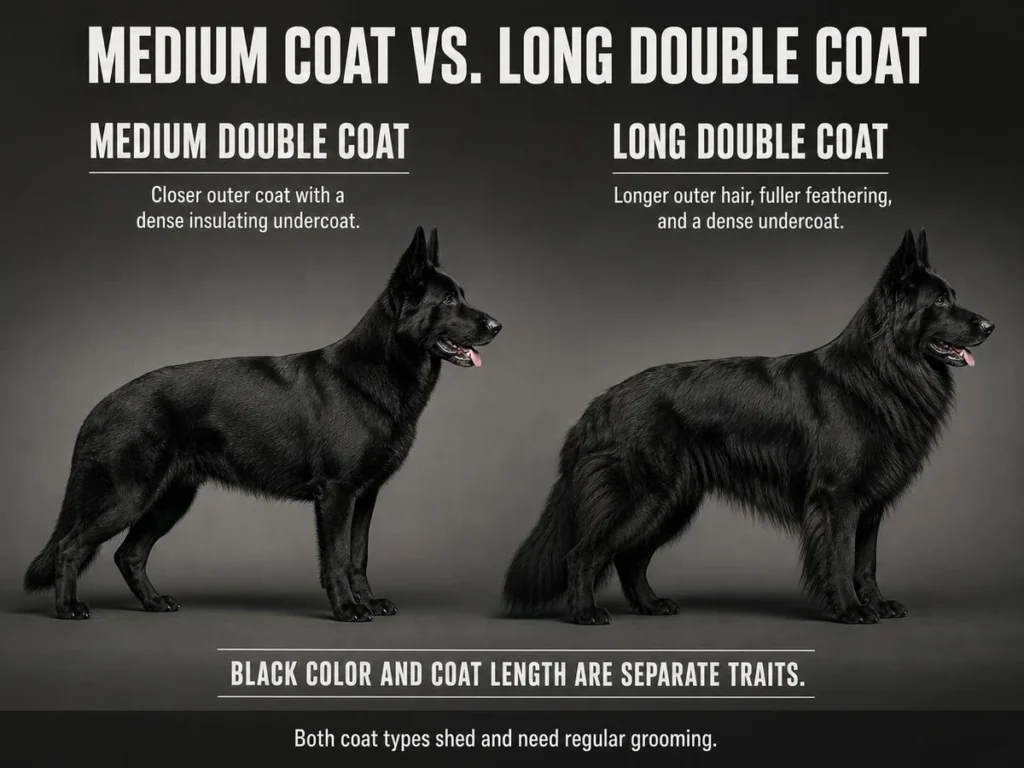
Yes. Coat color and coat length are separate traits.
The FCI standard recognizes both the regular double coat and the long double coat, and it separately recognizes single-colored black. Therefore, a German Shepherd can be both solid black and long-coated. (FCI)
A long-haired black puppy may develop:
- Longer hair around the neck
- Ear tufts
- More feathering behind the legs
- Fuller trousers
- A bushier tail
- Greater tendency for tangles in friction areas
Furbivo’s long-haired German Shepherd guide explains coat-length care in greater detail.
Black German Shepherd Temperament
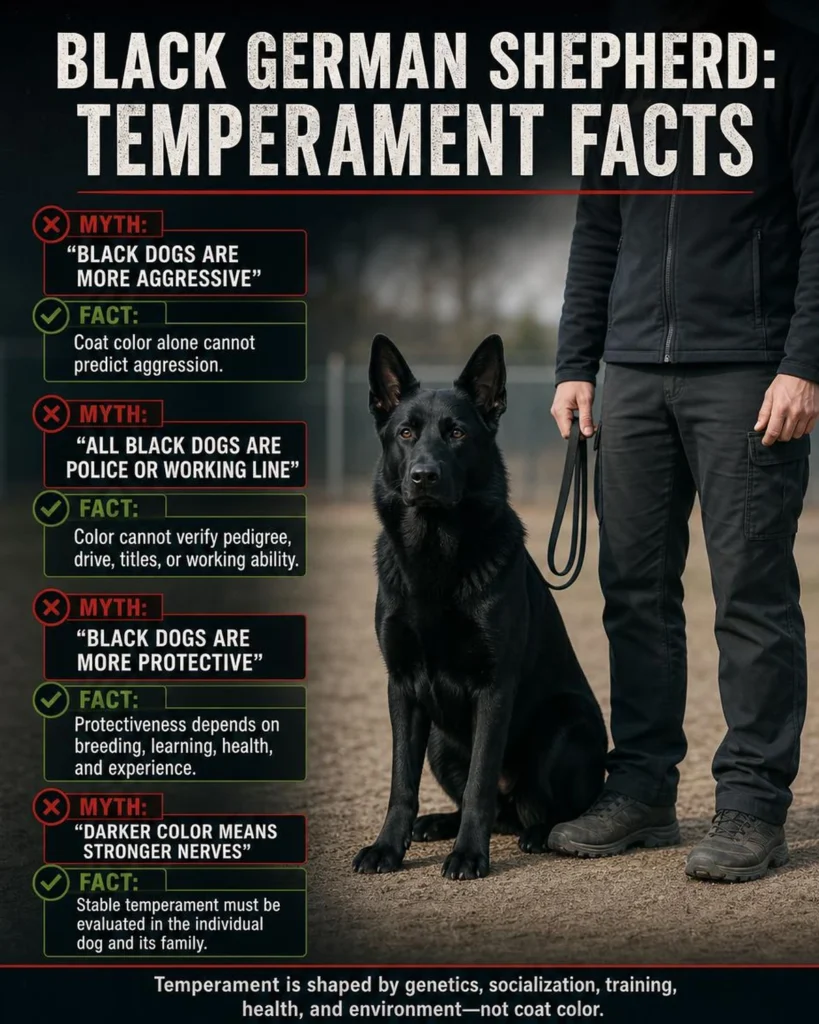
A black German Shepherd does not have a separate color-based temperament.
The official breed standard describes the German Shepherd as confident, poised, approachable, alert, willing to work, and neither timid nor hostile without cause. It does not establish a different temperament standard for black dogs.
An individual dog’s behavior is influenced by:
- The temperament of its parents and wider pedigree
- Early development
- Socialization
- Training methods
- Physical and mental exercise
- Home environment
- Previous experiences
- Fear and stress
- Pain or illness
- Owner management
A black coat does not automatically make a dog:
- More aggressive
- More protective
- More intelligent
- More loyal
- Easier to train
- Higher drive
- Better for police work
- Less suitable for families
Dark coloring can make facial expressions harder for people to read, especially in low light. That may change human perception, but it does not mean the dog has a darker or more dangerous personality.
For breed-level behavior guidance, read Furbivo’s German Shepherd temperament guide.
Socialization and Training
Every black German Shepherd puppy needs safe early socialization and reward-based training.
The American Veterinary Society of Animal Behavior identifies the first three months as an especially important socialization period. Exposure should be safe and positive without overwhelming the puppy or creating excessive fear and avoidance. (American Veterinary Society)
Useful early experiences include:
- Calm adults and supervised children
- People wearing hats or uniforms
- Household sounds
- Car travel
- Different safe surfaces
- Gentle grooming
- Veterinary-style handling
- Carefully selected vaccinated dogs
- Quiet observation of public places
- Short periods of calm separation
- Rewarded settling

Socialization is not forcing every stranger to touch the puppy. Calm neutrality is often a better goal.
AVSAB supports reward-based training because it offers strong learning benefits with less risk to animal welfare than pain, fear, or intimidation-based methods. (American Veterinary Society)
For a structured plan, use Furbivo’s:
- German Shepherd puppy socialization guide
- Guide on how to train a German Shepherd
- German Shepherd puppy daily routine
Size and Physical Structure
A black coat does not create a larger or heavier type of German Shepherd.
The AKC standard places males at 24–26 inches at the shoulder and females at 22–24 inches. The FCI standard lists males at 60–65 centimeters and 30–40 kilograms, while females are listed at 55–60 centimeters and 22–32 kilograms.
Individual dogs may fall outside common averages, but buyers should be cautious of sellers advertising:
- Giant black German Shepherds
- King-size German Shepherds
- Oversized rare blacks
- Extra-heavy police types
- Wolf-size German Shepherds
Extreme size is not a separate recognized color variety and may create additional stress on joints and movement.
For development references, see:
Coat, Shedding, and Grooming

A black German Shepherd normally has the same double-coat care needs as German Shepherds of other colors.
The ideal AKC coat is a dense, medium-length double coat with a firm outer layer. The FCI also recognizes a long double-coat variety with undercoat.
Expect:
- Loose hair throughout the year
- Heavier seasonal undercoat release
- Hair on furniture, bedding, floors, and clothing
- More frequent brushing during coat blow
- Greater tangle risk in long coats
The AKC notes that German Shepherds shed substantially and need regular grooming, along with more frequent brushing during heavier shedding periods. (American Kennel Club)
A practical routine includes:
- Brushing several times per week
- Increasing to daily or near-daily brushing during heavy coat blow
- Using light pressure
- Checking the skin while grooming
- Combing feathered areas on long coats
- Bathing only when needed
- Rinsing shampoo thoroughly
- Drying the undercoat fully
- Avoiding routine shaving
Black fur may be highly visible on pale carpet and furniture, but color does not increase the biological shedding cycle.
Read Furbivo’s guide to how much a German Shepherd sheds for a full shedding schedule and warning signs.
Exercise and Daily Care
German Shepherds were developed as versatile working dogs. A black coat does not reduce their need for mental and physical activity.
The AKC describes the breed as energetic and work-oriented, requiring daily outlets for both the body and mind. (American Kennel Club)
Appropriate activities can include:
- Sniffing walks
- Reward-based obedience
- Food-search games
- Tracking foundations
- Age-appropriate hiking
- Structured play
- Retrieve games
- Scent work
- Rally
- Herding
- Agility after physical maturity and appropriate preparation
- Calm settling practice
Young puppies should not be treated like adult endurance dogs. Avoid forced long-distance running, repetitive high jumps, hard stair workouts, and endless ball chasing during growth.
Balance activity with sleep. An overtired puppy may become more bitey, noisy, impulsive, and difficult to settle.
Health Considerations
Black coat color does not create a separate health profile.
A responsible breeder should address health risks associated with the German Shepherd breed rather than claiming that black dogs are stronger, healthier, or free from common conditions.
The German Shepherd Dog’s national breed-club recommendations listed by the AKC include:
- Hip evaluation
- Elbow evaluation
- Temperament testing (American Kennel Club)
Some breeders may complete other tests based on their pedigrees, regional requirements, veterinary guidance, and known concerns within their lines.
The OFA explains that a CHIC number means the breed’s required screenings were completed and made public at the relevant time. It does not mean every result was normal or guarantee that the dog will never develop disease. (OFA)
Ask for verifiable records rather than accepting phrases such as:
- Vet checked
- Healthy parents
- Strong genetics
- DNA clear
- No problems in our lines
- Rare black health guarantee
A general veterinary check is useful, but it does not replace formal hip and elbow evaluation of breeding dogs.
For wider breed-health education, read:
How to Choose a Black German Shepherd Puppy

Choosing a black German Shepherd puppy should begin with the breeder and parents—not the coat photograph.
1. Confirm the Puppy’s Identity
Ask for:
- Registered name or litter identification
- Date of birth
- Microchip information when available
- Registration details
- Names and registration numbers of both parents
- Pedigree information
- Recent, unedited photographs or video
Confirm important records independently where possible.
2. Verify the Parents’ Health Results
Request direct evidence of:
- Hip evaluation
- Elbow evaluation
- Temperament testing
- Any other line-relevant testing claimed by the breeder
Search the official database using the registered name or number. Do not rely only on screenshots that could belong to another dog.
3. Meet or Evaluate the Parent Dogs
Meet the mother when practical and ask for clear information about the father.
Look for adult dogs that can:
- Recover after a mild surprise
- Accept normal handling
- Remain manageable around people
- Engage with their handler
- Settle after activity
- Show confidence without uncontrolled behavior
A dog does not need to greet every stranger warmly, but panic, shutdown, severe avoidance, or uncontrolled aggression should not be dismissed as “protective black-line temperament.”
4. Ask Why the Pairing Was Chosen
A useful answer should discuss:
- Health
- Temperament
- Structure
- Working or companion goals
- Strengths and weaknesses of both parents
- What the breeder hopes to improve or preserve
“We wanted rare all-black puppies” is not a complete breeding plan.
5. Observe How the Puppies Are Raised
Look for:
- Clean living conditions
- Appropriate interaction with people
- Safe household exposure
- Age-appropriate play
- Gentle handling
- Grooming introduction
- Veterinary care
- Appropriate nutrition
- Time with the mother and littermates
Avoid breeders who isolate puppies for long periods merely to keep them clean or easier to sell.
6. Review the Contract
The contract should clearly address:
- Puppy identity
- Registration status
- Known health information
- Buyer and breeder responsibilities
- Breeding restrictions when applicable
- Return or rehoming arrangements
- What support is available after purchase
A responsible breeder should want the dog returned rather than passed through unknown homes if the buyer cannot keep it.
7. Do Not Pay for Color Alone
A seller may charge more because demand is high, but the evidence behind the puppy matters more than the shade.
Do not let phrases such as these rush the decision:
- Ultra rare black
- Exclusive midnight line
- Pure police black
- Military-grade puppy
- Wolf-black bloodline
- Only black puppy available
- Price increases tonight
Black German Shepherd Price and Value
There is no reliable universal black German Shepherd price.
Cost changes with:
- Country and region
- Breeder reputation
- Pedigree
- Parent health screening
- Puppy-raising standards
- Registration
- Training
- Age
- Import expenses
- Current demand
- Breeder support
A high price does not prove good breeding, and a low price does not automatically represent a bargain.
Compare evidence rather than advertisements:
| Appearance question | Evidence question |
| Is the puppy completely black? | Are the parents’ hip and elbow results verifiable? |
| Does the puppy have a long coat? | Are the parents temperamentally stable? |
| Is black uncommon locally? | Why was this pairing chosen? |
| Will the coat remain dark? | How were the puppies raised and socialized? |
| Does the puppy photograph well? | Is there a fair contract and return policy? |
The evidence column should remain convincing even if the puppy had a common coat color.
Common Black German Shepherd Myths
Myth 1: Black German Shepherds Are a Separate Breed
They are not. Black is a recognized color within the German Shepherd Dog breed. (American Kennel Club)
Myth 2: Every Black Dog Is Purebred
Color cannot prove ancestry. Registration, pedigree, parentage, structure, and breeder records provide stronger evidence.
Myth 3: Black German Shepherds Are More Aggressive
Coat color is not a temperament test. Breeding, socialization, training, health, and experience matter far more.
Myth 4: All Black German Shepherds Come From Working Lines
Solid-black dogs can appear in different pedigrees. Color alone does not prove working titles, police ancestry, drive, or suitability for protection work.
Myth 5: Black Dogs Are Larger
They follow the same breed size standards. Oversized marketing claims should be treated cautiously.
Myth 6: Black German Shepherds Do Not Shed
They have the same double-coat shedding cycle as comparable German Shepherds of other colors.
Myth 7: A Coat-Color DNA Test Proves the Puppy Is Healthy
A pigment test reports specific coat-color variants. It does not replace orthopedic screening, temperament assessment, pedigree research, or veterinary care.
Myth 8: Two Non-Black Parents Cannot Produce a Black Puppy
They may produce one when both carry recessive black and the puppy inherits the relevant variant from each parent. (Veterinary Genetics Laboratory)
What Most Articles Miss
Most articles focus on how dramatic the coat looks. The more useful question is whether color is distracting the buyer from the whole dog.
A solid-black puppy may be beautiful, but color cannot tell you:
- Whether its hips and elbows will be sound
- Whether the parents have stable nerves
- Whether it was raised carefully
- Whether it fits a first-time owner
- Whether it can settle in a family home
- Whether it has an unusually high working drive
- Whether the breeder will provide long-term support
Another overlooked point is that black German Shepherd genetics and breed quality are separate subjects. A breeder can understand color inheritance and still make poor choices about health, temperament, or structure.
The reverse is also true. A breeder may produce well-raised, health-tested dogs without marketing the genetics of every coat shade.
Use this decision order:
- Confirm the breed suits your lifestyle.
- Evaluate the breeder.
- Verify health records.
- Assess parent temperament.
- Review how puppies are raised.
- Check the contract.
- Consider the individual puppy.
- Choose the preferred color only after the important evidence is strong.
Frequently Asked Questions
Is a black German Shepherd rare?
Black German Shepherds may be less commonly seen than black-and-tan dogs in some areas, but there is no reliable universal rarity percentage. Availability depends on region, pedigree, breeding choices, and local demand.
Is a black German Shepherd purebred?
Yes, a black German Shepherd can be fully purebred. Black is a recognized breed color, but ancestry should be verified through registration, pedigree, parentage, and breeder records rather than color alone. (American Kennel Club)
Will a black German Shepherd puppy stay black?
A genetically recessive-black puppy is expected to keep an all-black base pattern. Coat texture, undercoat, seasonal changes, lighting, and maturity may affect how deep or uniform the black looks.
Can two black and tan German Shepherds have a black puppy?
Yes, they may produce a black puppy when both parents carry recessive black and the puppy inherits the relevant variant from each parent. Exact outcomes depend on verified parental genotypes. (Veterinary Genetics Laboratory)
Are black German Shepherds more aggressive?
No reliable evidence shows that a solid-black coat alone causes greater aggression. Evaluate the parents, pedigree, early socialization, training, health, and individual behavior.
Can a black German Shepherd have long hair?
Yes. A dog can inherit both solid-black coloring and a long double coat because coat color and hair length are separate traits. The FCI recognizes black coloring as well as double-coat and long-double-coat varieties. (FCI)
Do black German Shepherds shed a lot?
Yes. They have the breed’s double coat and commonly shed throughout the year, with heavier seasonal coat changes. Regular brushing helps control loose undercoat. (American Kennel Club)
How can I find a responsible black German Shepherd breeder?
Prioritize verifiable hip and elbow evaluations, stable parent temperament, transparent pedigrees, thoughtful puppy raising, a fair contract, and lifelong breeder support. Do not select a breeder mainly because they advertise rare black puppies.
Final Thoughts
A black German Shepherd is a recognized German Shepherd color, not a separate breed or automatic sign of superior working ability. Its solid coat is commonly linked to recessive-black inheritance at the ASIP locus, but color genetics reveal very little about the dog’s health, temperament, or suitability for your home.
When choosing a black German Shepherd puppy, look beyond the dramatic coat. Verify the parents, review orthopedic and temperament records, assess how the litter is raised, and choose a breeder who discusses the whole dog rather than relying on rarity claims.
Have questions about your dog’s health, nutrition, grooming, or daily care? Visit our Contact Us page to reach the Furbivo team. For any medical symptoms, diagnosis, or treatment advice, always consult a qualified veterinarian.
