
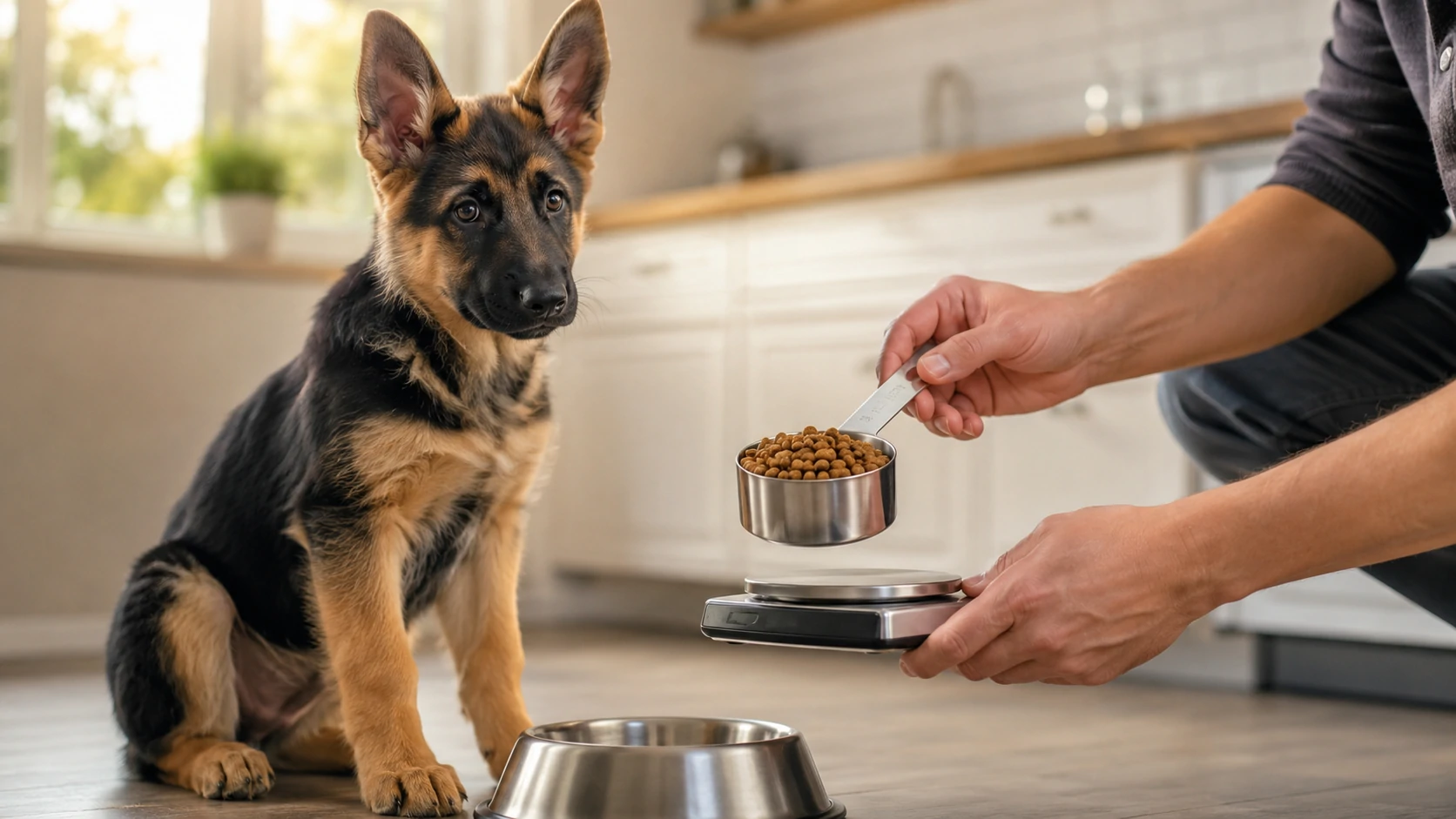
A German Shepherd puppy feeding chart gives you a practical starting point, but it cannot provide one universal number of cups. Foods vary in calories, puppies grow at different rates, and a portion that suits one dog may be too much or too little for another.
The safest approach is to choose a complete and balanced food made for growth, divide the daily amount into age-appropriate meals, measure each portion, and adjust gradually according to body condition, stool quality, activity, and veterinary advice.
The goal is controlled growth—not making a German Shepherd puppy become as large as possible as quickly as possible.
Quick Answer: How Often Should You Feed a German Shepherd Puppy?
Most healthy German Shepherd puppies follow this general meal pattern:
- 8–12 weeks: Three to four small meals each day
- 3–5 months: Three measured meals each day
- 6–12 months: Usually two or three meals, depending on the puppy
- 12–18 months: Usually two meals while growth continues
- After transitioning to adult food: Commonly two measured meals each day
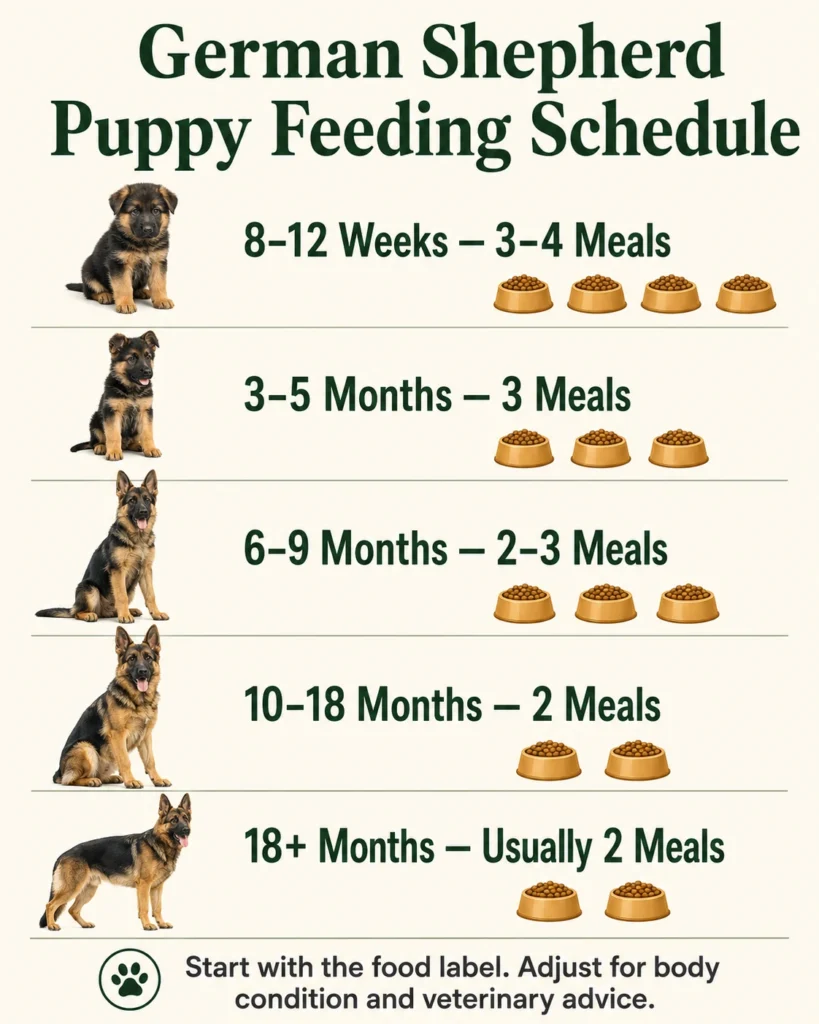
Use the feeding directions on the specific food as your starting daily amount. Divide that total between meals.
Do not copy cup amounts from another owner unless the food, calorie density, puppy age, body weight, and expected adult size are also the same.
German Shepherd Puppy Feeding Chart by Age
The German Shepherd puppy feeding chart below focuses on meal frequency and feeding decisions rather than fixed cup amounts.
That is intentional. One cup of a calorie-dense food may provide far more energy than one cup of another formula.
| Puppy Age | Meals Per Day | Recommended Food Type | Main Feeding Goal | Practical Owner Tip |
| 8–12 weeks | 3–4 | Complete and balanced large-breed puppy food | Support early growth with small, regular meals | Keep the breeder or shelter food at first when possible, then change gradually |
| 3–5 months | 3 | Large-breed puppy food | Build a steady routine during rapid growth | Measure the full daily amount before dividing it into meals |
| 6–9 months | 2–3 | Large-breed puppy food | Maintain lean, controlled growth | Use body shape and weight trend—not begging—to guide adjustments |
| 10–12 months | 2 | Large-breed puppy food | Support continued skeletal and muscle development | Do not switch to adult food only because the puppy looks tall |
| 12–18 months | 2 | Puppy or adult formula based on growth and veterinary advice | Complete the transition without unwanted weight gain | Many large-breed dogs remain on growth food longer than small breeds |
| 18 months and older | Usually 2 | Complete and balanced adult food | Maintain a healthy adult body condition | Recalculate portions after changing food because calories per cup may differ |
Use the chart as a planning framework, not a prescription. A puppy’s exact daily ration depends on:
- Current weight and expected adult size
- Calories per cup, can, tray, or gram
- Body-condition score
- Current growth rate
- Activity and training workload
- Treats, chews, and food toppers
- Neuter status
- Digestion and stool quality
- Health conditions and medications
When monitoring height and weight, compare the feeding record with Furbivo’s German Shepherd growth chart. A trend across several weeks is more useful than one isolated weigh-in.
Why Feeding a German Shepherd Puppy Is Different
German Shepherds are large-breed dogs. Their bodies gain height and weight rapidly, but their bones, joints, muscles, and coordination need time to mature.
This creates a careful balance. A puppy needs enough energy and nutrients to grow, yet excess calories can add body fat and encourage overly rapid weight gain.
A round puppy is not necessarily a well-fed puppy.
Large-breed growth also makes mineral balance important. The Merck Veterinary Manual’s nutrition guidance warns against indiscriminate mineral supplementation and explains that excessive calcium is particularly problematic for growing large- and giant-breed dogs.
For that reason:
- Do not add calcium powder to a complete puppy food
- Do not add bone meal for “stronger bones”
- Do not use growth supplements unless a veterinarian recommends them
- Do not build the main diet around meat and rice
- Do not use an unbalanced homemade recipe
- Do not increase food simply because an adolescent puppy looks lanky
A lean waist, ribs that are easy to feel without being sharply visible, steady energy, and a consistent growth trend are better targets than maximum body weight.
How Much Should You Feed a German Shepherd Puppy?
There is no accurate cup amount that applies to every German Shepherd puppy.
Start with the feeding guide printed on the food package. Check whether the guide is based on:
- Current body weight
- Expected adult weight
- Puppy age
- Daily amount rather than amount per meal
Then find the food’s calorie statement.
AAFCO explains that pet-food labels should state calories in kilocalories per kilogram and per familiar household unit, such as a cup or can. Its pet-food label guide also describes feeding directions as guidelines that may need to be modified for the individual animal.
A Simple Portion Method
- Find the recommended daily amount on the package.
- Confirm that the food is intended for puppy growth.
- Divide the daily amount by the number of meals.
- Include treats and chews in the day’s total intake.
- Recheck weight and body condition every one to two weeks.
- Make small adjustments instead of suddenly adding or removing a large amount.
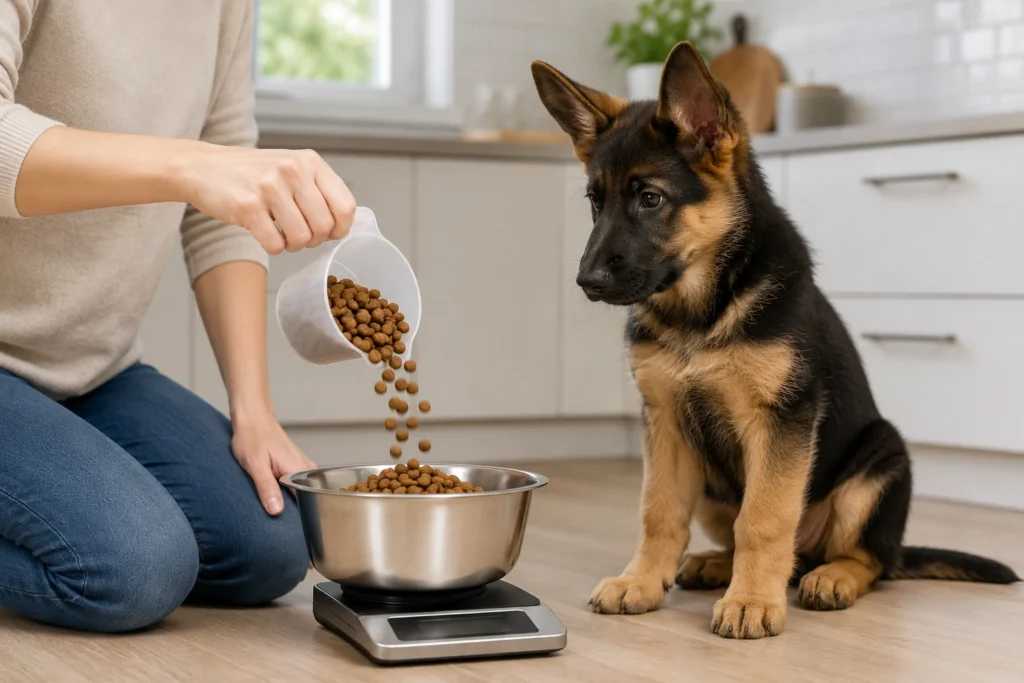
For example, if a package recommends three cups per day and the puppy eats three meals, the starting calculation is one cup per meal—not three cups at every meal.
This is only an example of how to divide a stated daily amount. It is not a portion recommendation for every puppy.
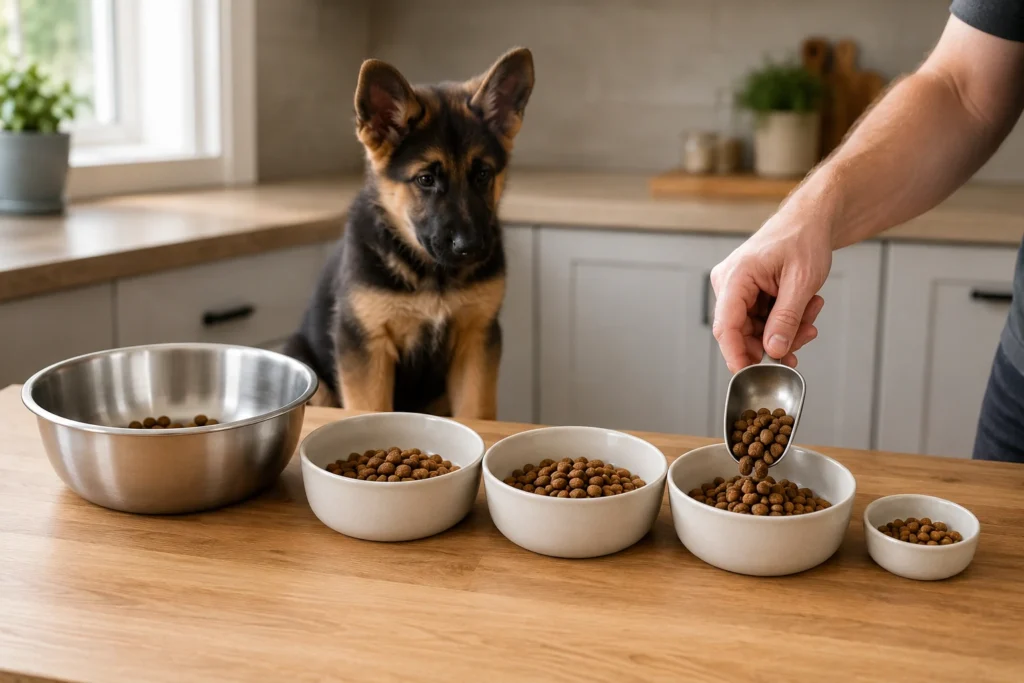
German Shepherd Puppy Feeding Schedule
A consistent German Shepherd puppy feeding chart becomes more useful when paired with regular meal times.
Predictable meals can help owners monitor:
- Appetite
- Digestion
- Bathroom patterns
- Training behaviour
- Changes in food intake
- Possible signs of illness
8 to 12 Weeks: Three or Four Small Meals
Young puppies have small stomachs and are adjusting to a new environment. Three to four meals spread across the day usually work better than one or two large servings.
Keep the puppy on its previous food during the first few days when practical. Moving home, meeting new people, and experiencing a new routine can already affect digestion.
A sample routine could include:
- Early morning
- Late morning or midday
- Late afternoon
- Early evening
Avoid leaving a full bowl down all day. Scheduled meals make it easier to notice appetite loss and prevent accidental double feeding.
3 to 5 Months: Three Measured Meals
Many puppies do well with breakfast, lunch, and dinner at this stage.
Growth is rapid, and food motivation may be high. Begging does not prove that the puppy needs more calories.
Measure the daily ration first, then reserve part of it for training when needed.
Short food-based lessons can teach calm mealtime behaviour. Furbivo’s German Shepherd training guide explains how to use brief reward-based sessions without turning every exercise into a high-calorie snack break.
6 to 9 Months: Two or Three Meals
Some puppies are ready for two meals, while others digest three smaller meals more comfortably.
Keep three meals a little longer if larger servings cause:
- Frantic gulping
- Loose stool
- Abdominal discomfort
- Vomiting
- Intense hunger between meals
The right schedule supports comfortable digestion while keeping total daily calories controlled.
10 to 18 Months: Usually Two Meals
Most adolescent German Shepherds eat twice daily by this stage.
They may look tall, narrow, or unfinished. That appearance can be part of normal large-breed development and does not automatically mean they need more food.
Use the German Shepherd puppy feeding chart together with body condition and the puppy’s growth record before changing portions.
How to Tell Whether the Portion Is Right
The scale alone cannot tell you whether a puppy is being fed correctly.
Look at body shape, feel the ribs, and observe how the puppy functions.
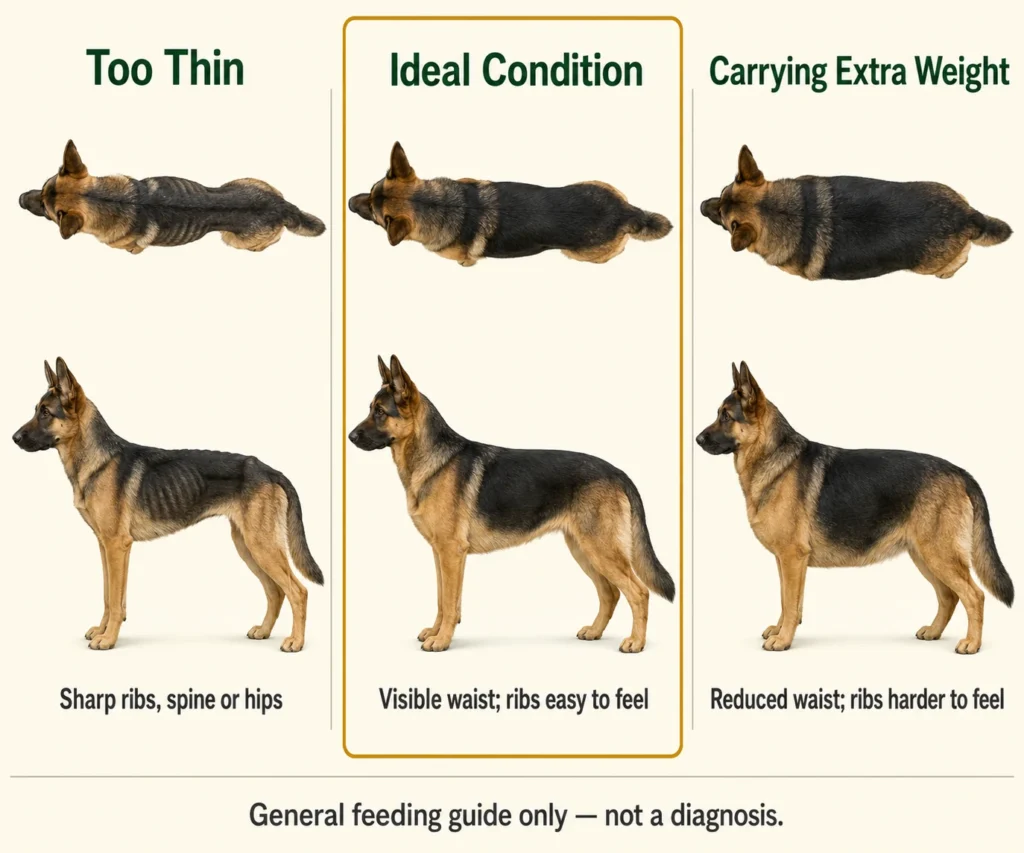
Signs the Portion May Be Appropriate
- Weight increases gradually
- A waist is visible from above
- The abdomen tucks slightly behind the ribs
- Ribs are easy to feel beneath a light fat covering
- Stool is formed and reasonably consistent
- Energy remains steady
- The puppy is alert and interested in normal activity
- The coat and skin appear healthy
Signs the Portion May Be Too High
- The waist begins to disappear
- Ribs become difficult to feel
- The puppy looks round through the abdomen and chest
- Weight rises faster than its established growth trend
- Treats and toppers make up a large part of daily intake
- Loose stool appears after oversized meals
- The puppy becomes less comfortable during activity
Signs the Portion May Be Too Low—or That a Health Check Is Needed
- Ribs, spine, or hip bones look sharp
- Weight gain stops or weight begins falling
- The puppy appears weak or unusually tired
- Appetite is poor
- Diarrhea or vomiting continues
- The abdomen looks swollen while the rest of the body is thin
- The puppy eats eagerly but fails to gain weight
- Coat condition becomes noticeably poor
Do not assume that every thin puppy simply needs more food. Parasites, digestive disease, poor nutrient absorption, dental pain, infection, and other health problems can interfere with growth.
Choosing the Best Food for a German Shepherd Puppy
A suitable food should do more than display a puppy photo on the package.
Look for a formula that is:
- Complete and balanced for growth
- Suitable for large-size dogs when that wording appears
- Appropriate for the puppy’s life stage
- Clearly labelled with calories
- Accompanied by feeding directions
- Produced by a company that provides contact information
- Practical for your budget
- Available consistently
- Well tolerated by your puppy
The FDA explains that food carrying a valid “complete and balanced” nutritional adequacy statement is intended to provide the required nutrients when fed as the main diet for the stated life stage.
For a broader comparison of food categories and label features, see Furbivo’s German Shepherd dog-food guide.
Read the Nutritional Adequacy Statement
The nutritional adequacy statement is usually printed in small text on the back or side of the package.
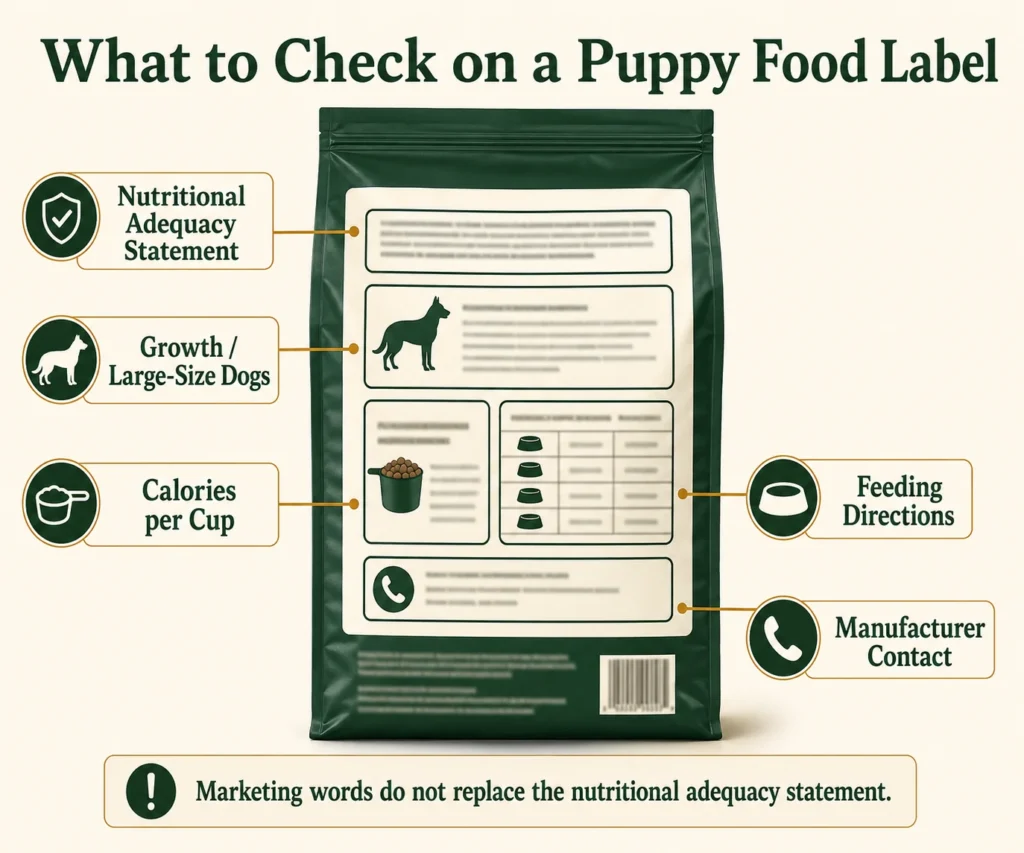
It tells you whether the product is intended for:
- Growth
- Adult maintenance
- All life stages
- Supplemental or intermittent feeding only
A treat, topper, or mixer may look nutritious but may not be suitable as the puppy’s main diet.
Check Calories Per Cup or Can
Cup size measures volume. It does not show how much energy the food provides.
When changing foods, compare the calories in the old and new products before using the same scoop amount.
A direct cup-for-cup switch can cause unintended underfeeding or overfeeding.
Look Beyond the Ingredient List
Ingredient lists are useful, but they do not show the exact quality, digestibility, or final nutrient balance of the whole food.
Do not select a diet based only on:
- The first ingredient
- Attractive meat pictures
- “Premium” wording
- Grain-free marketing
- A very long ingredient list
- A very short ingredient list
- Claims about wolves or ancestral diets
The nutritional adequacy statement, calorie content, feeding directions, company transparency, and your puppy’s response provide more practical information.
Dry Food, Wet Food, Fresh Food, or a Mix?
Different food formats can work when the total diet is complete, balanced, measured, and suitable for growth.
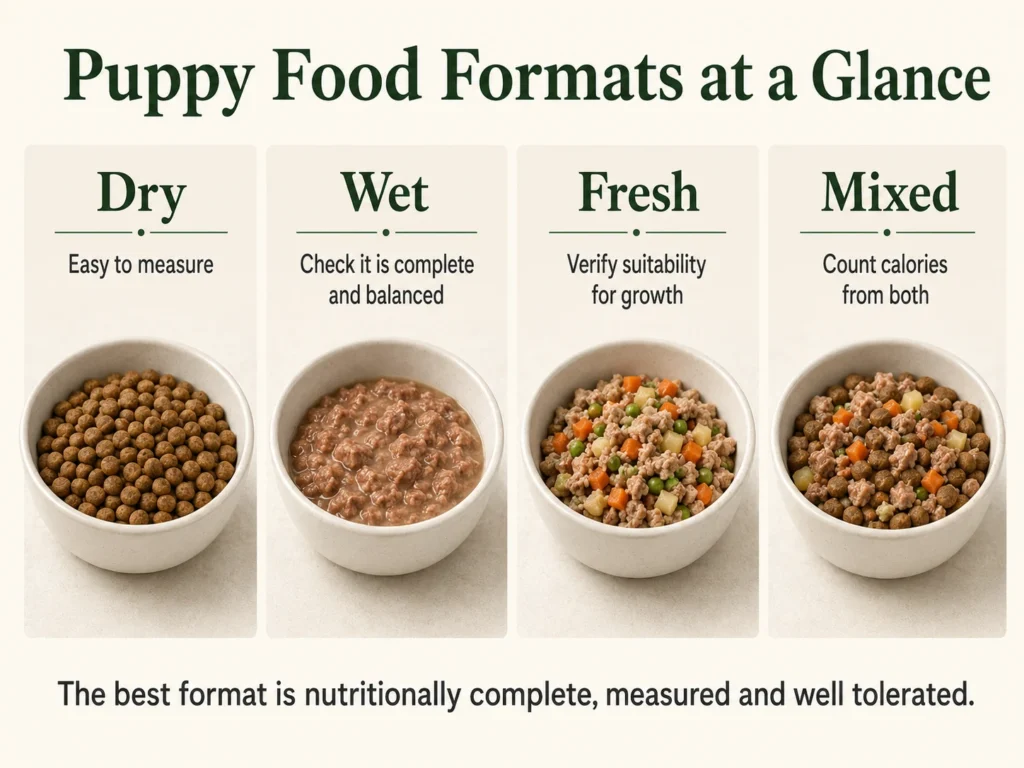
Dry Puppy Food
Dry food is usually convenient, easy to portion, and relatively affordable for a large-breed puppy. Part of the daily portion can also be reserved for training.
Its convenience does not make free-feeding a good idea. Measure the daily total.
Wet Puppy Food
Wet food offers a softer texture and stronger smell. It may be useful for a puppy with temporary chewing difficulty or low interest in dry food.
Check that the product is complete and balanced for growth—not merely a complementary topper.
Fresh or Gently Cooked Food
Commercial fresh diets may be appropriate when they provide complete and balanced nutrition for puppy growth and are stored and handled safely.
“Fresh” does not automatically mean nutritionally better. Suitability depends on formulation, calories, storage, and the individual puppy.
Mixed Feeding
Wet and dry foods can be combined, but calories from both must be counted.
Adding wet food on top of the puppy’s full dry-food allowance increases total energy. The extra calories do not disappear because the product is called a topper.
Furbivo’s guide to what German Shepherds eat covers daily diets, safe treats, human foods, and foods that should remain out of the bowl.
Treats, Chews, and Training Calories
Treats can quietly change the entire feeding plan.
A puppy may receive food from several people and sources, including:
- Training rewards
- Dental chews
- Stuffed toys
- Food toppers
- Table scraps
- Peanut butter
- Cheese
- Family members offering “just one bite”
Use small pieces and keep a simple daily record.
Reserving part of the measured kibble for training is often the easiest way to prevent reward calories from accumulating.
When several family members feed the puppy, place the full daily food allowance in one container. When the container is empty, the puppy has already received its planned amount.
How to Change Puppy Food Safely
A gradual food change gives the digestive system time to adjust.
Many puppies manage a transition over approximately seven to ten days, while sensitive dogs may need longer.
| Transition Stage | Old Food | New Food |
| Days 1–2 | 75% | 25% |
| Days 3–4 | 50% | 50% |
| Days 5–6 | 25% | 75% |
| Day 7 onward | 0% | 100% |
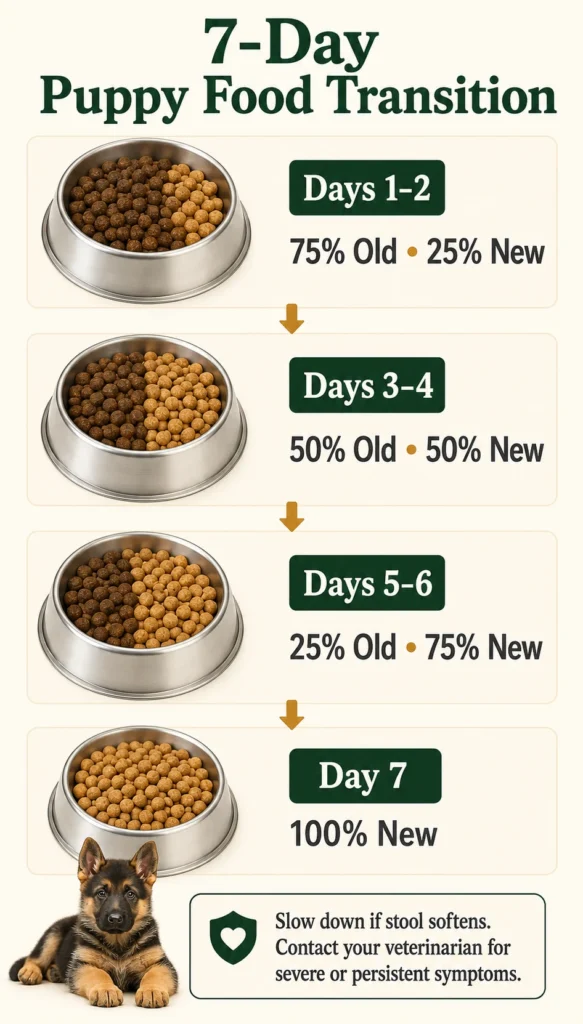
Treat this schedule as a starting template rather than a strict rule.
Slow the transition if the stool becomes softer but the puppy otherwise appears well.
Contact a veterinarian if diarrhea is:
- Severe
- Persistent
- Bloody
- Accompanied by vomiting
- Associated with weakness or pain
- Combined with appetite loss
- Causing signs of dehydration
Do not keep changing brands every few days. Repeated food changes can make digestive problems harder to interpret.
Foods German Shepherd Puppies Should Not Eat
Keep common food hazards out of reach, including items stored in backpacks, handbags, bedside tables, bins, and children’s snack areas.
The ASPCA’s people-food safety guide identifies several foods that can harm pets.
Avoid giving a puppy:
- Chocolate
- Coffee, tea, and other caffeine sources
- Grapes and raisins
- Onions, garlic, chives, and leeks
- Xylitol, sometimes labelled birch sugar
- Alcohol
- Raw yeast dough
- Macadamia nuts
- Cooked bones
- Moldy food
- Very fatty leftovers
- Heavily seasoned food
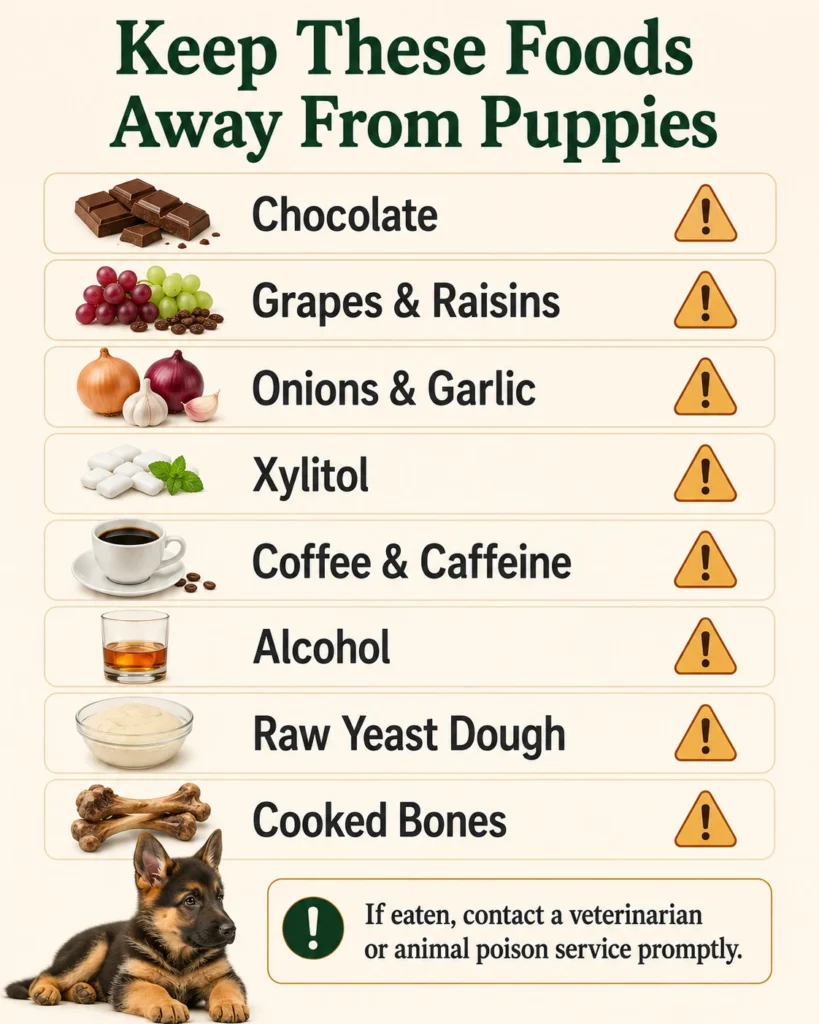
If a puppy eats a potentially toxic food, contact a veterinarian or animal poison-control service promptly.
Do not wait for symptoms, and do not induce vomiting unless a veterinary professional instructs you to do so.
What About Raw Food?
Raw meat and raw pet diets can expose dogs and people to harmful bacteria.
The FDA’s raw pet-food guidance reports that raw products in its study were more likely to be contaminated with disease-causing bacteria than the other tested pet-food categories.
A growing puppy also needs precise nutrient balance.
Do not build a raw or homemade puppy diet from an unverified online recipe. Speak with a veterinarian and an appropriately qualified veterinary nutrition professional before using a noncommercial diet.
Puppy Food Safety and Storage
Safe nutrition includes handling and storage.
The FDA recommends washing hands before and after handling pet food, cleaning bowls and measuring utensils with hot soapy water, promptly refrigerating opened wet food, and storing dry food in a cool, dry place.
Its pet-food handling guidance also advises keeping dry food in its original bag.
Practical food-safety habits include:
- Check bags and cans for damage before buying
- Keep the original packaging and lot number
- Place the original dry-food bag inside a sealed container
- Use a clean scoop reserved for pet food
- Wash food and water bowls regularly
- Refrigerate opened wet food promptly
- Discard food that smells spoiled or looks contaminated
- Keep the food supply where the puppy cannot reach it
- Check FDA or manufacturer recall notices when concerned
Pouring kibble directly into a permanent bin can leave old fat and crumbs behind. It can also remove the batch information needed during a recall or quality complaint.
Feeding Around Exercise and Bloat Risk
German Shepherd Dogs are among the breeds at risk for gastric dilatation-volvulus, commonly called GDV or bloat.
GDV is an acute veterinary emergency—not ordinary stomach gas.
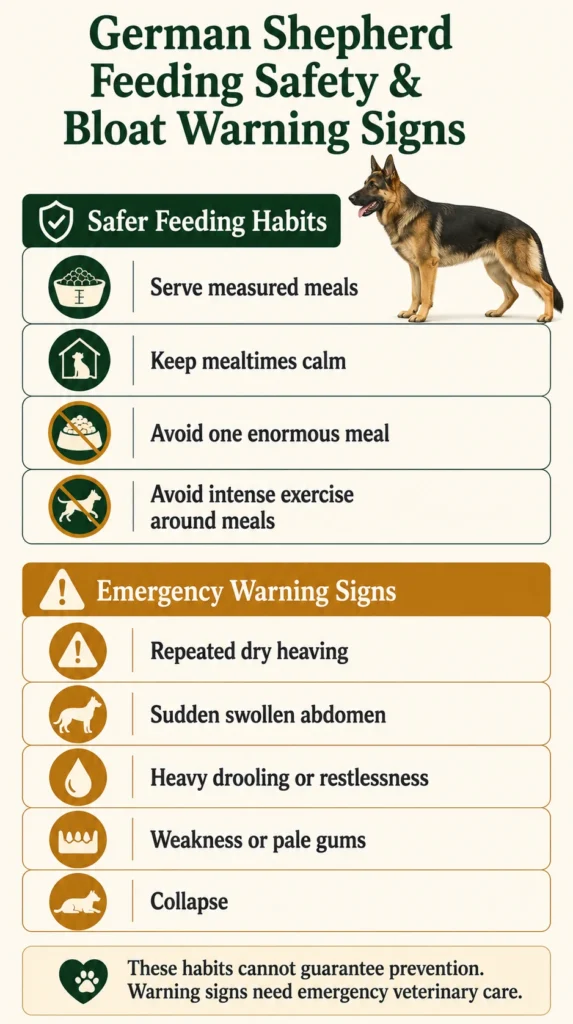
The Merck Veterinary Manual’s GDV guidance lists German Shepherd Dogs among at-risk breeds. Recommendations for higher-risk dogs may include multiple smaller meals, calmer mealtimes, and restricting exercise around meals.
Reasonable feeding habits include:
- Avoid one enormous daily meal
- Split the daily ration into measured meals
- Discourage frantic gulping
- Keep mealtimes calm
- Avoid intense exercise immediately around a large meal
- Ask your veterinarian about individual GDV risk
- Discuss preventive gastropexy when appropriate
No bowl, food, supplement, or feeding schedule can guarantee that GDV will not occur.
Seek emergency veterinary care immediately if your dog develops:
- Repeated unproductive retching
- Sudden abdominal enlargement
- Heavy drooling
- Severe restlessness
- Weakness
- Pale gums
- Breathing difficulty
- Collapse
Common Feeding Mistakes
Using a Random Scoop
A coffee mug, drinking cup, or unmarked scoop can produce a different portion at every meal.
Use a proper measuring cup or, for greater consistency, a kitchen scale.
Feeding the Bag’s Daily Amount at Every Meal
Package directions usually show the total amount for the day.
Divide that amount by the number of meals.
Increasing Food Every Time the Puppy Begs
German Shepherd puppies can be highly food motivated.
Appetite alone is not an accurate calorie calculator.
Ignoring Treats
Chews, toppers, training rewards, and family handouts all contribute calories.
Free-Feeding
Leaving food available all day makes intake difficult to measure and changes in appetite harder to notice.
Adding Calcium or Growth Supplements
A properly formulated puppy food should already contain a planned mineral balance.
Extra supplementation can disturb that balance.
Switching Food Too Quickly
Sudden food changes can cause gas, vomiting, or diarrhea even when the new formula is otherwise suitable.
Assuming a Tall Puppy Is Ready for Adult Food
A puppy may look adult-sized before skeletal and muscular development is complete.
When to Switch From Puppy Food to Adult Food
Many German Shepherds change to adult food somewhere around 12 to 18 months, but age alone should not determine the timing.
Consider:
- Current growth rate
- Expected adult size
- Body condition
- Whether height is still increasing
- The current food’s life-stage statement
- Neuter status and calorie needs
- Veterinary advice
When the time comes, compare calorie density and transition gradually.
Continue checking the dog’s weight and waist shape during the following month.
The German Shepherd puppy feeding chart should change with the dog. It should not lock an adolescent into the same portion used during the fastest growth stage.
What Most Feeding Charts Miss
Cups Are Not a Universal Unit of Nutrition
Two products can contain very different calorie levels in the same volume.
Publishing one cup amount without naming the product and its calorie density can mislead readers.
The Food Label Is Part of the Feeding Plan
The life-stage statement, calorie content, and feeding directions matter more than package colours or marketing claims.
Treats Can Undo an Accurate Meal Plan
Carefully measured breakfasts and dinners do not prevent overfeeding when rewards, chews, and toppers remain uncounted.
Body Condition Gives Real-Time Feedback
Breed averages and package directions provide a starting point.
The puppy’s waist, ribs, weight trend, stool, and energy show whether that starting point suits the individual.
A Feeding Problem May Be a Medical Problem
Persistent poor growth, extreme hunger with weight loss, repeated digestive upset, or appetite refusal needs veterinary assessment—not endless food changes.
When to Call Your Veterinarian
The German Shepherd puppy feeding chart provides general educational guidance.
Contact a veterinarian if your puppy:
- Refuses more than one meal and seems unwell
- Vomits repeatedly
- Has persistent or bloody diarrhea
- Becomes weak, dull, or unusually sleepy
- Loses weight
- Fails to gain weight across several weeks
- Develops a swollen or painful abdomen
- Appears painful after eating
- Has repeated itching, ear trouble, or stomach upset
- Drinks or urinates much more than usual
- Eats a potentially toxic food
- Is being fed a raw, homemade, or highly restricted diet
- Has a known health condition
- Takes medication that may affect appetite or weight
Urgent symptoms such as a rapidly swollen abdomen, repeated dry heaving, breathing difficulty, collapse, or severe weakness require emergency veterinary care.
Frequently Asked Questions
How Many Times a Day Should I Feed a German Shepherd Puppy?
Most puppies eat three to four meals daily at 8 to 12 weeks, around three meals at 3 to 5 months, and two or three meals from approximately 6 months onward.
Many are eating twice daily by late adolescence.
How Many Cups Should a German Shepherd Puppy Eat?
There is no safe universal cup amount.
Start with the daily directions for the specific food, check its calories per cup, divide the total between meals, and adjust gradually according to body condition and growth.
What Is the Best Food for a German Shepherd Puppy?
Choose a complete and balanced food formulated for growth and suitable for large-size dogs when indicated on the label.
The best practical option is one that meets the puppy’s nutritional needs, is consistently available, fits your budget, and supports healthy stool and body condition.
Can a German Shepherd Puppy Eat Adult Dog Food?
Adult-maintenance food is generally not designed to meet the nutritional needs of a growing puppy.
Do not switch simply because the puppy looks large. Ask your veterinarian when growth and body condition suggest that an adult formula is appropriate.
Should I Add Calcium to Puppy Food?
Do not add calcium unless a veterinarian identifies a specific need.
Excess mineral supplementation can disturb a balanced diet and is a particular concern in rapidly growing large-breed dogs.
Is It Normal for a German Shepherd Puppy to Look Skinny?
Adolescent German Shepherds can look lean and leggy while height increases faster than chest width and muscle development.
A visible waist may be healthy. Sharply projecting bones, weight loss, low energy, or digestive symptoms need attention.
Can I Mix Wet and Dry Puppy Food?
Yes, provided both products are appropriate for puppy growth and you calculate the combined calories.
Reduce the dry portion when adding wet food instead of placing wet food on top of the full dry-food ration.
When Should I Stop Feeding German Shepherd Puppy Food?
Many German Shepherds transition between approximately 12 and 18 months.
The right timing depends on growth, body condition, food formulation, calorie needs, and veterinary advice.
Final Thoughts
A German Shepherd puppy feeding chart works best as a decision tool—not a rigid cup calculator.
Choose a complete and balanced growth diet, measure the total daily ration, divide it into appropriate meals, count treats, and regularly reassess the puppy’s waist, ribs, weight trend, stool, and energy.
Controlled growth is the goal.
Your puppy does not need the largest serving or the fastest weight gain. It needs enough balanced nutrition to develop without carrying unnecessary body fat.
Have questions about your dog’s health, nutrition, grooming, or daily care? Visit our Contact Us page to reach the Furbivo team. For any medical symptoms, diagnosis, or treatment advice, always consult a qualified veterinarian.