
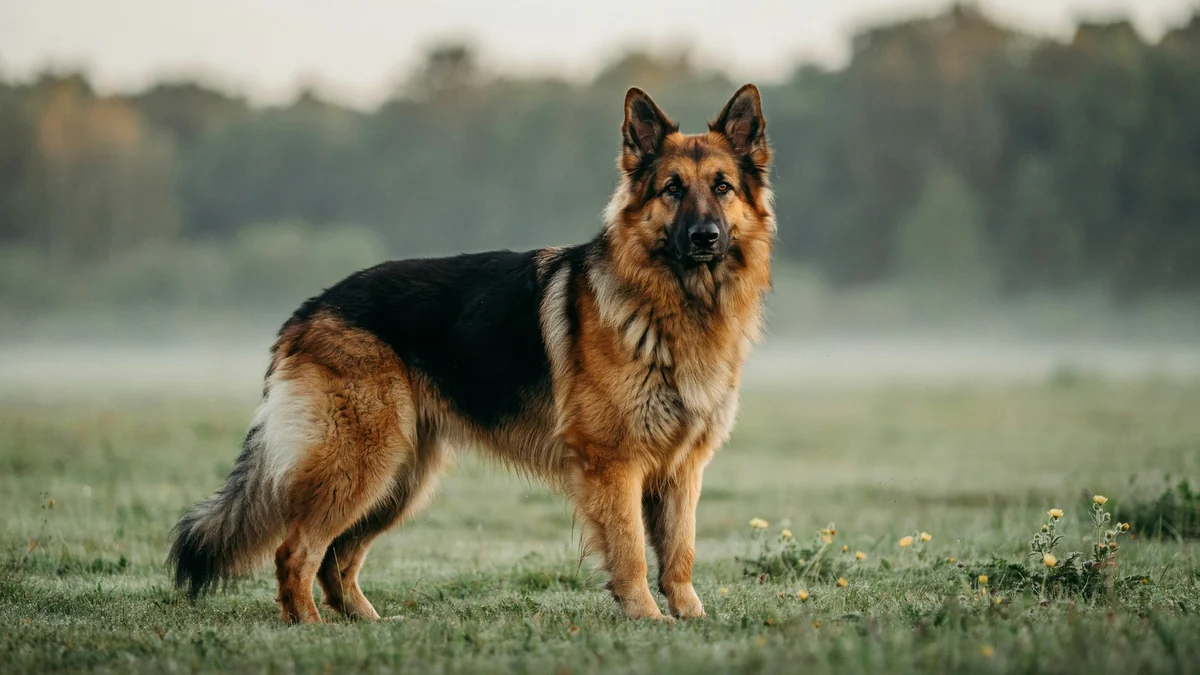
A long-haired German Shepherd is a purebred German Shepherd Dog with inherited coat-length variants that produce longer guard hairs, fuller feathering, a mane-like neck, bushy rear-leg furnishings, and a heavily feathered tail.
The long coat does not create a separate breed. These dogs should have the same fundamental structure, intelligence, temperament, exercise needs, and health considerations as standard-coated German Shepherds. The main practical difference is the coat itself and the extra grooming it may require.
Official standards do not treat every type of long hair identically. The FCI German Shepherd Dog standard recognizes a long double coat with an undercoat as one of the breed’s two hair varieties. The AKC German Shepherd Dog standard describes a medium-length double coat as ideal and lists a soft, excessively long, woolly, curly, or open outer coat as a fault.
Long-Haired German Shepherd: Quick Answer
A long-haired German Shepherd has longer, softer guard hairs with noticeable feathering around the ears, neck, legs, rear thighs, and tail. The trait is generally inherited recessively through variants in the FGF5 gene. Long-coated dogs are purebred when their ancestry is purebred, but show-ring treatment differs between organizations. They still shed, retain a double coat when correctly coated, and usually need more brushing than standard-coated German Shepherds.
Long Coat German Shepherd at a Glance
| Feature | Long double coat | Standard stock coat |
|---|---|---|
| Outer coat | Longer, softer, and less close-fitting | Dense, harsh, straight, and close-fitting |
| Undercoat | Present | Present |
| Neck | Heavy coat that may form a mane | Thick but less dramatic neck coat |
| Ears | Visible tufts or feathering | Shorter hair around ears |
| Legs | Longer feathering behind the legs | Moderate longer hair behind legs |
| Rear thighs | Distinct bushy breeches or “trousers” | Moderate breeching |
| Tail | Very bushy with hanging feathering | Bushy but less heavily feathered |
| Shedding | Regular shedding plus seasonal undercoat release | Regular shedding plus seasonal undercoat release |
| Grooming | Usually needs more combing and mat prevention | Generally easier to maintain |
| AKC standard | Excessively long or soft outer coat is a fault | Medium double coat is ideal |
| FCI standard | Long double coat with undercoat is recognized | Double coat with undercoat is recognized |
The FCI description specifically identifies ear and leg tufts, a fuller neck approaching a mane, bushy trousers, and a bushy feathered tail as characteristics of the long double coat.
What Is a Long-Haired German Shepherd?
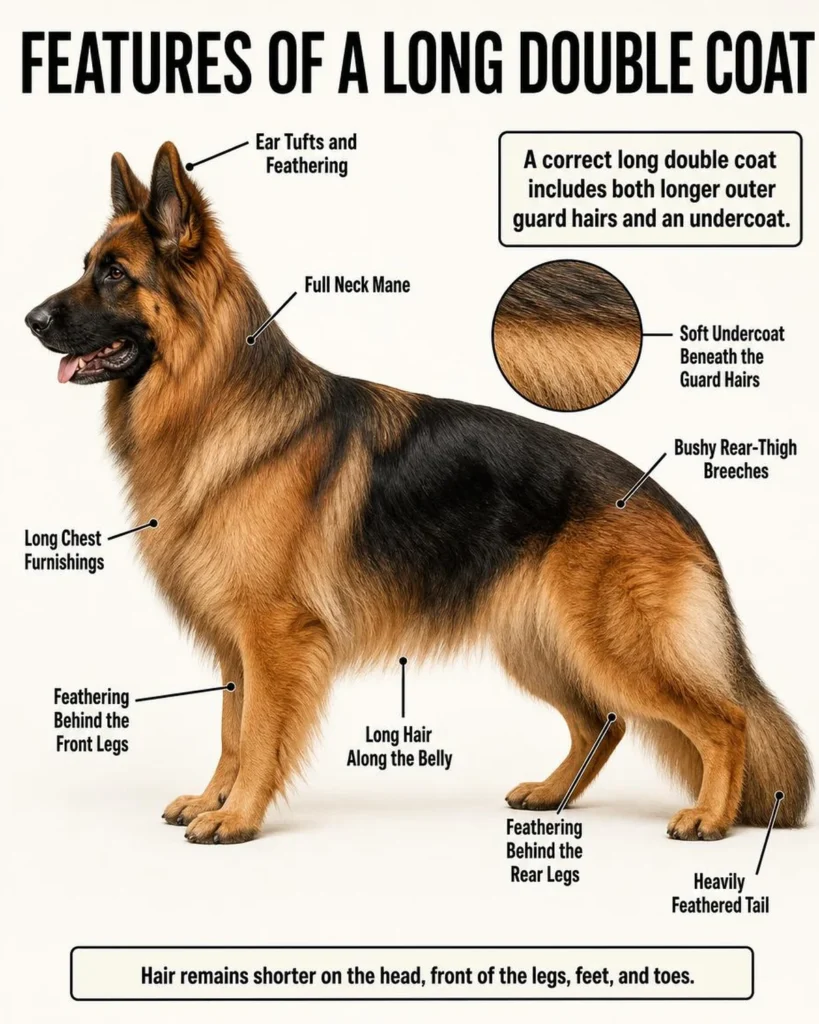
The everyday phrase “long-haired German Shepherd” usually refers to a German Shepherd with significantly longer hair than the standard stock coat.
Under FCI terminology, the more precise description is long double coat or long stock coat with undercoat. The coat should include:
- A protective outer layer
- A softer undercoat
- Long, soft guard hairs that do not lie tightly against the body
- Feathering or tufts around the ears
- Longer hair behind the front and rear legs
- A heavily coated neck
- Distinct rear-thigh breeching
- A bushy tail with hanging feathering
The hair should remain shorter on the head, front of the legs, feet, and toes.
A dog with a long coat but no undercoat is not the same coat variety. The FCI standard disqualifies long straight topcoat without undercoat and long, soft hair without undercoat that commonly parts down the middle of the back.
Long-Haired vs Short-Haired German Shepherd
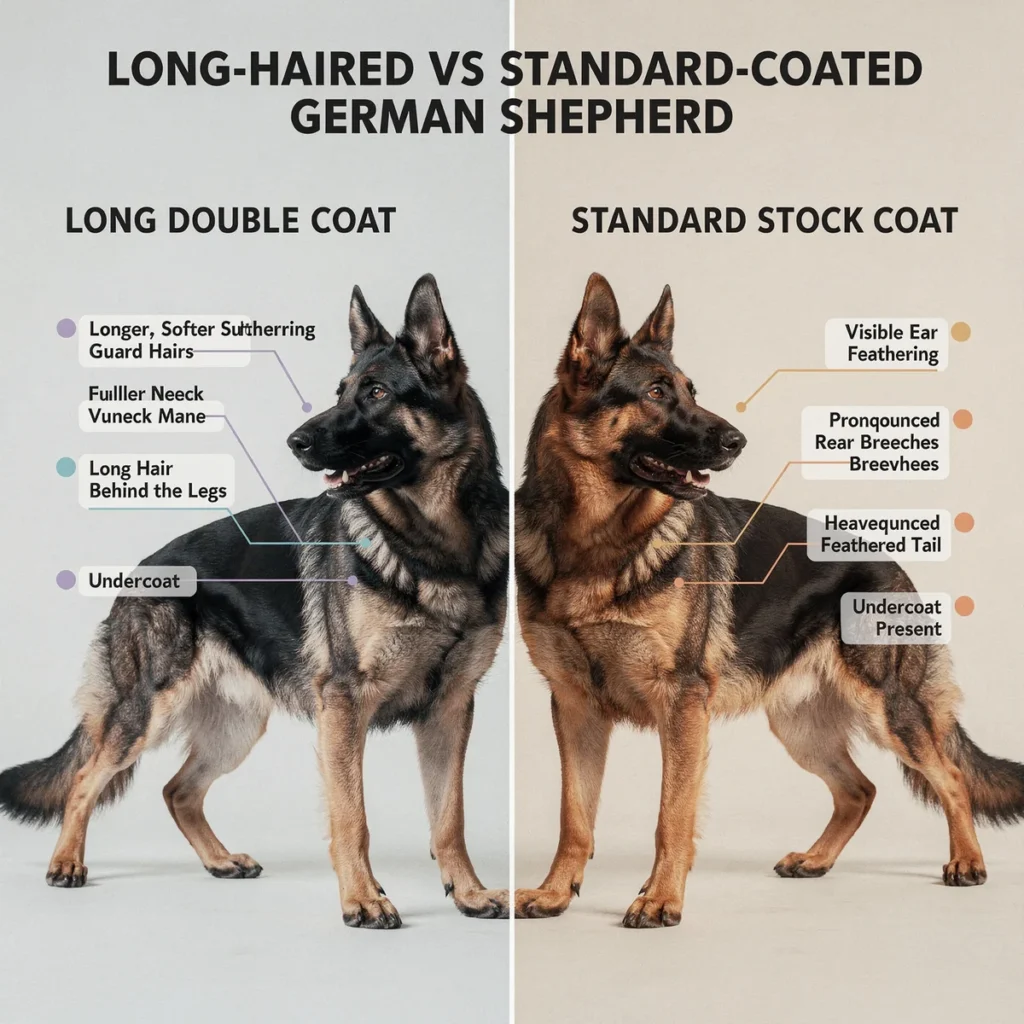
The phrase “short-haired German Shepherd” is commonly used by owners, but the official term is usually stock coat, normal coat, or double coat.
Standard Stock Coat
The standard coat has:
- Dense, straight guard hairs
- A harsh texture
- Hair lying close to the body
- A thick undercoat
- Short hair on the head, ears, feet, and front of the legs
- Moderate breeching behind the thighs
- A bushy tail without extremely long feathering
Long Double Coat
The long coat has:
- Longer, softer guard hairs
- Hair that does not lie as tightly against the body
- More visible ear and leg feathering
- A heavier neck mane
- Fuller rear-leg breeches
- A longer, more heavily feathered tail
The difference is mainly hair length and presentation. Coat length should not be used to predict intelligence, loyalty, aggression, trainability, or working ability.
Long Double Coat vs Long Coat Without Undercoat
This distinction is often missed in online breed guides.
Long Double Coat With Undercoat
This is the recognized FCI long-coat variety. The undercoat remains present beneath the long guard hairs.
Long Coat Without Undercoat
This coat may appear soft, flowing, open, or parted along the back, but it lacks the proper undercoat. The FCI lists this coat among its disqualifying faults.
An owner cannot always determine undercoat quality from one photograph. A hands-on coat examination, seasonal observation, pedigree information, or evaluation from an experienced breed specialist may be more useful.
Is a Long-Haired German Shepherd Purebred?
Yes. Long coat length can occur naturally in purebred German Shepherd Dogs.
Coat length does not establish or disprove breed ancestry. Purebred status depends on verified parentage, pedigree records, and the breeding population—not whether the coat is long or standard length.
The FCI explicitly describes the German Shepherd as being bred in two hair varieties: double coat and long double coat, both with undercoat. Dogs Australia’s Long Stock Coat breed standard also states that the long stock coat standard is the same as the German Shepherd Dog standard except for the coat description.
Under the AKC standard, an excessively long outer coat is a fault rather than a breed disqualification. The ideal AKC coat remains a medium-length double coat with a dense, harsh, close-lying outer layer.
Registration, breed ancestry, and conformation preference are therefore different questions.
Is the Long Coat Recognized by the AKC and FCI?
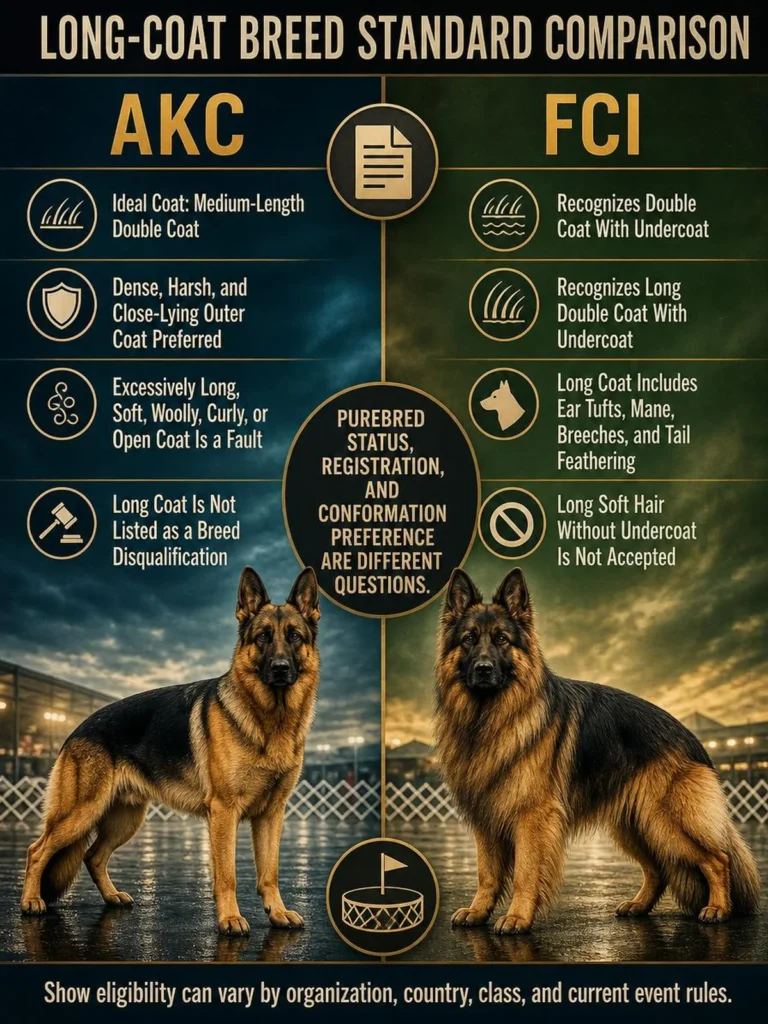
AKC Position
The AKC German Shepherd standard describes the ideal dog as having a medium-length double coat. It lists a soft, silky, excessively long, woolly, curly, or open outer coat as a coat fault.
This means:
- A long-coated dog can still be a purebred German Shepherd.
- Long coat is not listed as an AKC breed disqualification.
- Excessive coat length or incorrect texture can be penalized in conformation.
- Registration alone does not mean the coat matches the ideal show standard.
FCI Position
The FCI recognizes:
- Double coat with undercoat
- Long double coat with undercoat
The long double coat has soft, non-close-fitting guard hair, ear and leg tufts, a fuller mane, pronounced breeches, and a bushy feathered tail.
However, long hair without undercoat is not accepted under that standard.
Show eligibility can vary by registry, country, class, and event. Owners planning to show or breed should confirm the current rules with the organization involved.
What Does “Plush Coat” Mean?
“Plush coat” is an informal term rather than a clearly defined AKC or FCI coat category.
People may use it to describe:
- A standard coat with an especially dense undercoat
- A coat slightly longer than average
- A puppy with a fluffy temporary coat
- A coat between the visual appearance of stock coat and long stock coat
Because the term has no single official definition, it should not replace a clear description of:
- Guard-hair length
- Undercoat presence
- Ear feathering
- Rear-leg breeching
- Tail feathering
- Coat texture
A breeder advertising a “plush long coat” should explain what the term means within that breeding program.
Long-Haired German Shepherd Genetics
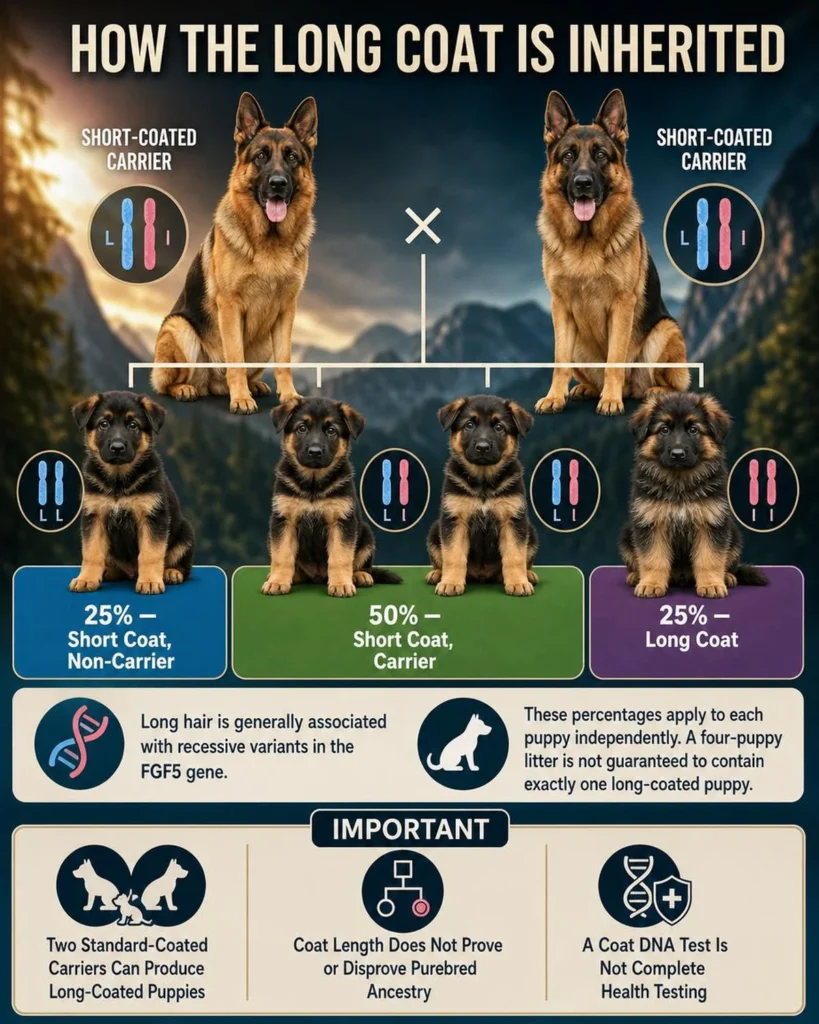
Long hair in dogs is associated with recessive variants in the FGF5 gene. The UC Davis Veterinary Genetics Laboratory coat-length test currently describes five recessive FGF5 variants associated with long-hair phenotypes across dogs.
In a simplified recessive inheritance pattern:
- A dog with no tested long-hair variant is expected to have short hair and not transmit that tested variant.
- A dog with one copy is usually short-coated but can carry and pass the variant.
- A dog with two relevant copies is expected to have long hair.
When two carriers of the same relevant recessive variant are bred, each puppy is expected to have approximately:
- 25% chance of inheriting two short-hair copies
- 50% chance of being a short-coated carrier
- 25% chance of inheriting long hair
These percentages apply to each puppy independently. They do not guarantee that a four-puppy litter will contain exactly one long-coated puppy.
A coat-length DNA test explains a physical trait. It does not prove overall health, breed purity, structural quality, or stable temperament.
Can Two Standard-Coated Parents Produce Long-Haired Puppies?
Yes.
Two standard-coated German Shepherds can both carry a recessive long-hair variant without showing the long coat themselves. When both pass a relevant variant to the same puppy, that puppy can develop a long coat.
This is not evidence that another breed was introduced. Parentage questions should be answered through pedigree records or DNA parentage testing rather than coat length alone.
Likewise, two long-coated parents are expected to produce long-coated puppies for the relevant recessive variant, but responsible breeding should never be based only on coat appearance.
How to Identify a Long-Haired German Shepherd Puppy
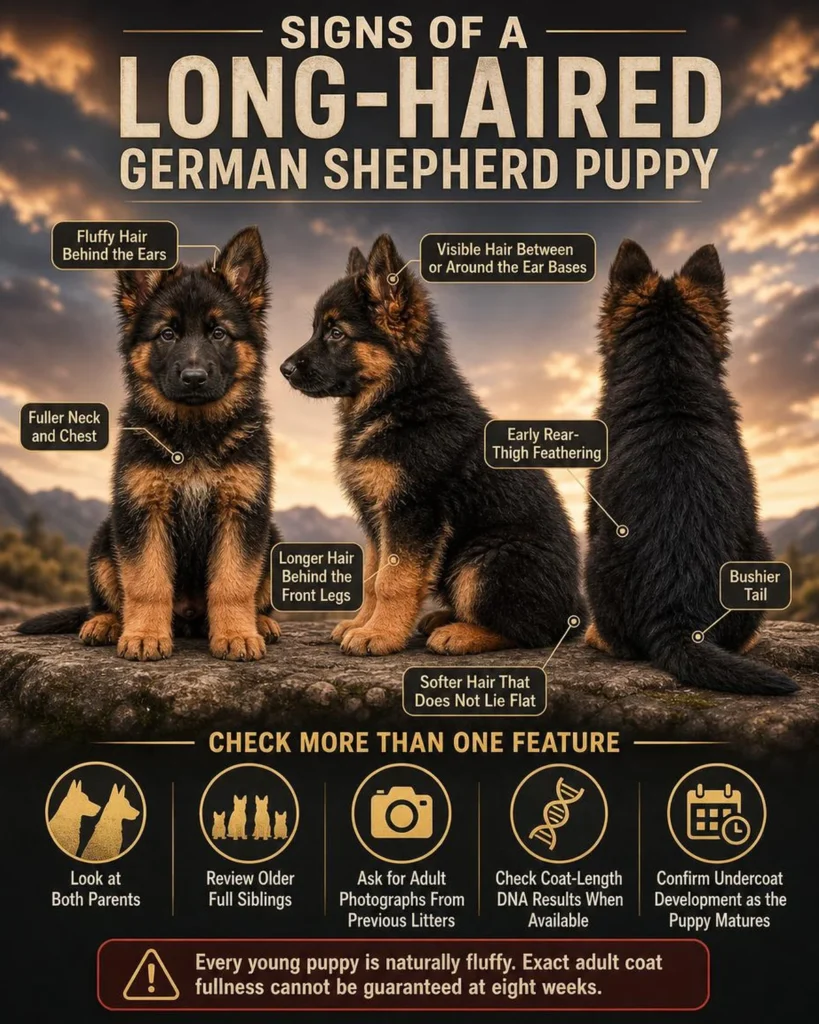
A long-coated puppy may show:
- Fluffy hair around or behind the ears
- Longer hair between or around the ear bases
- A fuller neck and chest
- Feathering behind the front legs
- Longer hair along the rear legs
- Fuller rear-thigh breeches
- A noticeably bushy tail
- Softer hair that does not lie as tightly against the body
Identification may be easier as the puppy matures. Puppy coats are naturally soft and fluffy, and the adult guard hairs have not fully developed at eight weeks.
Look at:
- Both parents
- Older full siblings
- Previous litters
- Adult relatives
- Coat-length DNA results when available
- The presence and quality of the undercoat
A breeder can estimate coat type, but should avoid promising the exact adult fullness, texture, or tail feathering from a very young puppy.
Do Long-Haired German Shepherd Puppies Lose Their Fluffy Coat?
Puppies shed their soft puppy coat as adult guard hairs and undercoat develop.
A puppy may become:
- More obviously long-coated
- Less uniformly fluffy
- More heavily feathered around the tail and legs
- Fuller around the neck
- Coarser in some outer-coat areas
- Different in color intensity as the adult coat appears
The adult coat can continue changing during adolescence and seasonal shedding. Coat length is inherited, but the final visual fullness is influenced by age, undercoat density, health, season, and grooming.
Use Furbivo’s German Shepherd colors guide to understand how saddle development, sable shading, masks, and pigment can also change while a puppy matures.
Long-Haired German Shepherd Colors
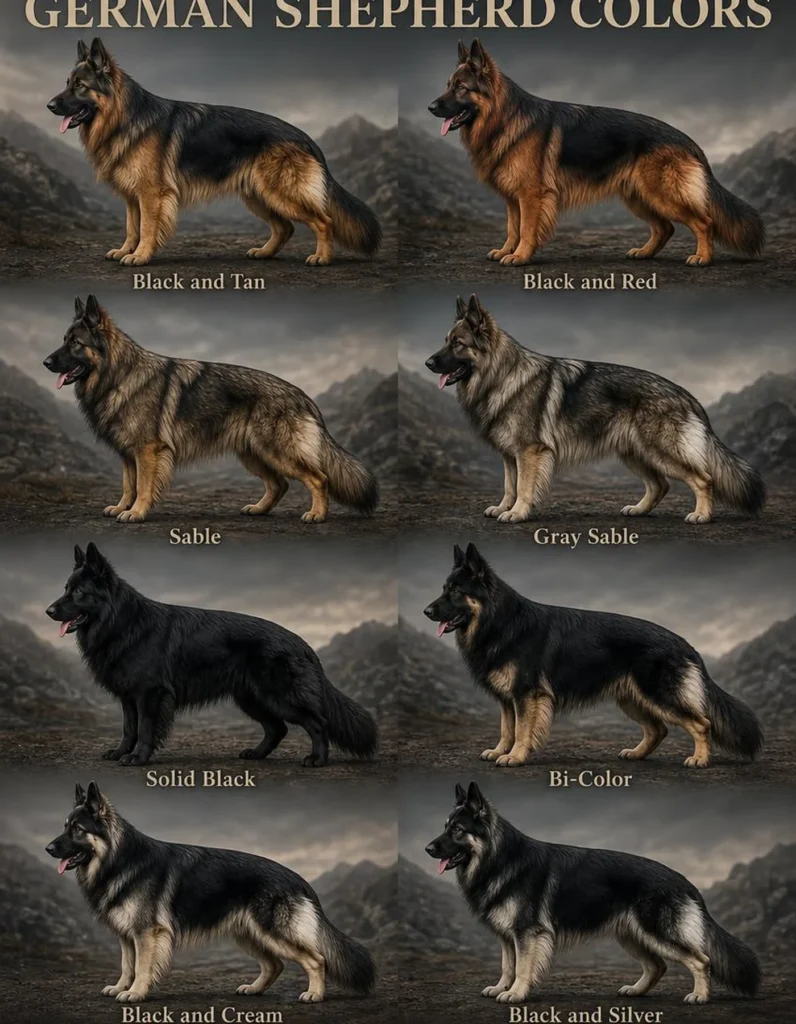
Long-coated German Shepherds can appear in the same inherited colors and patterns as other German Shepherds.
Common examples include:
- Black and tan
- Black and red
- Sable
- Gray sable
- Solid black
- Bi-color
- Black and cream
- Black and silver
White, blue, liver, and Panda-patterned dogs may also have long coats, but coat length does not change how those colors are treated under a breed standard.
Long hair can make color boundaries look softer. For example:
- A saddle may appear less sharply outlined.
- Sable tipping may look fuller or more blended.
- A black and red coat may appear richer because of the longer guard hairs.
- Seasonal undercoat can temporarily alter the overall shade.
The complete German Shepherd colors guide explains standard, faulted, disqualified, and uncommon colors separately.
Do Long-Haired German Shepherds Have a Different Temperament?
No reliable temperament prediction can be made from coat length alone.
A long-haired dog is not automatically:
- Calmer
- Friendlier
- Less protective
- More aggressive
- Easier to train
- Less suitable for work
- Better with children
Dogs Australia states that the long stock coat standard is the same as the broader German Shepherd standard except for the coat. The desired temperament therefore remains balanced, confident, attentive, trainable, and suitable for working and companion roles.
Some long-coated dogs come from particular family or show lines, which may create anecdotal personality patterns. Those patterns reflect ancestry, selection, socialization, and training—not the FGF5 coat-length trait itself.
Use Furbivo’s German Shepherd temperament guide when evaluating confidence, protectiveness, aggression concerns, family suitability, and behavior.
Can a Long-Coated German Shepherd Work?
Yes. A long-coated German Shepherd can participate in obedience, tracking, scent work, herding, protection sports, service work, hiking, and other activities when the individual dog has suitable health, temperament, structure, training, and conditioning.
The coat creates practical considerations rather than an automatic working limitation:
- Burrs and plant material may catch in feathering.
- Mud can collect around the legs, belly, and tail.
- Wet feathering can take longer to dry.
- Mats may form after repeated outdoor exposure.
- Snow may cling to foot or leg furnishings.
Inspect and comb the coat after outdoor work. Do not select or reject a working prospect solely because of hair length.
Do Long-Haired German Shepherds Shed?
Yes. Long-coated German Shepherds shed.
The breed has an undercoat and outer coat. Loose outer hairs are released regularly, while the undercoat may shed much more heavily during seasonal coat changes. The longer hairs can make shedding appear more dramatic because individual hairs are easier to see.
A long coat does not make the dog:
- Non-shedding
- Hypoallergenic
- Suitable for someone who cannot tolerate dog hair
- Free from seasonal coat changes
Regular brushing removes loose hair before it spreads around the home and helps prevent undercoat from compacting beneath longer furnishings.
Long-Haired German Shepherd Grooming Routine
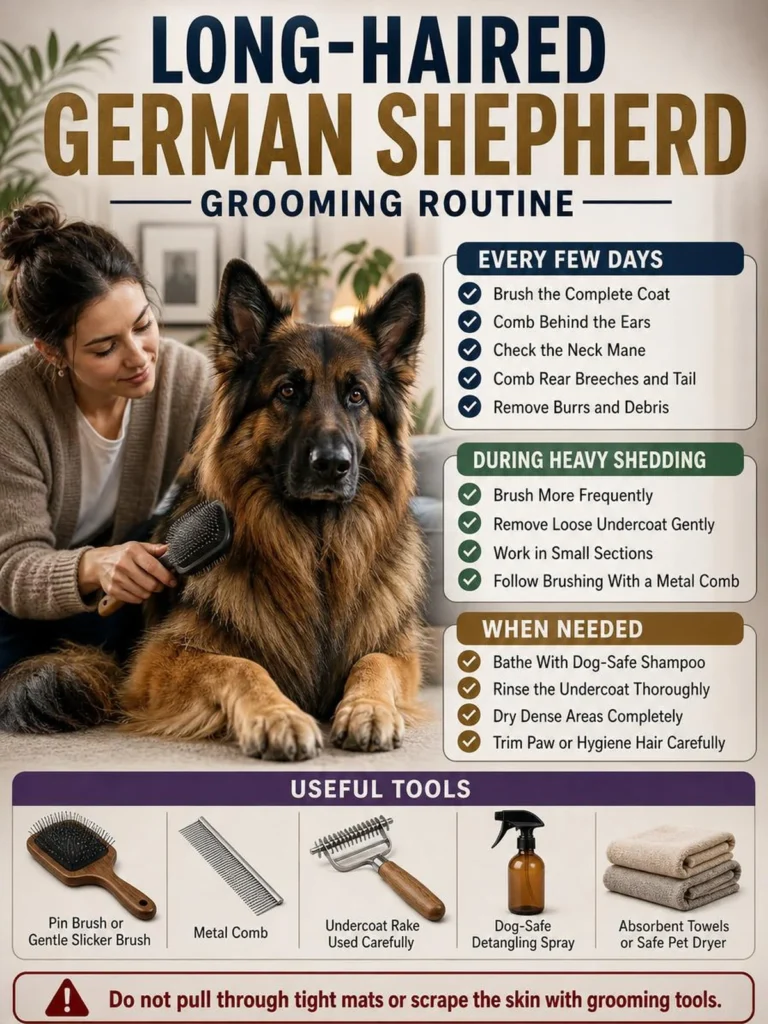
A long-haired German Shepherd usually needs more coat maintenance than a standard-coated dog because longer furnishings can tangle, hold debris, and conceal compacted undercoat.
A practical routine includes:
Brush Several Times Each Week
Brush the complete coat every few days. Increase to daily attention during heavy shedding, wet weather, outdoor adventures, or periods when feathering tangles easily.
The AKC’s German Shepherd grooming guidance recommends brushing German Shepherds every few days and increasing frequency during heavier seasonal shedding. Long stock coats generally require additional maintenance.
Work in Small Sections
Separate the coat gently and brush from the skin outward instead of passing only over the surface.
Pay close attention to:
- Behind the ears
- Neck mane
- Armpits
- Chest feathering
- Behind the front legs
- Rear-leg breeches
- Base of the tail
- Full tail feathering
- Belly and hygiene areas
Use Suitable Tools
A basic toolkit may include:
- Pin brush or gentle slicker brush
- Metal comb
- Undercoat rake used without scraping the skin
- Detangling spray formulated for dogs
- Nail clippers or grinder
- Dog-safe shampoo
- Absorbent towels or a pet dryer on a safe setting
Avoid aggressive deshedding that repeatedly cuts or damages the healthy outer coat.
Comb After Brushing
A brush can glide over the surface while a mat remains close to the skin. Run a metal comb gently through the feathering after brushing.
Do not pull hard through a tangle. Hold the hair near the skin, separate the knot gradually, and stop if the dog becomes uncomfortable.
Bathe Only When Needed
German Shepherds normally require occasional rather than constant bathing. Bathe when the dog is dirty, oily, has an odor, or needs veterinarian-directed skin care.
Rinse thoroughly because shampoo trapped under a dense coat can irritate the skin.
Dry the Undercoat Completely
Towel the coat and dry it carefully, especially around the neck, rear legs, tail, and undercoat.
Leaving dense areas damp may encourage tangling, odor, or skin irritation. Avoid excessive heat and keep the dryer moving.
For puppy handling, nail care, ear checks, bathing, and positive grooming introduction, use Furbivo’s German Shepherd puppy grooming guide.
How to Prevent Mats
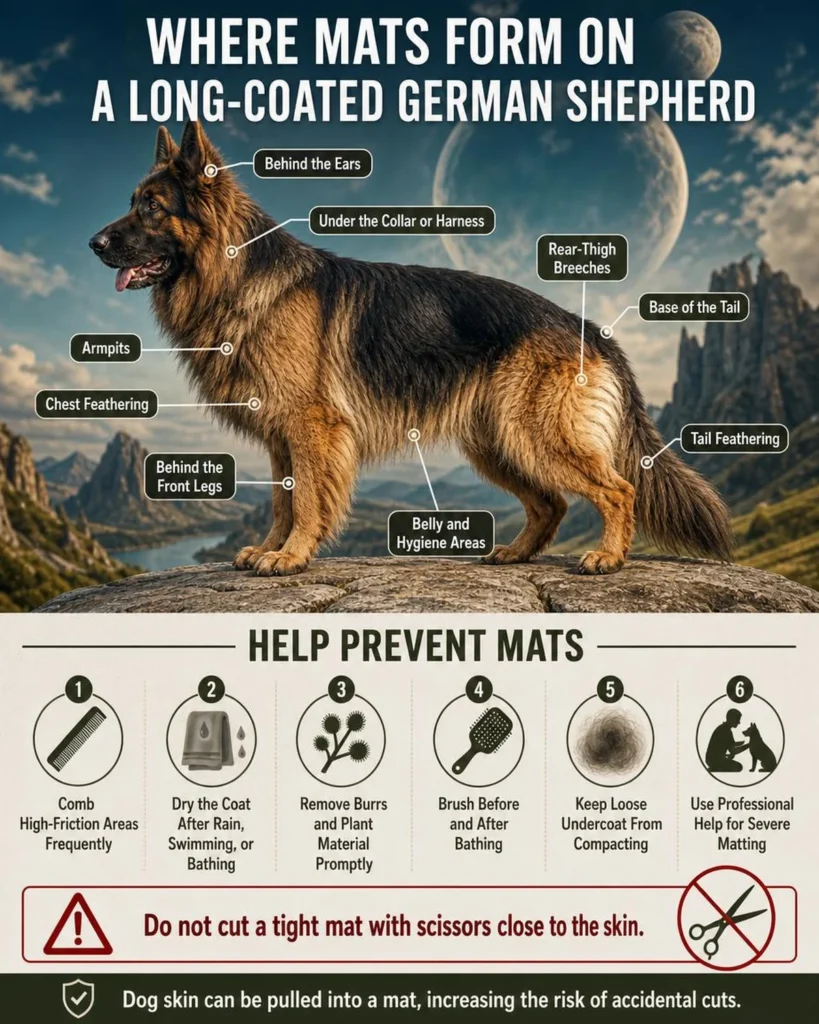
Mats form when loose hair, moisture, friction, and debris become compressed together.
Prevention is easier than removing a tight mat.
Use these habits:
- Comb behind the ears frequently.
- Dry the coat after rain, swimming, or bathing.
- Remove burrs and plant material after walks.
- Check friction areas under harnesses.
- Brush before and after bathing.
- Keep the undercoat free of compacted loose hair.
- Maintain sanitary areas carefully.
- Book professional grooming before mats become severe.
Do not cut a tight mat with scissors close to the skin. Dog skin can become pulled into the mat, making accidental cuts more likely. Severe matting should be handled by a professional groomer or veterinarian.
Should You Trim a Long-Haired German Shepherd?
Light trimming may be appropriate around:
- Paw edges
- Excess hair between the paw pads
- Hygiene areas
- A damaged or badly tangled section
- Feathering that repeatedly collects waste
The goal should be cleanliness and safety, not reshaping the entire dog.
Avoid:
- Sculpting the coat like a single-coated breed
- Cutting off the natural mane
- Shortening the complete body coat
- Removing the protective outer layer
- Trimming simply to stop shedding
A professional groomer familiar with double-coated breeds can neaten problem areas without removing the coat’s protective structure.
Should You Shave a Long-Haired German Shepherd?
A healthy long-haired German Shepherd generally should not be shaved for summer, convenience, or shedding; AKC grooming guidance for German Shepherds likewise advises against shaving or cutting the double coat as routine grooming.
Shaving can expose the skin, increase sun exposure, irritate the coat and skin, and create uneven regrowth. It also does not stop shedding because the dog may continue releasing shorter cut hairs.
Clipping may be appropriate when directed by a veterinarian or experienced groomer for:
- Surgery
- Wound care
- Severe matting
- A skin condition
- Hygiene problems
- Another specific medical need
That is different from routinely shaving the entire dog.
Read Can You Shave a German Shepherd? before using clippers on the body coat.
Keeping a Long Coat Comfortable in Hot Weather
Do not depend on shaving as a heat-management strategy.
Use:
- Fresh water
- Shade
- Air-conditioned or well-ventilated indoor rest
- Walks during cooler parts of the day
- Reduced exercise in heat and humidity
- Cool, non-slip resting surfaces
- Regular removal of loose undercoat
- Careful monitoring during outdoor activity
Stop activity and seek veterinary help for weakness, collapse, confusion, vomiting, excessive distress, or difficulty recovering from heat. The American Veterinary Medical Association’s warm-weather pet safety guidance lists heat-stress warning signs and recommends emergency veterinary care when serious signs appear.
Coat length does not make a German Shepherd safe in high temperatures. Climate, humidity, body condition, activity, health, and access to cooling all matter.
Long-Haired German Shepherd Health
Long hair is a coat trait, not a health certificate or diagnosis.
A coat-length DNA result does not replace screening for health concerns relevant to German Shepherds. The AKC’s German Shepherd breed guidance notes that responsible breeders screen breeding stock for concerns including hip and elbow dysplasia and degenerative myelopathy. Breeders should prioritize overall health, structure, temperament, and genetic diversity rather than producing puppies only for a fluffy appearance.
Ask about:
- Verified hip screening
- Verified elbow screening
- Degenerative myelopathy testing or family information
- Parent temperament
- Family longevity
- Digestive and skin history
- Other health testing recommended by the breeder’s national breed organization
Use Furbivo’s German Shepherd hip dysplasia guide and common diseases in German Shepherds guide when evaluating breeder health records.
The longer coat can make some problems harder to notice. During grooming, check for:
- Redness
- Scabs
- Lumps
- Parasites
- Moist skin
- Unusual odor
- Hair loss
- Pain
- Ear irritation
- Changes hidden beneath the undercoat
Contact a veterinarian when coat or skin changes persist or occur with itching, pain, odor, wounds, appetite changes, or reduced energy.
Is a Long-Haired German Shepherd Rare?
The long coat is less frequently seen than the standard coat because it is generally recessively inherited. However, reliable breed-wide percentages are limited.
“Rare” should not be treated as proof of:
- Superior quality
- Better temperament
- Greater purity
- Better health
- Higher working ability
- Ethical breeding
Availability also varies by region and bloodline. A breeder intentionally pairing known carriers or long-coated dogs may produce long coats regularly, while another breeding population may rarely produce them.
Does a Long Coat Cost More?
Some breeders charge more because long-coated puppies are less common or visually popular. There is no universal breed-based price difference.
Price should reflect:
- Responsible breeding
- Parent health screening
- Veterinary care
- Puppy raising and socialization
- Pedigree quality
- Contract support
- Breeder experience
- Location and demand
An extreme “rare fluffy coat” premium without verifiable health and temperament records is a warning sign.
How to Choose a Responsible Breeder
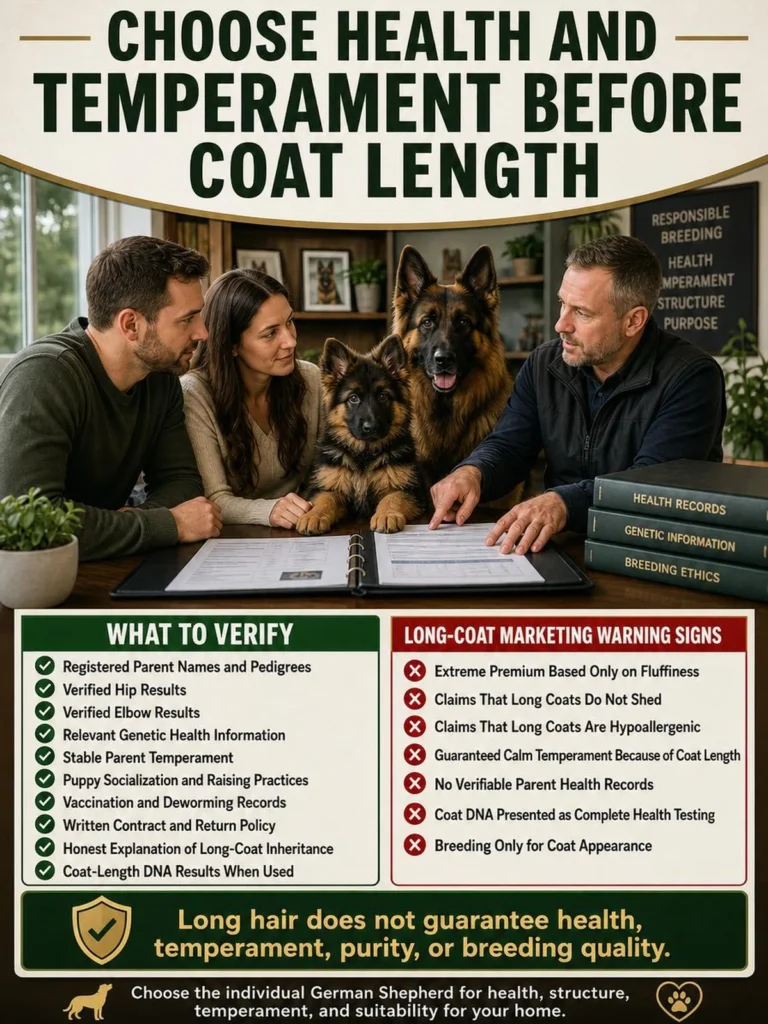
When looking for a long-haired German Shepherd, ask for:
- Registered names and pedigrees of both parents
- Verifiable hip and elbow results
- Relevant genetic health information
- Clear temperament information
- Details about working, sport, or companion suitability
- Vaccination and deworming records
- Puppy socialization information
- A written contract and return policy
- Honest explanation of coat inheritance
- Coat-length test results when used in the breeding plan
Warning signs include:
- Advertising only “rare fluffy puppies”
- No verifiable parent health testing
- Claiming long coats do not shed
- Calling the coat hypoallergenic
- Guaranteeing a calm temperament because of coat length
- Hiding information about the parents
- Presenting a color or coat DNA panel as complete health testing
- Breeding primarily for coat length without regard to structure
Use appearance as one preference, not the main measure of breeding quality.
What Most Long-Coat Guides Miss
Long Hair and Long Double Coat Are Not Always the Same
The recognized FCI variety includes an undercoat. Long hair without undercoat is treated differently under the standard.
AKC and FCI Rules Are Different
The AKC ideal is a medium double coat and excessively long hair is a fault. The FCI recognizes long double coat with undercoat as a hair variety.
Two Standard-Coated Parents Can Produce Long Coats
Short-coated dogs can carry recessive FGF5 variants and pass them to puppies.
Long Coats Still Shed
Long-haired dogs have not escaped the breed’s regular and seasonal shedding. The longer hair simply makes the shed coat more visible.
Coat Length Does Not Predict Personality
The same breed temperament and structural expectations apply apart from coat-specific wording.
More Hair Does Not Mean a Bigger Dog
The mane, breeches, and tail feathering can make the dog look larger. Actual size and body condition should be assessed beneath the coat.
Coat DNA Is Not Health Testing
An FGF5 result can explain hair length. It does not evaluate hips, elbows, temperament, digestion, working ability, or overall breeding quality.
Frequently Asked Questions
Is a long-haired German Shepherd a separate breed?
No. It is a German Shepherd Dog with an inherited long-coat trait. Under the FCI standard, long double coat with undercoat is one of the breed’s two hair varieties.
Are long-haired German Shepherds purebred?
Yes, they can be purebred. Coat length does not determine ancestry. Pedigree, registration, and verified parentage establish whether the dog comes from purebred German Shepherd parents.
Do long-haired German Shepherds shed more?
They shed regularly and seasonally like other double-coated German Shepherds. They may appear to shed more because each hair is longer and the feathering requires more maintenance.
How often should I brush a long-coated German Shepherd?
Most need brushing several times each week, with more frequent attention during seasonal shedding, wet weather, or periods when the feathering tangles. Comb behind the ears, under the legs, through the rear breeches, and along the tail.
Can two short-haired German Shepherds have a long-haired puppy?
Yes. Two standard-coated parents can both carry a recessive long-hair variant. When both pass the relevant variant to a puppy, the puppy can be long-coated.
Are long-haired German Shepherds calmer?
Coat length does not reliably predict temperament. Parent behavior, genetic selection, early development, socialization, health, and training are more useful indicators.
Are long-haired German Shepherds hypoallergenic?
No. They shed hair and skin material and are not considered hypoallergenic. Regular grooming may reduce loose hair around the home, but it does not remove allergens.
Can I shave a long-coated German Shepherd in summer?
Routine body shaving is generally not recommended. Use brushing, undercoat removal, shade, water, ventilation, and safer exercise timing instead. Clipping may be needed for specific medical or severe matting situations.
Final Thoughts
A long-haired German Shepherd is not a separate breed, a mixed dog by default, or a guaranteed calmer version of the German Shepherd.
The important distinctions are:
- The long coat is recessively inherited.
- Two standard-coated carriers can produce long-coated puppies.
- A correct long double coat includes an undercoat.
- AKC and FCI conformation rules differ.
- Long coats still shed.
- Feathering requires more mat prevention.
- Coat length does not predict temperament or health.
- A coat DNA test does not replace breed-relevant health screening.
Choose a puppy or adult dog for health, temperament, structure, and suitability for your household. Treat the long coat as an appearance and grooming consideration—not the main measure of quality.
Have questions about your dog’s health, nutrition, grooming, or daily care? Visit our Contact Us page to reach the Furbivo team. For any medical symptoms, diagnosis, or treatment advice, always consult a qualified veterinarian.