
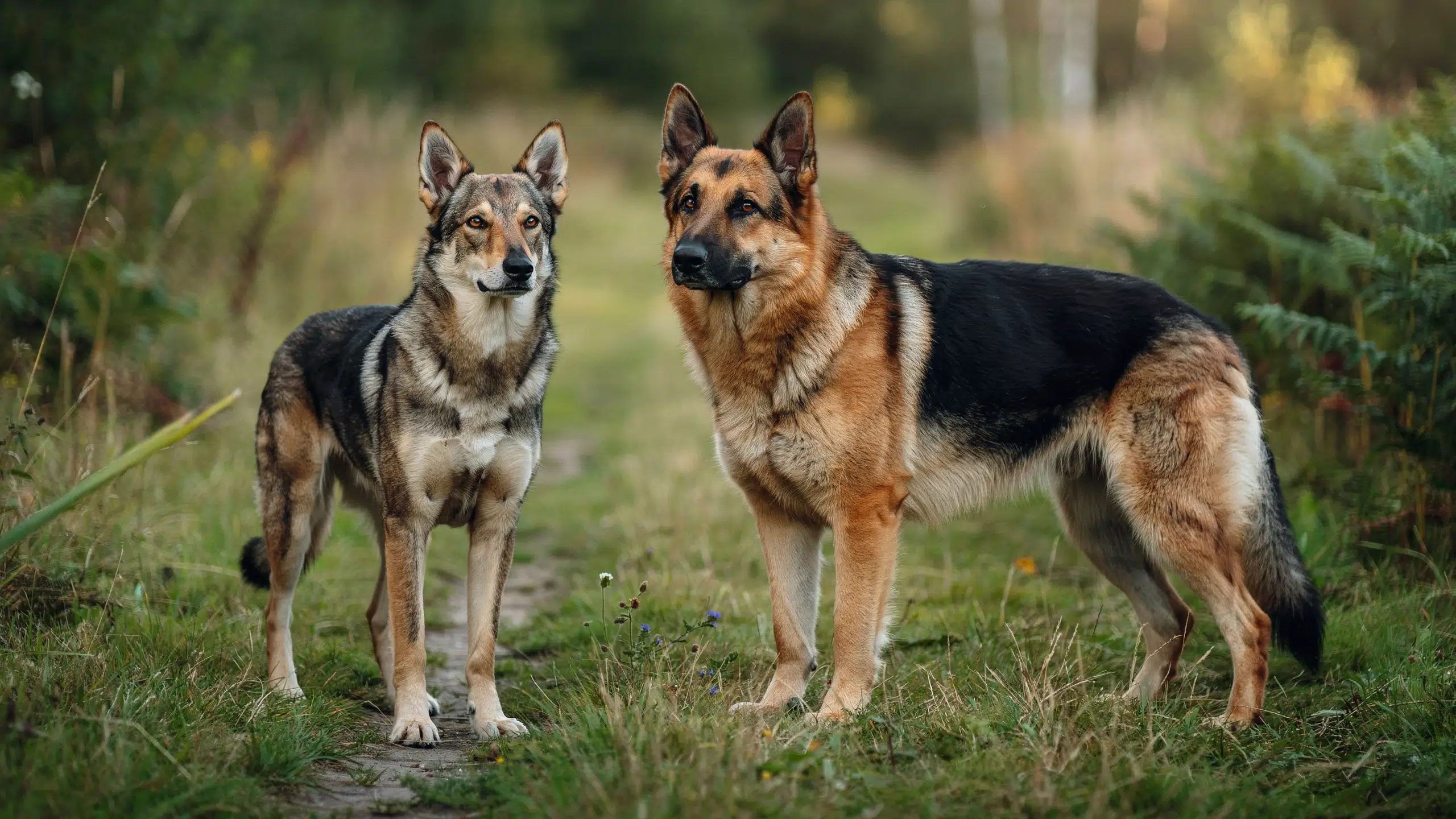
A miniature German Shepherd is not an officially recognized size variety of the German Shepherd Dog. The name is usually an informal marketing label for a smaller mixed-breed dog, an unusually small purebred German Shepherd, or—in rare cases—a dog affected by a growth disorder.
Official German Shepherd standards describe one general breed size rather than standard, miniature, and toy varieties. The FCI standard lists adult males at 60–65 centimeters and females at 55–60 centimeters, while the UKC uses 24–26 inches for males and 22–24 inches for females. Neither standard defines a miniature variety. (FCI)
That means anyone considering a mini German Shepherd should ask what the label actually represents before discussing size, temperament, health, or price.
Quick Answer: Is a Miniature German Shepherd a Real Breed?
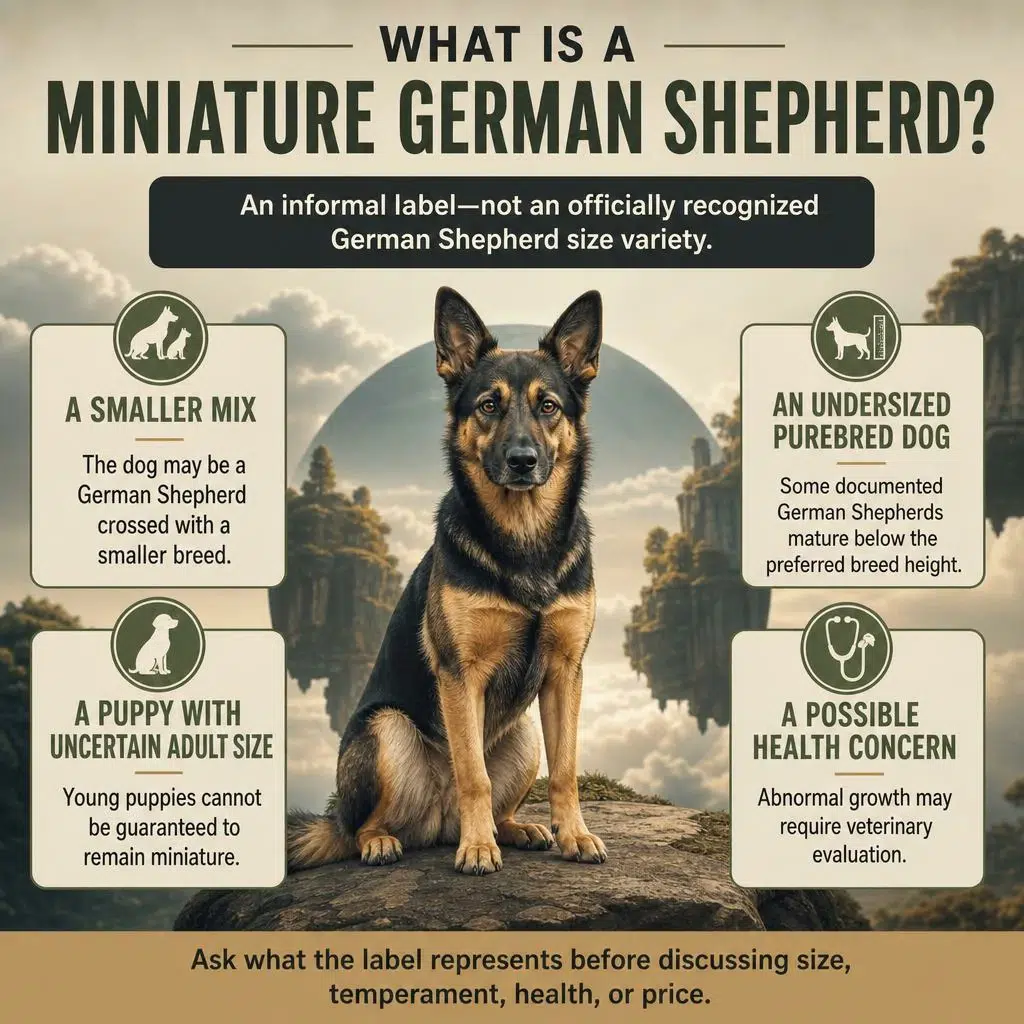
A miniature German Shepherd is not a separate recognized German Shepherd breed or official size division. The term may refer to:
- A German Shepherd crossed with a smaller dog
- A purebred German Shepherd that falls below the preferred height
- A puppy whose adult size is still uncertain
- A dog with pituitary dwarfism or another growth problem
- A small shepherd-looking mixed-breed dog
The AKC, FCI, UKC, and Royal Kennel Club standards describe the German Shepherd without creating a miniature category. The official ranges vary slightly by organization, but all describe a medium-to-large working dog rather than a toy or miniature companion breed. (FCI)
| Advertised description | What it may actually mean |
| Miniature German Shepherd | Informal label with no single official definition |
| Mini German Shepherd | Shortened version of the same informal label |
| Miniature German Shepherd mix | German Shepherd crossed with one or more smaller breeds |
| Small purebred German Shepherd | A registered dog below the preferred breed size |
| Teacup German Shepherd | Marketing phrase, not an official German Shepherd variety |
| German Shepherd dwarf | A dog that may have an inherited or acquired growth disorder |
| Small shepherd-looking dog | A mixed breed whose ancestry may or may not include German Shepherd |
What Does “Miniature German Shepherd” Actually Mean?
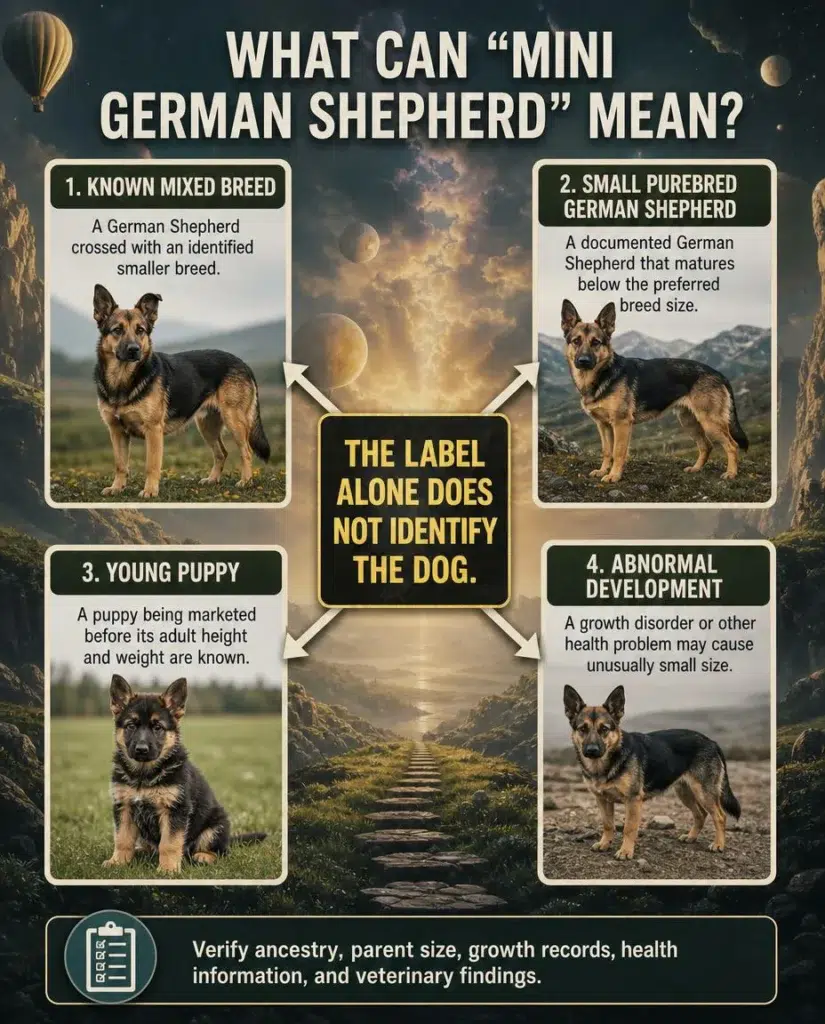
The name can describe very different dogs, so it should never be treated as a reliable breed identity.
A German Shepherd Mixed With a Smaller Breed
Many dogs advertised under this label are intended crosses between a German Shepherd and a smaller dog. Online designer-dog descriptions commonly use the term for German Shepherd mixes involving smaller herding or companion breeds. However, no one cross defines the label, and the parent breeds may differ among breeding programs. (The Spruce Pets)
Possible smaller parents may include:
- Border Collie
- Collie
- Australian Shepherd
- Miniature American Shepherd
- Poodle
- Corgi
- Shetland Sheepdog
- Other small or medium mixed-breed dogs
This list does not mean that every pairing is advisable or that every seller accurately identifies the parents.
A mixed-breed puppy can inherit any combination of:
- Adult height
- Body length
- Leg length
- Coat type
- Ear carriage
- Shedding level
- Herding behavior
- Trainability
- Vocal tendencies
- Sensitivity
- Energy
- Guarding behavior
Crossing one large and one smaller dog does not produce a perfectly scaled-down German Shepherd. Puppies within the same litter can mature at noticeably different sizes and display different physical or behavioral traits.
An Unusually Small Purebred German Shepherd
Some purebred German Shepherds mature below the preferred breed-standard height. A smaller adult may still have documented German Shepherd ancestry, but being undersized does not create a new miniature variety.
The FCI standard treats departures from the described breed characteristics as faults evaluated according to their degree and effect on health, welfare, and working ability. It does not reclassify an undersized dog as a miniature breed. (FCI)
A small purebred dog may result from normal family variation, poor early nutrition, illness, inaccurate age information, or another developmental factor. Size alone cannot identify the cause.
A Puppy Whose Adult Size Is Unknown
Young German Shepherd puppies naturally look much smaller than adults. A seller should not advertise an eight-week-old puppy as permanently miniature based only on its current weight or appearance.
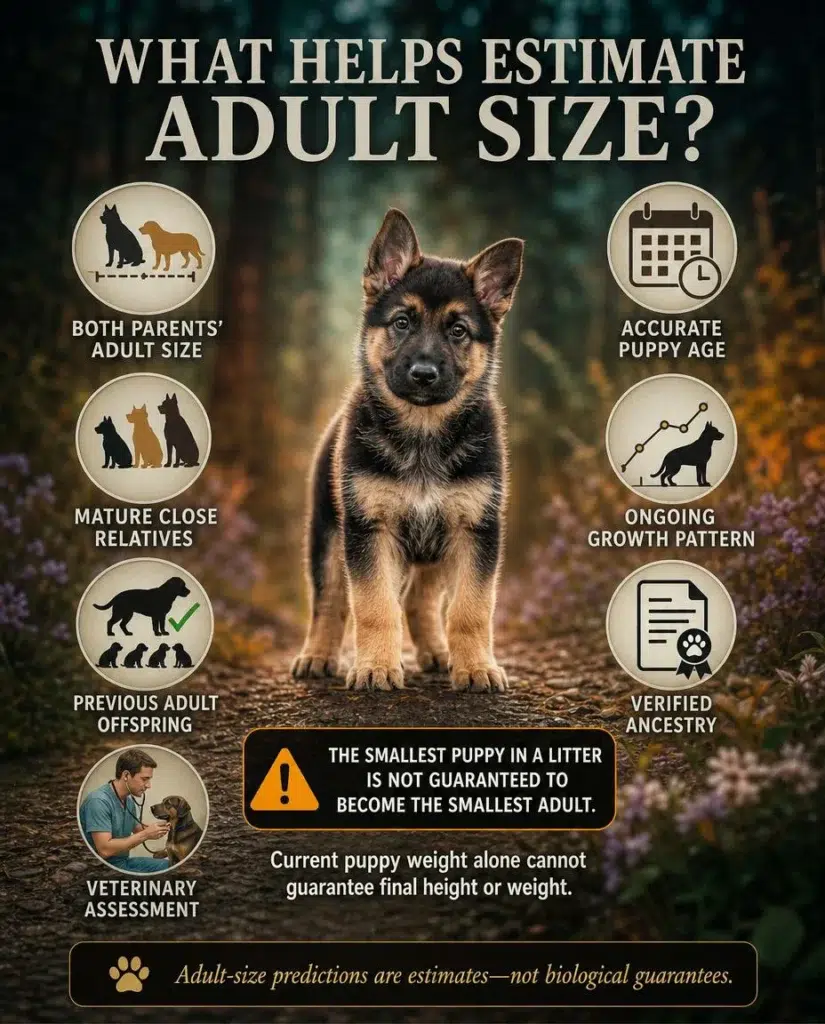
Adult size estimates are more meaningful when they include:
- Verified age
- Current growth pattern
- The sizes of both parents
- Mature sizes of close relatives
- Previous offspring from the same pairing
- Veterinary assessment
- Confirmed ancestry
Even with these records, adult size remains an estimate rather than a guarantee.
A Dog With a Growth Disorder
A German Shepherd that remains unusually small may have pituitary dwarfism or another medical condition. Pituitary dwarfism is an inherited disorder associated with abnormal pituitary development and combined hormone deficiencies; German Shepherd Dogs are the breed most frequently affected. (MSD Veterinary Manual)
A medical disorder must never be marketed as a desirable miniature trait.
How Big Does a Miniature German Shepherd Get?
There is no authoritative height or weight range for a miniature German Shepherd because it is not one standardized breed.
Some commercial articles provide ranges, but those numbers describe particular mixes or informal groups rather than an official standard. A dog’s mature size depends on its real parentage, sex, inherited build, nutrition, health, and growth history.
For comparison, official German Shepherd standards describe:
| Organization | Adult male height | Adult female height |
| FCI | 60–65 cm | 55–60 cm |
| UKC | 24–26 in | 22–24 in |
| Royal Kennel Club | Ideal 63 cm | Ideal 58 cm |
The official standards do not include a miniature division beneath these measurements. (FCI)
When evaluating a puppy, avoid promises such as:
- Guaranteed under 30 pounds
- Guaranteed apartment size
- Permanent puppy size
- Full German Shepherd personality in a toy body
- Exact adult height guaranteed
- Miniature because it is the smallest littermate
- Teacup bloodline
A responsible breeder should explain how the estimate was made and what uncertainty remains.
Miniature German Shepherd vs. Standard German Shepherd
| Feature | Miniature label | Standard German Shepherd |
| Recognition | No single official breed or size standard | Recognized German Shepherd Dog |
| Parentage | May be mixed, purebred but undersized, or uncertain | Documented German Shepherd ancestry |
| Adult size | Highly variable | Defined preferred breed ranges |
| Appearance | May or may not closely resemble a German Shepherd | Evaluated against an established breed standard |
| Temperament | Depends heavily on both parents and upbringing | Breed tendencies still vary by line and individual |
| Coat | May be double, single, curly, wavy, short, or long | Medium or long double coat under major standards |
| Shedding | Unpredictable in mixes | Regular shedding with heavier seasonal coat loss |
| Health screening | Must reflect every breed in the ancestry | German Shepherd breed screening priorities apply |
| Registration | Depends on ancestry and registry rules | Eligible when documented requirements are met |
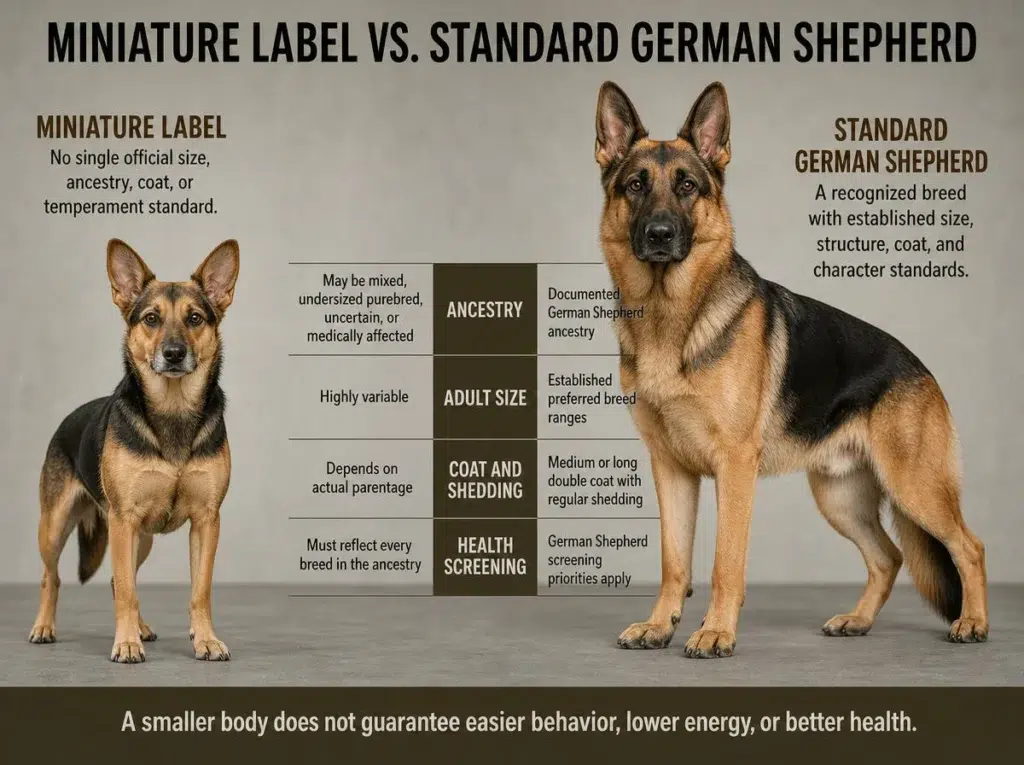
A smaller body does not necessarily mean lower energy, easier behavior, reduced shedding, or fewer health concerns.
Is a Mini German Shepherd Purebred?
A mini German Shepherd may be purebred, mixed breed, or of uncertain ancestry. The name alone provides no answer.
A dog may be purebred German Shepherd only when its ancestry is supported by credible records. Useful evidence includes:
- Registered names of both parents
- Registration numbers
- A traceable pedigree
- Litter records
- Parentage verification when needed
- Permanent identification such as a microchip
- Records that match the actual puppy
A DNA breed-composition test may offer supporting information for a mixed-breed dog, but it should not replace reliable pedigree and parentage records when a seller claims registered purebred ancestry.
If one parent belongs to another breed, the puppy is a mixed-breed dog even when it resembles a German Shepherd closely.
Common Miniature German Shepherd Mixes
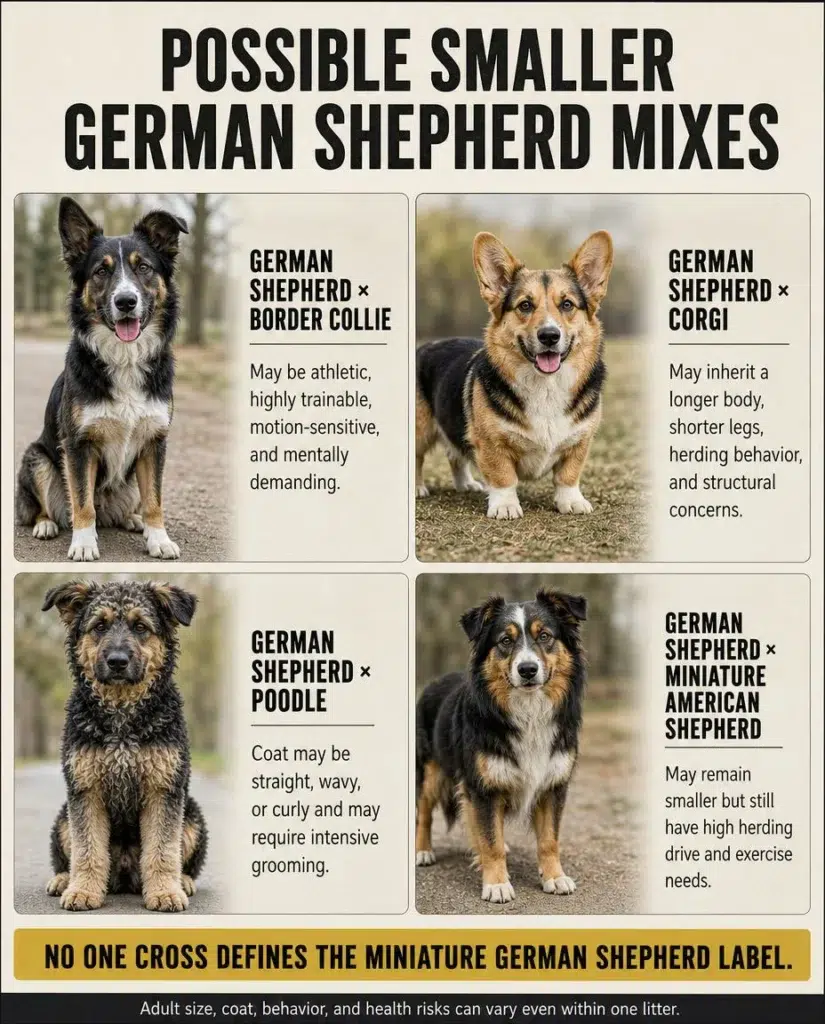
No specific cross owns the name. Two sellers may advertise dogs under the same label while producing completely different mixes.
German Shepherd and Border Collie Mix
This combination may produce an athletic, highly trainable herding dog. It may also inherit intense motion sensitivity, chasing behavior, high mental-stimulation needs, or difficulty settling without structured training.
German Shepherd and Collie Mix
The result may have a longer coat, a narrower head, more vocal behavior, or greater sensitivity. Adult size can still be substantial because many Collies are not small dogs.
German Shepherd and Poodle Mix
This pairing may produce straight, wavy, or curly coats. It does not guarantee a non-shedding or allergy-safe dog. Coat maintenance may become more demanding when dense undercoat and curl-related tangling occur together.
German Shepherd and Corgi Mix
A puppy may inherit a longer body or shorter legs, but those traits do not create a perfectly proportioned small German Shepherd. Structure, spinal load, joint health, herding behavior, and exercise needs require careful consideration.
German Shepherd and Miniature American Shepherd Mix
This mix may remain smaller than a standard German Shepherd, but both parent breeds are active herding dogs. Small size should not be confused with low exercise or training needs.
The exact parents should always be named. “Miniature shepherd mix” is not enough information for predicting care requirements.
Appearance and Coat
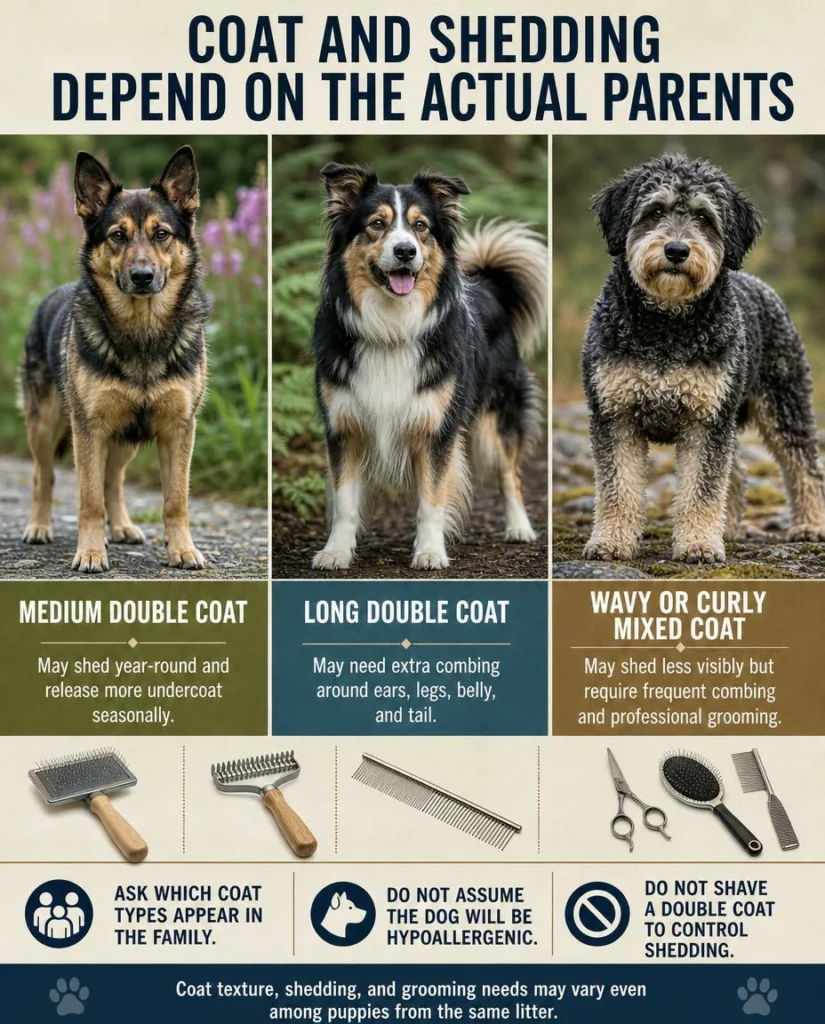
A miniature German Shepherd may resemble a compact German Shepherd, but appearance can vary widely.
Possible traits include:
- Upright or partly folded ears
- Black-and-tan, sable, black, red, merle, or mixed coloring
- Medium, long, curly, or wavy hair
- A single or double coat
- Long or short legs
- A narrow or broad head
- A long or compact body
- A bushy or lightly feathered tail
Some puppies look strongly German Shepherd-like during early development and become visibly more similar to the smaller parent as they mature.
Do Miniature German Shepherds Shed?
Shedding depends on the inherited coat.
A dog with a German Shepherd-type double coat may shed throughout the year and release much more undercoat seasonally. A mixed dog with a curly coat may release less loose hair into the home but require professional trimming and frequent combing to prevent mats.
No cross should be advertised as reliably hypoallergenic unless the seller explains the uncertainty. Even low-shedding dogs produce saliva, skin particles, and other potential allergens.
For German Shepherd double-coat guidance, read:
- How Much Does a German Shepherd Shed?
- Can You Shave a German Shepherd?
- German Shepherd Puppy Grooming Guide
Temperament and Behavior
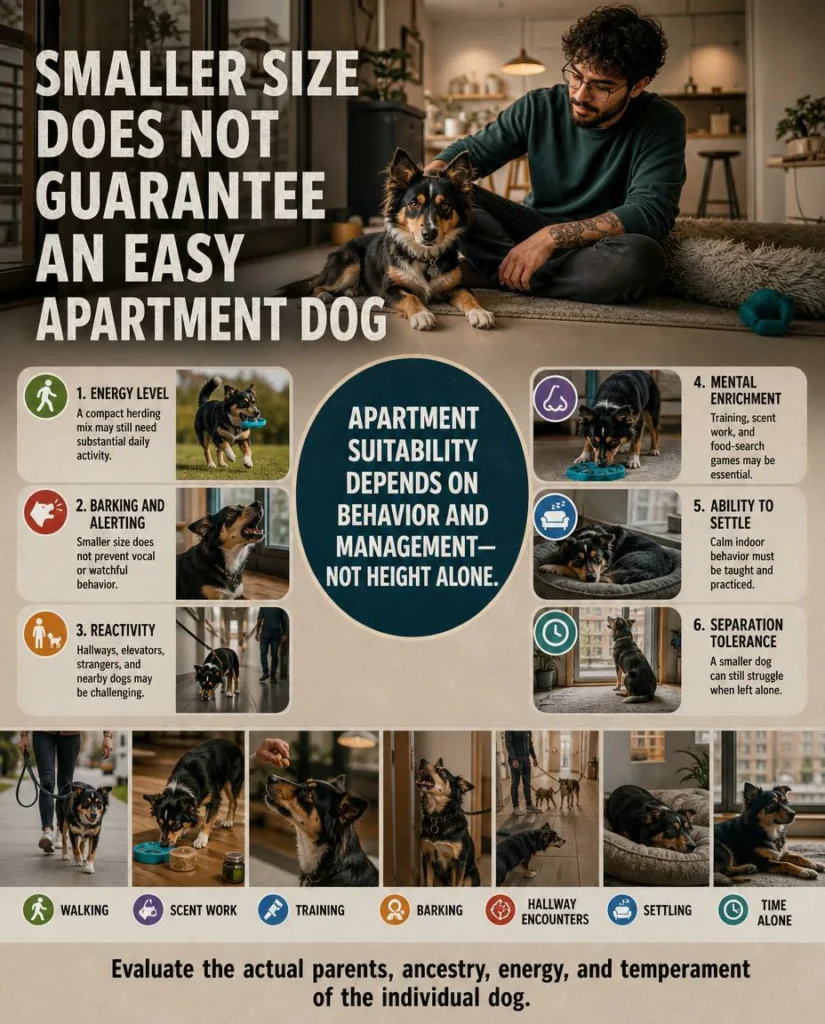
There is no single miniature German Shepherd temperament because there is no standardized breed behind the label.
A dog’s behavior may reflect:
- German Shepherd ancestry
- The smaller parent breed
- Wider family temperament
- Early puppy development
- Socialization
- Training
- Exercise
- Health and pain
- Home environment
- Previous experiences
A smaller German Shepherd mix may still be:
- Highly active
- Alert and vocal
- Reserved with strangers
- Sensitive to movement
- Prone to herding children or pets
- Protective of the home
- Strongly attached to one handler
- Easily bored
- Fast to learn both wanted and unwanted behavior
Do not assume a small dog is automatically easier for a first-time owner.
Training should focus on teaching desired behavior with rewards, structure, environmental management, and clear routines. AVSAB reports better welfare and training outcomes with reward-based approaches than with aversive methods involving fear, intimidation, or pain.
Furbivo’s German Shepherd Temperament Guide explains confidence, reserve, reactivity, fear, and aggression in more detail.
Exercise and Apartment Living
A smaller body does not guarantee a low-energy dog.
German Shepherds are athletic working dogs, and many breeds used to create smaller shepherd mixes are also active herding dogs. A compact dog may still need substantial daily physical activity, scent work, training, food-search games, exploration, and opportunities to settle calmly. (PetMD)
Apartment suitability depends on more than height or weight. Important factors include:
- Barking and alert behavior
- Ability to settle indoors
- Exercise access
- Noise sensitivity
- Reactivity in hallways or elevators
- Comfort around strangers and dogs
- Owner schedule
- Training consistency
- Separation tolerance
A quiet, trained medium-size dog may be easier in an apartment than a smaller, highly vocal, reactive dog.
Miniature German Shepherd Health Problems
Health risks depend on what the dog actually is.
A mixed dog may inherit conditions associated with either parent breed. Being a cross does not automatically make a puppy healthier, and selecting only for a smaller body can introduce problems when breeders ignore structure, temperament, or inherited disease.
German Shepherd Health Screening
For German Shepherd breeding dogs, the national breed-club recommendations compiled by the AKC include:
- Hip evaluation
- Elbow evaluation
- Temperament testing (American Kennel Club)
OFA explains that health screening can reduce inherited-disease risk but does not guarantee that an individual dog will remain free of disease. (OFA)
For a mixed litter, the smaller parent should also complete the health tests recommended for its own breed. Screening only the German Shepherd parent is incomplete.
Pituitary Dwarfism
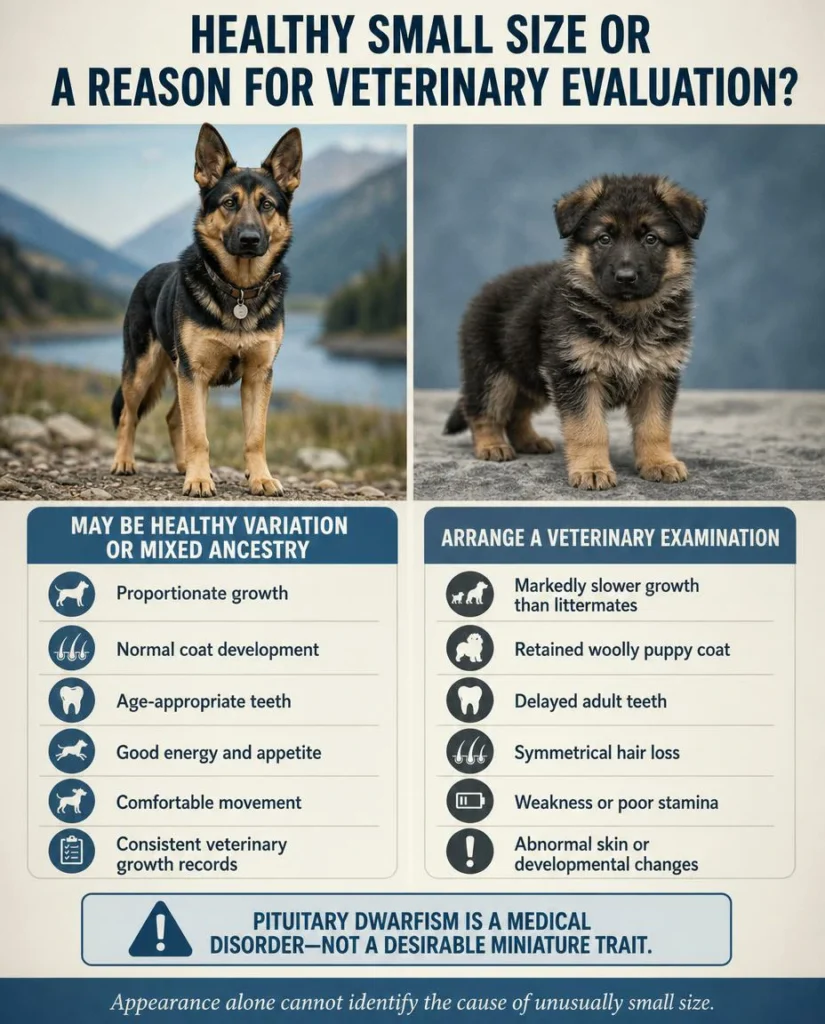
Pituitary dwarfism is not simply “being the runt.”
Affected puppies may appear similar to their littermates during the first two months. Later signs can include:
- Slower growth than littermates
- Retention of the soft puppy coat
- Failure to develop normal guard hairs
- A foxlike or coyote-like appearance
- Gradual symmetrical hair loss
- Delayed or absent adult teeth
- Abnormal reproductive development
- Other endocrine complications
The condition requires veterinary diagnosis, which may involve growth comparison, hormone testing, imaging, skin evaluation, and genetic testing. (MSD Veterinary Manual)
Contact a veterinarian promptly when a puppy stops keeping pace with littermates or shows abnormal coat, tooth, skin, or developmental changes. Do not purchase or breed a dog because dwarfism makes it look permanently puppy-like.
Warning Signs That Size May Be a Health Concern
Arrange a veterinary examination when a young dog has:
- Markedly delayed growth
- Loss of appetite
- Persistent digestive problems
- Weakness or poor stamina
- Delayed teeth
- Unusual symmetrical hair loss
- A woolly puppy coat that does not change
- Skin darkening or scaling
- Limb deformity
- Pain or abnormal movement
- A sudden slowing of growth
- A size dramatically different from littermates
These signs have many possible causes, so appearance alone cannot diagnose dwarfism.
How to Evaluate a Miniature German Shepherd Breeder
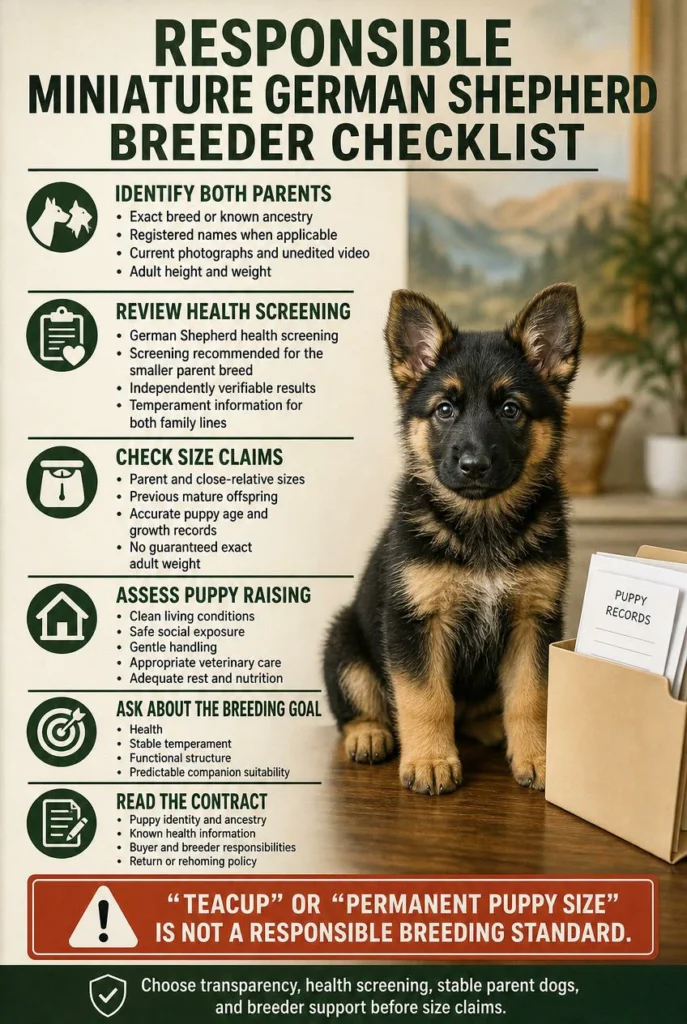
Because the label lacks one standard definition, buyers need more documentation—not less.
1. Ask for the Exact Parent Breeds
The breeder should identify both parents clearly.
Avoid answers such as:
- Miniature bloodline
- Special small shepherd
- Secret European mini line
- Teacup German Shepherd genetics
- Tiny shepherd type
- Mostly purebred
- The smaller breed does not matter
The other parent affects adult size, coat, temperament, exercise needs, and health risks.
2. Meet or Verify Both Parents
Request:
- Registered names when applicable
- Clear current photographs
- Unedited videos
- Adult height and weight
- Veterinary and identification records
- Temperament information
- Pedigree documents for any claimed purebred parent
The father may not live with the breeder, but the breeder should still provide credible information.
3. Review Health Screening for Both Sides
Ask which screenings are recommended for each parent breed and request independently verifiable results.
A generic DNA panel is not a replacement for:
- Hip radiographs
- Elbow evaluation
- Eye examinations when recommended
- Cardiac screening when recommended
- Patella evaluation when recommended
- Temperament assessment
- Other breed-specific tests
4. Ask How Adult Size Is Estimated
A reasonable estimate should use:
- Parent sizes
- Sizes of close relatives
- Previous mature offspring
- The puppy’s growth pattern
- Accurate age
- Veterinary assessment
“No dog from this litter will exceed 25 pounds” is not credible unless the breeding history supports that claim—and even then, biology does not provide perfect guarantees.
5. Examine the Breeding Goal
A responsible answer should cover:
- Health
- Stable temperament
- Functional structure
- Predictable companion suitability
- Sound movement
- Puppy raising
- Long-term breeder support
“Making German Shepherds fit in handbags” is not a responsible breeding objective.
6. Review the Contract
The contract should identify:
- The puppy
- Both parents
- Known breed ancestry
- Registration status
- Health records
- Buyer responsibilities
- Breeder responsibilities
- Return or rehoming arrangements
- What happens if the puppy develops a serious congenital problem
7. Consider Rescue and Adult Dogs
An adult rescue dog provides more certainty about final size, coat, and basic temperament than a young mixed-breed puppy.
A foster-based rescue may also provide useful information about:
- House behavior
- Barking
- Other pets
- Children
- Exercise needs
- Separation behavior
- Grooming
- Training level
Miniature German Shepherd Price
There is no reliable universal price because the name does not describe one standardized breed.
Cost can vary according to:
- Parent breeds
- Region
- Breeder reputation
- Health testing
- Puppy raising
- Training
- Age
- Demand
- Registration status
- Transport
- Marketing claims
A high price does not prove predictable adult size or responsible breeding.
Treat these phrases cautiously:
- Rare miniature bloodline
- Exclusive mini German Shepherd
- Teacup German Shepherd
- Permanent puppy size
- Apartment German Shepherd
- Hypoallergenic mini shepherd
- Guaranteed exact adult weight
- No health problems because it is mixed
Pay for documented health practices, responsible puppy raising, transparency, and support—not a vague label.
Common Myths
Myth 1: The Miniature German Shepherd Is an Official Breed
False. Major German Shepherd standards do not define a miniature size variety. (FCI)
Myth 2: Every Mini German Shepherd Is the Same Mix
False. The smaller parent may differ, and some dogs may be undersized purebreds or have uncertain ancestry.
Myth 3: Smaller Dogs Need Very Little Exercise
False. German Shepherds and many smaller herding breeds are energetic and mentally active. Body size does not reliably predict how easy the dog will be to exercise or train.
Myth 4: Mixed Breeding Guarantees Better Health
False. A mixed dog can inherit health risks from either parent, particularly when breeding dogs are not properly screened.
Myth 5: A Permanently Puppy-Like Coat Is Desirable
Not necessarily. Failure to replace the puppy coat can be one sign of pituitary dwarfism and deserves veterinary evaluation. (MSD Veterinary Manual)
Myth 6: The Smallest Puppy Will Stay Miniature
Not reliably. Litter position at one age does not provide a guaranteed adult measurement.
Myth 7: A Miniature Dog Is Automatically Better for an Apartment
False. Barking, reactivity, activity level, ability to settle, and training matter at least as much as physical size.
Myth 8: A Mini German Shepherd Will Have a German Shepherd Personality
Not predictably. A mixed puppy may inherit behavioral traits from either parent and from the wider family.
What Most Articles Miss
The biggest mistake is treating “miniature” as a breed description when it is actually a question that still needs answering.
Before discussing temperament, lifespan, grooming, or price, ask:
What exactly is this dog?
The answer may be:
- A known German Shepherd cross
- An unknown mixed breed
- A registered but undersized German Shepherd
- A young puppy with uncertain adult size
- A dog with abnormal development
Those possibilities require different care and buyer decisions.
The second missed issue is structural proportionality. A smaller dog is not automatically a healthier scaled-down version of a large dog. Shorter legs, a longer spine, altered joint angles, or mismatched body proportions may affect movement and physical comfort.
The third missed issue is temperament predictability. If breeders do not identify the smaller parent or evaluate both family lines, they cannot responsibly promise a loyal, calm, protective, low-energy German Shepherd in a smaller package.
Use this decision order:
- Identify both parents.
- Confirm whether the dog is purebred or mixed.
- Review adult sizes in the family.
- Verify health screening for both parent breeds.
- Assess parent temperament.
- Examine the puppy’s growth and veterinary records.
- Review how the litter was raised.
- Read the contract.
- Decide whether the likely adult dog fits your lifestyle.
- Ignore the miniature label until the evidence is clear.
Frequently Asked Questions
Is a miniature German Shepherd a real breed?
No. A miniature German Shepherd is not an official German Shepherd breed or size variety. The term generally describes a mix, an unusually small purebred dog, or another small shepherd-looking dog.
What breeds make a mini German Shepherd?
There is no one required combination. A mini German Shepherd may involve a smaller herding or companion breed, but the breeder should identify the exact parents rather than relying on a generic label.
How big will a miniature German Shepherd get?
There is no standard adult range. Final size depends on the actual parents, wider family, sex, health, nutrition, and individual growth.
Can a miniature German Shepherd be purebred?
A small dog can have documented purebred German Shepherd ancestry, but that does not make “miniature” an official variety. Verified pedigree and parent records are required to support a purebred claim.
Is a miniature German Shepherd suitable for an apartment?
Possibly, but size alone is not enough. Exercise needs, barking, reactivity, training, separation tolerance, and the ability to settle indoors are more important.
Do miniature German Shepherds shed?
Many do. Shedding depends on the inherited coat. A German Shepherd-type double coat can shed heavily, while other coat combinations may require frequent professional grooming.
Is pituitary dwarfism the same as a miniature German Shepherd?
No. Pituitary dwarfism is an inherited medical disorder involving abnormal growth and hormone deficiencies. It is not a desirable miniature breed trait. (MSD Veterinary Manual)
How can I find a responsible miniature German Shepherd breeder?
Ask for the exact parent breeds, parent identities, adult sizes, health screening for both sides, temperament information, puppy-development records, and a clear return contract. Avoid anyone selling only the idea of permanent small size.
Final Thoughts
A miniature German Shepherd is an informal label, not a recognized small version of the German Shepherd Dog. The dog may be a cross with a smaller breed, an undersized purebred German Shepherd, a puppy whose adult size is uncertain, or a dog with a medical growth problem.
The phrase mini German Shepherd tells you almost nothing by itself. Ask for the actual ancestry, parent sizes, health screening, temperament history, veterinary records, and breeding goal.
A smaller body does not guarantee easier behavior, low exercise needs, reduced shedding, better health, or apartment suitability. Choose the documented dog behind the marketing term.
Have questions about your dog’s health, nutrition, grooming, or daily care? Visit our Contact Us page to reach the Furbivo team. For any medical symptoms, diagnosis, or treatment advice, always consult a qualified veterinarian.
