
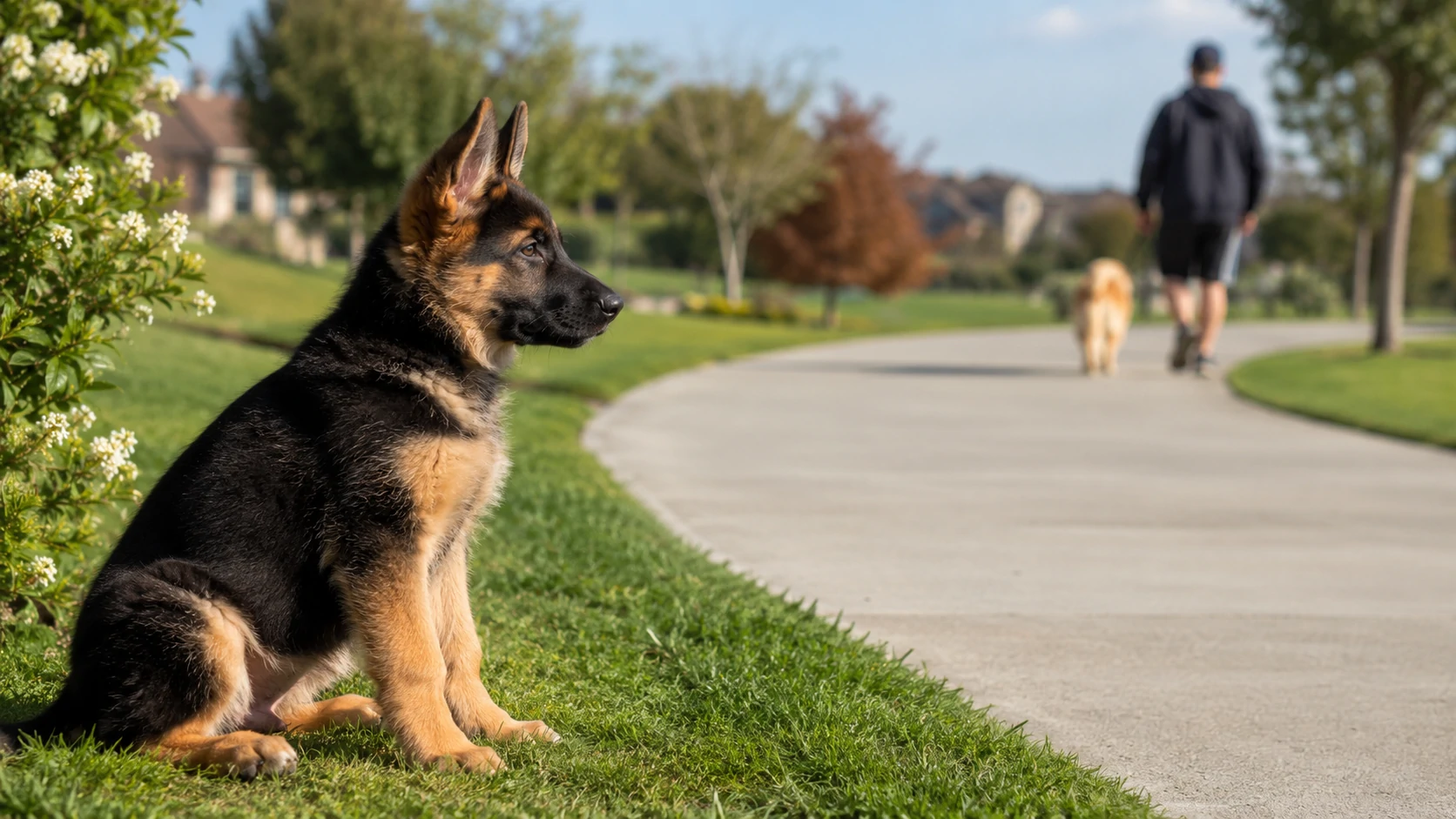
A German Shepherd puppy socialization guide should do more than tell you to “expose your puppy to everything.” That advice sounds simple, but it can backfire when a puppy feels rushed, trapped, or overwhelmed.
German Shepherd puppies are smart, alert, and quick to notice change. They may watch the delivery driver, a child on a scooter, a barking dog across the street, the vacuum cleaner, or a visitor walking through the front door. That awareness can become a strength when you guide it well. Without calm early practice, it can turn into fear, barking, pulling, hiding, or overprotective behavior later.
The goal is not to make your puppy greet every person or play with every dog. The goal is calm confidence. Your puppy should learn that everyday life is normal, people can pass by, dogs can exist at a distance, paws can be handled, and you are still a safe person to check in with.
As a pet parent, it is normal to feel pressure in the first few weeks. You want to do enough, but you do not want to make a mistake. Use this German Shepherd puppy socialization guide as a calm roadmap, not a pressure-filled checklist. This German Shepherd puppy socialization guide is designed for safe, realistic progress.
German Shepherd Puppy Socialization Guide: What Socialization Really Means
Socialization means helping your puppy feel safe around normal life. It includes people, places, sounds, surfaces, objects, car rides, grooming tools, veterinary handling, and carefully chosen dog interactions.
It does not mean forcing your puppy into situations they are not ready for.
A well-socialized German Shepherd puppy does not need to love every stranger. They do not need to run into every dog park. They do not need to be passed around at a party. Calm neutrality is often the better goal.
A good socialization session teaches your puppy:
- New things are usually safe.
- I can look without reacting.
- I can move away when I feel unsure.
- My owner will not force me.
- Calm behavior gets rewarded.
- I can recover after something surprises me.
The American Veterinary Medical Association describes socialization as preparing dogs to feel comfortable with animals, people, places, and activities. The American Veterinary Society of Animal Behavior also supports early, safe socialization before puppies are fully vaccinated when risk is managed properly.
That matters for German Shepherds because a nervous 15-pound puppy may bark and hide, but a nervous 75-pound adult can scare people or become hard to control. Early trust-building makes daily life easier for both of you.
Why German Shepherd Puppies Need Careful Early Socialization
German Shepherds were developed as herding and working dogs. Many are loyal, observant, athletic, and responsive to training. Those traits are valuable, but they also mean your puppy may notice things other puppies ignore.
A new hat, noisy trash truck, fast bicycle, barking dog, or child running across the yard can all feel important to a German Shepherd puppy.
A careful German Shepherd puppy socialization guide should respect both sides of the breed: intelligence and sensitivity.
Here is a real-world example. A confident puppy sees a person carrying an umbrella, pauses, takes a treat, and looks back at you. A worried puppy sees the same person, freezes, barks, backs away, and refuses food. The object is the same. The emotional response is different.
Your job is not to make the puppy “deal with it.” Your job is to make the situation easier, create distance, reward calm behavior, and try again later.
Socialization also supports training. A puppy who feels safe can learn name response, loose-leash walking, settle training, and polite greetings. A puppy who is scared may not be able to listen, even if they know the cue at home.
For a full training foundation, pair this article with Furbivo’s German Shepherd training basics.
When Should You Start Socializing a German Shepherd Puppy?
Start the day your puppy comes home.
Many German Shepherd puppies join their new families around 8 weeks old. The first few months are especially important for positive exposure, and many puppy training resources highlight the 8–16 week period as a key learning stage.
Starting early does not mean ignoring health risks. Your puppy’s vaccine schedule still matters. Disease risk changes by location, so ask your veterinarian which public places are safe in your area.
Before your vet clears higher-risk outings, avoid:
- Dog parks
- Pet store floors
- Public dog bowls
- Unknown dogs
- Busy dog-walking areas
- Puppy meetups with no vaccine rules
Safer early choices include:
- Carrying your puppy in public
- Letting your puppy watch activity from the car
- Inviting calm visitors to your home
- Practicing sounds and handling indoors
- Visiting a clean home with a healthy vaccinated dog
- Sitting on a clean blanket in a low-traffic area
- Joining a well-run puppy class that checks vaccine records
Socialize early, but manage risk wisely.
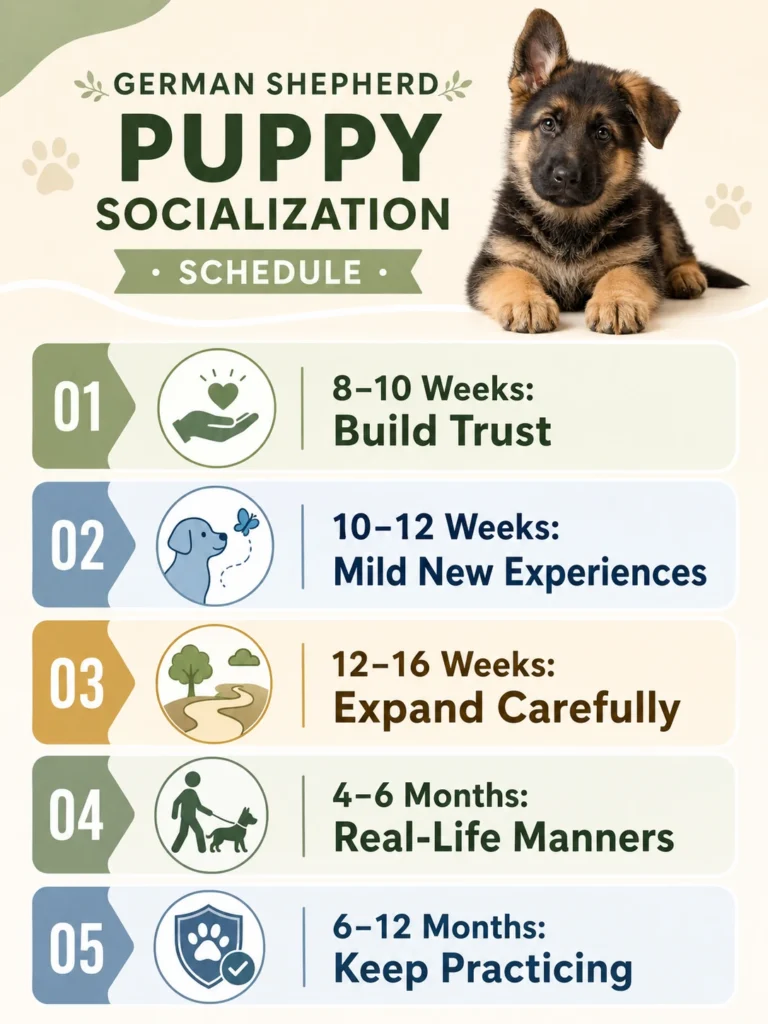
German Shepherd Puppy Socialization Schedule by Age
Use this schedule as a starting point. Your puppy’s confidence, health, sleep, vaccine progress, and personality should guide the pace.
| Puppy Age | Main Goal | Good Practice Ideas | Watch Out For |
| 8–10 weeks | Build trust at home | Gentle handling, crate time, household sounds, soft brushing, visitors, safe floor surfaces | Crowds, unknown dogs, long outings |
| 10–12 weeks | Add mild new experiences | Short car rides, porch watching, safe guests, grooming tools, vet-approved puppy class | Forced petting, rough play, loud events |
| 12–16 weeks | Expand carefully | Quiet outdoor viewing, calm vaccinated dogs, low-stress walks where safe, more surfaces | Dog parks, leash greetings, scary crowds |
| 4–6 months | Practice manners in real life | Loose-leash walking, settle training, calm greetings, vet-style handling | Letting barking or pulling become routine |
| 6–12 months | Keep confidence steady | Controlled outings, training around distractions, polite dog exposure | Assuming socialization is finished |
German Shepherd puppies are large-breed puppies, so socialization should not turn into long walks, hard fetch, repeated jumping, or forced stair workouts. Use sniffing, short training games, gentle play, and calm observation instead.
If you use food rewards, choose small treats that fit your puppy’s diet. For nutrition basics, see Furbivo’s guide on what German Shepherds should eat and the German Shepherd dog food page.
Safe Socialization Before Vaccines Are Complete
This is where many new owners get stuck. They hear that early socialization is important, but they also hear that puppies should not go everywhere before their vaccine series is complete.
Both concerns are valid.
The safest answer is not isolation. It is controlled exposure.
The AVSAB puppy socialization statement says puppies can often begin puppy classes as early as 7–8 weeks when they have had at least one vaccine set at least seven days before class, have had a first deworming, and stay current on vaccines during class. Your own vet should still guide the final decision.
A balanced German Shepherd puppy socialization guide uses low-risk setups first:
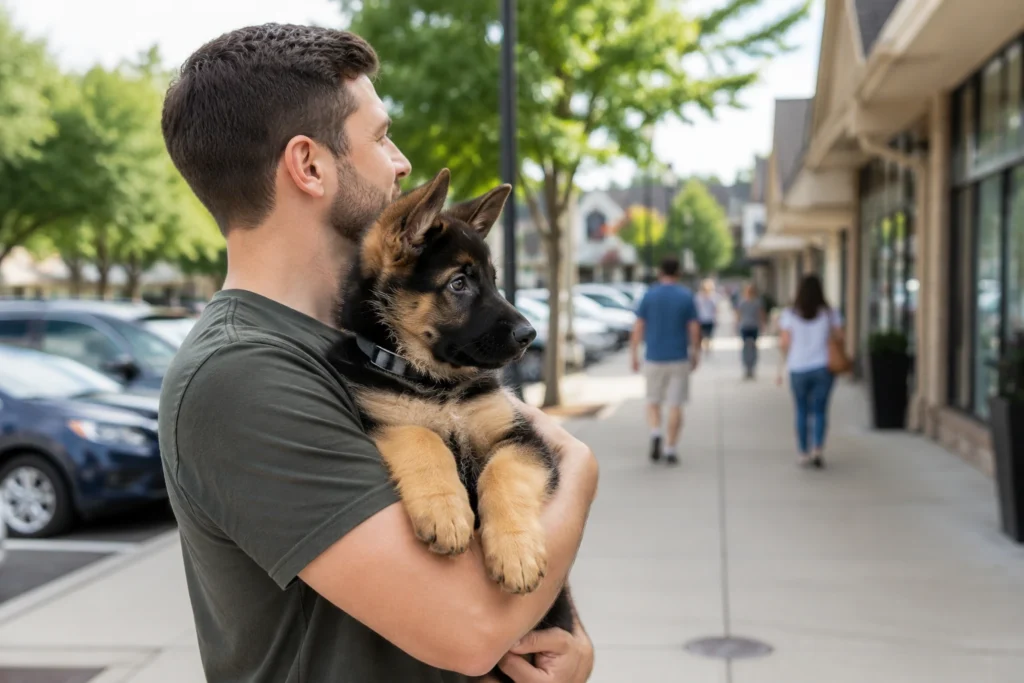
- Carry your puppy through a quiet outdoor shopping area.
- Park near activity and let your puppy watch from the car.
- Invite one calm friend over instead of hosting a crowd.
- Play traffic sounds at low volume during meals.
- Let your puppy explore cardboard, towels, rubber mats, and tile at home.
- Visit a trusted friend with a calm vaccinated adult dog.
- Practice gentle paw, ear, mouth, collar, and harness handling indoors.
Avoid high-risk setups like dog parks, pet store floors, shared water bowls, unknown dogs, and classes that do not check vaccines or clean properly.
A Simple Daily Routine for Busy Owners
You do not need a complicated plan. One or two easy exposures per day can work better than one stressful weekend outing.
| Time | Socialization Moment | Example |
| Morning | Sound exposure | Breakfast near the dishwasher running quietly |
| Midday | Handling practice | Touch one paw, reward, release |
| Afternoon | Surface practice | Walk across a towel or rubber mat |
| Evening | Outdoor observation | Sit in the driveway and watch people from a distance |
| Night | Calm recovery | Chew, crate rest, or quiet pen time |
Puppies need a lot of sleep. If your German Shepherd puppy becomes wild, bitey, jumpy, or unable to settle, they may be tired rather than “bad.” Rest is part of good behavior.
Puppy Socialization Checklist for German Shepherds
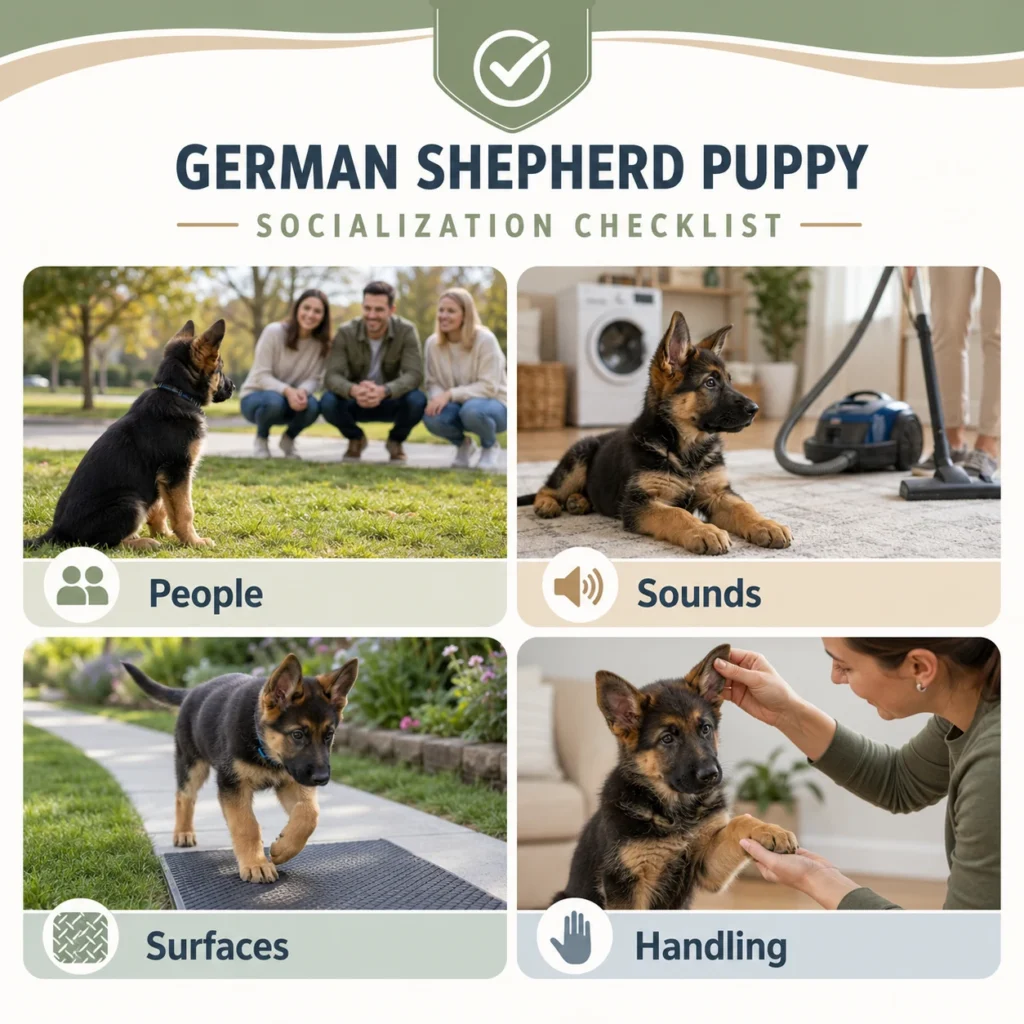
Use this checklist slowly. Your puppy does not need to finish everything in one week. Your goal is a positive or neutral response.
People
Let your puppy see different people without forcing contact: adults, children at a distance, seniors, people wearing hats, people with sunglasses, delivery drivers, visitors, and people using canes or wheelchairs.
Ask strangers not to rush your puppy. If your puppy wants to approach, keep it calm and brief. If your puppy wants to watch from behind you, allow that.
Sounds
Start quiet and increase only when your puppy stays relaxed. Try the doorbell, vacuum, blender, washer, dryer, garage door, traffic, garbage truck from a distance, thunder recordings, and dogs barking far away.
Pair sounds with food, play, or calm praise. If your puppy startles, lower the volume or add distance.
Surfaces
Let your puppy explore grass, carpet, tile, wood floor, concrete, gravel, rubber mats, cardboard, a shallow step, and a low stable platform.
Do not drag your puppy onto a surface. Toss a treat near the edge and let curiosity do the work.
Handling
Handling practice helps with grooming, vet visits, emergencies, and daily care. Practice collar touch, harness touch, ear checks, paw touch, nail tool introduction, mouth checks, brushing, towel drying, and brief calm restraint.
Keep it tiny: touch, treat, release.
Places
Start with low-risk places: front porch, driveway, backyard, friend’s clean home, vet parking lot, quiet street, park edge, outdoor shopping area from a distance, puppy class, or a clean training facility.
Your puppy does not need to walk through the middle of a crowd. Watching from the edge is often better.
Other Dogs
Choose calm, healthy, vaccinated dogs with good manners. Avoid unknown dogs, rough dogs, pushy dogs, and chaotic playgroups. One steady adult dog can teach more than ten random dogs at a park.
Good play includes loose bodies, breaks, role changes, and both dogs choosing to return.
How to Read Your Puppy’s Body Language
Your puppy’s body language tells you if the session is working. According to the Merck Veterinary Manual, dogs communicate through posture, facial expression, tail and ear position, vocalizations, scent, touch, and other signals.
Comfortable signs
- Loose body
- Soft eyes
- Normal sniffing
- Taking treats
- Gentle tail movement
- Checking in with you
- Curious approach
Unsure signs
- Pausing
- Leaning away
- Lip licking
- Yawning
- Turning away
- Hiding behind you
- Refusing treats
Overwhelmed signs
- Freezing
- Shaking
- Hard barking
- Growling
- Tucked tail
- Trying to escape
- Panic pulling
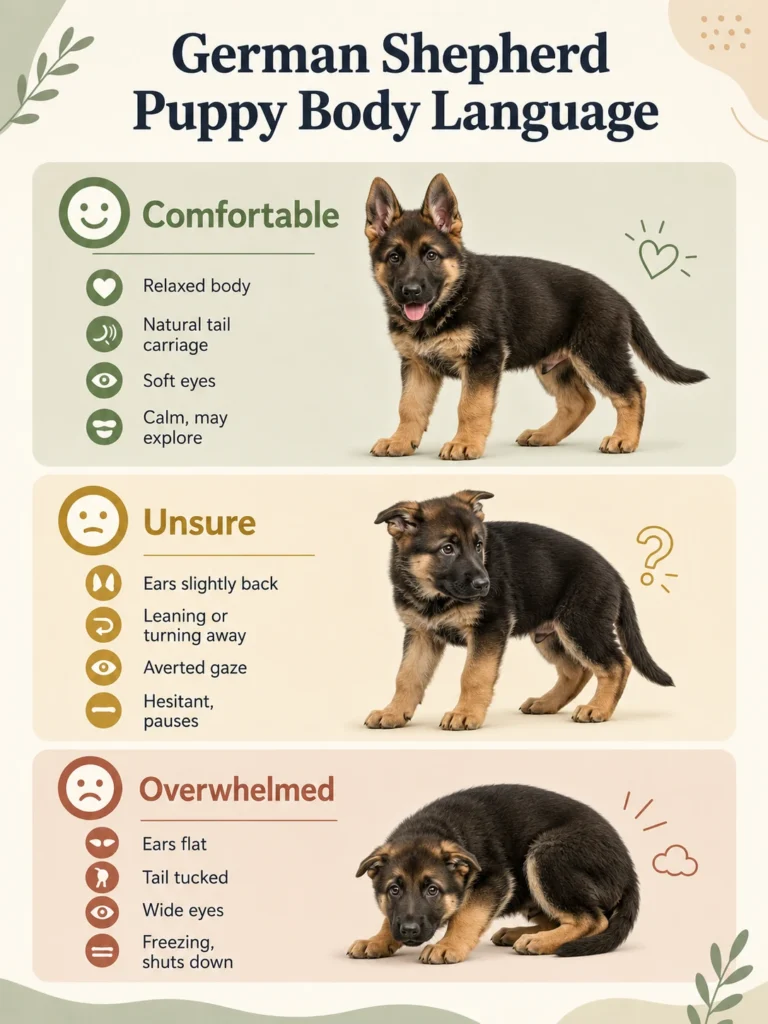
If your puppy shows stress, do not punish the reaction. Add distance, lower the intensity, and reward any calm check-in. Fear is not stubbornness. It is information.
Step-by-Step Socialization Session
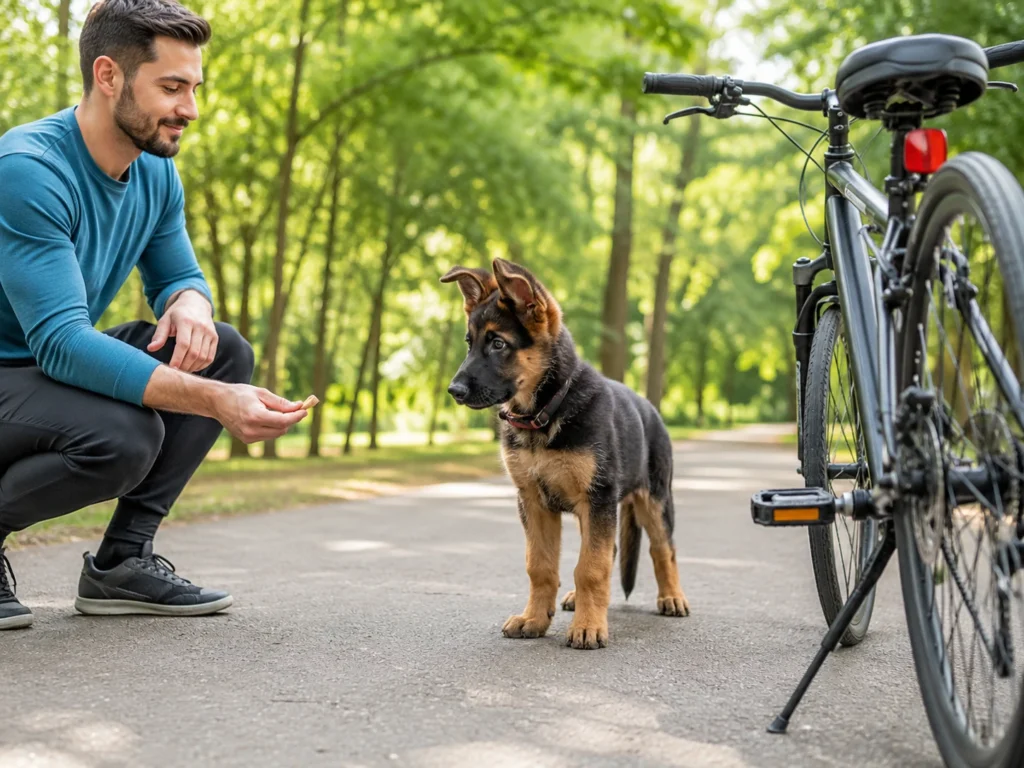
Use this process for a new person, sound, object, place, or dog.
1. Start farther away than you think you need
Distance gives your puppy room to think. If your puppy can notice the trigger and still eat, sniff, or look back at you, the distance is probably right.
2. Let your puppy observe
Do not drag, push, or lure your puppy right up to the scary thing. Observation is socialization too.
3. Reward calm behavior
When your puppy looks at the trigger and stays calm, mark it with a soft “yes” and give a treat.
4. Reward check-ins
If your puppy looks back at you, reward that. Check-ins become useful around dogs, bikes, visitors, and loud sounds.
5. Leave before stress builds
End while the session is still successful. A two-minute win is better than a 20-minute struggle.
6. Repeat another day
Progress comes from repetition. Move closer only when your puppy stays relaxed at the current distance.
Use this German Shepherd puppy socialization guide as a repeatable framework, not a one-time checklist.
Socializing Around Children
Children are exciting and confusing for puppies. They run, squeal, wave toys, hug too hard, and may not notice when a puppy wants space.
The CDC dog safety guidance recommends supervision around dogs, including familiar family dogs, and reminds families not to disturb dogs while they are eating, sleeping, or trying to be left alone.
Set clear rules. Children should not chase the puppy, hug tightly, pull ears or tail, climb on the puppy, grab toys, bother the puppy while eating, or wake the puppy from sleep.
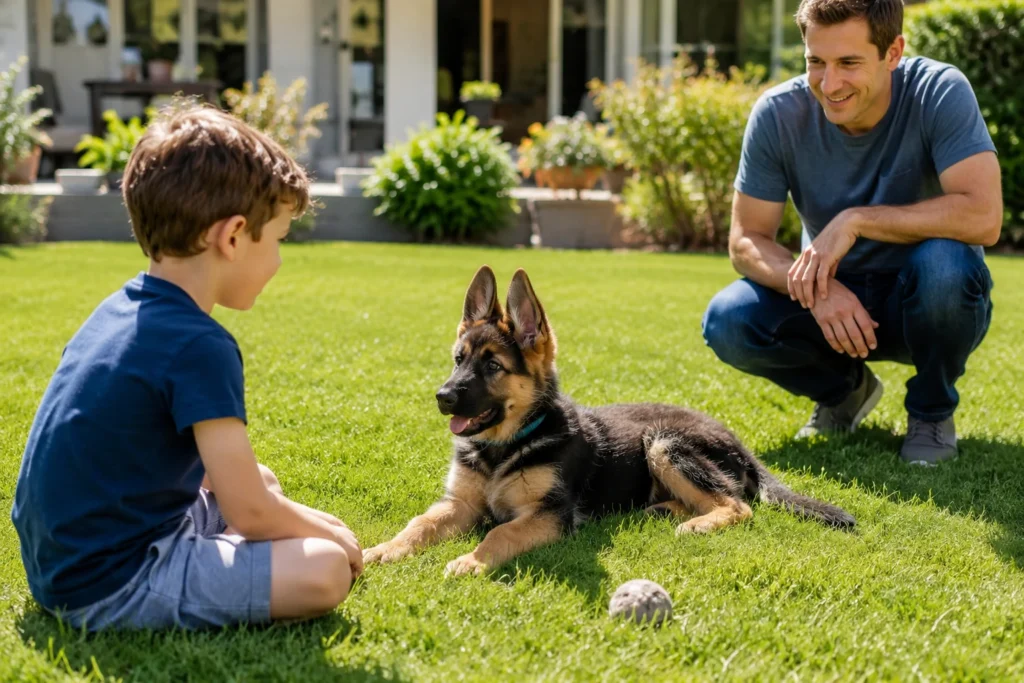
Your puppy should learn that children mean calm rewards, not chasing or chaos.
Start with distance. Let your puppy watch children playing across the street or at a park edge. Reward calm looking. If your puppy pulls, barks, or becomes frantic, move farther away.
Inside the home, use baby gates, crates, and playpens. Management prevents mistakes while everyone learns.
Socializing Around Other Dogs
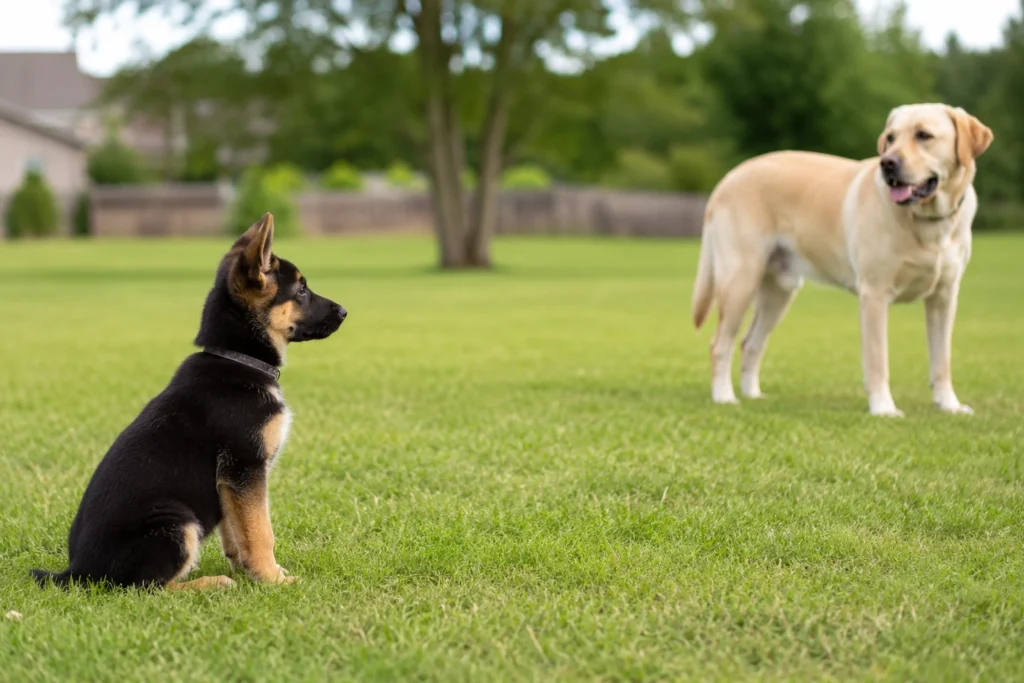
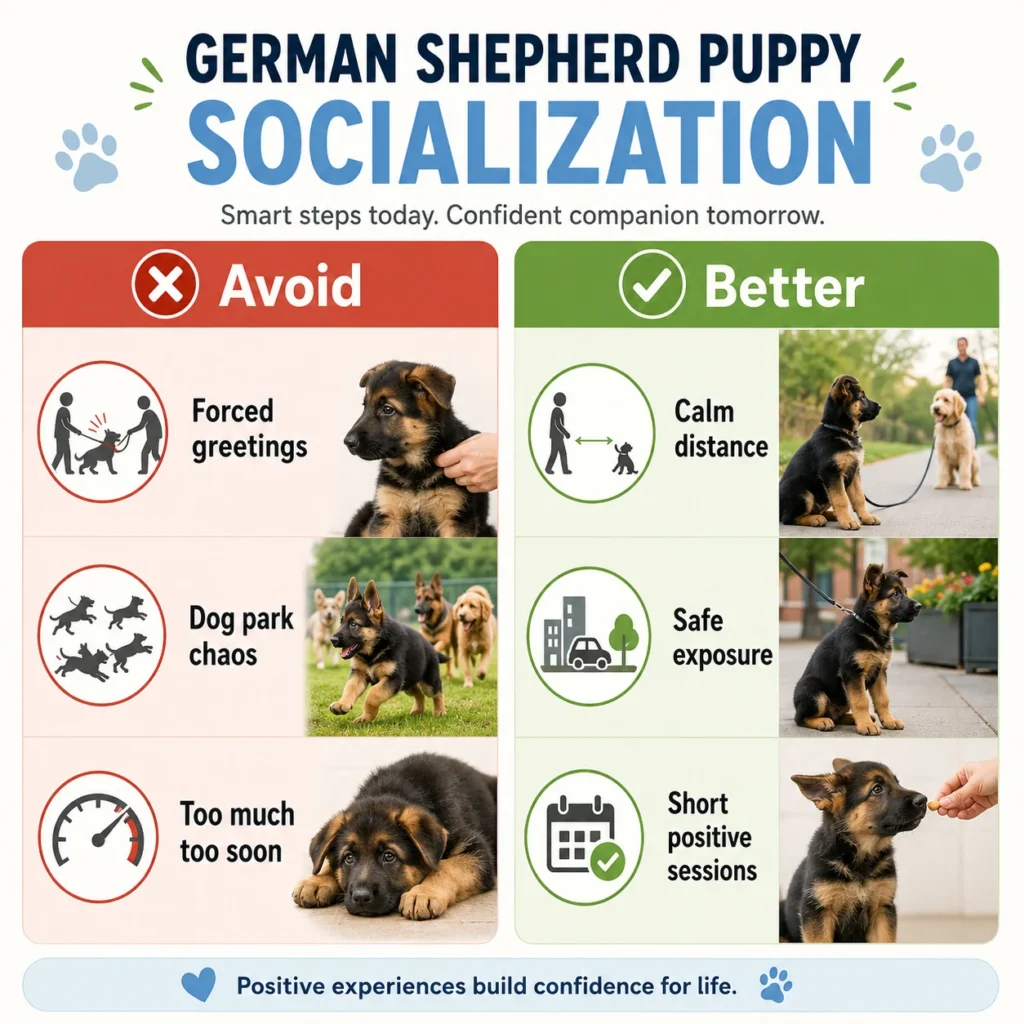
Your German Shepherd puppy does not need to meet every dog. Many leash greetings create frustration because both dogs are restricted and face-to-face.
Better dog socialization looks like this:
- Watching dogs from a distance
- Walking parallel with a calm dog
- Meeting one steady vaccinated dog
- Taking breaks during play
- Practicing “let’s go” around dogs
- Rewarding calm attention back to you
Avoid dog parks for young puppies. They can be rough, unpredictable, and risky from a disease standpoint. A stronger goal is neutrality: your adult dog should be able to see another dog without barking, lunging, or expecting play every time.
Grooming and Vet Visit Practice
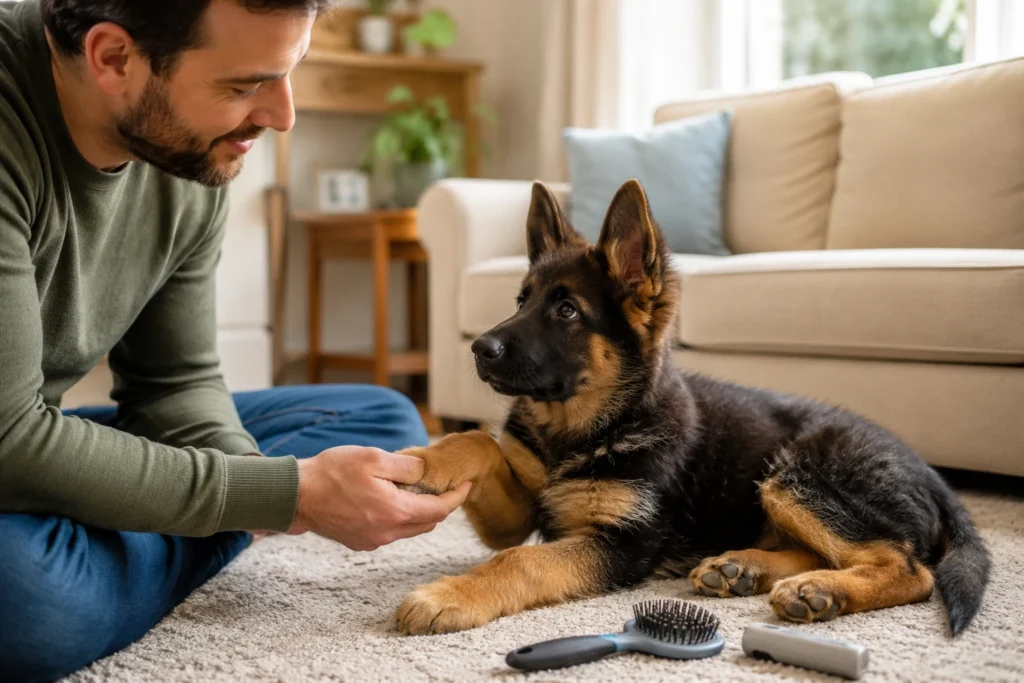
German Shepherds shed heavily and need regular brushing, nail care, and body handling. Socialization should include grooming from the start.
Begin with the easiest version:
- Show the brush, treat, put it away.
- Touch the brush to your puppy’s shoulder, treat, stop.
- Brush once, treat, stop.
- Build slowly over days and weeks.
For paws, do not start by clipping nails. Touch one paw for one second, reward, and release. Later, hold the paw. Then touch the nail clipper or grinder without using it. Then trim one tiny bit.
Practice vet-style handling too: ears, lips, belly, collar, tail, paws, and standing calmly on a mat. Short, positive practice can make future grooming and vet visits less stressful.
For long-term care planning, connect this article to Furbivo’s guide on German Shepherd lifespan and care.
Training Skills That Support Socialization
Socialization works best when your puppy has a few simple skills.
Name response
Say your puppy’s name once. When they look at you, reward.
Hand target
Teach your puppy to touch their nose to your hand. This gives you a friendly way to redirect them.
Let’s go
Use this cue to move away from something calmly before your puppy gets overwhelmed.
Settle
Reward your puppy for lying on a mat while normal life happens nearby.
Loose-leash walking
Short leash sessions teach your puppy that the leash is not for pulling toward every exciting thing.
For more training cluster support, link this post to Furbivo’s dog training tips and related German Shepherd training articles.
Common Socialization Mistakes New Owners Make
Doing too much in one day
A crowded store, noisy traffic, new dogs, children, and a long car ride can overwhelm a puppy.
Letting everyone pet the puppy
Some puppies enjoy attention. Others tolerate it until they do not. Let your puppy choose.
Using dog parks as socialization
Dog parks are uncontrolled. For young German Shepherd puppies, they are usually too much too soon.
Ignoring fear signals
Yawning, lip licking, freezing, hiding, and refusing treats are early warnings.
Punishing barking or growling
Barking and growling are communication. Punishment may suppress the warning without changing the fear.
Skipping handling practice
A puppy who never learns paw, mouth, ear, and brush handling may struggle with grooming and vet care later.
No German Shepherd puppy socialization guide should promise perfect behavior after a few weeks. Real progress comes from patient repetition.
What Most Socialization Advice Gets Wrong
The biggest mistake is treating socialization like a numbers game.
Meet 50 people. Hear 20 sounds. Visit 10 places. Check every box.
That can look productive, but it misses the point. The emotional response matters more than the number of exposures.
If your puppy meets 15 people and feels scared each time, that is not good socialization. If your puppy calmly watches three people from a safe distance and takes treats, that is useful.
Another overlooked point is neutrality. Many owners accidentally teach overexcitement. The puppy learns that every person means jumping, every dog means pulling, and every outing means high arousal.
Calm observation is underrated. A well-socialized German Shepherd can notice the world without needing to control it.
What Is Normal and What Needs Help?
Normal puppy behavior can include chewing, mouthing, jumping, barking sometimes, being startled, getting tired quickly, and needing frequent naps.
It is also normal for a German Shepherd puppy to watch new things carefully. Careful watching is not automatically a problem.
Ask your veterinarian or a qualified reward-based trainer for help if you see repeated panic, snapping, hard biting that breaks skin, intense growling during normal handling, extreme fear of everyday sounds, constant barking and lunging, long hiding periods, sudden behavior change, limping, or unusual sensitivity.
Avoid trainers who rely heavily on fear, intimidation, dominance language, alpha rolls, shock collars, or harsh leash corrections. German Shepherd puppies need clear structure, but structure should not mean scaring the dog.
Helpful Supplies for Socialization
You do not need a house full of gear. A few basics are enough:
- Soft training treats
- Treat pouch
- Comfortable harness
- 6-foot leash
- Long line for safe open areas
- Crate or playpen
- Baby gate
- Soft brush
- Nail clippers or grinder
- Towel
- Lick mat or food puzzle
- Washable mat for settle training
Use supplies to create calm routines. A treat pouch helps you reward quickly. A crate or playpen helps your puppy rest. A mat gives your puppy a clear place to settle when visitors arrive.
Quick Featured Answer
The best way to socialize a German Shepherd puppy is to start early, keep sessions short, use positive reinforcement, avoid overwhelming situations, and safely expose your puppy to people, sounds, surfaces, handling, places, and calm vaccinated dogs. Focus on calm confidence, not forced greetings.
FAQs
When should I start socializing my German Shepherd puppy?
Start when your puppy comes home, often around 8 weeks, using short, safe, positive sessions.
Can I socialize my puppy before vaccines are complete?
Yes, but use low-risk options and ask your veterinarian which public places are safe.
Is 3 months too late to socialize a German Shepherd puppy?
No. Start now, move slowly, reward calm behavior, and avoid forcing scary interactions.
How long should I follow a German Shepherd puppy socialization guide?
Follow it through puppyhood and keep practicing during adolescence to protect confidence.
What are signs my puppy is overwhelmed?
Freezing, shaking, tucked tail, hard barking, hiding, refusing treats, or trying to escape.
Should I take my German Shepherd puppy to a dog park?
No. Dog parks are usually too risky and chaotic for young puppies.
Can socialization prevent aggression in German Shepherds?
It can reduce fear-based behavior risk, but genetics, health, training, and management also matter.
How do I socialize a shy German Shepherd puppy?
Use more distance, quieter places, better rewards, and shorter sessions. Never force greetings.
Final Thoughts
A confident German Shepherd is not created by flooding a puppy with noise, people, dogs, and pressure. Confidence grows through safe experiences, enough distance, kind guidance, and time to recover.
Keep sessions short. Watch body language. Reward calm choices. Protect your puppy from rough dogs and overwhelming people. Ask your veterinarian about vaccine safety and local disease risk. Get professional help early if fear or reactivity feels bigger than normal puppy caution.
Keep this German Shepherd puppy socialization guide close during the first year, especially when your puppy enters new fear periods or adolescent stages. Small, steady lessons now can help your German Shepherd grow into a calmer, safer, more relaxed adult companion.
Have questions about your dog’s health, nutrition, grooming, or daily care? Visit our Contact Us page to reach the Furbivo team. For any medical symptoms, diagnosis, or treatment advice, always consult a qualified veterinarian.