
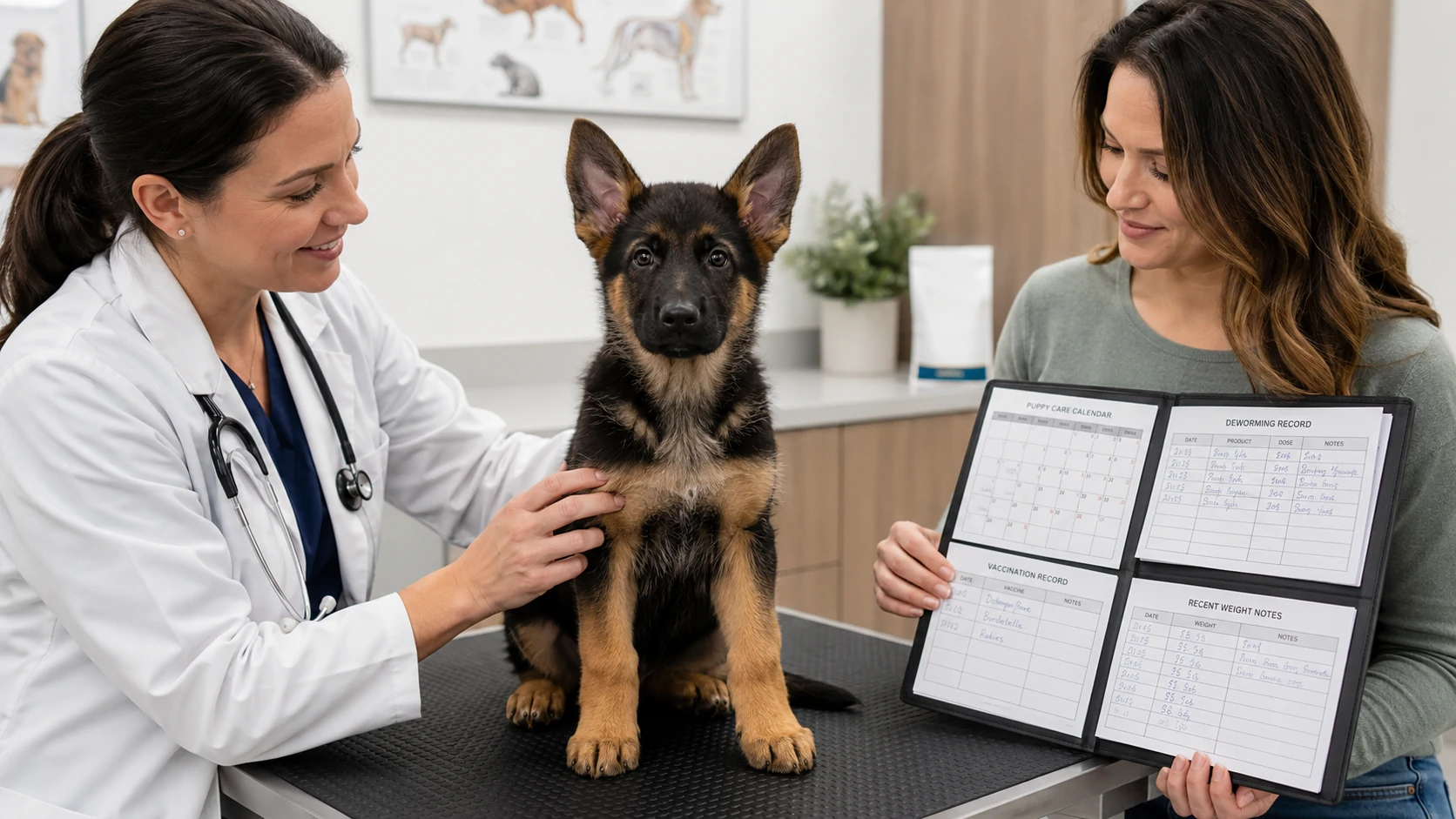
A German Shepherd puppy deworming schedule usually begins when a puppy is about 2 weeks old, with treatment repeated every 2 weeks during early puppyhood. Many puppies are treated at approximately 2, 4, 6, and 8 weeks, then move to a veterinarian-selected monthly broad-spectrum preventive as soon as the product label allows.
This timeline is a general framework, not a dosing prescription. Your puppy’s exact plan depends on previous treatments, current weight, fecal-test results, symptoms, location, lifestyle, travel, flea exposure, diet, and the parasites covered by the chosen product. Do not select or calculate a dewormer dose from an online chart alone.
German Shepherd Puppy Deworming Schedule: Quick Answer
A typical German Shepherd puppy deworming schedule starts at 2 weeks of age and repeats treatment every 2 weeks until regular broad-spectrum parasite control begins. The Companion Animal Parasite Council’s general guidelines recommend starting puppies at 2 weeks, repeating treatment every 2 weeks during the early period, and maintaining year-round parasite control whenever possible.
When year-round monthly control is not possible, CAPC describes a fallback approach of treatment every 2 weeks until 2 months of age, monthly until 6 months, and at least every 3 months afterward, together with appropriate fecal testing. Your veterinarian may adjust that framework for local parasite risks and the product being used.
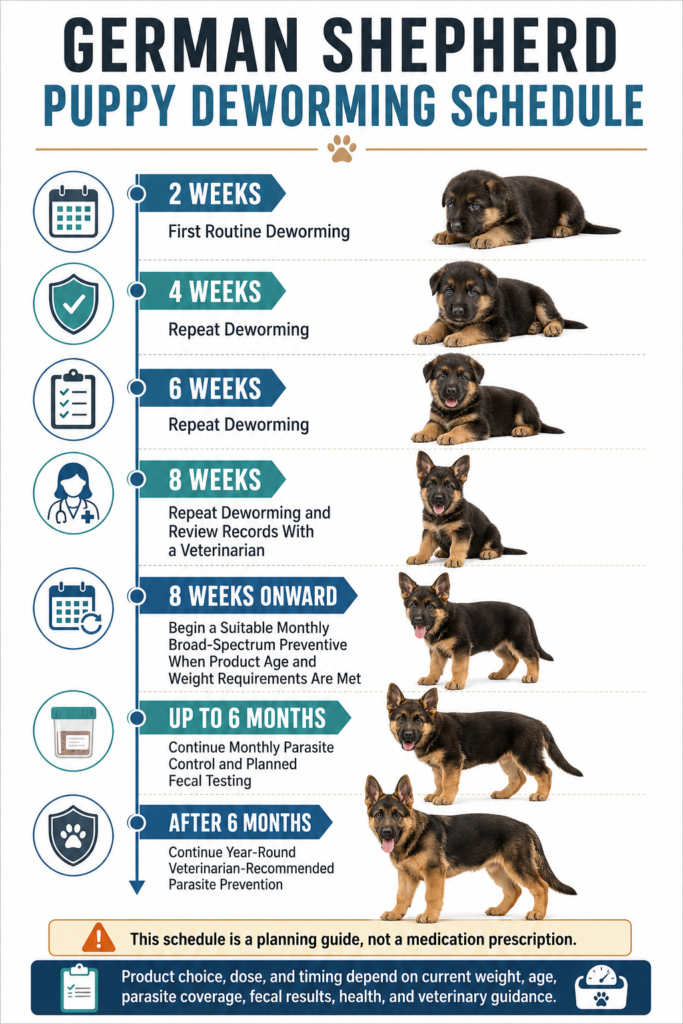
Deworming Schedule at a Glance
| Puppy age | Common veterinary plan | What owners should know |
|---|---|---|
| 2 weeks | First routine deworming | Usually managed by the breeder, shelter, rescue, or veterinarian |
| 4 weeks | Repeat treatment | Early treatment commonly targets roundworms and hookworms |
| 6 weeks | Repeat treatment | A healthy-looking puppy may still carry parasites |
| 8 weeks | Repeat treatment and veterinary review | Bring all breeder or shelter records and a stool sample if requested |
| 8 weeks onward | Begin an appropriate monthly broad-spectrum preventive when label requirements are met | Parasite coverage differs between products |
| Up to 6 months | Continue monthly control and planned fecal testing | Growing puppies remain vulnerable to reinfection |
| After 6 months | Continue year-round veterinarian-recommended parasite prevention | Testing and prevention depend on health, location, and exposure |
This German Shepherd puppy deworming schedule is based on common veterinary parasite-control guidance, but it should be individualized rather than followed blindly.
Is the Schedule Different for German Shepherd Puppies?
The basic timing is generally the same for German Shepherds as for other dog breeds. A German Shepherd puppy deworming schedule is driven mainly by parasite life cycles, age, previous treatment, exposure, fecal results, local risk, and medication-label requirements—not by breed alone.
Breed and size still matter during veterinary visits. German Shepherd puppies grow rapidly, so the veterinarian should confirm the puppy’s current weight and body condition before selecting a product. Use Furbivo’s German Shepherd puppy feeding chart to organize measured meals, and the German Shepherd growth chart to monitor trends without treating one online number as a mandatory target.
Why Deworming Starts So Early
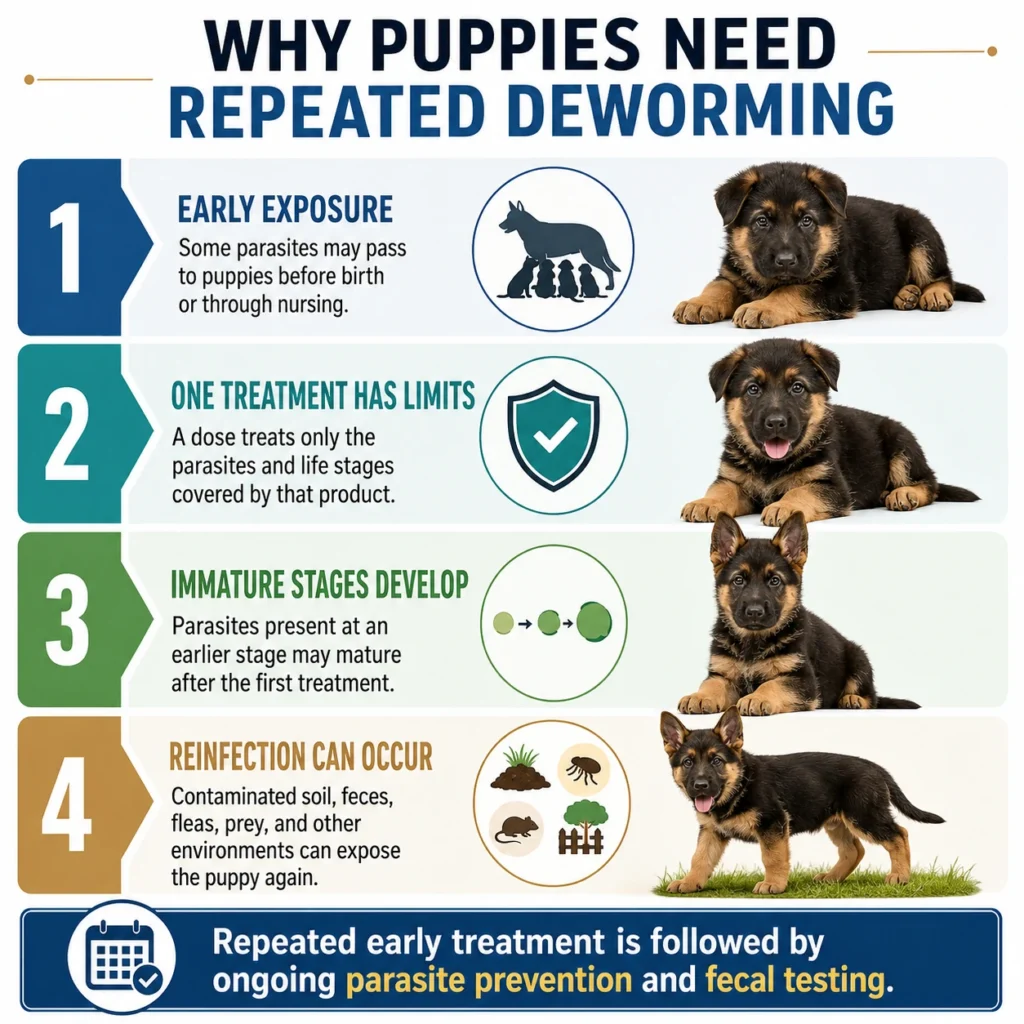
Roundworms and hookworms can infect puppies very early in life. Puppies may acquire these parasites from their mother, including before they arrive in a new home. A clean-looking environment and normal-looking stool do not rule out infection.
Early treatments are repeated because one treatment may remove susceptible parasites present at that time without preventing later reinfection or eliminating every immature stage. CAPC’s hookworm guidance specifically describes treatment at 2, 4, 6, and 8 weeks, followed by a suitable monthly preventive as soon as label directions allow.
The nursing mother’s parasite-control plan also matters. Pregnant and nursing dogs should receive only veterinarian-selected products that are appropriate for their reproductive status and health.
German Shepherd Puppy Deworming Schedule by Age
Two Weeks: First Routine Treatment
The first routine treatment commonly occurs at about 2 weeks of age. At this stage, the puppy is usually still with its mother, so the breeder, shelter, rescue organization, or supervising veterinarian manages the product and keeps the record.
The record should show the date, product, active ingredient, puppy’s weight, dose, administrator, and any reaction. A vague note such as “wormed once” is not enough to identify what was given or which parasites were covered.
Four Weeks: Repeat Treatment
A second treatment is commonly given at 4 weeks. This step targets parasites that may have developed since the first treatment or that the puppy acquired again from its environment or mother.
Record any vomiting, diarrhea, weakness, appetite change, facial swelling, or other unexpected reaction and contact the supervising veterinarian when needed.
Six Weeks: Continue the Early Series
Puppies commonly receive another treatment at 6 weeks. Even a puppy that eats, plays, and gains weight normally may carry intestinal parasites without obvious signs.
Vaccination and deworming may occur during the same period, but they are separate preventive-care plans. Furbivo’s guide on how to take care of a German Shepherd puppy can help you organize veterinary care, nutrition, training, sleep, and daily monitoring around these early visits.
Eight Weeks: Veterinary Review and Transition Planning
At approximately 8 weeks, many puppies move to their new homes. Bring all vaccination, deworming, microchip, breeder, shelter, and medical records to the first veterinary appointment.
The veterinarian may:
- Verify which earlier treatments were administered
- Weigh and examine the puppy
- Review appetite, stool quality, hydration, and growth
- Request a fecal examination
- Repeat deworming when appropriate
- Select a monthly preventive based on age, weight, location, and exposure
- Explain exactly which parasites the product covers
- Schedule follow-up testing
If no reliable treatment history exists, do not guess. CAPC’s hookworm guidance notes that puppies first treated at 6–8 weeks or later may need a suitable monthly preventive, another treatment after 2 weeks, and continued monthly prevention according to the label. The veterinarian should decide how to safely restart or continue the German Shepherd puppy deworming schedule.
After Eight Weeks: Moving to Monthly Prevention
After the early every-two-week series, many puppies transition to a monthly broad-spectrum preventive when they meet the product’s minimum age and weight requirements.
“Broad spectrum” does not mean that every product covers every parasite. Some products target roundworms and hookworms, while others may also cover whipworms, tapeworms, heartworm, fleas, or ticks. Always check the active ingredients and label claims.
A well-planned German Shepherd puppy deworming schedule should identify both the treatment interval and the parasites covered. Recording only “dewormed” can hide important gaps.
Up to Six Months: Continue Monthly Control
Growing puppies remain vulnerable to reinfection. Continue the exact product and interval recommended by your veterinarian, and complete planned fecal examinations even when the puppy appears healthy.
Monthly prevention is easier to manage when it is connected to a consistent household system. Furbivo’s German Shepherd puppy daily routine can help you track meals, stool, potty trips, medication dates, activity, training, and rest.
After Six Months: Continue Prevention, Not Neglect
Parasite risk does not end when puppyhood does. Dogs can be reinfected through contaminated soil, feces, prey, fleas, raw meat, scavenging, and contact with other animals.
Continue year-round veterinarian-recommended parasite control. Testing frequency should reflect the dog’s health, travel, outdoor activity, diet, boarding, daycare, hunting, and previous parasite history.
Why Fecal Testing Still Matters
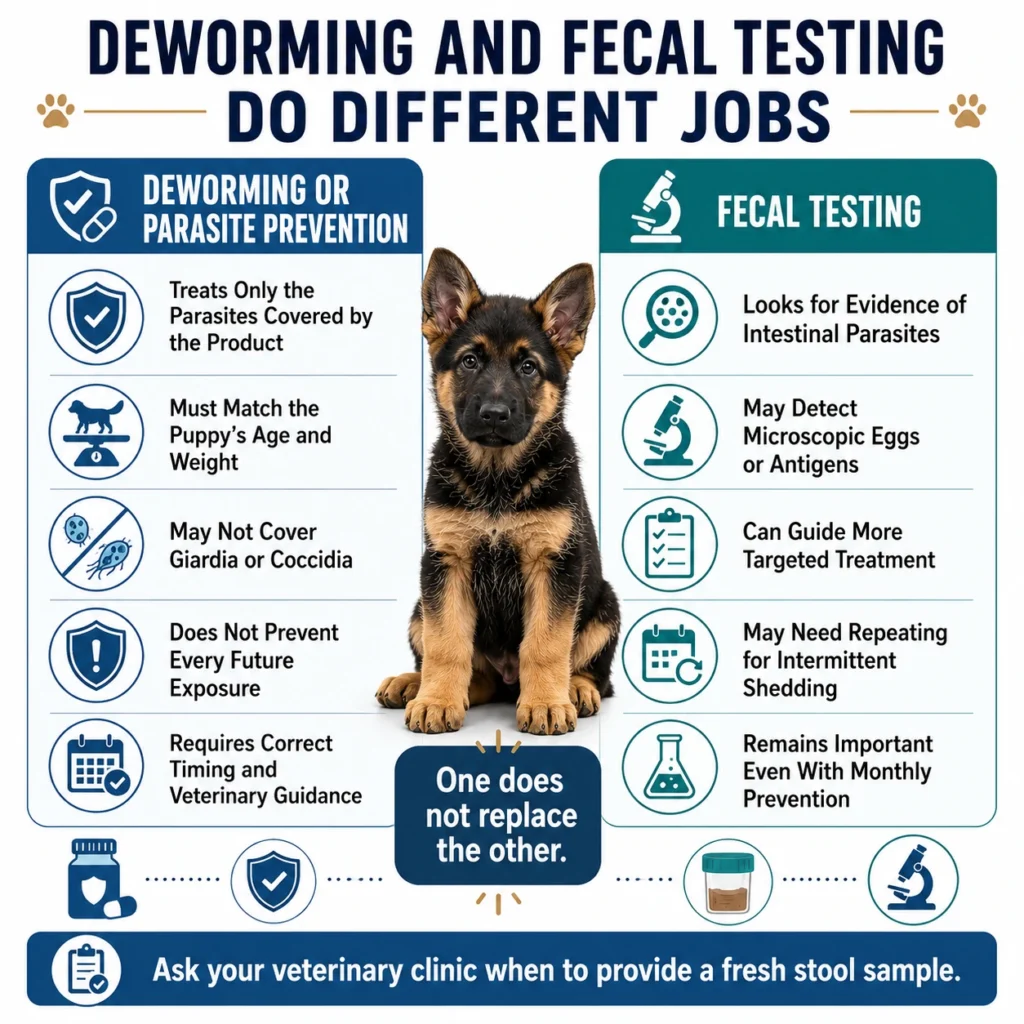
Deworming and fecal testing do different jobs. A dewormer acts only against the parasites and life stages covered by that product. Fecal testing looks for evidence of infection and may detect parasites that routine prevention does not cover.
CAPC recommends testing puppies for intestinal parasites at least four times during the first year and testing adults at least twice yearly depending on health and lifestyle. Its whipworm guidance also notes that whipworm infections may become evident from approximately 3–6 months of age.
Bring a sample according to your clinic’s instructions, especially when the puppy has:
- Diarrhea
- Blood or mucus in the stool
- Vomiting
- Poor weight gain
- A pot-bellied appearance
- Visible worms or rice-like segments
- Recent shelter, boarding, daycare, or group-housing exposure
- Missed preventive doses
- Hunting, scavenging, or raw-meat exposure
One negative test does not always rule out every parasite. The veterinarian may combine centrifugal flotation, antigen testing, PCR, or repeat testing depending on symptoms and risk.
Common Puppy Parasites
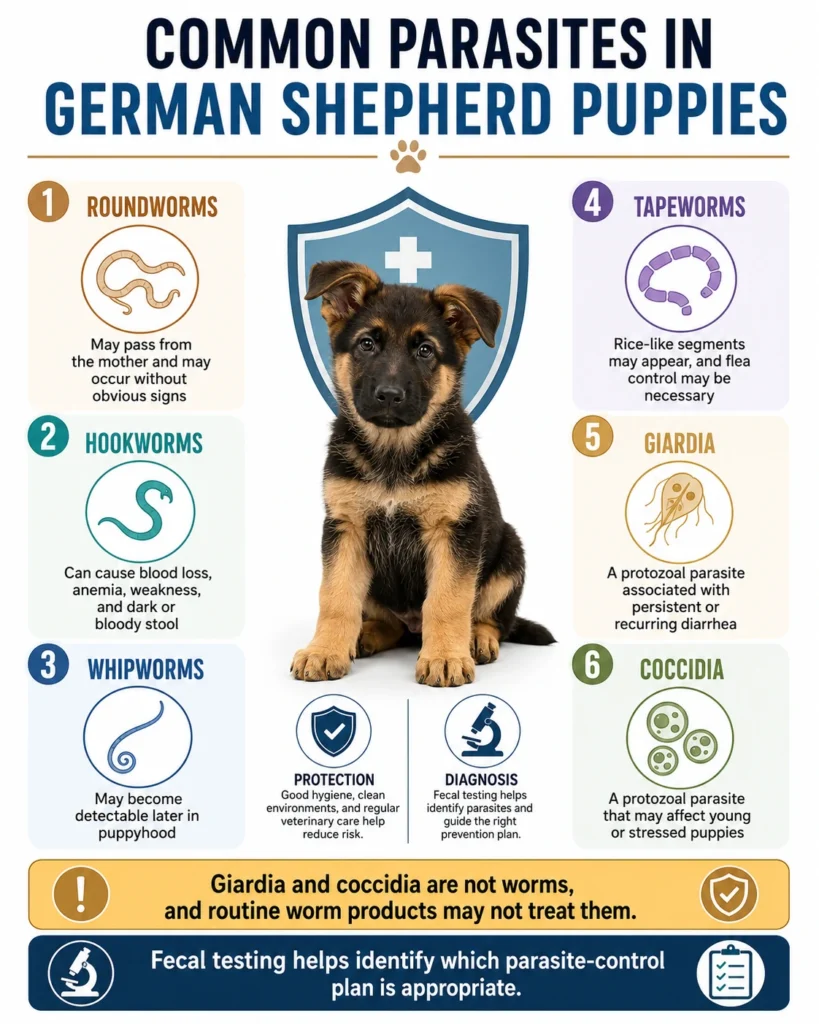
Roundworms
Roundworms are common in puppies and may be passed from the mother. Some infected puppies have no obvious signs, while heavier infections may contribute to poor growth, digestive problems, or a pot-bellied appearance.
CAPC’s roundworm guidance supports early treatment, year-round control, immediate stool pickup, daily yard cleanup, and protection of sandboxes and play areas from fecal contamination.
Roundworms also create a public-health concern. The CDC explains how toxocariasis spreads through contact with infected dog or cat feces, contaminated soil, and unwashed hands.
Hookworms
Hookworms attach to the intestinal lining and feed on blood. A heavy infection can be especially dangerous for a young puppy because it may contribute to anemia, weakness, and rapid decline.
Pale gums, marked weakness, black or bloody stool, collapse, or sudden deterioration require urgent veterinary attention. Hookworm larvae can also affect people. The CDC’s zoonotic hookworm guidance explains that larvae in feces-contaminated soil can penetrate human skin.
Whipworms
Whipworms generally become more relevant as puppies get older because they have a longer development period. Not every monthly preventive covers them, so product-label review and fecal testing remain important.
Persistent large-bowel diarrhea, mucus, blood, straining, or weight loss should be evaluated by a veterinarian rather than treated repeatedly with random over-the-counter products.
Tapeworms
The common flea tapeworm, Dipylidium caninum, is acquired when a dog swallows an infected flea. Owners may notice moving or dried rice-like segments around the anus, on bedding, or near the stool.
Treatment without flea control can lead to reinfection. CAPC states in its Dipylidium caninum guidance that treatment must be combined with appropriate flea control.
Giardia and Coccidia
Giardia and coccidia are protozoa, not worms. Routine worming products may not treat them, so persistent or recurring diarrhea requires appropriate fecal testing and targeted veterinary care.
CAPC’s Giardia guidance notes that follow-up testing may be considered when signs do not resolve and that repeated infection may require treatment together with bathing and careful feces removal. CAPC also provides separate coccidia guidance because diagnosis and treatment differ from routine worm control.
Do not keep giving over-the-counter wormers to a puppy with ongoing diarrhea. A different parasite, infection, diet problem, medication reaction, or another illness may be responsible.
How to Read a Dewormer Label
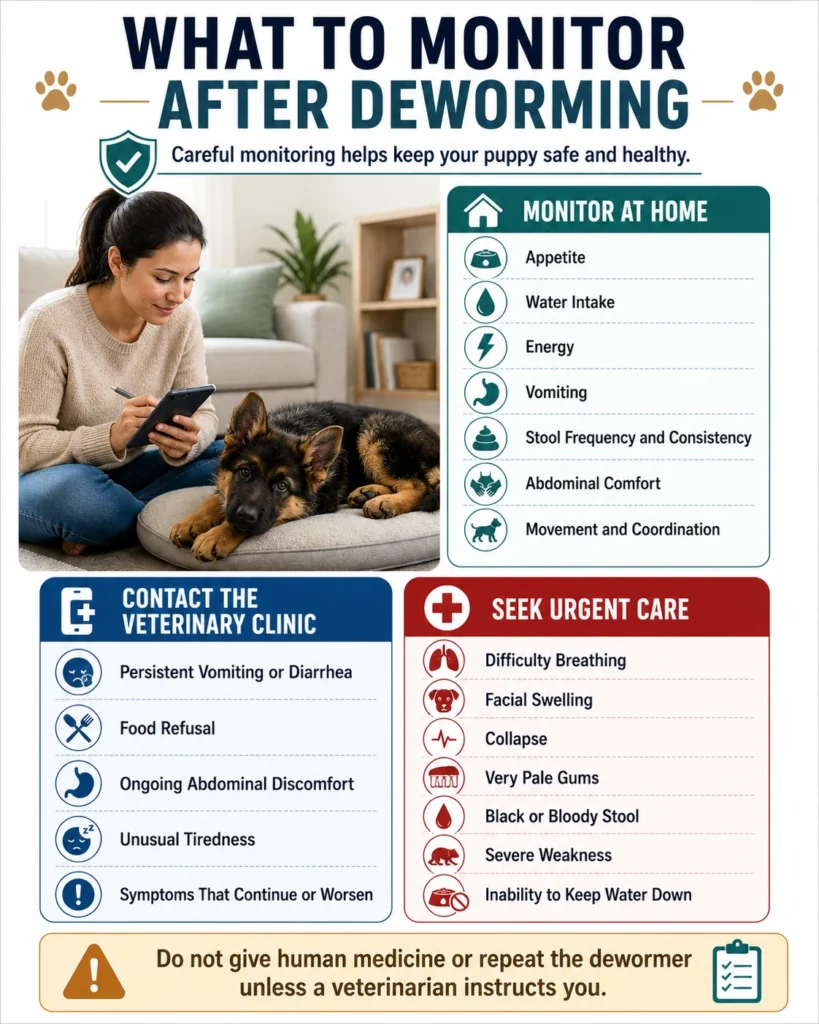
Do not assume that a product described as “broad spectrum” covers every intestinal parasite.
Check:
- Minimum age
- Minimum weight
- Active ingredients
- Parasites covered
- Dose interval
- Whether the product treats an existing infection, prevents new infection, or both
- Whether it also covers heartworm, fleas, or ticks
- Whether another product could duplicate an active ingredient
- Storage and administration instructions
- What to do after vomiting or a missed dose
Do not split an adult product, copy another dog’s dose, use livestock dewormers, or give human medication unless a veterinarian specifically directs you. The FDA advises owners not to share one animal’s medication with another or give human medication without veterinary direction in its guidance on medication errors in pets.
What to Expect After Deworming
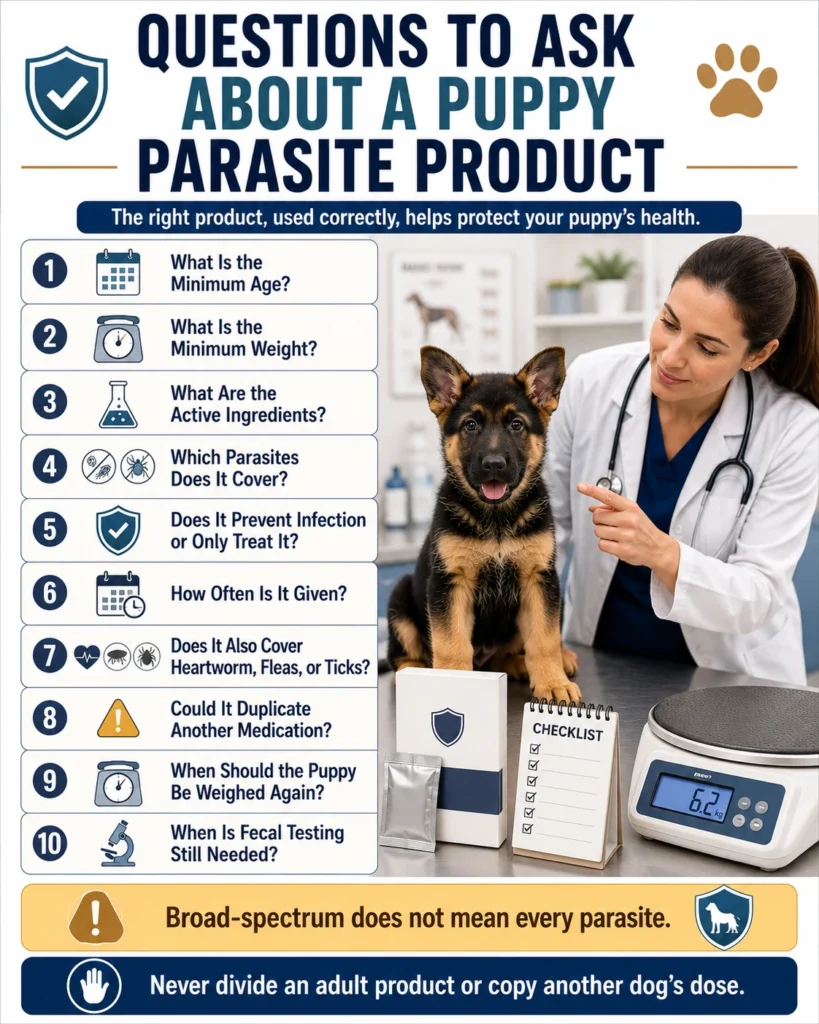
Some puppies may develop mild, short-lived digestive changes after treatment. You may see worms in the stool, but not seeing worms does not prove that the puppy was parasite-free.
Monitor:
- Appetite
- Water intake
- Energy
- Vomiting
- Stool frequency and consistency
- Abdominal discomfort
- Facial swelling
- Breathing
- Coordination
Contact your veterinarian if vomiting or diarrhea continues, the puppy will not eat, or you are concerned about any reaction. Seek urgent care for:
- Difficulty breathing
- Facial swelling
- Collapse
- Severe weakness
- Repeated vomiting
- Bloody or black stool
- Very pale gums
- A swollen or painful abdomen
- Inability to keep water down
When appetite drops, Furbivo’s guide on why a German Shepherd may not be eating can help you identify warning signs, but it should not delay veterinary care for a young or unwell puppy.
Do Not Use Home Remedies as Dewormers
Do not use garlic, essential oils, tobacco, bleach, diatomaceous earth, herbal mixtures, human medicine, livestock products, or leftover medication as substitutes for veterinary parasite control.
“Natural” does not automatically mean safe or effective. Delaying appropriate diagnosis can allow parasites or another illness to harm the puppy and contaminate the environment.
Prevent Reinfection at Home
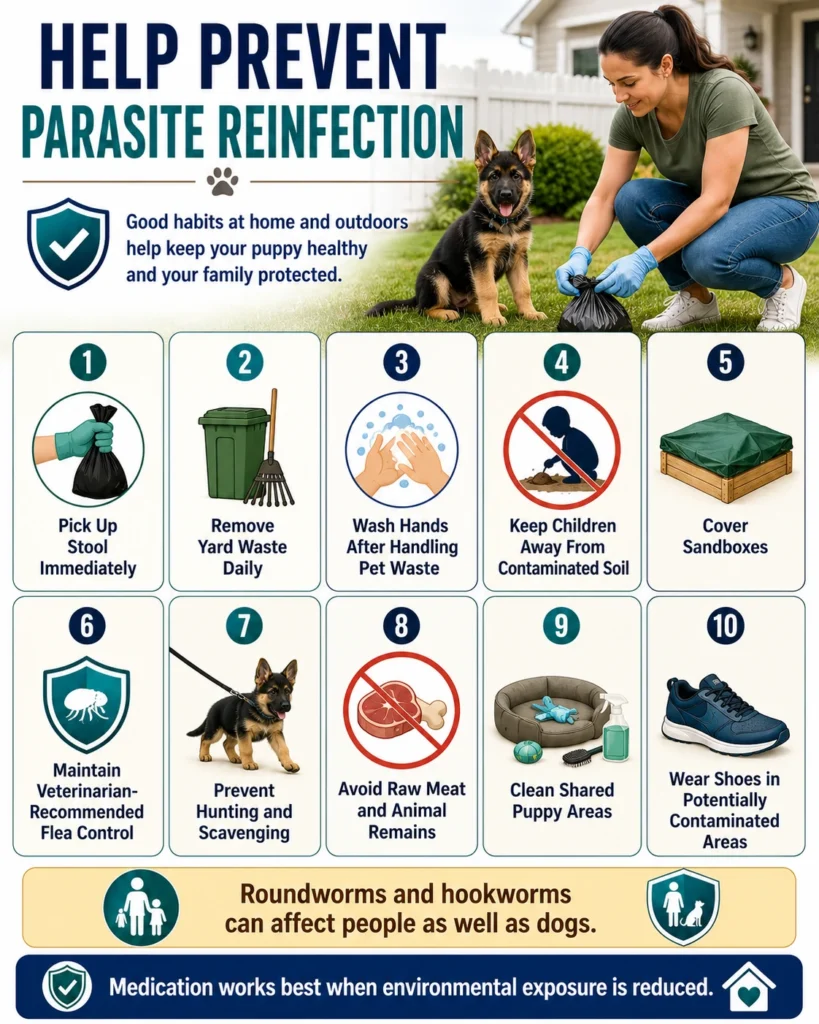
Medication alone cannot control constant environmental exposure.
Use these habits:
- Pick up stool immediately during walks
- Remove feces from the yard every day
- Wash hands after handling waste and before eating
- Prevent children from playing in contaminated soil
- Keep sandboxes covered
- Maintain veterinarian-recommended flea control
- Prevent hunting and scavenging
- Avoid raw meat and animal remains
- Clean shared puppy areas regularly
- Follow boarding, daycare, and puppy-class health requirements
When planning safe exposure to other dogs and public places, Furbivo’s German Shepherd puppy socialization guide can help you balance early social learning with local disease-risk advice from your veterinarian.
Keep Complete Deworming Records
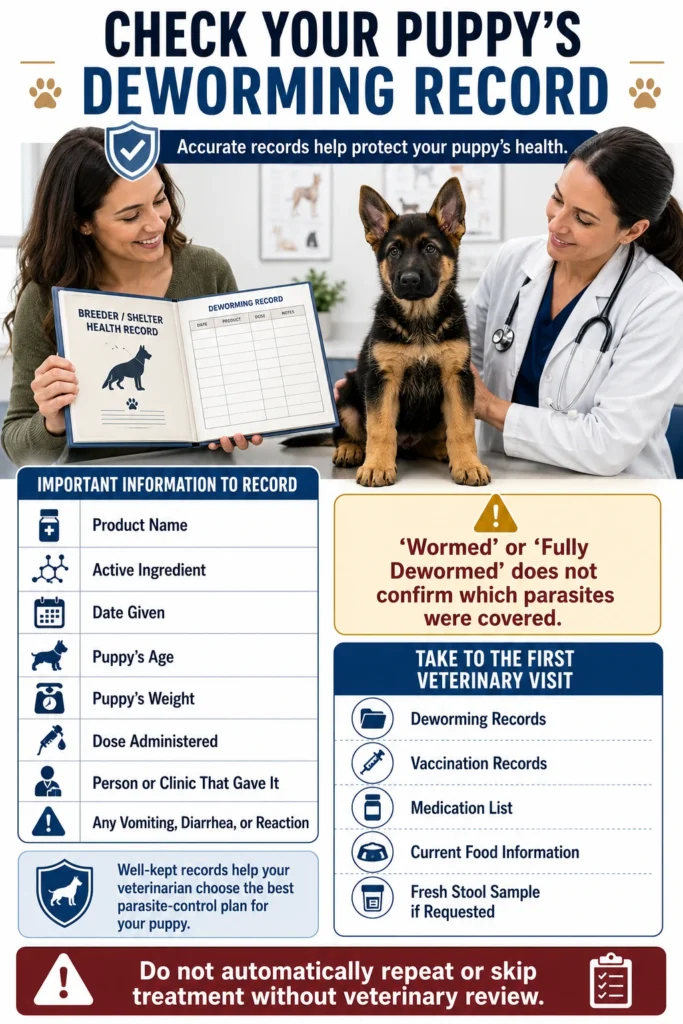
A safe German Shepherd puppy deworming schedule depends on knowing what has already been given. Keep a record showing:
- Product name
- Active ingredient
- Date administered
- Puppy’s weight
- Dose
- Person or clinic administering it
- Any reaction
- Fecal-test results
- Next planned treatment date
Do not automatically repeat or skip a treatment because a breeder’s note says “fully wormed.” That wording does not identify the product, parasite coverage, dose, or dates.
What If You Miss a Deworming Dose?
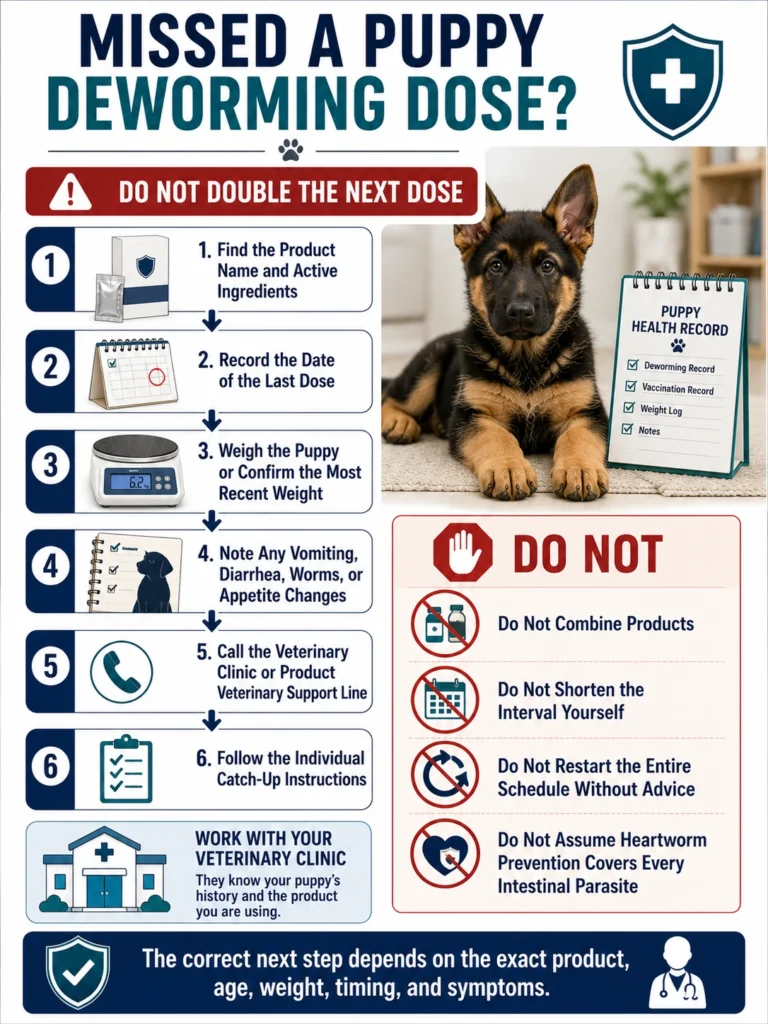
Call your veterinarian or the product manufacturer’s support line for guidance based on the exact product.
Do not:
- Double the next dose
- Shorten the interval yourself
- Combine two products
- Restart the entire series without advice
- Assume a heartworm preventive covers every intestinal parasite
Provide the puppy’s current age, weight, last dose date, product name, symptoms, and possible exposures. The veterinarian can then update the German Shepherd puppy deworming schedule safely.
How Deworming Fits With Vaccines, Meals, and Sleep
Deworming and vaccination visits often occur during the same months, but they should have separate written records. Follow the medicine label and veterinary directions about giving a product with food.
Avoid changing several parts of the diet at once when a puppy has vomiting, diarrhea, or appetite loss. Multiple simultaneous changes make it harder to identify the cause.
Young puppies also need substantial rest. Furbivo’s German Shepherd puppy sleep schedule can help you plan naps and calm recovery after veterinary visits without confusing unusual lethargy with normal sleep.
What Owners Commonly Miss
Deworming Is Not One Product
Different products treat different parasites. Record the product, active ingredients, date, weight, and dose rather than writing only “dewormed.”
Clear Stool Does Not Prove the Puppy Is Parasite-Free
Many parasite eggs and immature stages are too small to see. Some infected puppies have no obvious signs.
Giardia and Coccidia Are Not Worms
Routine worm products may not resolve diarrhea caused by protozoa. Testing helps the veterinarian choose the correct treatment.
Flea Control Is Part of Tapeworm Control
Treating the tapeworm without controlling fleas allows reinfection.
The Environment Can Undo Treatment
Daily stool pickup, handwashing, flea prevention, and avoiding contaminated soil reduce reinfection and protect people.
Prevention Continues After Puppyhood
The final early puppy dose is not the end of parasite control. Continue veterinarian-recommended year-round prevention and fecal testing.
Frequently Asked Questions
What Is a Normal German Shepherd Puppy Deworming Schedule?
A normal German Shepherd puppy deworming schedule commonly begins at 2 weeks, with repeat treatments at approximately 4, 6, and 8 weeks. Many puppies then move to an age- and weight-appropriate monthly broad-spectrum preventive selected by their veterinarian.
How Often Should a German Shepherd Puppy Be Dewormed?
Early treatment commonly occurs every 2 weeks during the first weeks of life. Afterward, frequency depends on the monthly product, label directions, fecal results, exposure, location, and veterinary recommendations.
Can I Deworm My German Shepherd Puppy at Home?
Only administer a veterinarian-approved or properly labeled product that is appropriate for the puppy’s current age and weight. Do not guess the product, divide an adult dose, or use human, livestock, or leftover medication.
Does a Puppy Need Deworming If the Stool Looks Normal?
Possibly. Puppies can carry roundworms, hookworms, or other parasites without visible signs, and parasite eggs are generally too small to see without testing.
Does Routine Deworming Treat Giardia and Coccidia?
Not necessarily. Giardia and coccidia are protozoa, and many routine worm products do not cover them. Persistent or recurring diarrhea requires veterinarian-selected testing and targeted treatment.
Why Does My Puppy Still Have Worms After Deworming?
Possible causes include immature parasite stages, reinfection, an incomplete series, an incorrect product for the parasite, inaccurate dosing, missed doses, or poor environmental control. Contact your veterinarian and bring a stool sample when requested.
When Is a Puppy Parasite Problem an Emergency?
Seek urgent veterinary care for very pale gums, collapse, severe weakness, repeated vomiting, black or bloody stool, a swollen painful abdomen, breathing difficulty, or inability to keep water down.
Final Thoughts
A safe German Shepherd puppy deworming schedule begins early, repeats treatment during the first weeks of life, and then transitions into year-round veterinarian-recommended parasite control.
Remember the main framework:
- Begin routine treatment at approximately 2 weeks
- Repeat treatment about every 2 weeks during early puppyhood
- Bring complete breeder or shelter records to the veterinarian
- Use only age- and weight-appropriate products
- Complete regular fecal testing
- Confirm which parasites each product covers
- Maintain flea control and remove stool promptly
- Seek veterinary care for persistent digestive signs, anemia, weakness, or medication reactions
Do not copy medication choices or doses from another puppy. Your puppy’s plan should be based on current weight, health, test results, previous treatments, local exposure, and the product label.
Have questions about dog health, nutrition, grooming, or everyday care? Visit Furbivo’s Contact Us page. For symptoms, diagnosis, medication, or treatment advice, always consult a qualified veterinarian.