
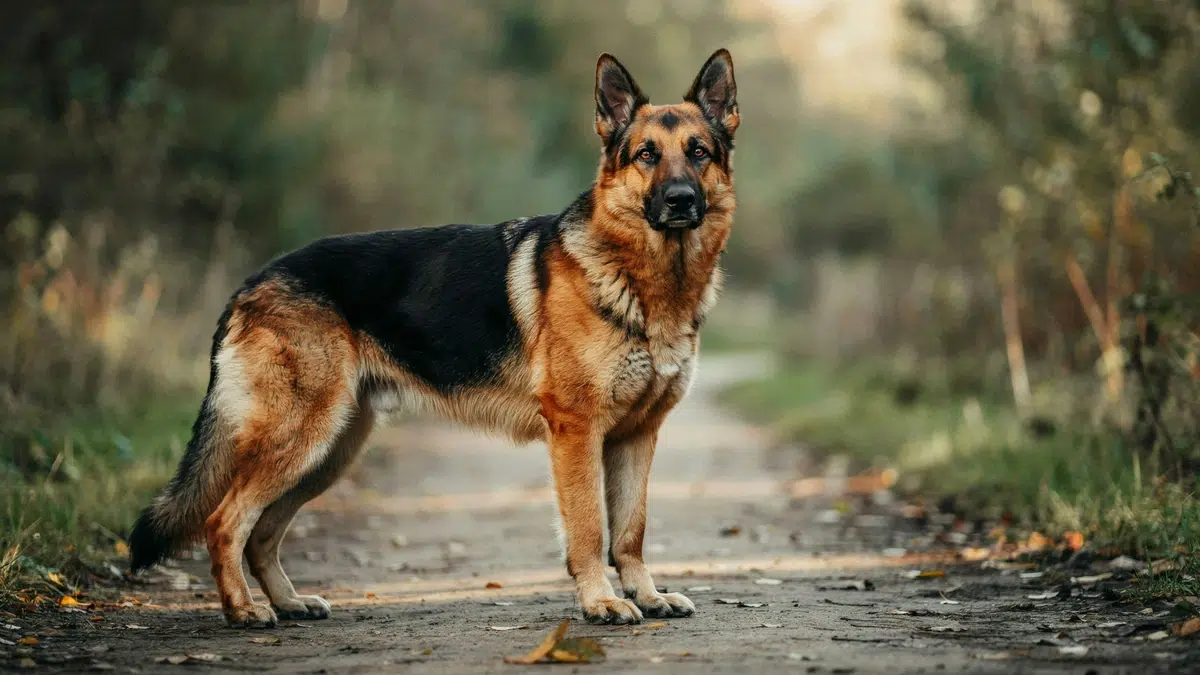
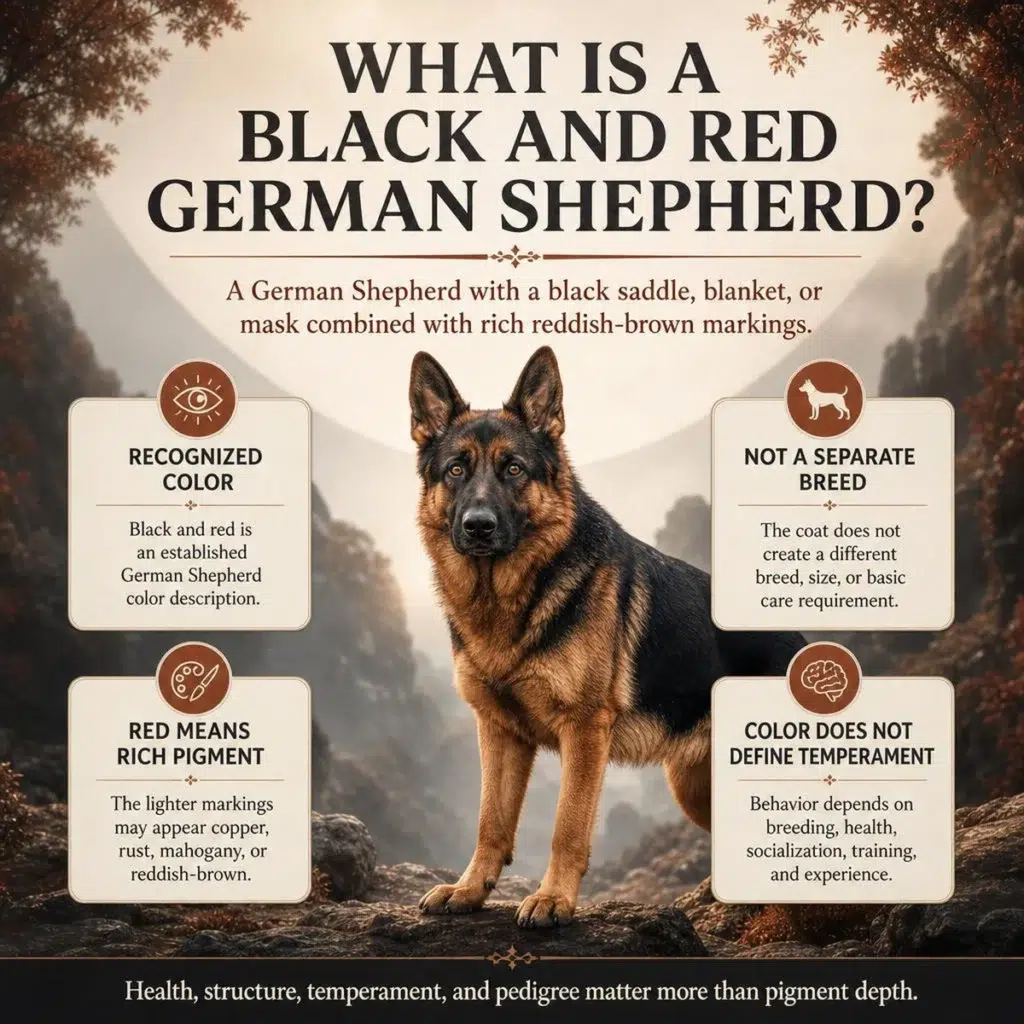
A black and red German Shepherd is a German Shepherd Dog with a black saddle, blanket, mask, or darker upper-body pattern combined with rich reddish-brown, copper, or mahogany markings. Major registries recognize the color, but it is not a separate breed, size category, temperament, or proof of a particular bloodline.
The phrase red German Shepherd is often used loosely. It may describe a black-and-red dog, a red sable dog, or simply a German Shepherd with warmer-than-average tan markings. A responsible seller should identify the actual coat pattern rather than relying only on the word “red.”
Quick Answer: What Is a Black and Red German Shepherd?
A black and red German Shepherd has black eumelanin in areas such as the saddle, blanket, mask, or upper body and richer red-to-copper phaeomelanin on the legs, chest, face, and underside. The pattern controls where the pigments appear, while separate genetic influences affect how pale or deep the reddish areas look.
| Feature | What it means |
|---|---|
| Breed identity | A coat-color variation within the German Shepherd Dog breed |
| Typical pattern | Black saddle or blanket with reddish-brown markings |
| Official terminology | AKC and UKC list Black & Red; FCI uses reddish-brown wording |
| Coat length | May occur with a medium or long double coat |
| Temperament | Not determined by coat color |
| Shedding | Regular year-round shedding with heavier seasonal periods |
| Health priorities | The same breed-level screening priorities as other German Shepherds |
| Puppy selection | Health, temperament, structure, and breeder practices come before color |
What Does “Black and Red” Actually Mean?
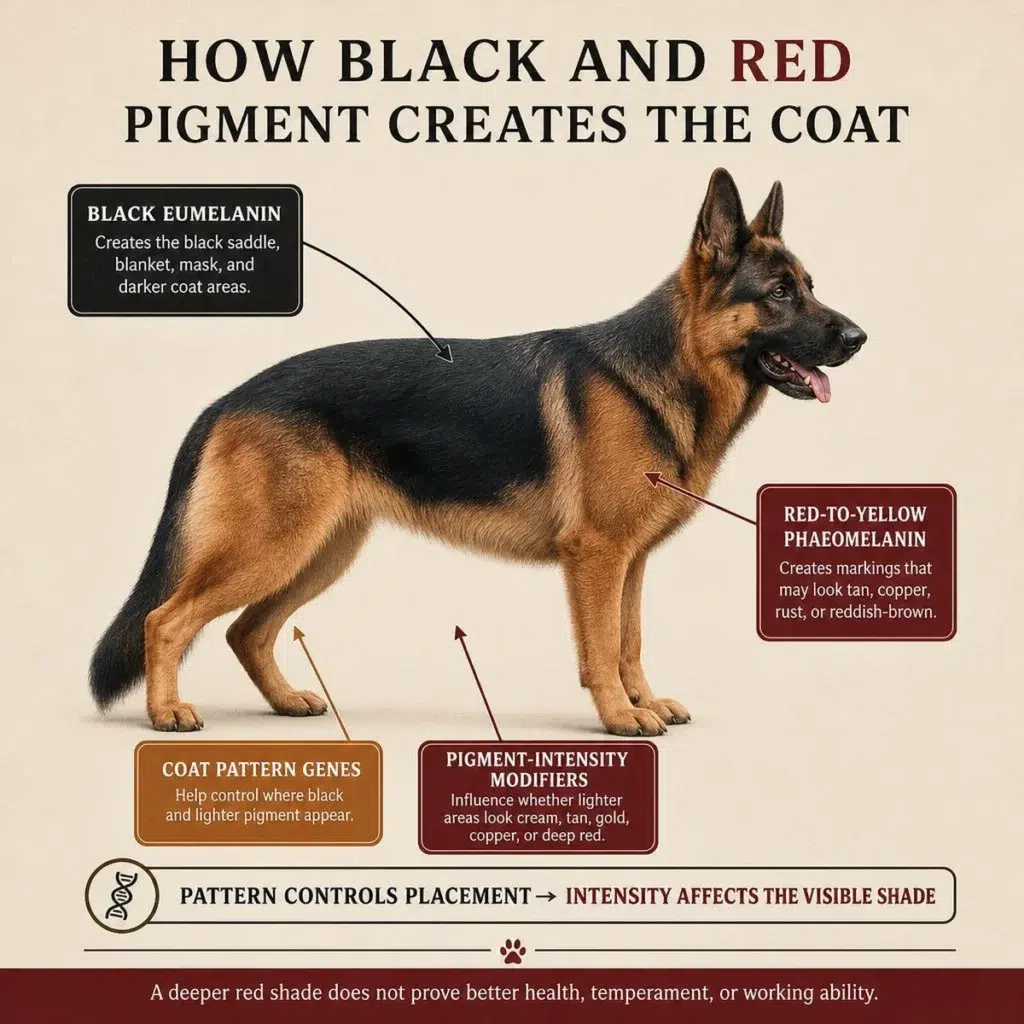
The word black describes areas where the coat contains eumelanin, the pigment responsible for black or brown coloration. The word red describes areas rich in phaeomelanin, which can range from pale cream and yellow through tan, copper, rust, and deep reddish-brown.
A typical dog may have:
- A black facial mask
- A black saddle or broader blanket
- Reddish markings on the cheeks
- Rich color on the chest and legs
- Red or copper color beneath the tail
- Reddish pigment along the abdomen and underside
- Darker shading around the ears and shoulders
The red areas should not be interpreted as bright scarlet. In German Shepherd terminology, red normally means a deeper and warmer version of tan or reddish-brown.
The amount of black also varies. One dog may have a compact saddle with large visible red areas, while another may carry a heavier black blanket with less reddish pigment showing.
Coat length, natural light, seasonal undercoat, wet fur, camera settings, and editing can all change how the color appears in photographs.
Is a Red German Shepherd a Separate Color?
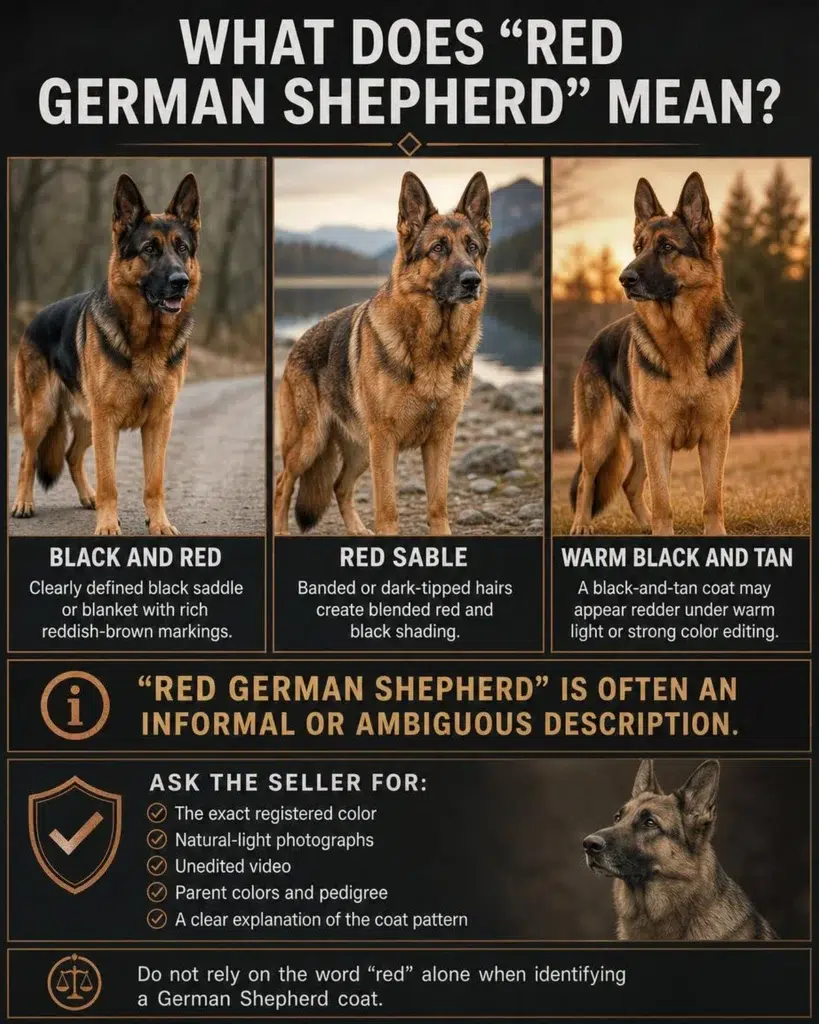
The term red German Shepherd is not precise enough by itself.
The American Kennel Club lists Black & Red as a German Shepherd registration color, but it does not list solid red as a separate standard color.
People may use the phrase to describe:
- A black-and-red saddle dog
- A red sable German Shepherd
- A black-and-tan dog with unusually warm pigment
- A puppy expected to develop richer reddish markings
- A marketing label rather than formal registry terminology
Ask the breeder which pattern the dog actually has and how the parents are registered.
An apparently all-red or solid copper dog is not the same as the familiar black-and-red pattern. A red sable dog also differs because its coat is made largely from banded or black-tipped hairs rather than clearly separated black and reddish areas.
How Black-and-Red Coat Genetics Work
The UC Davis Veterinary Genetics Laboratory canine coat-color resource explains that dog coat color begins with two pigment families:
- Eumelanin creates black or brown areas.
- Phaeomelanin creates red, yellow, tan, cream, or pale areas.
Genes including ASIP, commonly called the agouti locus, help control where these pigments appear. The UC Davis Veterinary Genetics Laboratory ASIP resource describes the black-saddle pattern as black-pigmented hair concentrated mainly across the dorsal region, with red pigment across much of the remaining coat.
The depth of the red areas is another part of the genetic picture. Pigment-intensity modifiers affect how concentrated the phaeomelanin appears.
This is why two dogs with similar saddle patterns may look very different:
- One may have pale cream markings.
- One may appear golden or tan.
- One may have copper or rust pigment.
- One may display deep reddish-brown or mahogany areas.
A single coat-color result does not prove that a puppy will mature into one exact shade. Breeders may make an informed estimate from the parents, pedigree, older relatives, previous litters, and genetic information, but they should not guarantee a precise adult color from an early photograph.
Is Deep Red Pigment Genetically Better?
No.
Rich color may be preferred aesthetically in some breed standards and show communities, but darker red does not automatically mean:
- Better hips
- Better elbows
- Better health
- Stronger nerves
- Greater intelligence
- Superior working ability
- Better movement
- More stable temperament
- Higher breeding quality
Pigment and health are separate subjects. Selecting dogs mainly for dramatic color becomes a problem when sound structure, stable behavior, and appropriate health testing receive less attention.
Black and Red vs. Other German Shepherd Colors
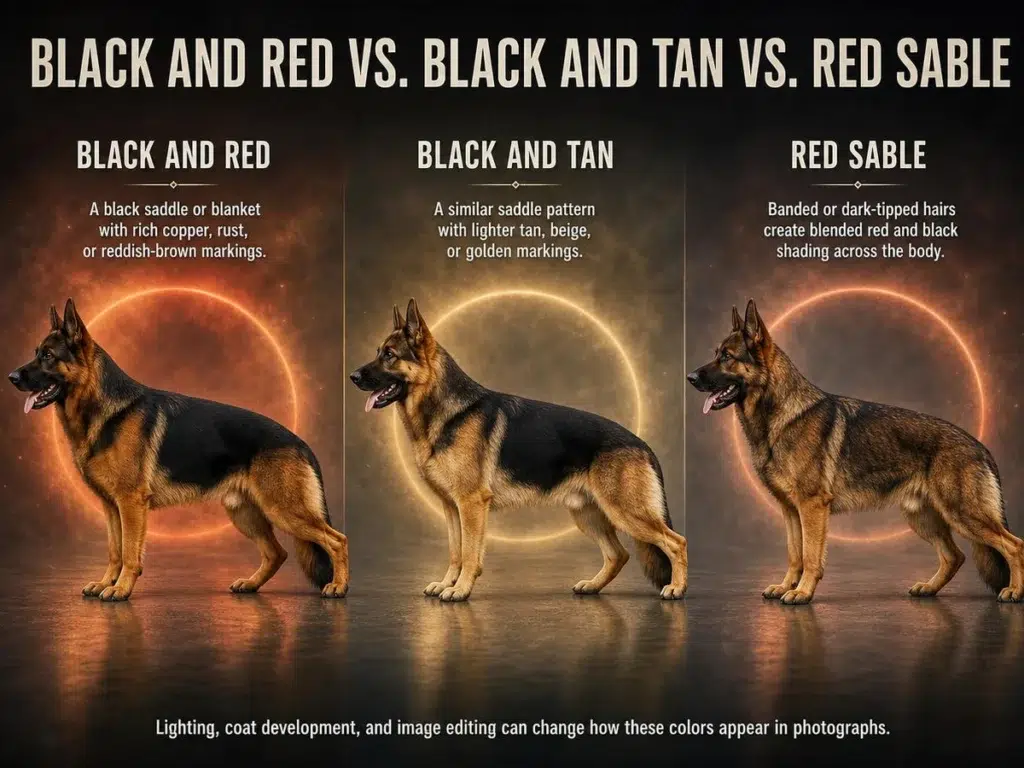
Black and Red vs. Black and Tan
Both patterns usually include a dark saddle or blanket. The main difference is the visible intensity of the lighter pigment.
Black-and-tan dogs have tan, beige, or golden areas. Black-and-red dogs have richer copper, rust, reddish-brown, or mahogany areas.
The dividing line is not always exact because pigment intensity exists on a spectrum. Two registries or breeders may describe similar dogs differently.
Black and Red vs. Black and Cream
Black-and-cream dogs have much paler phaeomelanin. Their markings may look cream, light beige, or pale yellow rather than rich copper.
Black and Red vs. Sable
A sable coat is made largely from banded or dark-tipped hairs distributed across the body. A black-and-red dog usually has more clearly defined areas of solid black and reddish pigment.
A dark red sable can look similar in certain photographs, but close inspection normally reveals banded guard hairs instead of one clearly defined saddle.
Read Furbivo’s sable German Shepherd guide for a detailed explanation of banded hairs and agouti patterning.
Black and Red vs. Bi-Color
A bi-color dog is predominantly black with smaller tan or reddish markings. These markings commonly appear on the legs, feet, face, chest, or underside.
A black-and-red dog usually displays more extensive reddish areas and a more obvious saddle or blanket pattern.
Black and Red vs. Solid Black
A solid-black German Shepherd appears predominantly uniform black and lacks the widespread red markings of a black-and-red dog.
Furbivo’s black German Shepherd guide explains the recessive-black pattern and how it differs from other dark coats.
| Coat description | Main visual feature |
| Black and red | Black saddle or blanket with rich copper or reddish-brown areas |
| Black and tan | Similar pattern with lighter tan or golden markings |
| Black and cream | Black pattern with pale cream or beige markings |
| Sable | Banded or dark-tipped hairs across much of the body |
| Bi-color | Predominantly black with limited tan or red markings |
| Solid black | Mostly uniform black coat |
Is Black and Red an Officially Recognized Color?
Yes.
The American Kennel Club lists Black & Red among German Shepherd registration colors. The United Kennel Club also lists Black and Red in its German Shepherd breed standard.
The German Shepherd Dog Club of America states in its judges’ education material that strong, rich colors are highly desired, including black and red.
The FCI uses slightly different wording. Its German Shepherd Dog standard describes black German Shepherds with reddish-brown, brown, yellow, or light-gray markings among accepted colors.
Different organizations may therefore use different labels for similar-looking coats. When registration, showing, or breeding records matter, follow the terminology and rules of the specific organization rather than relying solely on informal advertising language.
Do Black-and-Red Puppies Change Color?
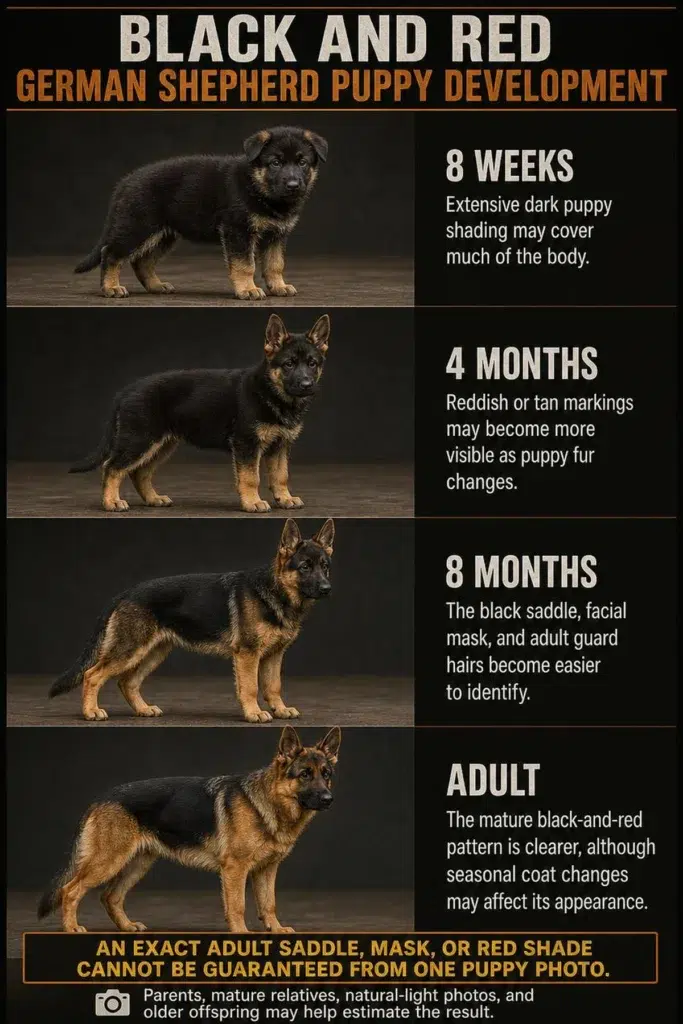
A black-and-red puppy may look much darker than the adult it becomes.
Many saddle-pattern puppies begin with extensive dark areas. The reddish or tan markings may expand and become clearer as the puppy coat is replaced and adult guard hairs develop.
During growth, owners may notice:
- Red or tan areas becoming more visible
- The black saddle becoming better defined
- A dark puppy mask changing in size
- Adult coat texture becoming firmer
- Seasonal undercoat changing the visible color
- Neck and tail feathering developing in long-coated dogs
- The contrast between black and red becoming stronger
The final adult pattern should not be judged from one early photograph.
Ask to see the puppy:
- In natural daylight
- At several different ages
- Beside littermates
- With both parents when practical
- In unedited video
- Alongside mature relatives
- Alongside older offspring from the same parents, when available
These references improve the estimate but cannot guarantee an exact adult saddle, mask, or shade.
Temperament and Personality
A black and red German Shepherd does not have a separate color-based temperament.
Behavior is influenced by:
- The parents and wider pedigree
- Breeder selection
- Early handling
- Socialization
- Training methods
- Physical and mental exercise
- Health and pain
- Home environment
- Previous experiences
- The individual dog
Coat color cannot reliably tell you whether a dog will be:
- Calm or intense
- Social or reserved
- High or moderate drive
- Suitable for children
- Easy for a first-time owner
- Protective or fearful
- Stable or reactive
- Suitable for sport or service work
Evaluate the parent dogs and wider family. A stable adult should be manageable, capable of recovering after a mild surprise, willing to engage with its handler, and able to settle after activity.
Furbivo’s German Shepherd temperament guide explains the difference between confidence, reasonable reserve, fear, reactivity, and uncontrolled aggression.
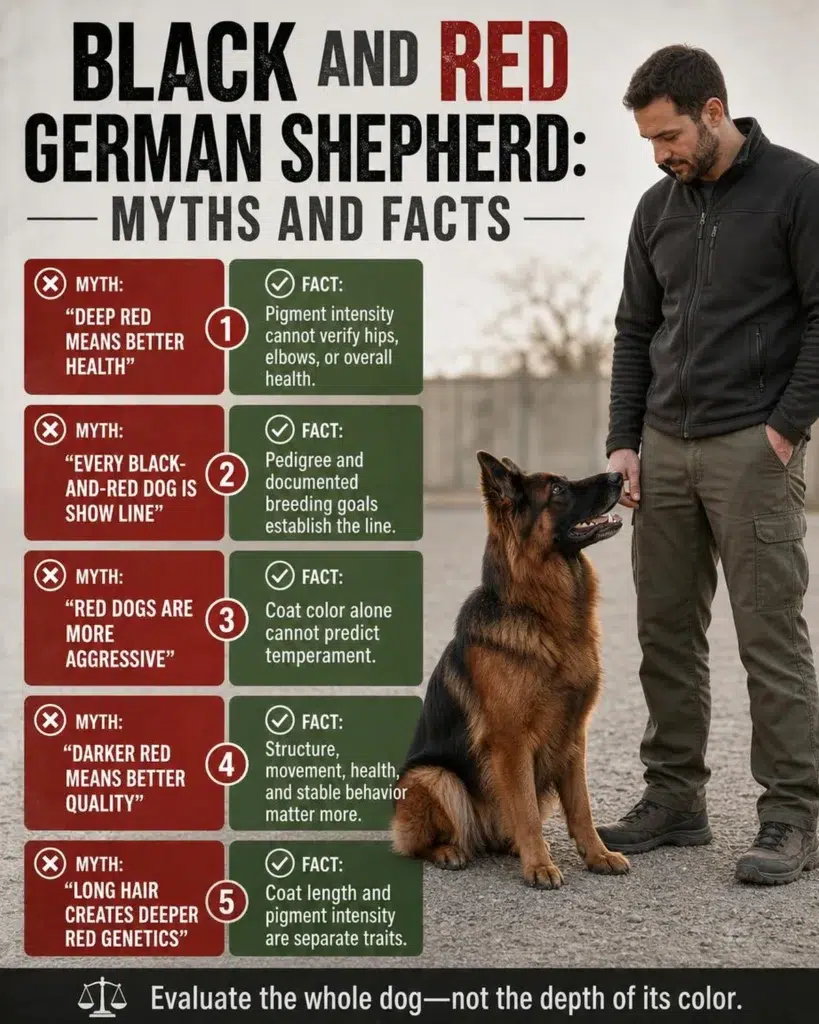
Are Black-and-Red German Shepherds Show-Line Dogs?
The color is often associated with some show-focused pedigrees, especially dogs selected for strong saddle patterns and rich pigment. However, color alone cannot prove that a dog belongs to a specific line.
A valid lineage claim should be supported by:
- A traceable pedigree
- Registered names of the parents
- Verified titles when advertised
- Accurate information about the breeder’s goals
- Evidence of the relatives’ structure and temperament
- Honest discussion of working or companion suitability
Not every show-line dog has this color, and not every richly pigmented dog comes from a well-planned show pedigree.
The phrase red German Shepherd should never be treated as proof of imported ancestry, championship quality, police lineage, protection ability, or a particular working level.
Size, Build, and Lifespan
Coat color does not change the German Shepherd breed standard.
Adult males are generally expected to stand about 24–26 inches at the shoulder, while females are generally 22–24 inches under the AKC standard.
A healthy German Shepherd should have:
- Balanced proportions
- Functional movement
- Appropriate muscle
- Strong but realistic bone
- A healthy body condition
- Stable temperament
- Sound feet and joints
Avoid sellers who connect rich red pigment with claims such as:
- Giant size
- Extra-heavy bone
- King-size structure
- Guaranteed show quality
- Superior European build
- Stronger joints
- Longer lifespan
Furbivo’s German Shepherd growth chart and German Shepherd height and weight guide provide age-based development context.
Red pigment is not a separate lifespan predictor. Longevity is affected by inherited health risk, body condition, preventive care, accidents, nutrition, exercise, and general breeding quality.
Coat Length, Grooming, and Shedding
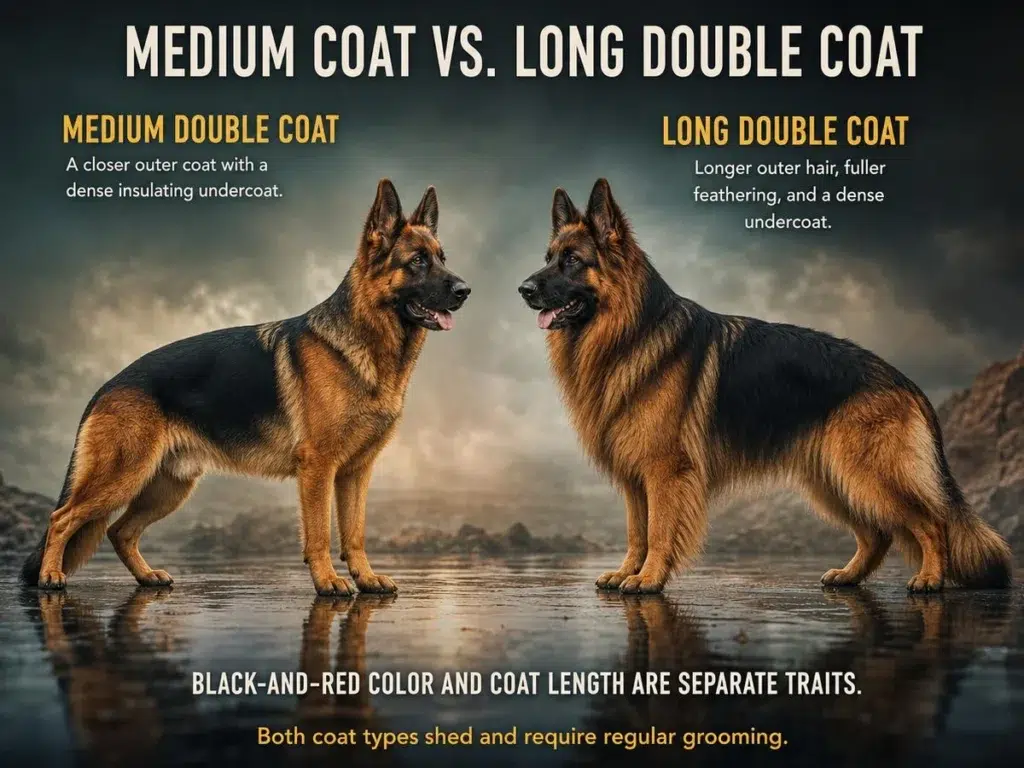
A black and red German Shepherd may have either a medium double coat or a long double coat. Coat color and coat length are inherited separately.
Both coat types shed.
Most owners should expect:
- Loose hair throughout the year
- Heavier undercoat release during seasonal changes
- Regular brushing
- Increased grooming during coat blow
- Extra combing around feathering in long coats
- Hair on bedding, furniture, clothing, and floors
Brush several times per week using light pressure and tools suited to the coat length. Increase brushing frequency temporarily when the undercoat is releasing heavily.
Long-coated dogs may need extra combing:
- Behind the ears
- Around the neck
- In the armpits
- Along the rear legs
- Around the tail
- Across the belly and friction areas
Do not shave the double coat to make the red areas look brighter or to stop shedding. Shaving changes hair length but does not stop the natural growth cycle.
Read Furbivo’s guides to:
- How Much Does a German Shepherd Shed?
- Long-Haired German Shepherd
- Can You Shave a German Shepherd?
- German Shepherd Puppy Grooming Guide
Health Considerations
The black-and-red coat does not create a separate health profile.
A responsible breeder should address German Shepherd health priorities instead of claiming that rich color proves stronger genetics.
Current national breed-club health-testing recommendations listed by the AKC include:
- Hip evaluation
- Elbow evaluation
- Temperament testing
Other testing may be used based on the pedigree, breeder program, regional requirements, and veterinary guidance.
Ask for registered names or identification numbers so that results can be verified independently.
Be cautious of statements such as:
- “Deep red dogs have stronger hips.”
- “Show color means perfect structure.”
- “Our line has no health issues.”
- “DNA clear means the dog cannot develop disease.”
- “A routine veterinary exam replaces hip screening.”
- “Champion ancestry guarantees stable temperament.”
Coat-color testing identifies pigment-related variants. It does not replace orthopedic screening, pedigree research, temperament evaluation, or veterinary care.
Useful Furbivo health resources include:
- Common Diseases in German Shepherds
- German Shepherd Hip Dysplasia
- German Shepherd Puppy Vaccination Schedule
- German Shepherd Puppy Deworming Schedule
How to Choose a Puppy Responsibly
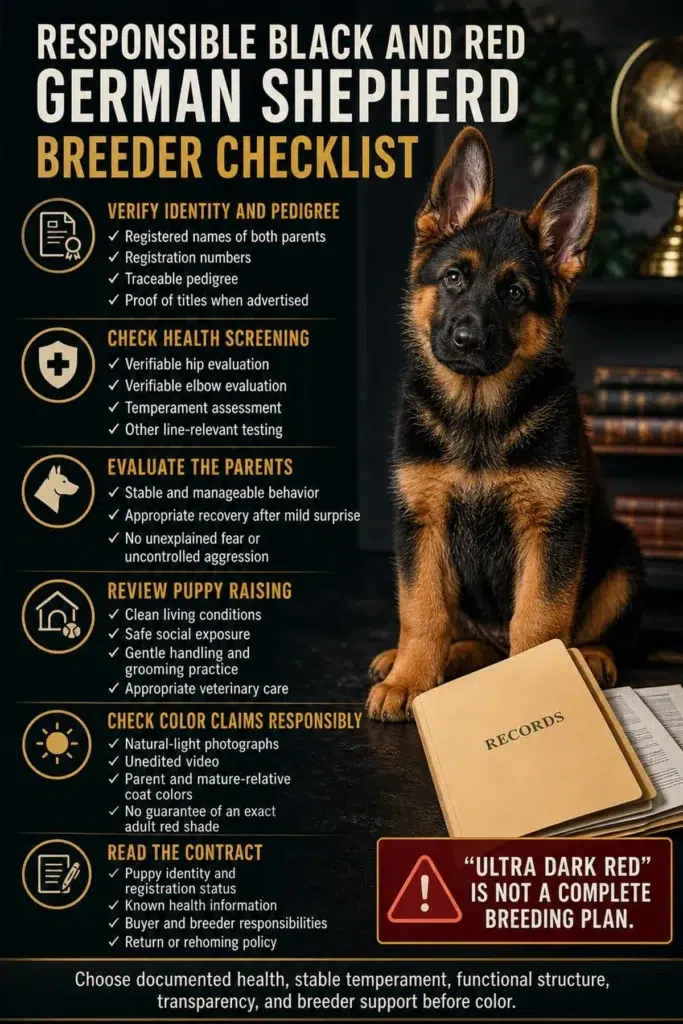
Choosing a black-and-red puppy should begin with the breeder and parents, not the intensity of the coat.
1. Verify Identity and Pedigree
Ask for:
- Registered names of both parents
- Registration numbers
- Pedigree documentation
- Litter details
- Microchip or permanent identification when available
- Clear photographs and unedited video
- Proof of advertised titles
2. Check Health Results
Look for independently verifiable:
- Hip evaluations
- Elbow evaluations
- Temperament testing
- Any other testing relevant to the line
A large DNA panel does not replace orthopedic screening.
3. Evaluate the Parents
Meet the mother when practical and request useful information about the father.
Look for adults that can:
- Recover after a mild surprise
- Remain manageable around people
- Accept ordinary handling
- Engage with their handler
- Settle after excitement
- Explore without panic
- Show confidence without uncontrolled aggression

4. Ask Why the Pairing Was Chosen
A thoughtful answer should discuss:
- Health
- Temperament
- Structure
- Working or companion goals
- Strengths and weaknesses
- Compatibility of the parents
- What the breeder hopes to preserve or improve
“We wanted darker red puppies” is not a complete breeding plan.
5. Review Puppy Raising
Look for:
- Clean living conditions
- Appropriate time with the mother
- Safe interaction with people
- Age-appropriate play
- Household exposure
- Gentle grooming introduction
- Veterinary care
- Appropriate nutrition
- Adequate rest
- Thoughtful matching of puppies to homes
6. Read the Contract
The agreement should clearly identify:
- The puppy
- Registration status
- Known health information
- Buyer responsibilities
- Breeder responsibilities
- Breeding restrictions when relevant
- Return or rehoming arrangements
- Support after purchase
7. Do Not Choose by Color Alone
| Appearance question | Evidence question |
| Is the pigment deep red? | Are hip and elbow results verifiable? |
| Is the saddle attractive? | Are the parents temperamentally stable? |
| Is the puppy long-haired? | How was the litter raised? |
| Does the puppy look like a show dog? | Is the pedigree transparent? |
| Will the red become darker? | Why was this pairing selected? |
| Is the color unusual locally? | Does the breeder offer responsible support? |
The evidence column should remain convincing even if the puppy had a more common shade.
Price and Value
There is no responsible universal price for a black and red German Shepherd.
Cost varies according to:
- Country and region
- Pedigree
- Parent health screening
- Breeder expenses
- Puppy-raising standards
- Registration
- Age
- Training
- Import costs
- Current demand
- Breeder support
A higher price does not prove better breeding, and a lower price does not automatically represent better value.
Treat labels such as these cautiously:
- Ultra dark red
- Championship red
- Imported red
- Fire red
- Rare mahogany
- Premium show color
- Guaranteed red adult
- Exclusive European pigment
A puppy’s value as a companion, sport prospect, or working dog depends on much more than pigment depth.
Common Myths
Myth 1: Black and Red Is a Separate Breed
False. It is a coat-color description within the German Shepherd Dog breed.
Myth 2: A Red German Shepherd Is Solid Red
Usually false. The phrase often refers to black and red or red sable. Ask for the exact pattern and registration terminology.
Myth 3: Deeper Red Means Better Health
False. Color intensity cannot verify hips, elbows, temperament, movement, or overall breeding quality.
Myth 4: Every Black-and-Red Dog Is Show Line
False. The pedigree—not the coat alone—establishes the line.
Myth 5: These Dogs Are More Aggressive
False. Temperament must be assessed through the dog, its relatives, health, socialization, training, and experience.
Myth 6: Long-Haired Dogs Have Richer Red Genetics
False. Coat length and pigment intensity are separate traits, although longer hair and warm lighting can increase the visual effect.
Myth 7: Red Coats Shed Less
False. A comparable double coat follows the same shedding cycle regardless of the richness of its markings.
Myth 8: A Dark Puppy Will Stay Equally Dark
Not necessarily. The saddle, mask, and visible red areas can change as the adult outer coat develops.
What Most Articles Miss
The first missed distinction is between pattern and intensity.
The black saddle or blanket is one part of the coat pattern. The depth of the red areas is another feature influenced by pigment intensity.
Two dogs can have very similar saddle placement but very different lighter markings:
- Cream
- Gold
- Tan
- Copper
- Rust
- Mahogany
- Deep reddish-brown
The second overlooked issue is photography.
Warm sunlight, indoor bulbs, camera white balance, contrast, saturation, wet fur, and editing can make the same dog appear tan in one photograph and deep red in another.
Request natural-light photographs and unedited video before making a buying decision based on an advertisement.
The third missed point is that a coat label cannot establish the bloodline.
A richly pigmented dog may come from:
- Show-focused breeding
- Working-focused breeding
- Mixed show and working goals
- Companion-focused breeding
- Poorly planned breeding selected mainly for appearance
Only the pedigree and documented breeding program answer that question.
Use this decision order:
- Confirm that the breed suits your lifestyle.
- Investigate the breeder.
- Verify health screening.
- Evaluate parent temperament.
- Review the pedigree and claimed titles.
- Assess how the puppies are raised.
- Read the contract.
- Consider the individual puppy.
- Choose the preferred color after the important evidence is strong.
Frequently Asked Questions
Is a black and red German Shepherd purebred?
Yes. A black and red German Shepherd can be fully purebred. The color is listed by the AKC and UKC, while purebred status depends on documented ancestry rather than coat shade alone.
What is the difference between black and red and black and tan?
The main difference is pigment intensity. Black-and-red dogs have richer copper or reddish-brown markings, while black-and-tan dogs have lighter tan, gold, or beige areas. The boundary may be gradual rather than exact.
Is a red German Shepherd an official color?
The phrase is ambiguous. The AKC lists Black & Red, but not solid red, as a German Shepherd registration color. Red can also be used informally for a red sable dog.
Do black-and-red puppies get lighter as they grow?
Some puppies become visually lighter as extensive dark puppy shading recedes, while their red areas may become richer or more visible. The final pattern becomes clearer after the adult outer coat develops.
Are black-and-red German Shepherds more expensive?
They may be marketed at a premium where rich pigment is popular, but no universal price applies. Health testing, pedigree, temperament, puppy raising, and breeder support are more meaningful than color.
Are black-and-red German Shepherds more aggressive?
No. Coat color does not establish aggression or protectiveness. Evaluate the parents, pedigree, early development, training, health, and individual behavior.
Can a black-and-red German Shepherd have long hair?
Yes. Coat length and coat color are separate traits, so the pattern may occur in both medium and long double coats.
Do black-and-red German Shepherds shed?
Yes. They have the German Shepherd double coat and normally shed year-round, with heavier undercoat release during seasonal changes.
Final Thoughts
A black and red German Shepherd combines a black saddle, blanket, or mask with rich reddish-brown markings. It is a recognized color description, not a separate breed or proof of a particular bloodline.
The phrase red German Shepherd should be treated carefully because it may describe black and red, red sable, or simply warmer tan pigment. Ask for the exact pattern, view the dog in natural light, and verify registration and pedigree claims.
Choose the dog behind the color. Prioritize stable temperament, health screening, functional structure, transparent records, responsible puppy raising, and long-term breeder support before paying more for deeper pigmentation.
Have questions about your dog’s health, nutrition, grooming, or daily care? Visit our Contact Us page to reach the Furbivo team. For any medical symptoms, diagnosis, or treatment advice, always consult a qualified veterinarian.
