
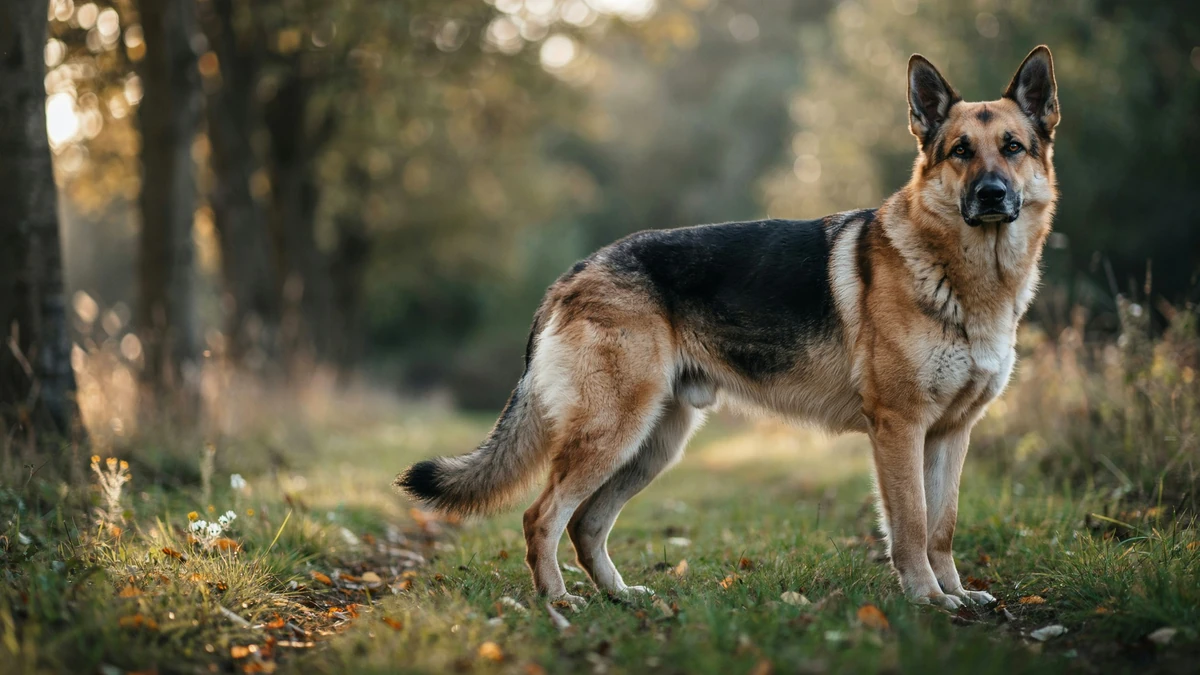
A sable German Shepherd is a purebred German Shepherd Dog whose individual hairs often contain alternating light and dark pigment, creating a layered gray, gold, red, brown, or dark appearance. Sable is a recognized German Shepherd color, not a separate breed, mixed breed, wolf hybrid, or proof of a specific working line.
The coat can look very different from one dog to another. Some sable dogs appear pale gray, some warm gold or red, and others nearly black from a distance. Coat color alone does not determine health, trainability, aggression, adult size, or suitability as a family dog.
Quick Answer: What Is a Sable German Shepherd?
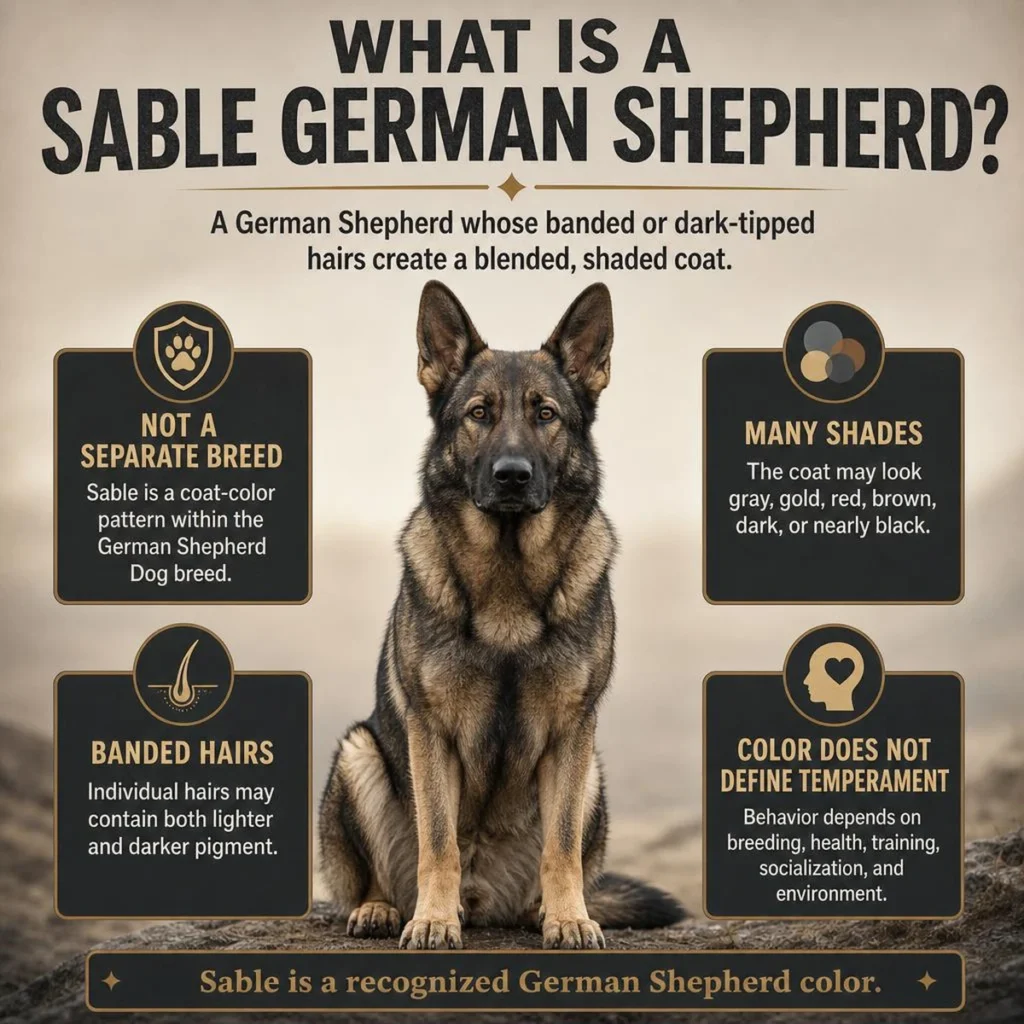
A sable German Shepherd has a coat made up largely of banded hairs instead of one uniform color or a sharply defined black saddle. A visible hair may contain lighter pigment along part of its shaft and darker pigment along another part, producing the blended, shaded appearance commonly called sable or agouti.
The American Kennel Club lists sable as a standard registration color for German Shepherd Dogs. Other registries may use related descriptions such as sable, dark sable, gold sable, gray sable, or gray with darker shading.
| Feature | What it means |
|---|---|
| Breed status | A coat-color pattern within the German Shepherd Dog breed |
| Typical appearance | Banded or dark-tipped hairs creating blended shading |
| Common descriptions | Gray, gold, red, light, dark, or black sable |
| Coat type | Usually a medium or long double coat |
| Temperament | Influenced by breeding, socialization, training, health, and environment |
| Grooming | Regular brushing with heavier seasonal shedding |
| Health priorities | The same breed-level screening priorities as other German Shepherds |
| Registry status | Recognized, although terminology differs among kennel organizations |
What Does “Sable” Mean in a German Shepherd?
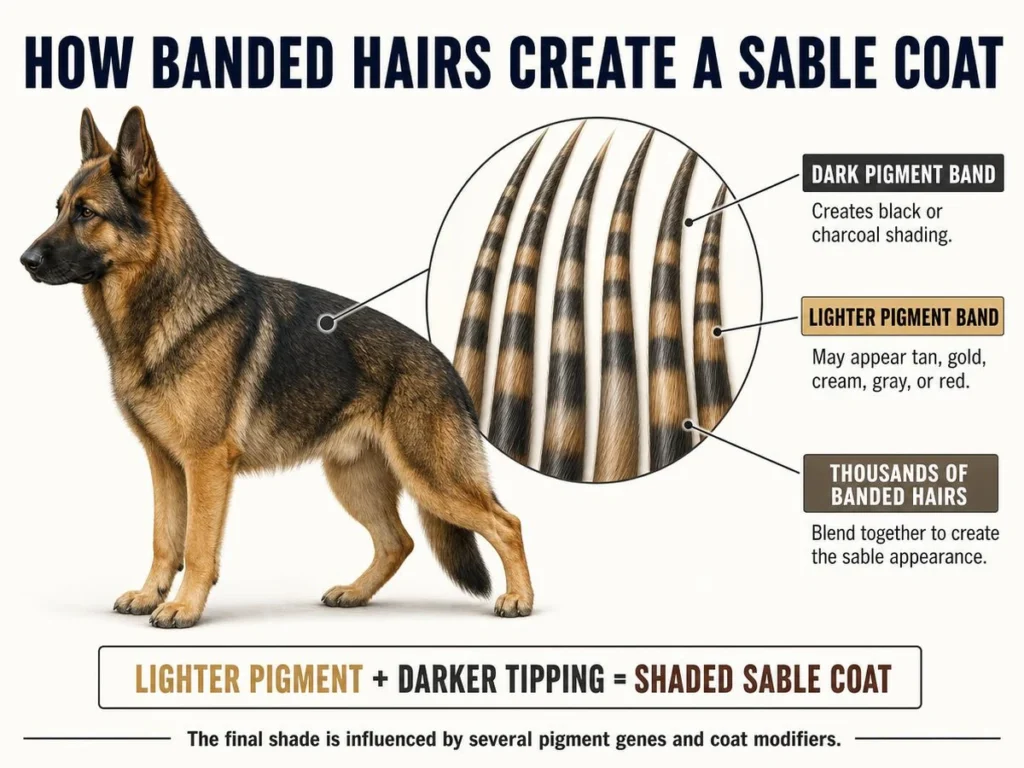
In everyday breed language, sable describes a German Shepherd whose coat looks shaded because many hairs contain more than one pigment band. Rather than seeing one solid black saddle placed over a tan body, you see dark tips or bands distributed across much of the torso, neck, shoulders, and head.
Up close, individual hairs may show combinations of black and tan, gray, cream, gold, or reddish pigment. From a distance, those hairs visually blend into an overall gray, brown, golden, reddish, charcoal, or nearly black coat.
UC Davis Veterinary Genetics Laboratory describes the agouti phenotype as banded yellow-and-black hairs when the relevant pigment pattern is expressed without dominant black masking it. Final appearance can also be affected by other pigment genes and modifiers.
Owners and breeders may use terms such as:
- Gray sable
- Wolf sable
- Gold sable
- Red sable
- Dark sable
- Black sable
- Silver sable
These are descriptive terms, not separate German Shepherd breeds. They also may not match the exact color written on registration documents. The Royal Kennel Club, for example, lists sable, dark sable, gold sable, and gray sable among recognized breed-standard colors, while the AKC separately lists sable and gray.
Sable German Shepherd Genetics Explained Simply
The sable German Shepherd pattern is connected partly to the ASIP gene, which is often called the agouti locus. This gene helps control when a hair follicle produces dark eumelanin and when it produces lighter red-to-yellow phaeomelanin.
When pigment production switches during hair growth, one hair can develop multiple colored bands instead of remaining uniformly black, tan, or red. Thousands of those hairs combine to create the shaded sable appearance.
Coat genetics are more complicated than a single “sable gene.” UC Davis explains that ASIP pattern variants interact with other locations, including the K locus and MC1R. Other genes can influence whether the lighter pigment appears cream, tan, gold, or deeper red.
This helps explain why two sable dogs can have noticeably different:
- Amounts of black tipping
- Base shades
- Masks
- Leg coloring
- Undercoat shades
- Adult coat depth
- Seasonal appearance
A coat-color DNA test can identify certain pigmentation variants, but it cannot prove that a dog is well bred, healthy, temperamentally stable, suitable for breeding, or even correctly represented by a seller. Pedigree documentation, parentage information, health screening, and evaluation of the whole dog remain necessary.
Is Sable Genetically Dominant?
Sable has traditionally been described as dominant within simplified German Shepherd color charts. Modern genetic laboratories use a more detailed model involving multiple ASIP haplotypes and interactions with other pigment genes.
For an owner, the practical point is that a sable parent may produce sable puppies, depending on the genetic contribution of both parents. A responsible breeder can estimate likely patterns using pedigree information and current testing, but litter colors remain probabilities rather than absolute guarantees.
What Shades Can a Sable Coat Have?
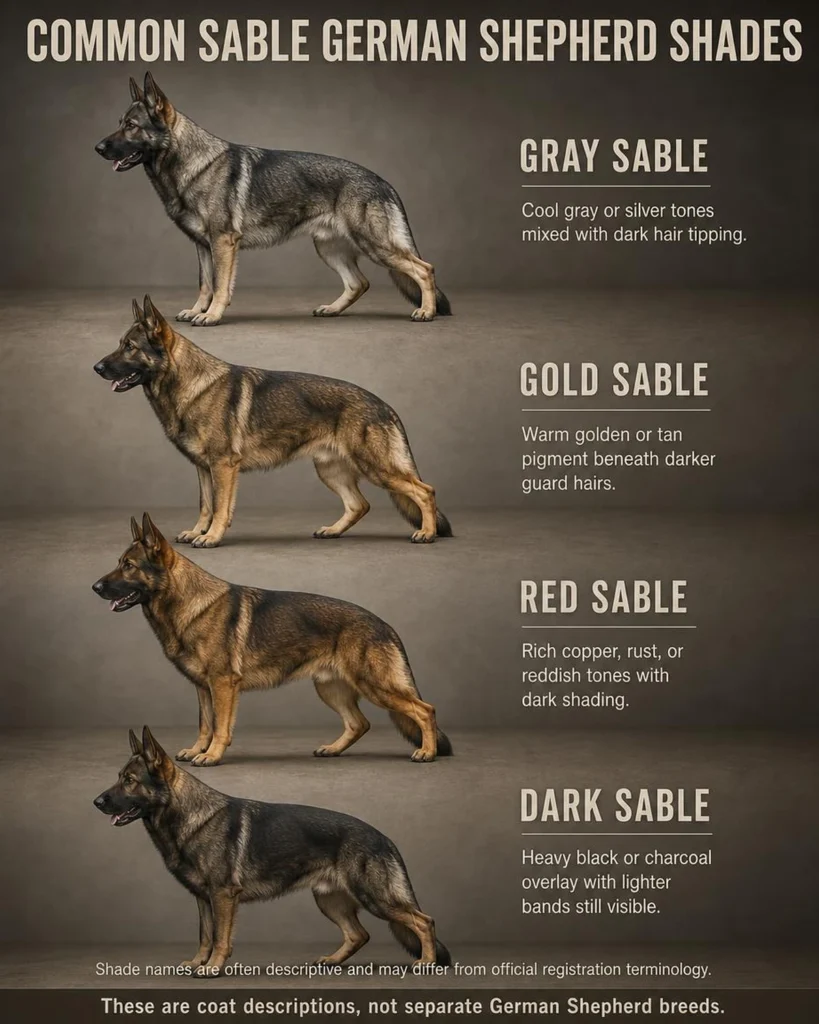
The sable coat can appear in a wide range of shades because the word describes pigment distribution rather than one fixed color.
Gray Sable
Gray sable dogs often have cool silver, gray, or wolf-like coloring mixed with black bands. Their legs and underside may appear lighter while the back, shoulders, neck, and head appear more heavily shaded.
The FCI German Shepherd standard recognizes gray with darker shading among accepted breed colors, while the Royal Kennel Club lists gray sable as a standard color.
Gold Sable
Gold sable coats contain warm cream, tan, or golden pigment beneath black-tipped hairs. The gold may be most visible along the shoulders, legs, cheeks, sides, and lower body.
Red Sable
Red sable dogs have richer copper, rust, mahogany, or reddish pigment underneath their dark overlay. The word “red” describes the intensity of the lighter pigment and does not create a separate breed or size category.
Dark Sable
A dark sable dog has extensive dark shading. From a distance, it may look almost black, but closer examination usually reveals lighter bands around the neck, legs, flanks, belly, or undercoat.
Black Sable
“Black sable” is commonly used as an informal description for a very dark sable coat. It should not be confused with a genetically solid-black German Shepherd.
A true solid-black coat appears much more uniform. A black sable coat normally reveals lighter pigment bands or areas when inspected closely.
Light Sable
Light sable dogs have less dark overlay or paler underlying pigment. The AKC breed standard prefers strong, rich colors and considers pale or washed-out colors less desirable in conformation judging. That judging preference does not mean a light-colored dog can be diagnosed as unhealthy from coat shade alone.
How Is Sable Different From Black and Tan?
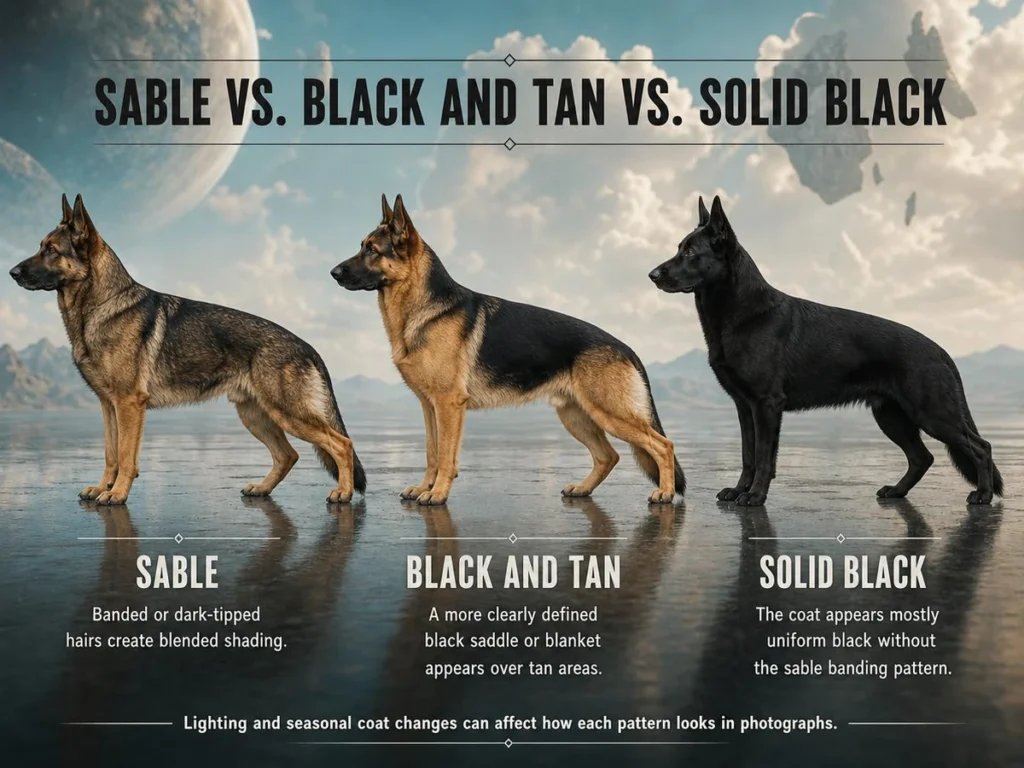
A black-and-tan German Shepherd normally has clearer sections of solid black and tan. Black often forms a saddle or blanket over the back, while tan appears on the legs, chest, underside, cheeks, and parts of the face.
A sable coat looks more blended because dark pigment is spread through banded hairs over a larger portion of the body. The border between dark and light areas is usually less sharply defined.
| Coat pattern | Main visual feature | Boundary between colors |
| Sable | Banded or dark-tipped hairs across much of the body | Blended and shaded |
| Black and tan | Black saddle or blanket with tan areas | More clearly defined |
| Bi-color | Predominantly black with smaller tan markings | Heavy black coverage |
| Solid black | Mostly uniform black pigment | No tan saddle pattern |
| Gray | Overall gray appearance; terminology may overlap with sable | Depends on registry and coat |
Lighting, wet fur, seasonal undercoat, camera filters, and image processing can change how the pattern looks in photographs. Registration color should be based on the actual coat and the definitions used by the relevant registry.
For a broader comparison of the breed’s recognized and commonly discussed coat patterns, read Furbivo’s guide to German Shepherd colors.
Do Sable Puppies Change Color?
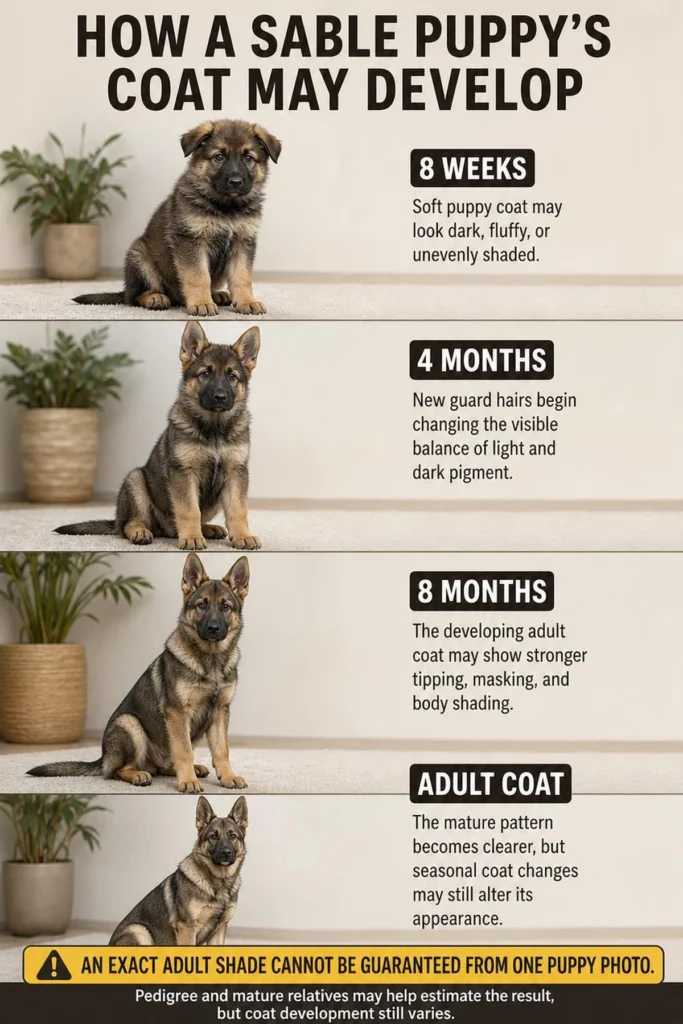
A sable puppy may look noticeably different as its soft puppy coat is replaced by adult guard hairs and a denser undercoat. Dark tipping may become more visible, and the balance between lighter and darker hairs may appear to shift.
This is best understood as coat development rather than the puppy repeatedly changing into unrelated colors. The underlying genetic pattern remains, but newly growing hairs, adult coat texture, seasonal undercoat, and lighting can change the visible result. This explanation is an inference from how agouti pigment bands and the German Shepherd double coat develop.
A young puppy may:
- Look darker at birth
- Develop lighter areas as puppy fluff grows
- Show stronger dark tipping during later coat development
- Look lighter during one seasonal coat
- Look darker when the undercoat is reduced
- Develop a more defined mask or facial shading
Do not demand a guaranteed adult shade based on one photograph taken at six or eight weeks.
Ask to see:
- Both parents
- Older relatives
- Previous mature offspring from the same parents, when available
- Unedited photographs in natural daylight
- Photographs from several ages
- The registered colors of the parents
These references may improve the estimate, but no ethical breeder should promise an exact adult darkness, overlay, mask, or photographic appearance.
Is a Sable German Shepherd Recognized by the AKC?
Yes. The sable German Shepherd is recognized by the American Kennel Club as a standard registration color. The AKC’s official German Shepherd Dog standard states that most colors are permissible, strong and rich colors are preferred, blue and liver are serious faults, and white is disqualifying in conformation competition.
The German Shepherd Dog Club of America also explains that strong, rich colors—including various sable shades—are desirable.
International terminology is slightly different. The FCI standard includes gray with darker shading, black saddle, and mask among accepted color descriptions. The Royal Kennel Club recognizes several sable labels, including dark sable, gold sable, gray sable, and sable.
Recognition does not make coat color the main measure of quality. Breed type, health, sound movement, stable temperament, and functional ability matter more than selecting the darkest or most fashionable shade.
Is Sable a Rare German Shepherd Color?
Sable may be less familiar to casual pet owners than classic black and tan, but it is an established standard color rather than a newly created exotic variation. AKC registration material includes sable as a standard color, and German Shepherd Dog Club of America statistics record sable registrations over multiple years.
Its availability depends on:
- Country
- Region
- Bloodline
- Breeder goals
- Local demand
- Type of work or sport favored by breeders
Sable is frequently associated with working pedigrees, which can make it appear more common among sport, police, military, tracking, and protection dogs. However, color alone does not prove working ancestry, imported bloodlines, exceptional drive, courage, or intelligence.
Be cautious when a seller relies heavily on terms such as:
- Ultra rare
- Exclusive black sable
- Wolf German Shepherd
- Military color
- Old-world sable
- Police blood color
- One-of-a-kind coat
Those phrases may be marketing descriptions rather than registry classifications or evidence of breeding quality.
Sable German Shepherd Temperament
The sable German Shepherd should have the temperament expected of a responsibly bred German Shepherd Dog: confident, alert, intelligent, trainable, courageous, and capable of controlled work.
The AKC breed standard describes an approachable, self-confident dog that is not hostile without cause. The standard does not create a separate temperament requirement for sable dogs.
Color alone cannot tell you whether an individual dog will be:
- Calm or intense
- Social or reserved
- Easy or difficult to train
- High or moderate drive
- Reactive or stable
- Protective or fearful
- Suitable for children
- Suitable for a first-time owner
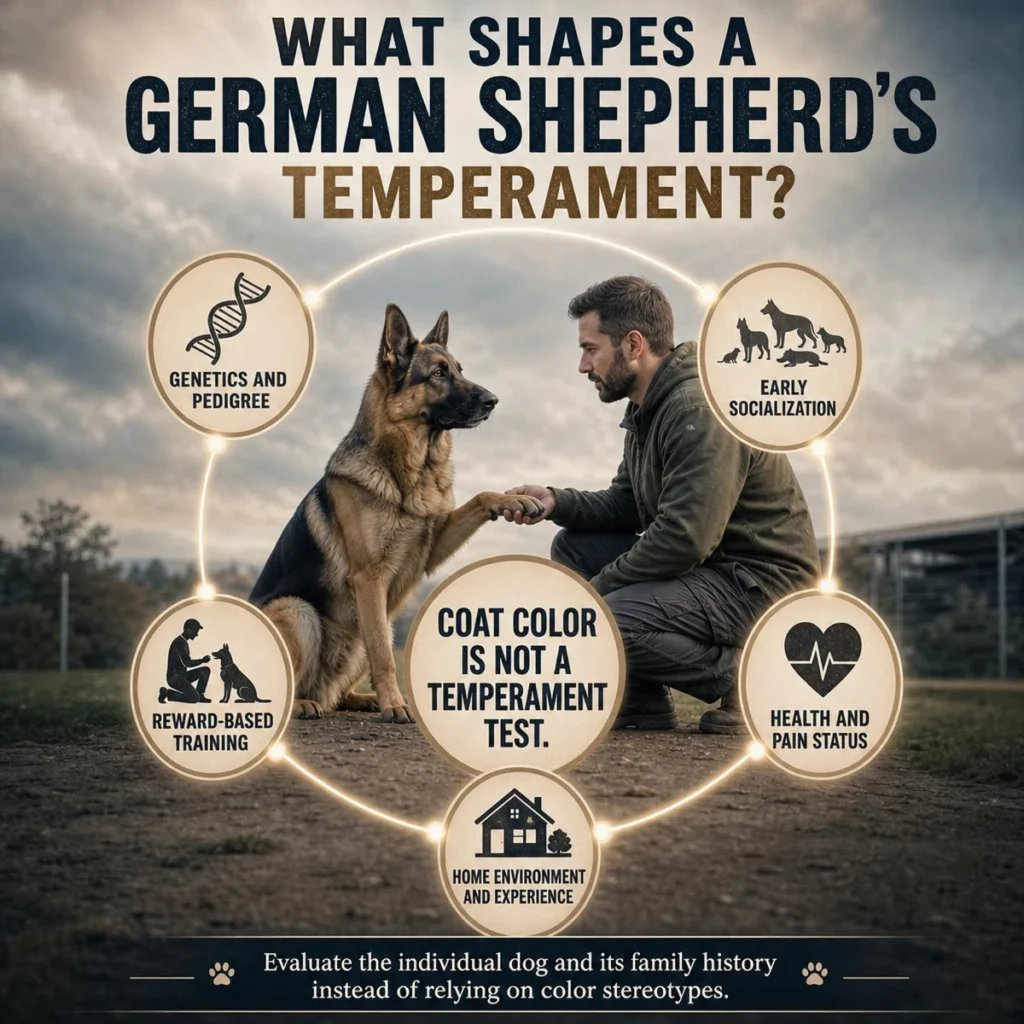
Behavior is influenced by the temperament of the parents and wider pedigree, early handling, socialization, training, exercise, environment, pain, illness, and the individual dog’s experiences.
Studies in other dog populations have also shown that broad coat-color stereotypes are unreliable predictors of behaviors such as aggression. Results can differ by breed and population, which is another reason not to assign a special personality to a German Shepherd based only on sable coloring.
A dark sable dog from a high-drive working pedigree may be intense because breeders selected working traits within that line—not because black-tipped hairs produce intensity.
For a detailed explanation of stable confidence, protectiveness, reactivity, and aggression, read Furbivo’s guide to German Shepherd temperament.
Size, Build, and Lifespan
A sable-coated German Shepherd follows the same size and structural standards as German Shepherds of other recognized colors. Sable is not a size variation and does not produce a taller, heavier, or more wolf-like dog.
The AKC standard places males at 24–26 inches at the withers and females at 22–24 inches. The FCI standard gives heights of 60–65 centimeters for males and 55–60 centimeters for females.
Responsible breeding should prioritize:
- Balanced proportions
- Functional movement
- Appropriate bone
- Healthy body condition
- Stable temperament
- Sound hips and elbows
- Absence of exaggerated size or structure
For age-based development, use Furbivo’s German Shepherd growth chart and German Shepherd height and weight guide.
Coat color is not a separate lifespan predictor. Longevity depends more on inherited disease risk, body condition, preventive care, accidents, nutrition, activity, and overall breeding quality.
Coat Type, Shedding, and Grooming
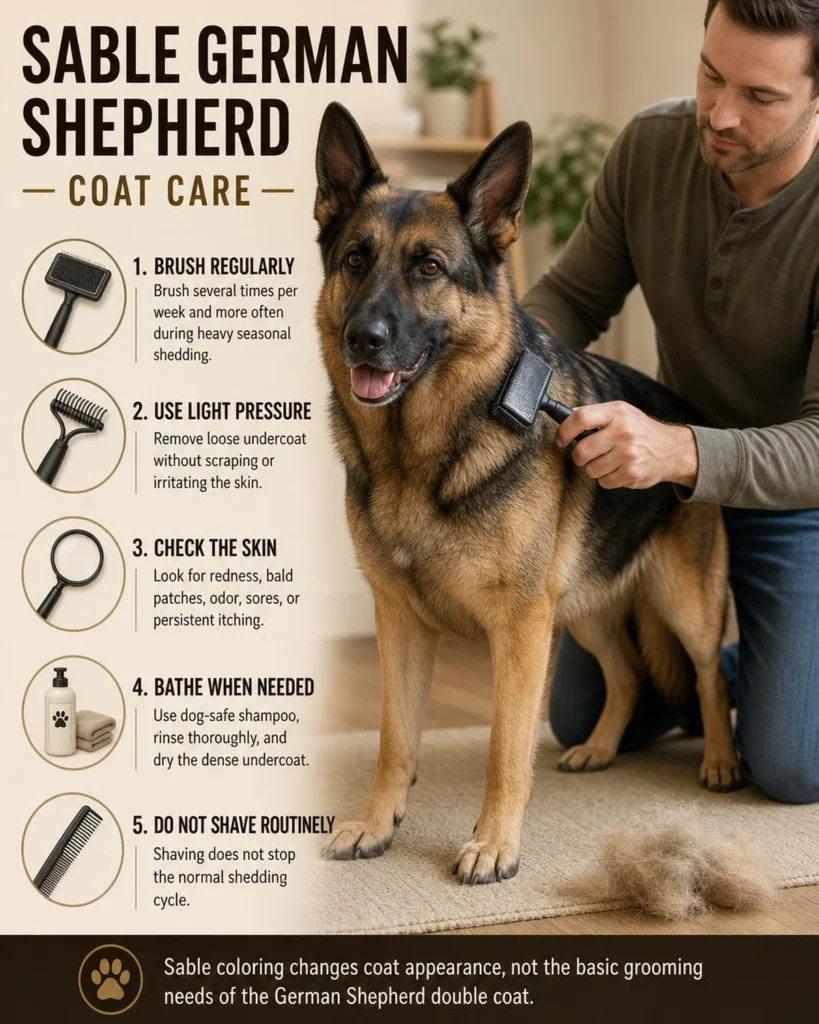
Most sable-coated German Shepherds have the breed’s medium-length double coat, although the sable pattern can also occur in long-coated dogs. The standard coat includes firmer guard hairs over a softer undercoat.
They shed throughout the year and commonly release more undercoat during seasonal changes. Their mixed light-and-dark hairs may be especially visible on contrasting flooring, clothing, or furniture.
A practical routine includes:
- Brushing several times per week
- Brushing more frequently during a coat blow
- Using light pressure with an appropriate slicker brush or undercoat rake
- Checking the skin during grooming
- Bathing only when needed
- Rinsing shampoo thoroughly
- Drying the dense undercoat fully
- Avoiding routine shaving of a healthy double coat
Furbivo’s guide to how much a German Shepherd sheds explains seasonal coat blow, grooming tools, household management, and warning signs of abnormal hair loss.
A dog that is both sable and long-coated may need extra combing behind the ears, around the neck, on the rear legs, and along the tail. Read the long-haired German Shepherd guide for those additional grooming needs.
Does Sable Color Cause Health Problems?
Sable is a recognized coat pattern and should not be treated as a medical diagnosis. A standard color does not prove that a dog is healthy, and a lighter or darker sable shade does not diagnose disease.
Health priorities remain the same as they are for the German Shepherd breed generally.
The national breed-club health-testing recommendations listed by the AKC include:
- Hip evaluation
- Elbow evaluation
- Temperament testing
The AKC German Shepherd breed page also advises responsible breeders to screen breeding dogs for hip and elbow dysplasia and degenerative myelopathy.
The Orthopedic Foundation for Animals explains that its CHIC program works with parent clubs to establish breed-specific screening protocols and publish results. Receiving a CHIC number means the required tests were completed and made public; it does not guarantee that every result was normal or that the dog can never develop disease.
Ask for independently verifiable results instead of accepting phrases such as:
- Vet checked
- Healthy bloodline
- Parents never had problems
- DNA clear
- Health guaranteed
- Strong working genetics
A routine veterinary examination is valuable, but it is not the same as formal hip and elbow screening.
Furbivo’s guide to common diseases in German Shepherds covers breed-associated orthopedic, neurologic, digestive, skin, and eye conditions without suggesting that every German Shepherd will develop them.
How to Choose a Sable German Shepherd Puppy
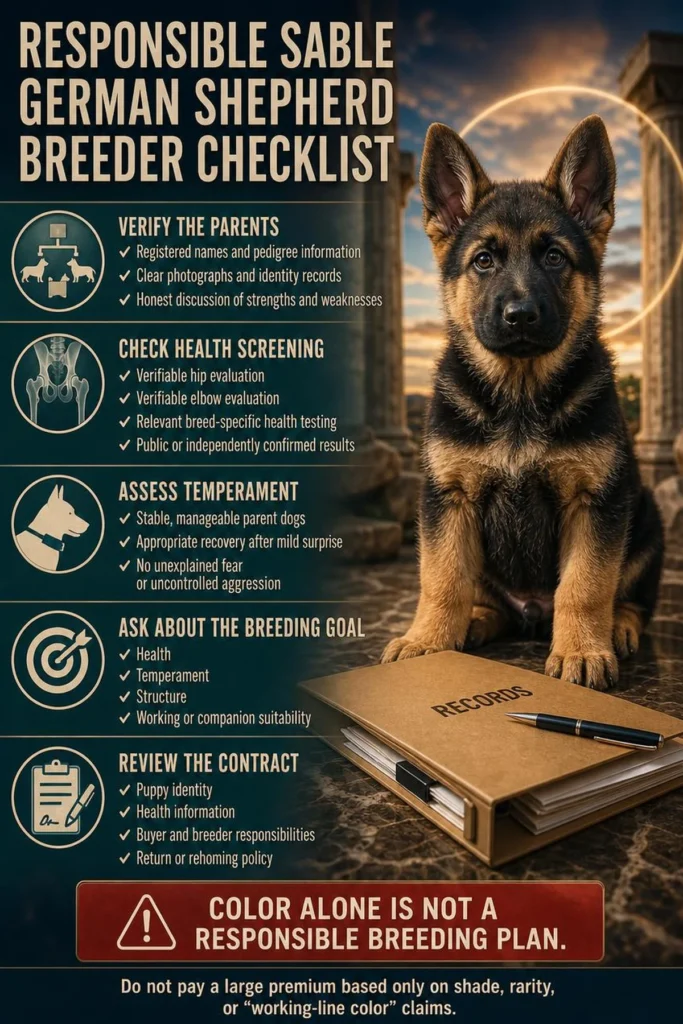
Choosing a sable German Shepherd puppy by appearance alone creates unnecessary risk. A responsible breeder should be able to discuss the entire dog rather than focusing only on the coat.
1. Verify the Parents
Ask for:
- Registered names
- Registration numbers
- Pedigree information
- Clear photographs
- Age and health information
- Work, sport, or conformation results when claimed
Confirm important records through the named registry or health database rather than relying only on screenshots supplied by the seller.
2. Review Health Testing
Look for independently verifiable hip and elbow results and the temperament testing recommended by the German Shepherd’s national breed club.
Discuss other tests used within the breeder’s lines, but remember:
- A DNA panel cannot replace hip radiographs.
- One clear DNA result does not make a dog free from every inherited disease.
- Testing the puppy does not correct an irresponsible mating.
- Health testing reduces risk; it does not create a lifetime guarantee.
3. Evaluate Temperament
Meet the mother when possible and ask detailed questions about the father.
Look for adults that can:
- Recover after mild surprise
- Remain manageable around people
- Accept normal handling
- Engage with their handler
- Settle after excitement
- Work without uncontrolled aggression
- Show confidence without being chaotic
Reasonable reserve is different from panic, shutdown, frantic barking, or inability to recover.
4. Ask Why the Pairing Was Chosen
A thoughtful answer should discuss:
- Temperament
- Health
- Structure
- Working ability
- Strengths and weaknesses
- Compatibility between the parents
- The breeder’s goal for the litter
“We wanted very dark sable puppies” is not an adequate breeding plan by itself.
5. Avoid Guaranteed Adult-Color Claims
Breeders may estimate likely adult shades from pedigree, genetics, and earlier litters. They should not guarantee an exact future shade, amount of black overlay, mask, or photographic appearance.
6. Review the Contract
A responsible contract should clarify:
- The puppy’s identity
- Registration status
- Known health information
- Buyer and breeder responsibilities
- Return or rehoming arrangements
- Breeding restrictions, when applicable
- What happens if the buyer cannot keep the dog
Be cautious when pressure to pay immediately is based mainly on the claim that a rare color will disappear.
7. Consider a Rescue
German Shepherd rescues may have sable puppies and adults. An adult dog has the advantage of an already visible mature coat, and foster-based organizations may provide useful information about behavior in a home.
Remember that rescue behavior can change as the dog adjusts, so use proper introductions and allow a settling period.
How Much Does a Sable German Shepherd Cost?
There is no responsible universal price for a sable German Shepherd. Prices change with location, pedigree, age, training, health testing, breeder expenses, availability, and current demand.
Color may influence marketing, but it should not replace evidence of responsible breeding.
Compare what is documented:
- Parent health screening
- Temperament evaluation
- Pedigree
- Registration
- Veterinary care
- Puppy raising and socialization
- Contract terms
- Breeder support
- Return policy
- Training already completed
A higher price does not prove quality. A lower price does not automatically represent value.
Avoid paying a large premium based only on labels such as rare, wolf-like, imported, old-world, military, police, or black sable.
Daily Care Needs
A sable-coated dog requires the same structured care as any other German Shepherd:
- Daily activity appropriate for age and health
- Mental enrichment
- Reward-based training
- Early controlled socialization
- Household boundaries
- A complete and balanced diet
- Weight management
- Regular grooming
- Preventive veterinary care
- Secure containment
- Identification and microchipping
The breed is intelligent and physically capable, but intelligence does not make ownership effortless. An under-stimulated adolescent may create unwanted jobs such as fence running, barking, chewing, digging, chasing movement, or guarding household activity.
New puppy owners can use Furbivo’s:
- German Shepherd puppy daily routine
- German Shepherd puppy socialization guide
- Guide on how to train a German Shepherd
- German Shepherd puppy grooming guide
Common Myths About the Sable Coat
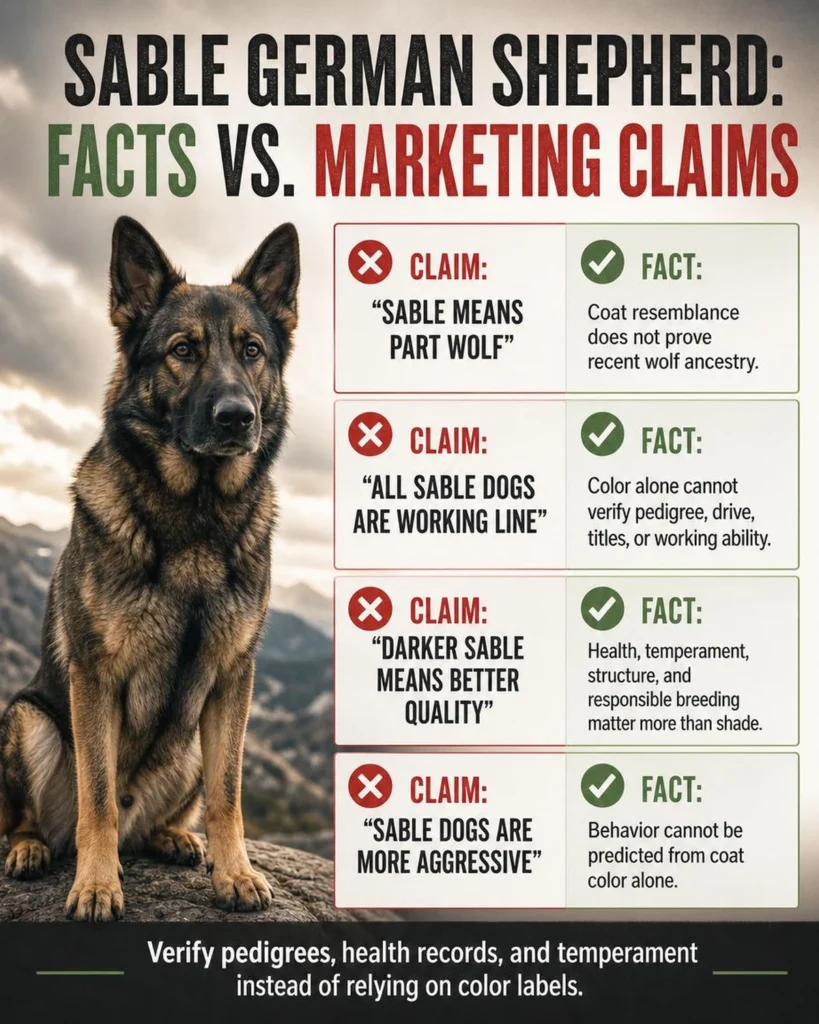
Myth 1: Sable Dogs Are Part Wolf
The banded coat may look wolf-like, but visual resemblance does not prove recent wolf ancestry. A registered sable dog remains a German Shepherd Dog unless verified ancestry shows otherwise.
Myth 2: Every Sable Dog Comes From Working Lines
The color is common in some working pedigrees, but the coat itself does not establish line, working titles, drive, ability, or imported ancestry.
Check the pedigree and the accomplishments of the actual dogs.
Myth 3: Darker Sable Means Better Health or Quality
A dark coat can be striking, but more black does not automatically mean:
- Better hips
- Stronger nerves
- Better movement
- Greater intelligence
- Better health
- Better working ability
- Higher breeding quality
The official standard evaluates the entire dog, not darkness alone.
Myth 4: Sable Dogs Are More Aggressive
There is no separate sable temperament standard. Color should not be used to predict aggression, courage, or family suitability.
Evaluate the individual dog, its parents, pedigree, social development, training history, health, and environment.
Myth 5: Sable Dogs Do Not Shed as Much
Sable dogs have the same double-coat shedding needs as other German Shepherds with a comparable coat length. Their mixed coloring may hide some hair on certain surfaces, but it does not stop the shedding cycle.
Myth 6: A Color DNA Test Proves Purebred Status
A coat-color test identifies variants related to pigmentation. It does not replace:
- Pedigree documentation
- Parentage verification
- Full breed identification
- Health testing
- Temperament assessment
- Responsible breeding records
What Most Articles Miss
The most important fact about this color is that “sable” can be both a visual description and a registry term. Those two uses do not always align perfectly.
A dog may be described casually as:
- Dark sable
- Wolf sable
- Black sable
- Red sable
- Gray sable
Its official paperwork may simply list sable or gray. This does not automatically mean the breeder is dishonest, but buyers should ask which term is informal and which is recorded by the registry.
The second missed point is that color and bloodline are separate questions. Sable is strongly associated with some working pedigrees, so people sometimes treat the coat as proof of courage, drive, police potential, or superior intelligence.
It is not.
Pedigree, health records, temperament, titles, training history, and individual evaluation provide that information.
Finally, an attractive coat can distract a buyer from serious weaknesses. Use a two-column decision:
| Appearance questions | Evidence questions |
| Do I like the shade? | Are hip and elbow results verifiable? |
| Is the mask attractive? | Are the parents temperamentally stable? |
| Will the coat become darker? | Why was this mating selected? |
| Is the color unusual locally? | Is the breeder transparent? |
| Does the puppy photograph well? | Does this breed fit my lifestyle? |
Do not commit until the evidence column is strong enough without the color.
Frequently Asked Questions
Is a sable German Shepherd purebred?
Yes, a sable German Shepherd can be fully purebred. Sable is a recognized German Shepherd color. Purebred status depends on ancestry and documentation rather than whether the coat is sable, black and tan, solid black, or another recognized color.
What is the rarest sable coat shade?
There is no authoritative universal ranking of sable shades by rarity. Availability varies by region and bloodline, while descriptions such as red sable or black sable are often informal. Select for health and temperament rather than claimed rarity.
Do sable German Shepherds get darker with age?
Some sable German Shepherds appear darker or lighter as the puppy coat is replaced, adult guard hairs develop, and seasonal undercoat changes occur. An exact adult shade cannot be guaranteed from a single young-puppy photograph.
Are sable-colored German Shepherds more expensive?
They can be priced higher where the color is in demand, but color alone does not justify a large premium. Health testing, temperament, pedigree, puppy raising, training, and breeder support are more meaningful measures of value.
Are sable-colored German Shepherds more aggressive?
No separate evidence-based temperament applies to sable dogs. Behavior is influenced by breeding, socialization, training, health, environment, and experience—not a color label.
Do sable-colored German Shepherds shed?
Yes. They have the breed’s double coat and typically shed throughout the year, with heavier undercoat release during seasonal changes.
Can a sable-colored German Shepherd have a long coat?
Yes. Sable describes pigment pattern, while medium or long coat describes hair length. A German Shepherd can therefore be both sable and long-haired.
Is sable the same as gray in German Shepherds?
The terms sometimes overlap in everyday descriptions, but registries may list sable and gray separately or describe gray dogs within a broader sable category. Follow the definitions used by the organization handling the registration.
Final Thoughts
A sable German Shepherd is a recognized color variation with a blended coat created by banded or dark-tipped hairs. Its appearance may be gray, gold, red, light, dark, or nearly black, and the visible shade can develop as the puppy matures.
The coat does not create a separate breed, temperament, size, health profile, or working ability. Choose the dog behind the color: verify its pedigree, review hip and elbow screening, assess temperament, consider lifestyle fit, and avoid sellers who use rarity claims to distract from missing evidence.
Have questions about your dog’s health, nutrition, grooming, or daily care? Visit our Contact Us page to reach the Furbivo team. For any medical symptoms, diagnosis, or treatment advice, always consult a qualified veterinarian.
