
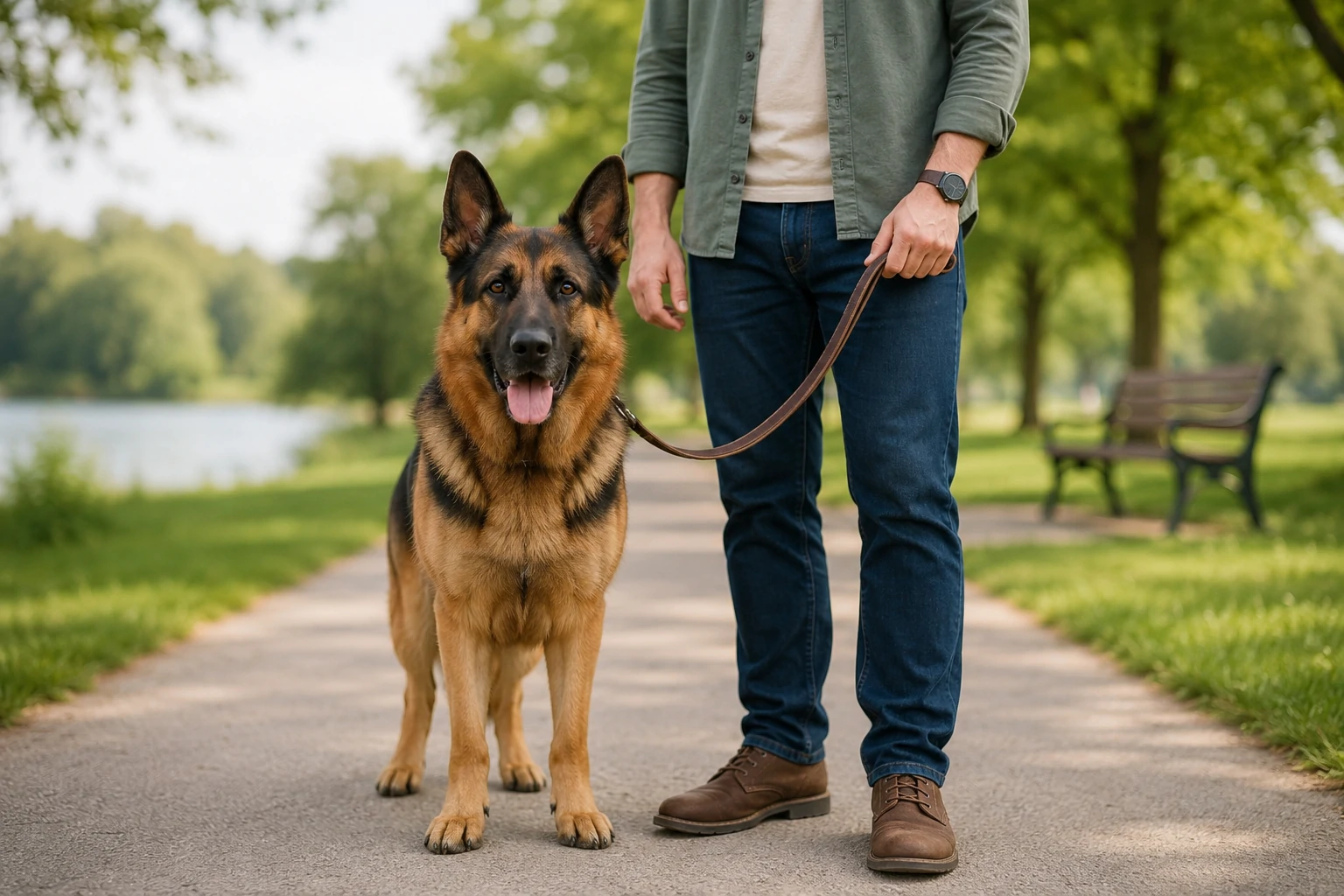
German Shepherd temperament is often misunderstood because this breed can look serious, alert, and intense even when it is simply paying attention. Many owners and future owners ask the same question: are German Shepherds aggressive, or are German Shepherds naturally protective?
The honest answer is that a well-bred, well-socialized, and well-trained German Shepherd is usually not “naturally aggressive.” This breed is known for loyalty, intelligence, courage, confidence, and strong working ability. Those strengths can make a German Shepherd a calm family companion, a focused service dog, or a dependable working dog. They can also become difficult if the dog is poorly socialized, under-exercised, fearful, frustrated, or handled with harsh training.
Quick Answer: Are German Shepherds Aggressive or Protective?
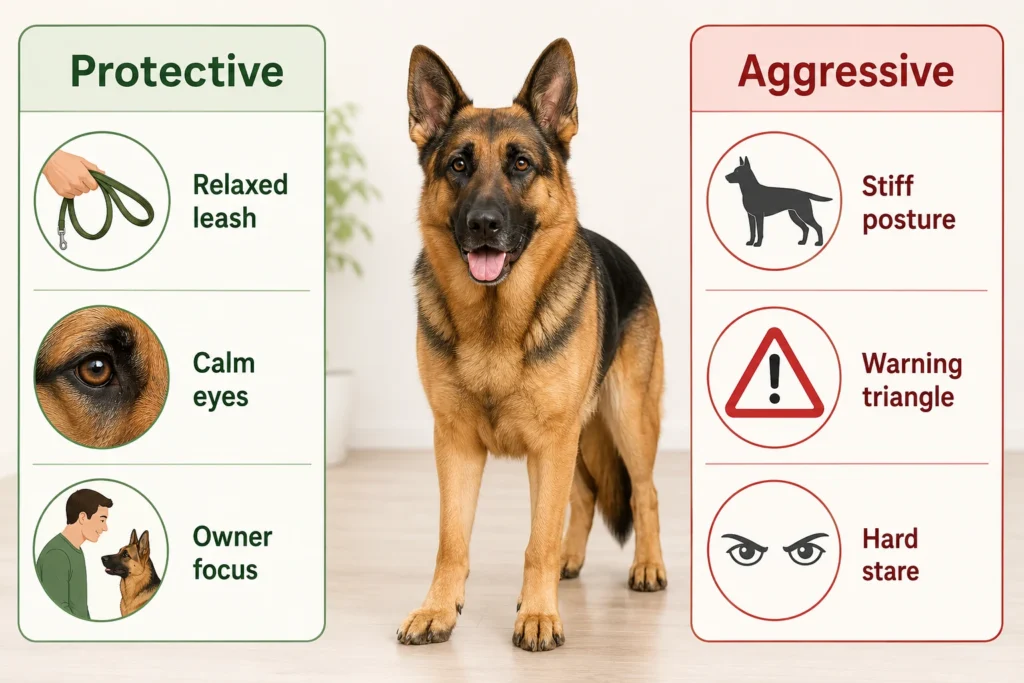
German Shepherd temperament is typically loyal, alert, intelligent, and naturally protective rather than automatically aggressive. A stable German Shepherd should be confident and controllable, not nervous, unpredictable, or eager to attack. Aggression usually develops from fear, poor socialization, pain, frustration, weak handling, or repeated rehearsal of unwanted behavior.
The American Kennel Club describes the German Shepherd Dog as loyal, confident, courageous, steady, and highly intelligent. The Royal Kennel Club breed standard describes the breed as steady of nerve, loyal, self-assured, courageous, tractable, and never nervous, over-aggressive, or shy.
German Shepherd Temperament at a Glance
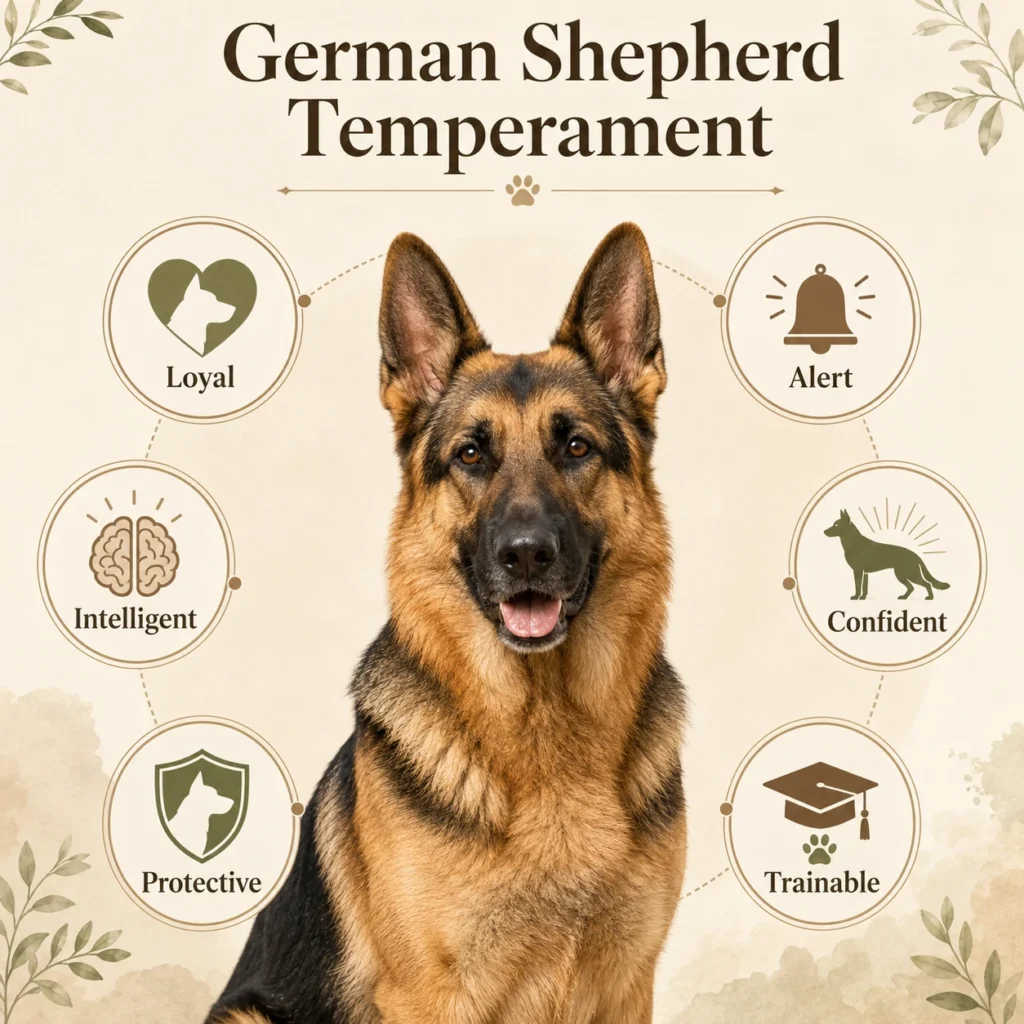
German Shepherd temperament is best understood as a mix of working drive, loyalty, awareness, and trainability. This is not a lazy background dog that ignores the world. A German Shepherd usually notices movement, strangers, sounds, family routines, and changes in the environment.
| Temperament Trait | What It Usually Means | When It Can Become a Problem |
| Loyalty | Strong bond with family | Separation stress, over-attachment, guarding one person |
| Alertness | Notices sounds, visitors, movement | Barking, reactivity, scanning constantly |
| Intelligence | Learns routines and commands quickly | Learns bad habits quickly too |
| Protectiveness | Watches over home and family | Suspicion without control or socialization |
| Working drive | Enjoys tasks, training, and purpose | Destructive behavior if bored |
| Confidence | Calm in new situations | Can turn into pushiness without boundaries |
A German Shepherd should not be judged by one behavior alone. Barking at a stranger, standing between an owner and a visitor, or watching the gate does not automatically mean aggression. The key question is whether the dog can recover, listen, disengage, and remain under control.
What Shapes German Shepherd Temperament?
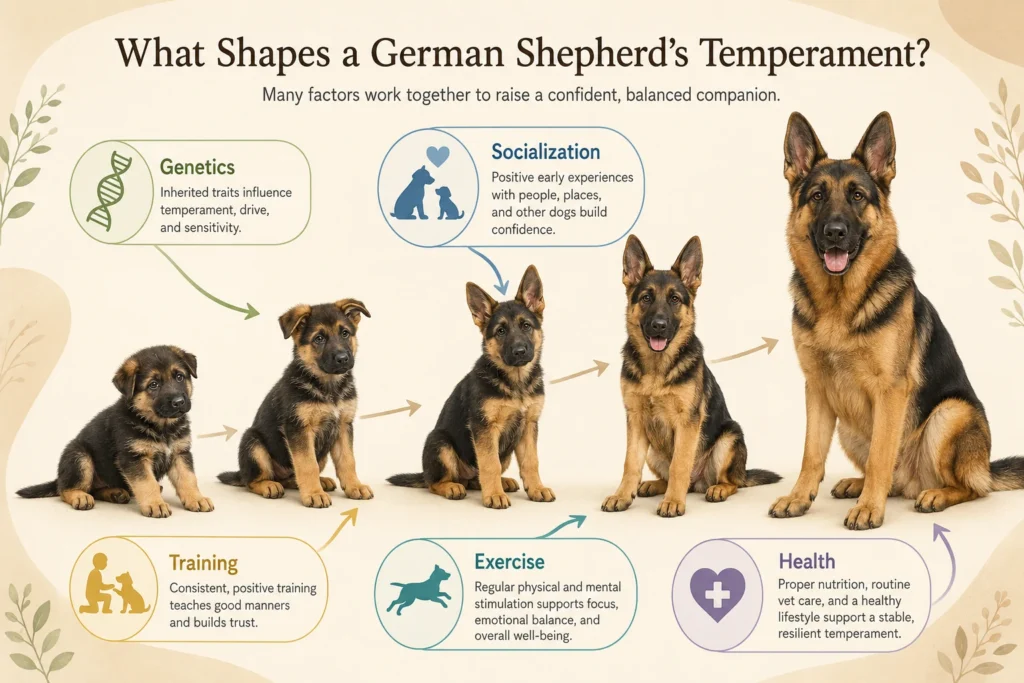
German Shepherd temperament is shaped by genetics, early socialization, training, daily routine, health, and owner handling. Breed instincts matter, but they are not the whole story.
A German Shepherd may inherit strong guarding instinct, high energy, or working drive. But the way those traits appear depends heavily on the dog’s environment. A puppy that meets different people, surfaces, sounds, dogs, and normal daily situations in a positive way is more likely to become calm and adaptable. Furbivo’s German Shepherd puppy socialization guide explains how early exposure helps reduce fear, barking, and overprotective behavior.
Important influences include:
- Breeding: Stable parent dogs increase the chance of stable puppies.
- Early socialization: Puppies need positive exposure, not overwhelming pressure.
- Reward-based training: Clear rewards teach the dog what to do instead of only punishing mistakes.
- Exercise and enrichment: A bored German Shepherd often creates its own “job.”
- Owner consistency: Mixed rules can create anxiety and pushy behavior.
- Health and pain: Sudden irritability or aggression may need veterinary evaluation.
The Royal Kennel Club German Shepherd breed page lists the breed as a large, active working dog with high exercise needs. That does not mean every German Shepherd should be pushed into hard exercise, especially as a puppy, but it does mean the breed needs daily structure, movement, and mental work.
Are German Shepherds Aggressive?
When people ask about German Shepherd temperament, they often mean: “Will this dog bite, attack, or become dangerous?” The answer is that German Shepherds are not automatically aggressive, but they can become aggressive if their instincts, fear, frustration, pain, or training are poorly managed.
Aggression is not one single behavior. VCA Animal Hospitals explains that aggressive behavior can have different motivations, including fear-based, defensive, possessive, food-related, redirected, or conflict-related aggression. VCA also notes that cases involving bites or threats to family members can be serious and may require help from a veterinary behavior professional.
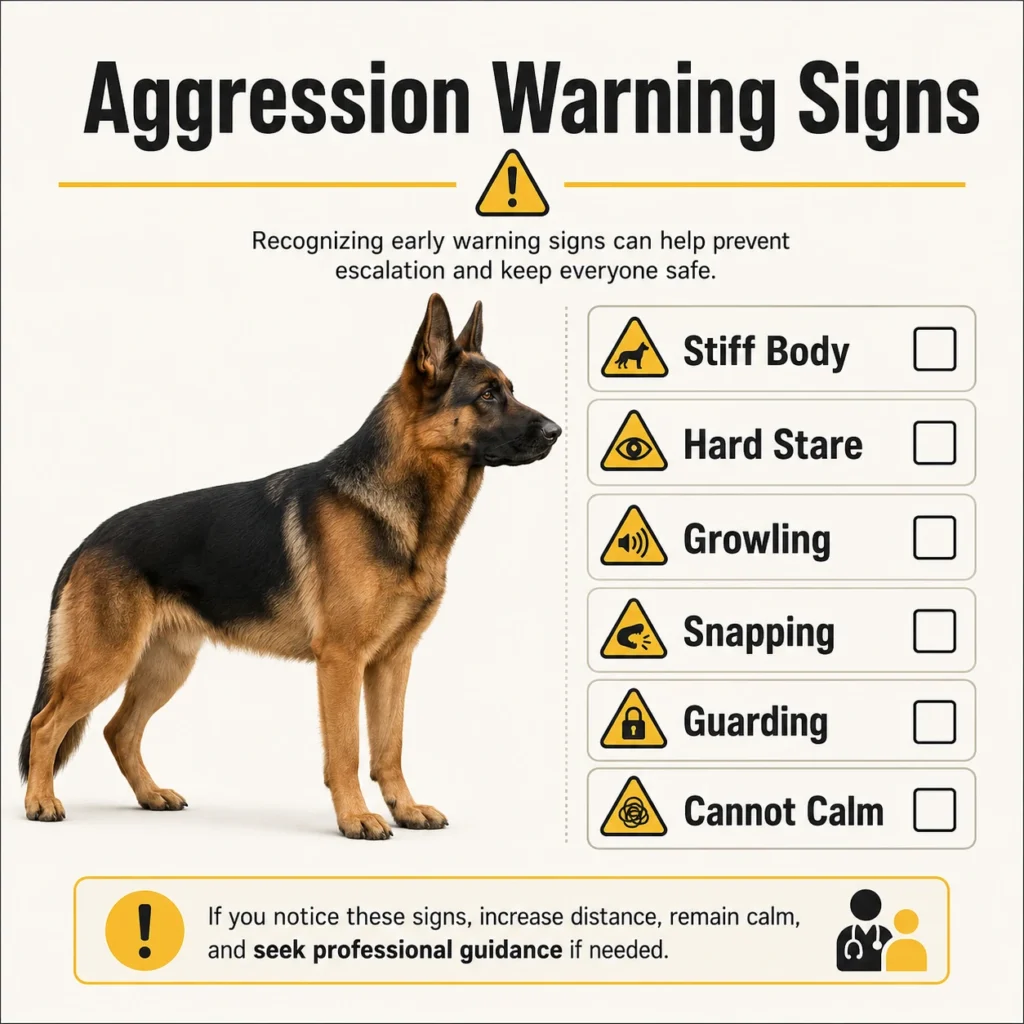
Possible aggression warning signs include:
- Stiff body posture with hard staring
- Repeated growling that escalates rather than settles
- Snapping, lunging, or biting
- Guarding food, toys, beds, doorways, or family members
- Inability to calm down after a trigger leaves
- Sudden behavior change without a clear reason
- Aggression toward children, visitors, or household pets
- Bites that break skin or repeated near-bites
One growl does not always mean a dog is “bad.” Growling is communication. But ignoring, punishing, or challenging a growling German Shepherd can make the situation more dangerous. The safer response is to create distance, identify the trigger, prevent rehearsal, and get qualified help when the risk is serious.
Are German Shepherds Naturally Protective?
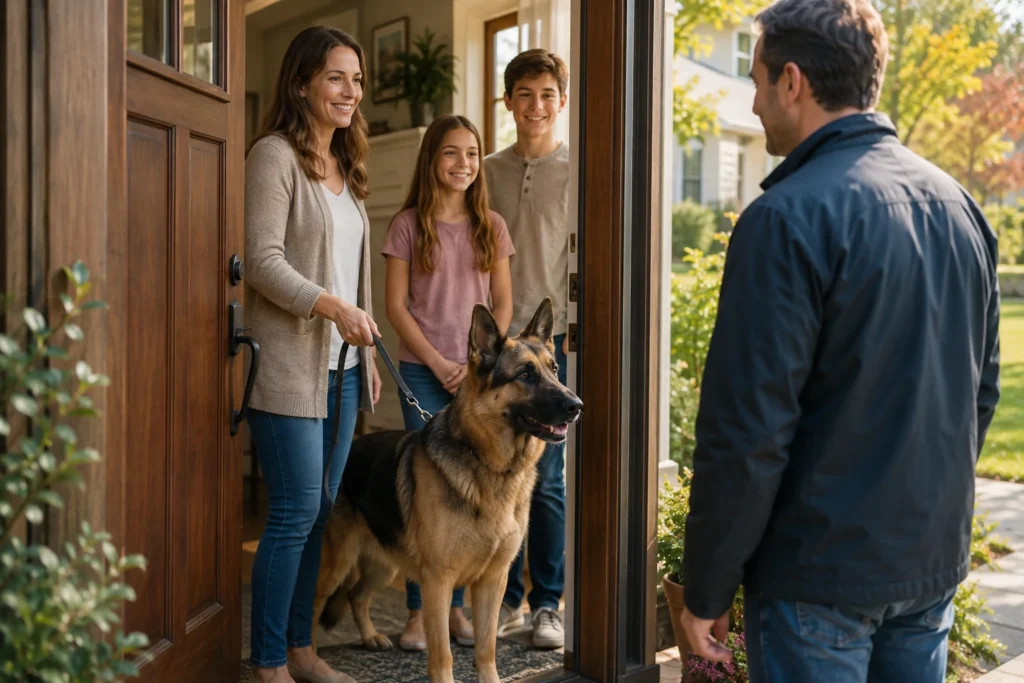
Yes, German Shepherds are naturally protective, but protection should not look like uncontrolled aggression. A healthy protective dog notices what is happening, stays aware of its owner, and can respond to training. An unsafe dog reacts before thinking, ignores commands, and treats normal people or normal situations as threats.
Healthy German Shepherd temperament looks protective without being chaotic. A balanced dog may bark when someone comes to the door, watch a stranger calmly, or position itself near the family. But it should still be able to stop, move away, sit, settle, or accept guidance.
| Situation | Natural Protectiveness | Concerning Aggression | Better Owner Response |
| Visitor at the door | Alert bark, then settles | Lunging, biting, cannot disengage | Train a place command and controlled greetings |
| Stranger on a walk | Watches, then moves on | Hard staring, pulling, repeated barking | Add distance and reward calm focus |
| Child running nearby | Curious but controllable | Chasing, nipping, blocking | Supervise and teach impulse control |
| Family member hugged | Notices contact | Pushes, growls, guards one person | Teach calm neutrality around normal contact |
| Food or toy nearby | Enjoys item normally | Freezes, growls, snaps | Stop access conflicts and seek help if severe |
A German Shepherd that is truly protective should be stable first. Unstable fearfulness is not the same as courage. Constant suspicion is not the same as loyalty.
Protective vs Reactive vs Aggressive: The Difference Owners Must Know
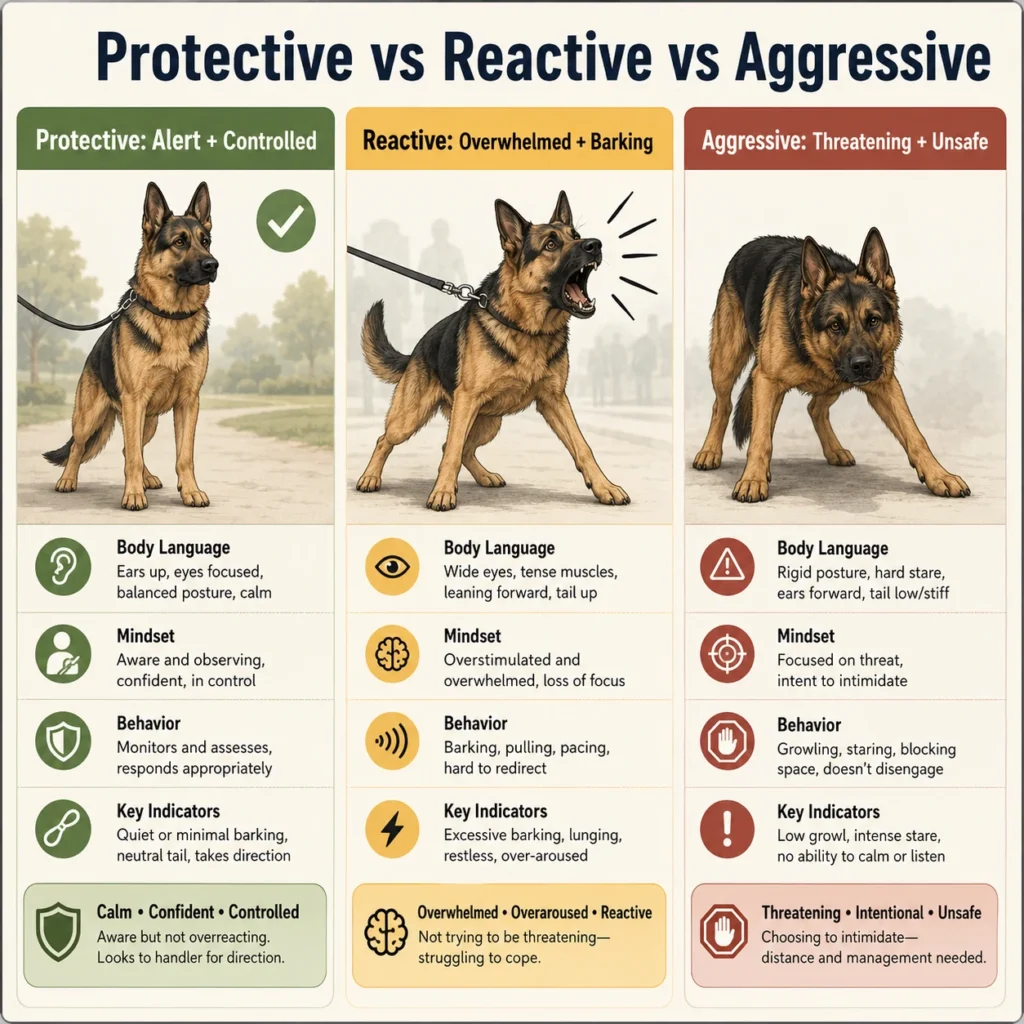
Many owners accidentally praise reactivity because they think it proves bravery. The dog barks at the window, rushes the fence, or explodes on the leash, and the owner says, “He is protecting me.” Sometimes that may be true, but often the dog is anxious, frustrated, or overstimulated.
Here is the difference:
| Behavior Type | What It Looks Like | What It Usually Means |
| Protective | Alert, controlled, aware of owner | Dog notices a possible concern but can listen |
| Reactive | Barking, lunging, whining, pulling | Dog is over threshold and struggling to cope |
| Aggressive | Threatening, snapping, biting, pursuing | Dog may intend to increase distance or cause harm |
| Fearful | Cowering, barking, retreating, defensive biting | Dog feels unsafe and trapped |
| Guarding | Protecting food, toys, space, or people | Dog is controlling access to a valued resource |
This distinction matters because each problem needs a different plan. A protective dog needs training and direction. A reactive dog needs distance, desensitization, confidence-building, and calm handling. An aggressive dog may need a professional behavior plan and safety management.
Why German Shepherds Can Seem Intimidating
German Shepherds can appear more serious than many companion breeds. They are large, athletic, alert, and expressive. Their ears, posture, eye contact, and movement can make normal attention look intense.
Several breed traits contribute to this impression:
- They were developed as working dogs with strong focus.
- They often bond deeply with their household.
- They notice environmental changes quickly.
- They may be reserved with strangers.
- They need both physical exercise and mental work.
- They can become vocal when bored, frustrated, or undertrained.
None of these traits automatically equal aggression. The same alertness that makes the breed useful in service, sport, police, military, search, tracking, and protection roles can also make it challenging in an unstructured home.
German Shepherds With Families and Children
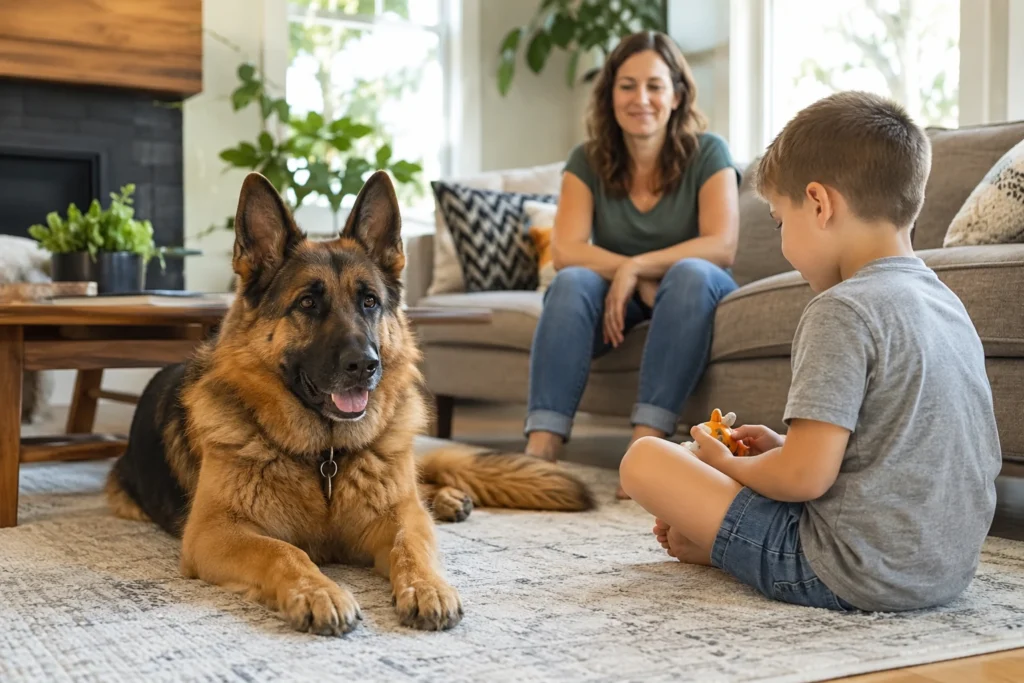
The best German Shepherd temperament for a household is calm, social, trainable, and predictable. Many German Shepherds live well with families, but they are not a breed to raise casually without rules.
A family German Shepherd should learn:
- Calm greetings
- Loose-leash walking
- Place or mat settling
- Leave it and drop it
- Gentle play rules
- No jumping on children
- No chasing running children
- Calm behavior around food and toys
Children should also learn safe dog manners. They should not climb on the dog, pull ears, grab food, disturb sleep, or corner the dog. Even a loving German Shepherd can react if pushed, startled, or hurt.
Supervision is not optional. A powerful dog and a young child should never be left to “figure it out” alone.
German Shepherds With Strangers and Visitors
German Shepherds are often naturally reserved with strangers. Reserved does not mean unfriendly. A stable German Shepherd may simply prefer to observe before interacting.
Problems begin when owners force greetings or allow the dog to rehearse door chaos. If every visitor becomes a barking event, the dog learns that the doorway is a battlefield.
A better visitor routine is:
- Put the dog on leash or behind a barrier before opening the door.
- Reward calm behavior before the visitor enters.
- Avoid direct face-to-face pressure.
- Let the dog observe from a comfortable distance.
- Ask for simple known cues such as sit, place, or touch.
- End the greeting before the dog becomes overwhelmed.
For a full foundation, pair this with Furbivo’s guide on how to train a German Shepherd and its German Shepherd puppy socialization guide.
Training Style Matters: Avoid the “Alpha” Mistake
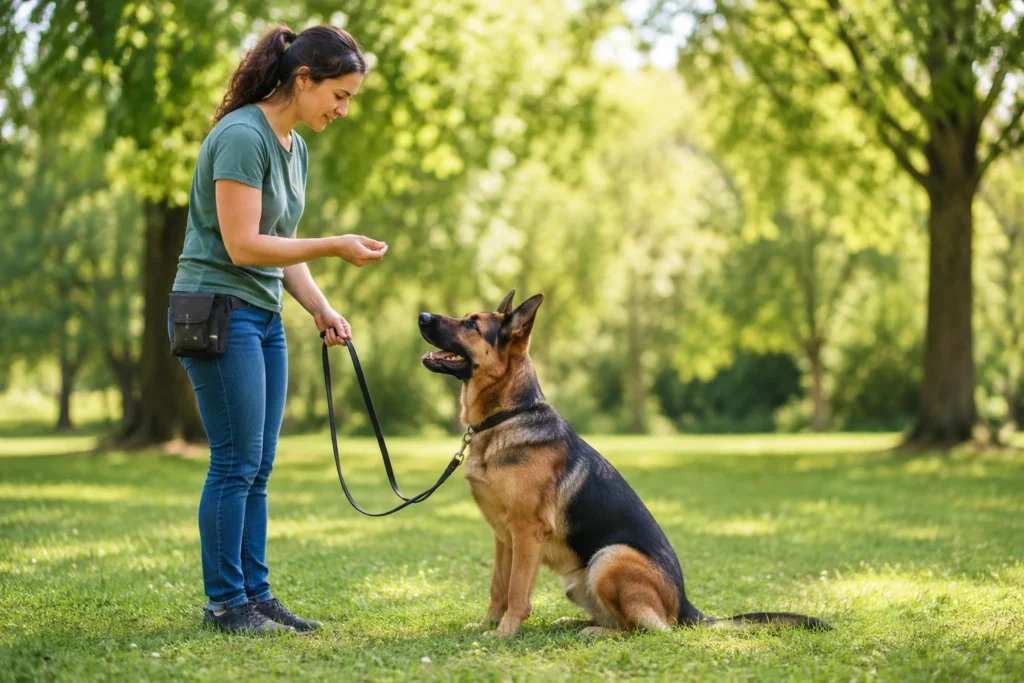
German Shepherds are strong dogs, so some owners assume they need harsh handling. That is one of the fastest ways to damage trust and increase defensive behavior.
The American Veterinary Society of Animal Behavior supports reward-based methods for canine training and warns against aversive methods that rely on force, pain, intimidation, or emotional discomfort. VCA also explains that aggression is often linked to fear, anxiety, conflict, or uncertainty rather than a simple “dominance” problem.
Good training should create:
- Clear rules
- Predictable rewards
- Calm correction of the environment, not intimidation
- Strong recall and leash control
- Confidence around normal triggers
- Trust between dog and owner
A German Shepherd should respect its owner, but respect is not fear. Fear can suppress warning signs until the dog reacts more severely.
Exercise, Mental Work, and Daily Routine
German Shepherds need more than a walk around the block. A physically mature, healthy adult usually needs structured exercise, training, and mental enrichment. Without that, the dog may bark, chew, dig, pace, jump, mouth, or become hyper-alert.
Useful outlets include:
- Loose-leash walks
- Fetch with controlled starts and stops
- Scent games
- Obedience training
- Puzzle feeders
- Tracking-style games
- Tug with rules
- Place training
- Calm settle practice
Puppies need care because their joints and growth plates are still developing. Furbivo’s German Shepherd growth chart can help owners understand growth stages before choosing exercise intensity.
Mental exercise is especially important. A German Shepherd that has used its brain is often calmer than one that only ran in circles.
Pros and Cons of German Shepherd Temperament for Families
| Option or Method | Pros | Cons | Best For | Safety Notes |
| German Shepherd as a family companion | Loyal, trainable, protective, intelligent | Needs time, structure, and socialization | Active families who can train daily | Supervise around children and visitors |
| German Shepherd for first-time owners | Can learn quickly with guidance | Mistakes can become serious because of size and strength | First-time owners willing to get coaching | Choose a stable breeder or rescue match |
| German Shepherd in apartments | Possible with enough exercise and training | Barking, boredom, and space issues can develop | Owners with strong routines | Manage noise and provide daily enrichment |
| German Shepherd with other pets | Can do well when socialized early | Prey drive, chasing, or guarding may appear | Homes that introduce pets slowly | Use barriers, leashes, and supervision |
| German Shepherd as a protection-minded dog | Naturally alert and loyal | Can become reactive if encouraged to be suspicious | Experienced owners focused on control | Do not encourage aggression without professional guidance |
Common Myths About German Shepherd Behavior
Myth 1: “A good German Shepherd should be suspicious of everyone.”
A stable German Shepherd does not need to treat every stranger as a threat. Neutrality is better than constant suspicion.
Myth 2: “Growling should always be punished.”
Growling is a warning signal. Punishing the warning may stop the sound but not the emotion behind it.
Myth 3: “Protection training will fix fear.”
Protection training is not a shortcut for insecurity. A fearful dog needs confidence-building and professional guidance, not more pressure.
Myth 4: “If the dog is friendly with family, it is safe with everyone.”
A dog may behave differently with children, visitors, delivery workers, other dogs, or people near food and toys.
Myth 5: “German Shepherds become calm automatically with age.”
Maturity can help, but training gaps usually do not disappear on their own. Bad habits can become stronger with repetition.
Signs of a Stable German Shepherd
A stable German Shepherd does not have to be overly social. Some are friendly with everyone; others are polite but reserved. What matters is control, recovery, and predictability.
Positive signs include:
- Recovers quickly after a noise or surprise
- Can watch strangers without escalating
- Responds to known commands around distractions
- Accepts normal handling from trusted people
- Plays without losing control
- Settles after exercise or training
- Shows curiosity without panic
- Can disengage from dogs, people, or movement
A stable dog is not silent all the time. Barking can be normal. The question is whether the dog can stop and think.
Signs You Need Professional Help
Get professional help if a German Shepherd shows serious or repeated aggression. Do not wait for a bite to “prove” the problem is real.
Seek help from a qualified trainer, certified behavior consultant, veterinarian, or veterinary behaviorist if you see:
- Biting or repeated snapping
- Aggression toward children
- Guarding food, toys, sleeping areas, or people
- Lunging at strangers or dogs on walks
- Sudden aggression after being touched
- Aggression that appears after illness, injury, or pain
- Escalating growling or hard staring
- Inability to calm after triggers
For immediate safety, increase distance from triggers, use barriers, avoid risky greetings, and prevent the dog from practicing the behavior. VCA Animal Hospitals emphasizes identifying situations that may lead to aggression, preventing access to those triggers when needed, and avoiding repeated aggressive episodes.
How to Raise a Balanced German Shepherd
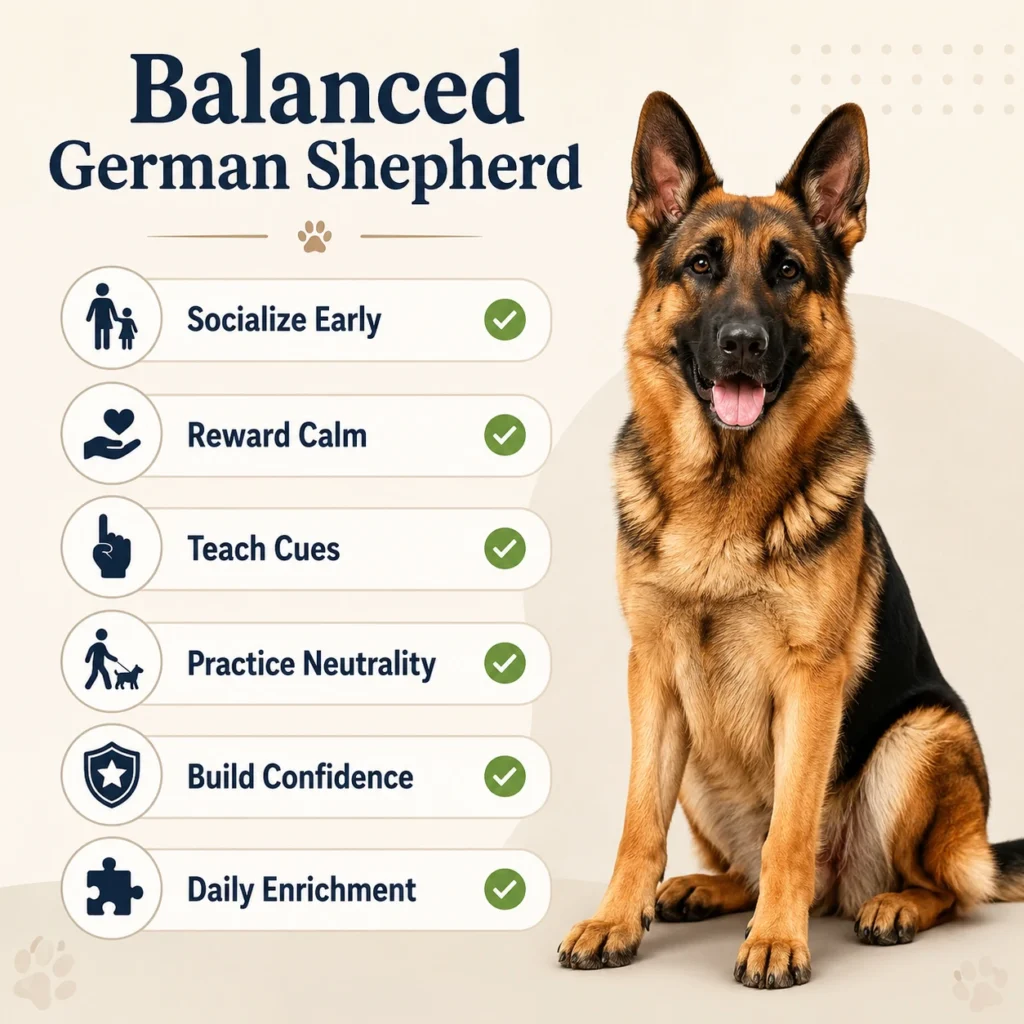
A balanced German Shepherd is built through small daily habits, not one dramatic training session.
Focus on these foundations:
- Socialize early and safely: Expose puppies to normal people, sounds, surfaces, and environments without flooding them.
- Reward calm behavior: Do not only reward excitement, barking, or intensity.
- Teach useful cues: Sit, down, stay, come, leave it, drop it, place, and heel all matter.
- Practice neutrality: Your dog does not need to greet everyone.
- Build confidence: Let the dog solve simple training problems and earn rewards.
- Control the environment: Prevent fence fighting, window barking, and uncontrolled door greetings.
- Use food wisely: Nutrition supports overall health, energy, and growth. Furbivo’s German Shepherd dog food guide and article on what German Shepherds eat can support breed-specific feeding decisions.
- Plan for life stages: Puppy behavior, adolescent testing, adult maturity, and senior comfort all need different expectations. Furbivo’s German Shepherd lifespan guide can support long-term care planning.
What Most Articles Miss About German Shepherd Temperament
German Shepherd temperament is not one thing. It is a balance of nerve, confidence, social exposure, training history, health, and daily lifestyle.
Many articles simply say “German Shepherds are loyal and protective.” That is true, but incomplete. Loyalty without boundaries can become guarding. Protectiveness without socialization can become suspicion. Intelligence without structure can become problem-solving in the wrong direction.
The most important missing point is this: a German Shepherd should learn when not to react.
A good family German Shepherd does not need to bark at every window, pull toward every dog, or inspect every visitor. Calm neutrality is one of the most valuable skills this breed can learn.
FAQ
Are German Shepherds aggressive by nature?
No, German Shepherds are not aggressive by nature when bred, socialized, trained, and managed responsibly. They are naturally alert and protective, but aggression usually comes from fear, poor socialization, frustration, pain, guarding behavior, or repeated rehearsal of bad habits.
Are German Shepherds naturally protective of their owners?
Yes, German Shepherds are naturally protective of their owners and home, but healthy protectiveness should be controlled. A well-balanced dog can notice a possible threat while still listening, disengaging, and staying manageable.
Is German Shepherd temperament good for families?
German Shepherd temperament can be excellent for families that provide training, exercise, supervision, and structure. The breed is loyal and intelligent, but families with young children must teach both the dog and the children safe behavior.
Why does my German Shepherd bark at strangers?
A German Shepherd may bark at strangers because of alertness, fear, territorial behavior, excitement, lack of socialization, or learned habit. The goal is not to punish barking blindly, but to teach calm observation, distance control, and a reliable alternative behavior.
Can German Shepherd temperament change with age?
Yes, German Shepherd temperament can change with age, especially during adolescence, maturity, illness, pain, or major routine changes. Sudden aggression, fear, or irritability should be taken seriously and may need veterinary or behavior support.
Are male German Shepherds more aggressive than females?
Sex alone does not determine aggression. Individual genetics, socialization, training, health, neuter status, environment, and owner handling matter more than simply choosing male or female.
Can a German Shepherd be protective without being trained for protection?
Yes, many German Shepherds naturally become watchful and protective without formal protection training. Most family dogs need obedience, socialization, impulse control, and calm confidence more than protection training.
Final Thoughts
Good German Shepherd temperament is not created by making the dog suspicious, intense, or hard. It is created by building confidence, trust, obedience, social awareness, and calm control.
A German Shepherd should be loyal without being possessive, protective without being reckless, alert without being anxious, and powerful without being unsafe. With the right breeding, socialization, training, exercise, and health care, this breed can be one of the most dependable companions a committed owner can have.
Have questions about your dog’s health, nutrition, grooming, or daily care? Visit our Contact Us page to reach the Furbivo team. For any medical symptoms, diagnosis, or treatment advice, always consult a qualified veterinarian.