
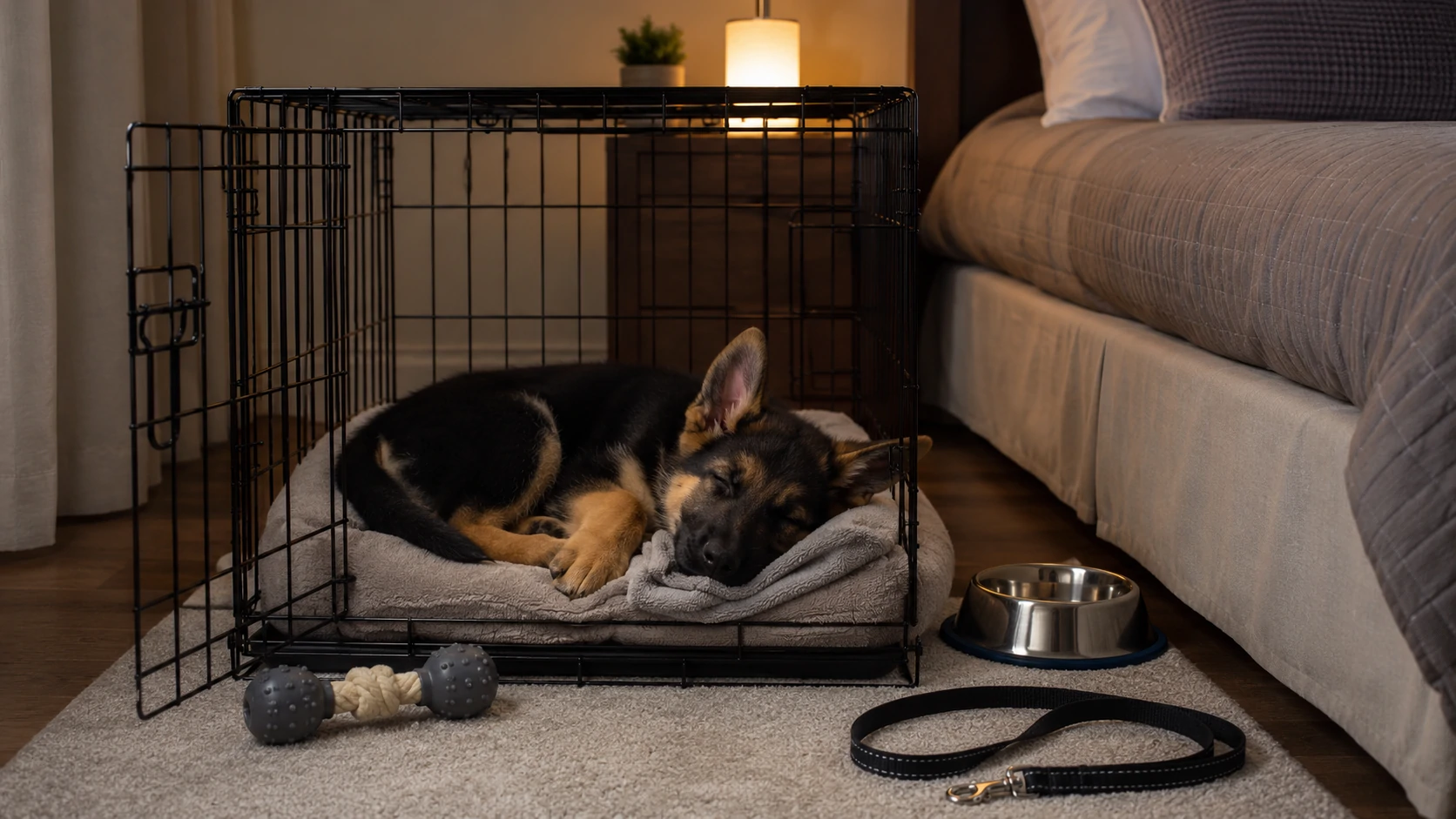
A practical German Shepherd puppy sleep schedule balances long periods of rest with potty trips, measured meals, brief training, gentle activity, and calm family time. Young puppies may sleep for much of the day, but usually in several naps plus overnight sleep rather than one uninterrupted block.
The goal is not to force an exact number of hours. It is to provide regular sleep opportunities and check whether your puppy wakes alert, eats normally, moves comfortably, and can settle after activity.
German Shepherd Puppy Sleep Schedule: Quick Answer
A young German Shepherd often needs several daytime naps plus overnight sleep. Puppy-care guidance commonly estimates about 16–20 hours of total daily sleep for young puppies, although individual needs vary. Plan a potty trip after waking, follow short activity with quiet rest, and expect some young puppies to need an overnight toilet break.
German Shepherd Puppy Sleep Needs at a Glance
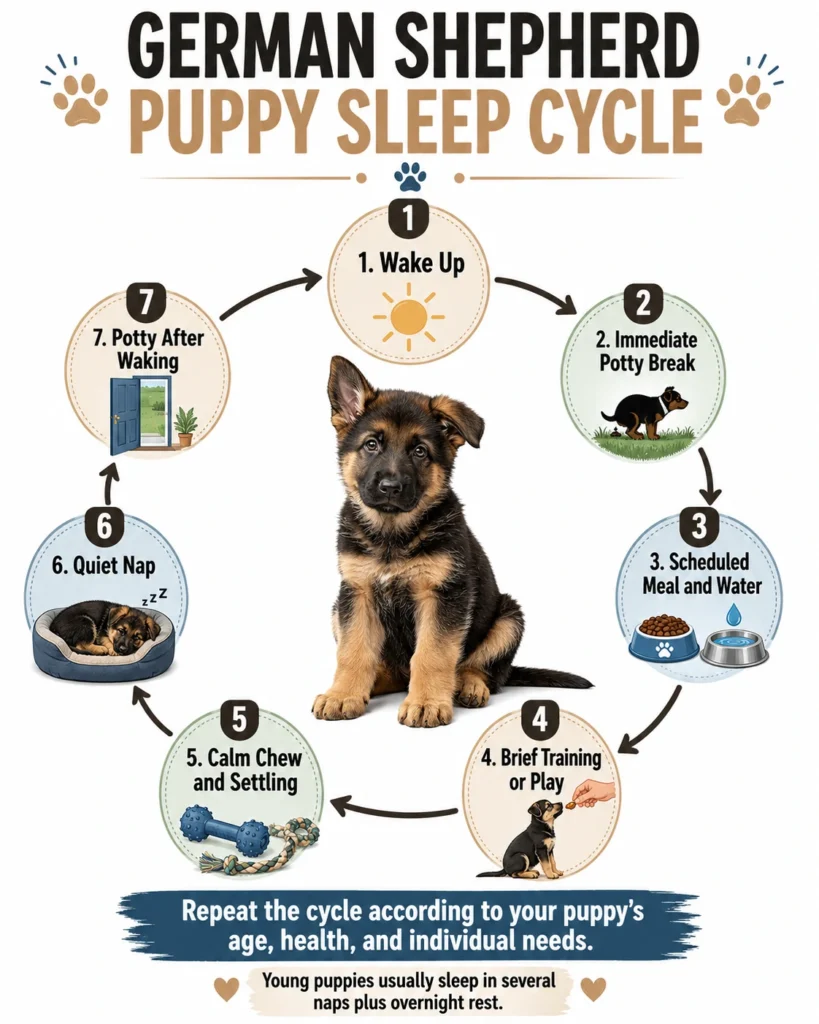
| Puppy age | Common sleep pattern | Main owner priority |
| 8–12 weeks | Frequent naps, short awake periods, possible overnight potty breaks | Protect rest and prevent overtired behavior |
| 3–5 months | Several naps with longer awake periods | Schedule rest around meals, training, and teething |
| 6–9 months | Fewer but still important naps | Do not remove rest because the puppy looks large |
| 10–18 months | Longer nighttime sleep with flexible daytime rest | Balance exercise, training, and recovery |
These are patterns, not requirements. Health, activity, household noise, stress, travel, growth, and individual temperament can change sleep.
For feeding, training, grooming, exercise, and preventive-care context beyond sleep, use Furbivo’s guide to taking care of a German Shepherd puppy.
Why Sleep Matters for a German Shepherd Puppy
Rest supports normal growth, learning, recovery, and behavior. A well-rested puppy can usually focus briefly, play more appropriately, and recover more easily after excitement.
An overtired puppy may become:
- Mouthy or nippy
- Frantic or barky
- Unable to focus
- Rough during play
- Restless
- More likely to have a potty accident
- Unable to settle without help
Puppies may nap every hour or so, with naps commonly lasting from about 30 minutes to two hours. Active periods should be followed by quiet rest.
Sleep is also a useful health signal. A sudden change in duration, waking behavior, appetite, movement, or breathing matters more than comparison with one online number.
How Much Should a German Shepherd Puppy Sleep?
There is no exact total that every healthy puppy must meet.
Some puppy guidance cites 16–18 hours a day, while other guidance commonly uses 18–20 hours. VCA also emphasizes that normal duration varies between puppies.
Use those estimates as reassurance that frequent sleep is normal, not as a target to force.
Look at the whole puppy:
- Does it wake easily?
- Is appetite normal?
- Are stool and urination normal?
- Does it play and explore when awake?
- Can it move without pain or stiffness?
- Can it settle again after an appropriate awake period?
A puppy may sleep more after class, travel, a veterinary visit, social exposure, or a growth period. It may sleep less in a noisy home, during teething discomfort, or when it needs to eliminate.
Sample German Shepherd Puppy Sleep Schedule for 8–12 Weeks
At this age, awake periods are often brief. The puppy may eliminate, eat, play or train for a few minutes, and then need another nap.
| Approximate time | Example activity |
| 6:30 a.m. | Wake and potty |
| 6:45 a.m. | Breakfast and water |
| 7:00 a.m. | Potty, brief training, and gentle play |
| 7:30–9:00 a.m. | Nap |
| 9:00 a.m. | Potty and calm exploration |
| 9:45–11:15 a.m. | Nap |
| 11:15 a.m. | Potty and scheduled meal if applicable |
| 12:00–2:00 p.m. | Nap |
| 2:00 p.m. | Potty, handling, or gentle play |
| 2:30–4:00 p.m. | Nap |
| 4:00 p.m. | Potty and scheduled meal |
| 5:00–6:30 p.m. | Nap or quiet rest |
| 6:30 p.m. | Potty and calm activity |
| 7:00 p.m. | Final meal if included in the feeding plan |
| 8:00 p.m. | Quiet rest, chew, and final potty |
| 9:30–10:00 p.m. | Bedtime |
| Overnight | Quiet potty trip if genuinely needed |
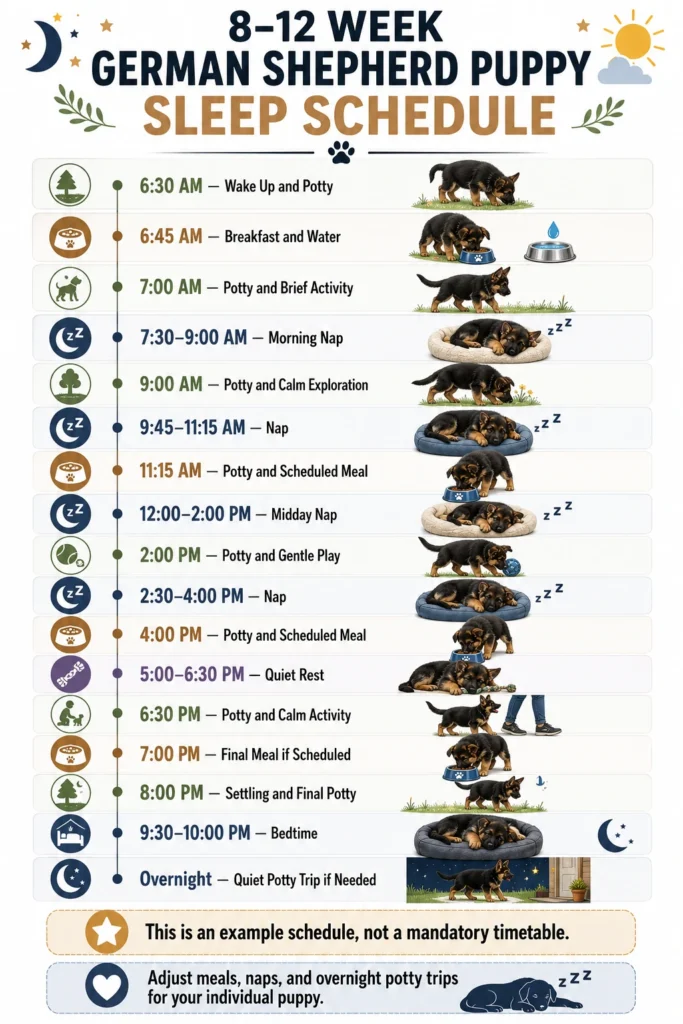
This is an example, not a mandatory timetable. Adjust meals to your puppy’s feeding plan and take the puppy outside after every nap. AKC housetraining guidance recommends an immediate potty trip whenever a sleeping puppy wakes.
Use Furbivo’s German Shepherd puppy daily routine to organize meals, potty trips, training, play, grooming, and socialization around these sleep blocks.
German Shepherd Puppy Sleep Schedule for 3–5 Months
A puppy in this stage may stay awake longer, but regular naps are still useful.
| Approximate time | Example activity |
| 6:30 a.m. | Wake, potty, and breakfast |
| 7:00 a.m. | Potty, short training, and sniffing |
| 8:00–10:00 a.m. | Nap |
| 10:00 a.m. | Potty and controlled activity |
| 11:00 a.m.–12:30 p.m. | Quiet rest |
| 12:30 p.m. | Potty and lunch when scheduled |
| 1:00–3:00 p.m. | Nap |
| 3:00 p.m. | Potty, short walk, play, or social exposure |
| 4:00–5:00 p.m. | Rest |
| 5:30 p.m. | Dinner and potty |
| 6:00 p.m. | Calm family time |
| 7:00–8:00 p.m. | Nap or settling period |
| 9:30–10:00 p.m. | Final potty and bedtime |
Teething can increase chewing and restlessness. Offer safe chewing options before naps and use Furbivo’s German Shepherd puppy teething stages for normal development and warning signs.
German Shepherd Puppy Sleep Schedule for 6–12 Months
An adolescent may look nearly adult-sized but still require substantial recovery.
A flexible day may include:
- Consistent overnight sleep
- Morning activity, breakfast, and quiet recovery
- A late-morning nap
- Midday potty and enrichment
- Afternoon rest after training or social activity
- Dinner followed by calm recovery
- A predictable bedtime routine
Do not replace every nap with harder exercise. The important signs are that the puppy settles, wakes responsive, eats normally, moves comfortably, and does not show persistent nighttime distress.
The German Shepherd puppy daily routine can help balance adolescent sleep with meals, training, enrichment, and joint-safe movement.
Build the German Shepherd Puppy Sleep Schedule Around Sleep–Wake Cycles
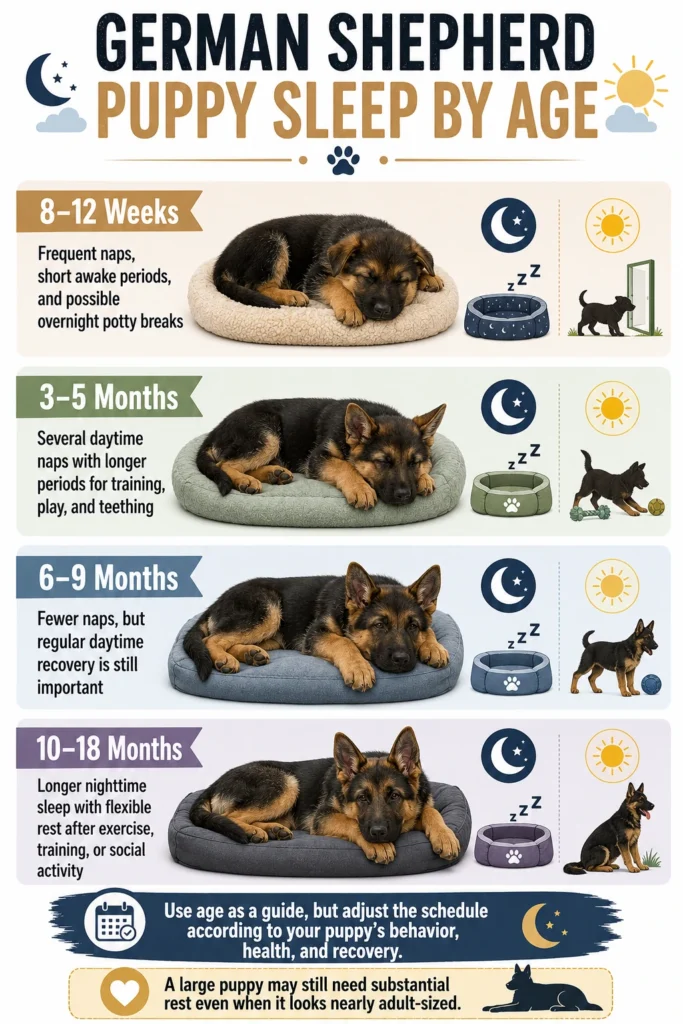
A useful cycle is:
- Wake and go outside.
- Offer a scheduled meal when appropriate.
- Return outside after eating or drinking.
- Add brief training, play, sniffing, grooming, or socialization.
- Reduce stimulation.
- Offer a safe chew when appropriate.
- Guide the puppy to its sleep area.
- Go outside immediately after waking.
This supports housetraining because naps create predictable potty opportunities. It also prevents owners from stacking too many exciting activities into one awake period.
How Long Should a Puppy Stay Awake Between Naps?
Do not use one rigid awake-time rule.
Very young puppies may need another nap after approximately 30–60 minutes of eating, toileting, play, and exploration. Older puppies may remain awake longer. AKC guidance notes that young puppies may nap every hour or so, but the puppy’s behavior should guide the final schedule.
The awake period is probably appropriate when the puppy can:
- Respond to a familiar cue
- Play without becoming frantic
- Disengage from activity
- Accept a calm chew
- Settle without a prolonged struggle
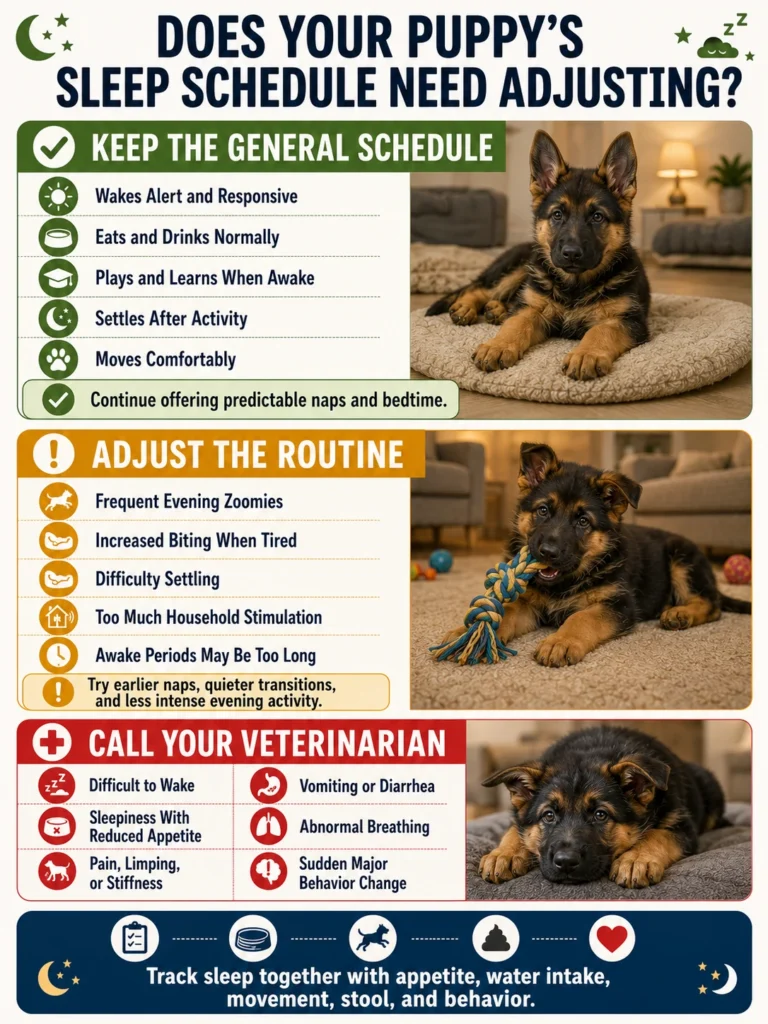
The awake period may have been too long when biting becomes harder, zooming becomes frantic, familiar cues seem forgotten, barking increases, or the puppy repeatedly leaves its bed.
Guide the puppy toward rest before behavior becomes chaotic.
Signs of an Overtired German Shepherd Puppy
An overtired puppy often looks more energetic rather than less energetic.
Common signs include:
- Evening zoomies
- Increased nipping
- Tugging clothing
- Barking for attention
- Rough play
- Restless pacing
- Difficulty lying down
- Poor response to familiar cues
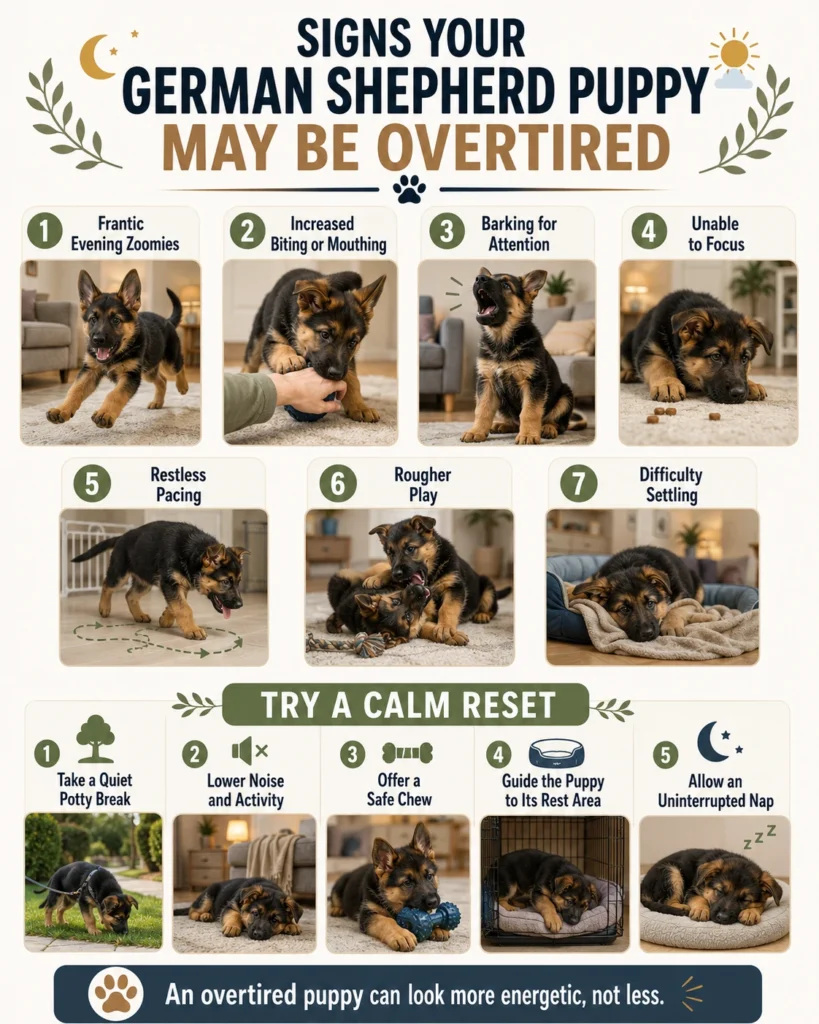
Try a quiet potty trip, lower household activity, offer a safe chew, and guide the puppy to its normal rest space.
Do not automatically add a hard walk or repeated ball chasing. More stimulation can increase arousal rather than helping the puppy settle.
Create a Safe Nap Area
The sleep area may be a crate, exercise pen, puppy-proofed room, gated space, or dog bed when the puppy can settle safely.
It should have:
- Comfortable, washable bedding
- Good airflow and moderate temperature
- Low foot traffic
- No swallowable loose objects
- Protection from children and playful pets
- Reduced visual stimulation when needed
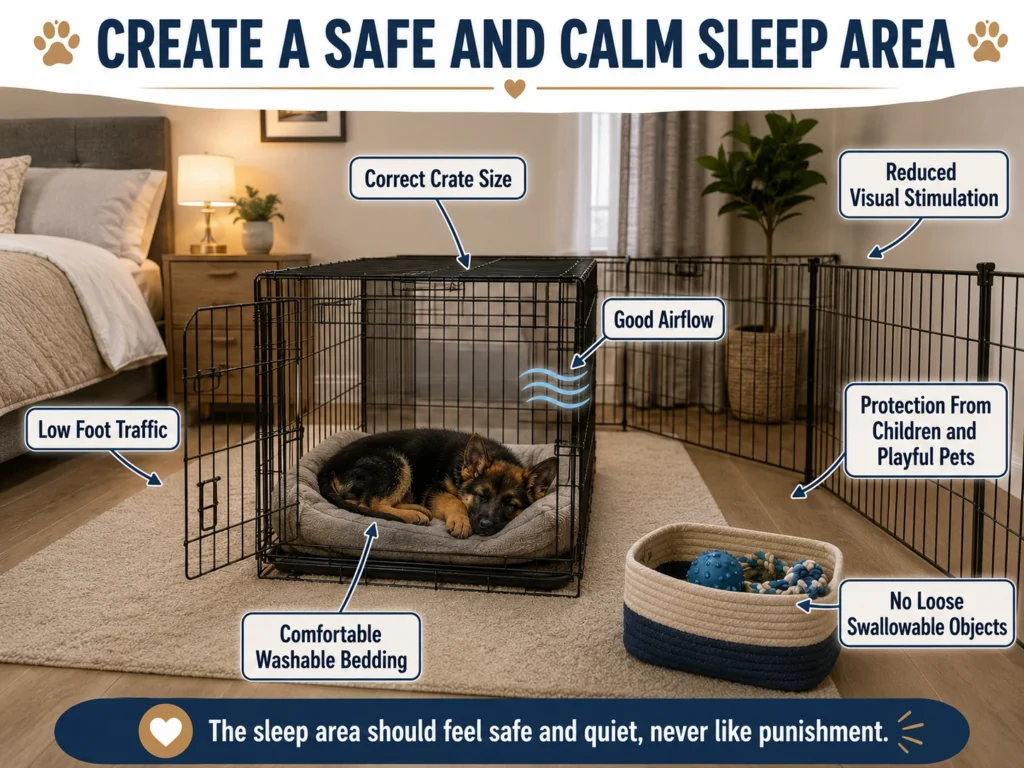
Family members should not wake, hug, climb on, or tease a sleeping puppy. AVMA safety guidance advises against disturbing a dog while sleeping.
A puppy does not require total silence for every nap, but an overtired puppy may need a quieter location.
Should a German Shepherd Puppy Sleep in a Crate?
A crate can be useful when introduced gradually and positively. It should not be used as punishment or for excessive confinement.
The crate should allow the puppy to:
- Stand naturally
- Turn around
- Lie down comfortably
- Stretch into a normal resting position
For a growing German Shepherd, an adult-size crate with an adjustable divider may be practical. See Furbivo’s crate size guide for fit and divider use.
Build positive associations by offering treats, allowing voluntary entry, starting with short calm periods, and using the crate for daytime naps as well as nighttime sleep.
Furbivo’s crate-training guide for a German Shepherd puppy provides the complete introduction and nighttime process.
Nighttime German Shepherd Puppy Sleep Schedule
A calm bedtime sequence is more useful than placing an alert puppy in the crate without preparation.
Try this order:
- End high-energy play earlier.
- Provide quiet family time.
- Take a final potty trip.
- Lower lights and voices.
- Use the same bedtime cue.
- Guide the puppy to the crate or bed.
- Provide an overnight potty break when needed.
- Go outside immediately in the morning.
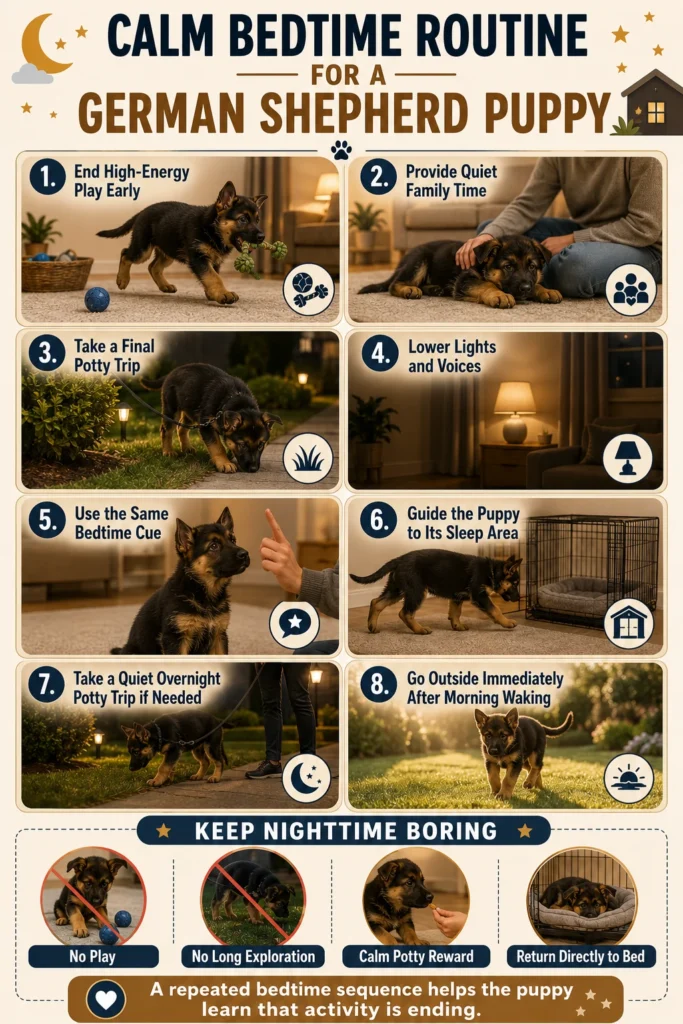
Nighttime potty breaks are normal for young puppies and usually become less frequent with age.
Keep overnight trips boring:
- Go directly outside.
- Avoid play and exploration.
- Reward elimination calmly.
- Return directly to bed.
This helps the puppy learn that nighttime waking is for toileting rather than entertainment.
Where Should the Puppy Sleep at Night?
During the first days or weeks, placing the crate close enough to hear genuine toilet signals can help with supervision and reassurance.
Possible locations include:
- Beside the owner’s bed
- Just outside the bedroom
- In a quiet nearby room
- In the intended long-term location if the puppy settles there
If the long-term plan is another room, move the crate gradually rather than changing the location abruptly.
The best position is one that supports safe supervision, housetraining, and calm sleep.
What to Do When a Puppy Cries at Night
First consider what the puppy may need:
- A potty break
- Reassurance in a new home
- A more comfortable temperature
- Relief from teething discomfort
- Protection from noise or light
- Veterinary attention for pain or illness
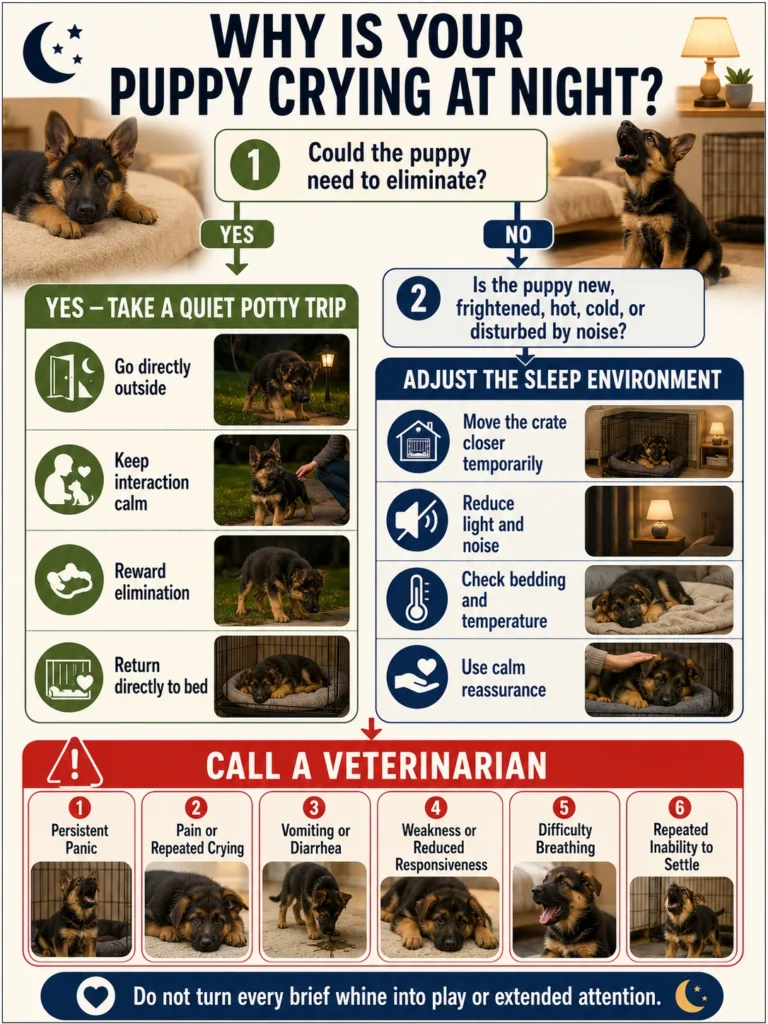
Take a very young puppy outside when toileting is reasonably likely. Keep the trip calm and return directly to bed.
Do not ignore prolonged panic, vomiting, diarrhea, breathing difficulty, pain, weakness, or repeated inability to settle. Those signs may need veterinary advice.
At the same time, do not turn every brief whine into play or extended attention.
Should You Wake a Sleeping Puppy to Potty?
During the day, take the puppy outside when it wakes naturally. There is usually no reason to interrupt every healthy nap solely because of the clock.
At night, consider:
- Age
- Previous accidents
- Time of the last potty trip
- Recent drinking
- Health
- Whether the puppy signals reliably
A planned overnight trip may help a very young puppy. As the puppy stays dry consistently, move that trip gradually later.
Do not treat the common “age in months plus one” bladder estimate as a guarantee. Individual puppies vary.
Sleep, Meals, and Potty Breaks
A useful sequence is:
- Wake
- Potty
- Scheduled meal
- Potty
- Brief activity
- Nap
Use Furbivo’s German Shepherd puppy feeding chart for age-appropriate meal frequency. Young puppies usually need several measured meals before moving gradually toward fewer meals.
Do not free-feed simply to help the puppy settle. Scheduled meals make appetite and bathroom changes easier to detect.
If appetite falls along with unusual sleepiness, read Why Is My German Shepherd Not Eating and contact a veterinarian when the change persists or other symptoms appear.
Normal Puppy Sleep Behaviors
Normal sleep may include:
- Paw twitching
- Brief leg movement
- Small facial movements
- Quiet whimpers
- Position changes
- Short periods of faster breathing
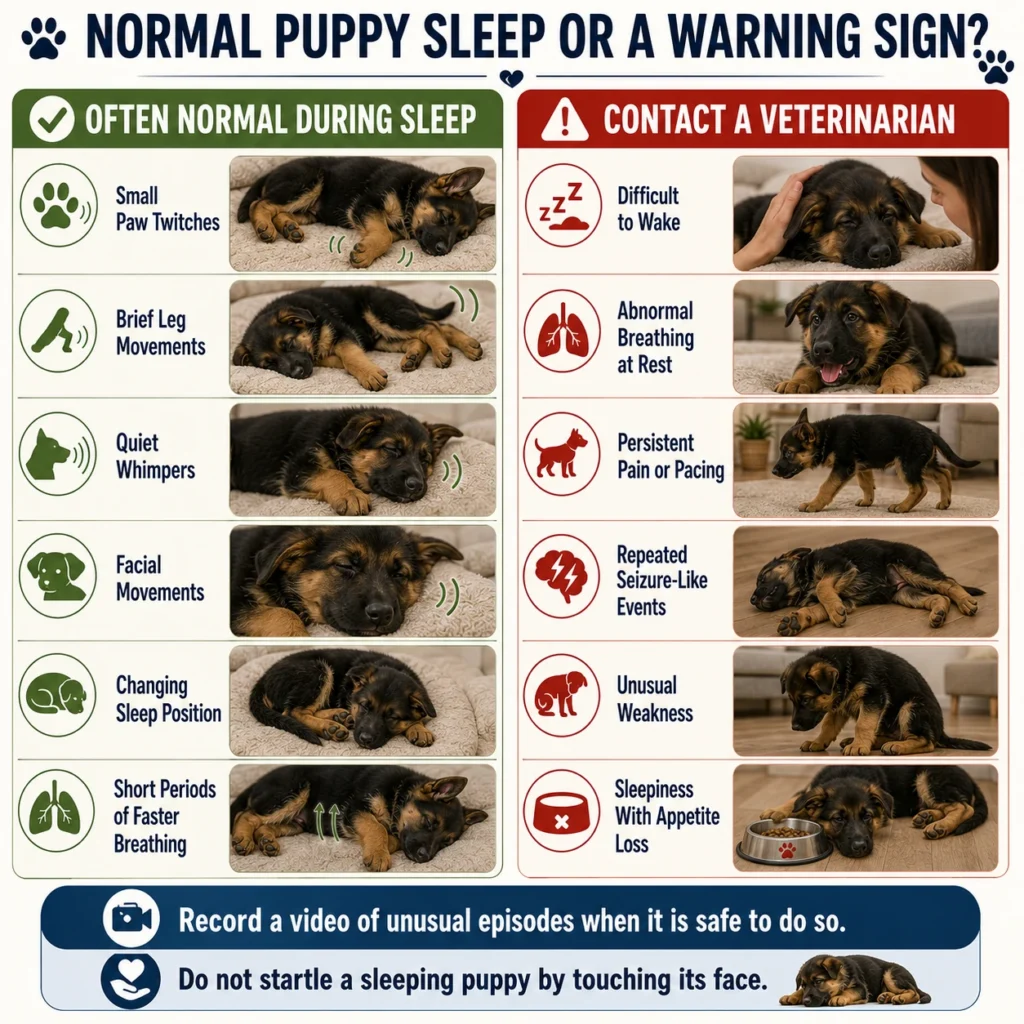
Dogs dream, so movement or vocalization during sleep is not automatically a seizure or nightmare.
Do not startle a sleeping puppy by touching its face. Call softly from a safe distance when waking is necessary.
Record a video when a sleep behavior seems unusual. It may help a veterinarian assess the event.
When Sleep Changes Need Veterinary Attention
Contact your veterinarian when your puppy:
- Is much sleepier than usual or difficult to wake
- Sleeps more while eating less
- Cannot settle because of pain
- Paces repeatedly at night
- Cries despite normal toilet care
- Coughs or breathes abnormally during rest
- Develops vomiting or diarrhea
- Is stiff or limps after sleep
- Shows weakness, collapse, tremors, or seizure-like activity
VCA describes 15–30 breaths per minute as a typical resting or sleeping range for normal dogs and advises contacting a veterinarian when the rate is consistently elevated.
Seek emergency care for:
- Difficulty breathing
- Blue, gray, or very pale gums
- Collapse
- A prolonged or repeated seizure
- Severe weakness
- Suspected toxin exposure
- Severe trauma
- A swollen, painful abdomen with repeated retching
These signs can indicate a serious emergency rather than a routine sleep problem.
What Most German Shepherd Puppy Sleep Schedule Articles Miss
Total Hours Are Less Useful Than Sleep Quality
A puppy may lie down for hours without resting well because of noise, children, another dog, heat, or discomfort.
Look for restful sleep followed by normal waking behavior.
Overtired Behavior Can Look Like Excess Energy
Zoomies, biting, barking, and grabbing may signal that the puppy stayed awake too long.
More Exercise Is Not Always the Fix
Repeated high-impact activity can overwork a developing large-breed puppy without teaching calmness.
Night Waking Is Not Always a Training Problem
A puppy may wake because of toileting needs, diarrhea, urinary discomfort, pain, temperature, fear, or another health issue.
Sleep and Appetite Should Be Tracked Together
A puppy sleeping more after an active day may be normal. Unusual sleepiness combined with food refusal deserves closer attention.
The Schedule Should Become Flexible
The goal is not an adult dog that becomes distressed when bedtime shifts by a few minutes. Keep the general sequence consistent while allowing reasonable variation in exact timing.
Frequently Asked Questions
What is a good German Shepherd puppy sleep schedule?
A good schedule alternates potty trips, scheduled meals, brief activity, calm enrichment, and naps. Young puppies may need several naps and an overnight potty break. Keep the sequence predictable while adjusting timing to age, health, and behavior.
How many hours should a German Shepherd puppy sleep?
Many young puppies sleep roughly 16–20 hours across a full day, including naps, but individual needs vary. Focus on normal appetite, comfortable movement, alert waking behavior, and the ability to settle.
How long should a German Shepherd puppy nap?
A nap may last about 30 minutes to two hours, although shorter and longer naps occur. Let a healthy puppy wake naturally when possible, then go outside immediately.
Why will my German Shepherd puppy not sleep during the day?
Noise, excitement, constant attention, teething, hunger, a toilet need, fear, or overtiredness may interfere. Reduce stimulation and meet basic needs. Contact a veterinarian for persistent restlessness, pain, or signs of illness.
Should my German Shepherd puppy sleep in a crate at night?
A crate can provide a safe sleep area when correctly sized and introduced positively. It should not be used as punishment or for excessive confinement. Very young puppies may still need quiet overnight toilet trips.
When will a German Shepherd puppy sleep through the night?
There is no fixed age. Longer stretches develop as bladder control, confidence, and routine improve. Recent drinking, feeding times, health, and individual development all affect nighttime waking.
Why does my puppy wake crying at night?
The puppy may need to eliminate, feel frightened, be uncomfortable, hear a disturbance, or have learned that crying brings attention. Check physical needs calmly. Persistent distress, pain, vomiting, diarrhea, weakness, or breathing changes require veterinary advice.
Final Thoughts
A balanced German Shepherd puppy sleep schedule protects rest without controlling every minute.
Use a repeatable cycle:
- Wake and potty
- Scheduled meal when appropriate
- Potty again
- Brief training, play, or exploration
- Calm enrichment
- Nap
Young puppies need frequent sleep opportunities and may need overnight toilet trips. Adolescents still need recovery even when they look adult-sized.
Pay attention to quality as well as quantity. Your puppy should generally wake responsive, eat normally, move comfortably, and participate in age-appropriate activity.
When sleep changes suddenly with appetite loss, pain, vomiting, diarrhea, weakness, breathing difficulty, or unusual behavior, contact a veterinarian instead of changing only the timetable.
Have questions about your dog’s health, nutrition, grooming, or daily care? Visit our Contact Us page to reach the Furbivo team. For any medical symptoms, diagnosis, or treatment advice, always consult a qualified veterinarian.