
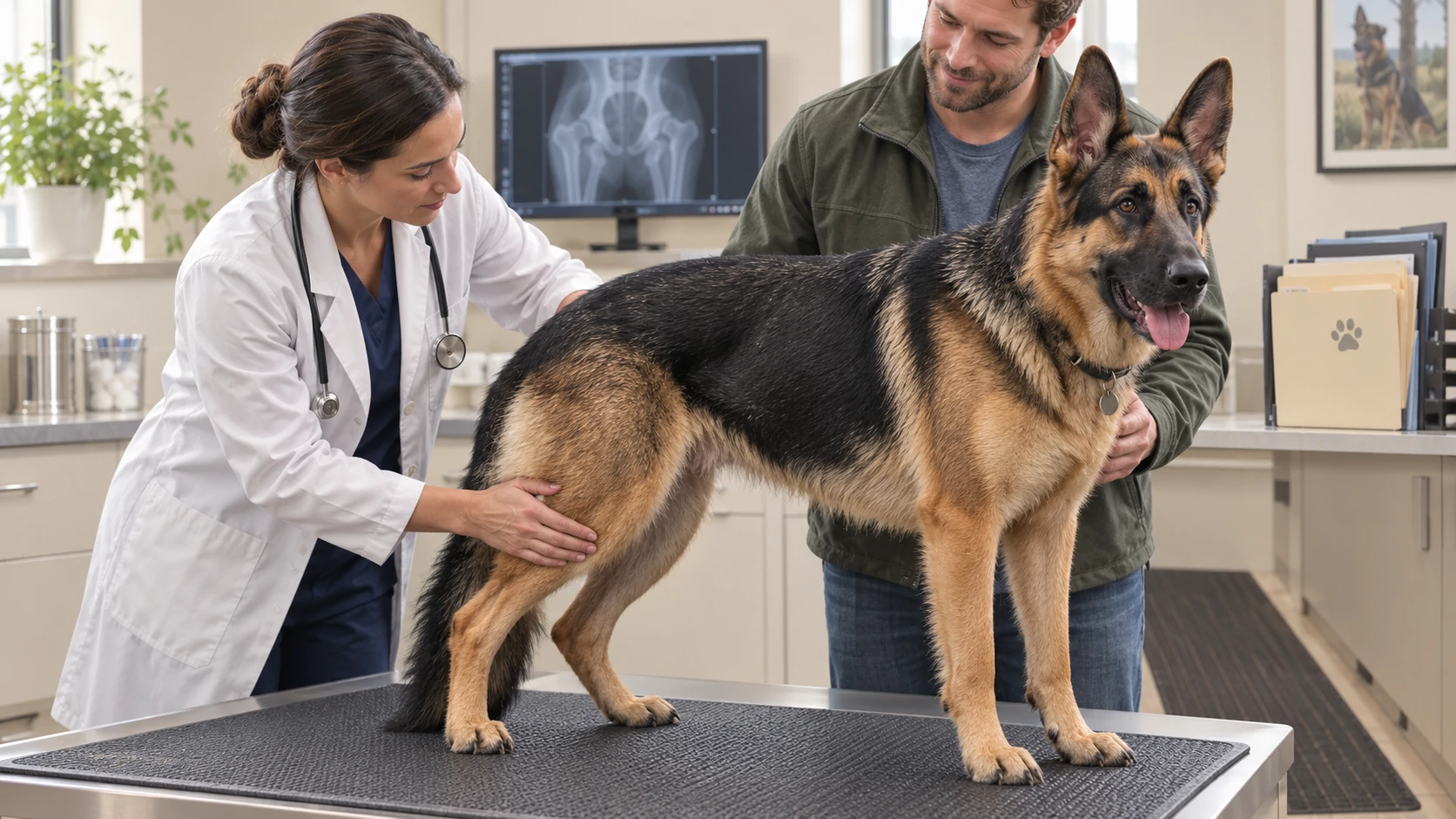
German Shepherd hip dysplasia is an inherited developmental condition in which the ball and socket of the hip do not fit together as securely as they should. The resulting looseness, called hip laxity, allows abnormal joint movement that can damage cartilage and lead to pain, reduced mobility, and osteoarthritis o
German Shepherds are among the large breeds commonly affected, but not every puppy with loose hips shows immediate signs. Some dogs remain active despite substantial changes on X-rays, while others experience pain with less dramatic radiographic
A veterinarian should evaluate persistent limping, stiffness, bunny hopping, difficulty rising, or reluctance to exercise. These signs can also come from injuries, knees, muscles, the spine, growth plates, or other orthopedic conditions, so appearance alone cannot confirm the d
German Shepherd Hip Dysplasia: Quick Answer
German Shepherd hip dysplasia begins during growth when inherited hip laxity allows abnormal movement between the femoral head and hip socket. Signs may include bunny hopping, hind-leg limping, difficulty rising, reduced activity, swaying hips, muscle loss, and reluctance to jump. Diagnosis requires a veterinary examination and properly positioned hip radiographs. Treatment may include healthy-weight management, controlled exercise, rehabilitation, veterinary pain control, or
What Happens Inside a Dysplastic Hip?
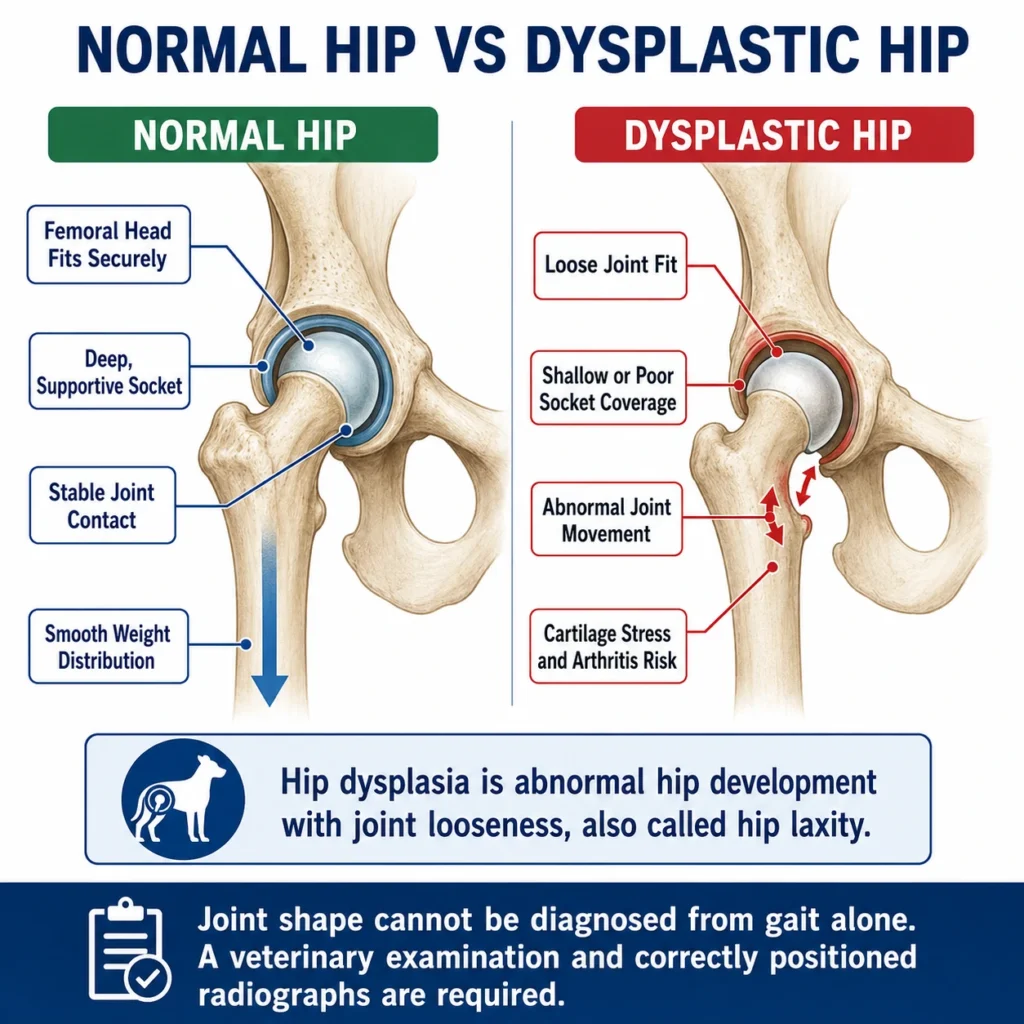
A normal hip is a ball-and-socket joint. The rounded head of the femur should sit securely inside the acetabulum, which is the socket in the pelvis.
With hip dysplasia, the joint is too loose or develops abnormally. As the puppy bears weight, the femoral head moves excessively inside or partly outside the socket. Repeated abnormal movement can stretch tissues, damage cartilage, reshape the joint, and encourage bone-spur f
Hip dysplasia and osteoarthritis are related but are not identical:
- Hip dysplasia describes abnormal development and looseness of the hip.
- Osteoarthritis is progressive inflammation and cartilage deterioration that may develop because the unstable joint repeatedly damages itself.
Once radiographic osteoarthritis has developed, the structural changes are considered irreversible, although pain and function can often be
What Causes German Shepherd Hip Dysplasia?
Genetics are the largest single risk factor. Hip dysplasia is polygenic, meaning several genes contribute rather than one simple gene determining the outcome. A puppy can inherit susceptibility even when one or both parents appear to move
Environmental factors can influence how strongly the condition is expressed. Excess calorie intake, overly rapid weight gain, obesity, and inappropriate stress on immature joints may worsen the effects in a genetically predisposed dog. These factors do not create the inherited disease by th
Important influences include:
- Family history and breeding selection
- Hip conformation inherited from both parents
- Rate of puppy growth
- Excess calorie intake
- Excess body weight
- Muscle condition
- Repetitive high-impact activity
- Previous trauma
- Development of secondary arthritis
A responsible plan therefore combines breeder screening, controlled growth, suitable nutrition, healthy body condition, and age-appropriate movement. No single step guarantees prevention.
Hip Dysplasia in German Shepherd Puppies
Hip dysplasia in German Shepherd puppies may begin before the owner notices anything unusual. Some affected puppies have significant joint laxity but continue to run, play, and climb normally.
Clinical signs may appear within the first few months, during adolescence, or much later after osteoarthritis develops. The absence of symptoms does not prove that the hips ar
This creates an important distinction:
- Symptom evaluation investigates a puppy that is limping, painful, stiff, or moving abnormally.
- Early screening evaluates hip laxity before obvious symptoms or irreversible arthritis develop.
- Breeding certification assesses an older dog for breeding-related documentation and is not the same as diagnosing a painful puppy.
If a German Shepherd puppy has a family history of hip dysplasia, unusual hind-leg movement, or persistent pain, discuss early screening rather than waiting for adulthood.
Cornell recommends that predisposed breeds or symptomatic puppies be evaluated for hip laxity before 20 weeks when joint-preserving intervention is being co
German Shepherd Hip Dysplasia Signs
Possible signs in puppies and adults include:
- Bunny hopping when running
- Hind-leg limping
- Stiffness after rest
- Difficulty standing up
- Reluctance to run or play
- Avoiding stairs
- Hesitation before jumping
- Swaying or rolling hips while walking
- Shifting weight toward the front legs
- Reduced range of motion
- Pain when the hip area is handled
- Loss of muscle in the rear legs
- Shortened steps
- Reduced endurance
- Difficulty getting into a vehicle
- Irritability associated with pain
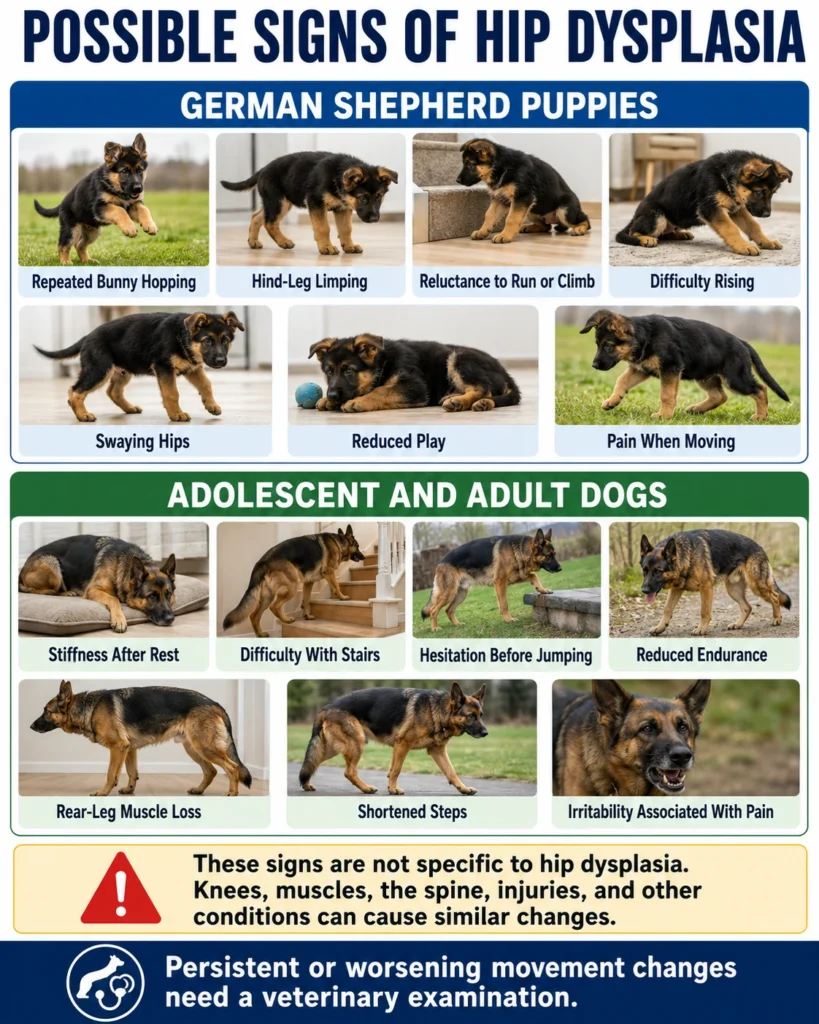
These signs vary in severity. A dog may show several, one,
Does Bunny Hopping Mean Hip Dysplasia?
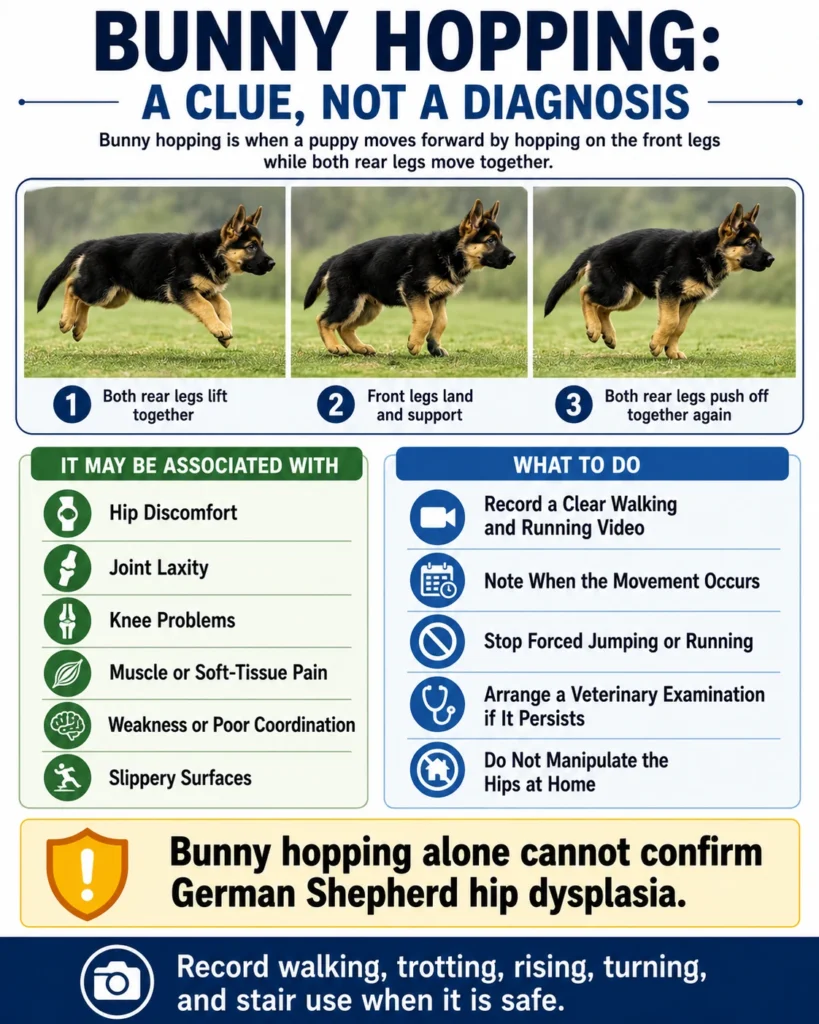
Bunny hopping means the rear legs move together during running rather than alternating normally. It can occur with hip discomfort, but it does not prove that a puppy has hip dysplasia.
Young puppies can sometimes use unusual gaits because they are excited, uncoordinated, growing quickly, or moving on a slippery surface. Knee problems, pain, weakness, or other orthopedic conditions may also affect gait.
Record a clear video showing the puppy walking, trotting, running, rising, turning, and using stairs when safe. Home videos can be useful because excitement or adrenaline may temporarily hide lameness during a clin
Is an Unusual Sitting Position a Sign?
A puppy sitting with one leg extended to the side does not automatically have hip dysplasia. Puppies may sit loosely because of flexibility, fatigue, surface traction, habit, or developing coordination.
The sitting position is more meaningful when it occurs with:
- Limping
- Pain
- Stiffness
- Difficulty rising
- Reduced play
- Reluctance to climb
- Repeated bunny hopping
- Muscle loss
- A worsening gait
Do not repeatedly force the puppy into a square sitting position when movement appears painful.
When Should a German Shepherd See a Veterinarian?
Arrange a veterinary appointment when:
- Limping continues or keeps returning
- The puppy appears stiff after rest
- Bunny hopping is frequent
- The puppy resists hip movement
- Activity decreases without a clear reason
- Rising becomes difficult
- Rear-leg muscles appear uneven
- The dog avoids stairs, jumping, or normal play
- Movement worsens after exercise
- A breeder or close relative has documented hip dysplasia
Limping usually indicates pain or weakness and deserves veterinary attention because the problem may involve bones, joints, muscles, tendons, ligaments, nerves, or t
Seek urgent care when the dog:
- Cannot stand
- Cannot bear weight after trauma
- Cries or shows severe pain
- Drags one or both rear legs
- Suddenly loses coordination
- Has an obvious fracture or major swelling
- Becomes weak, collapses, or develops other serious symptoms
Sudden severe lameness should not be assumed to be chronic hip dysplasia.
How Veterinarians Diagnose Hip Dysplasia
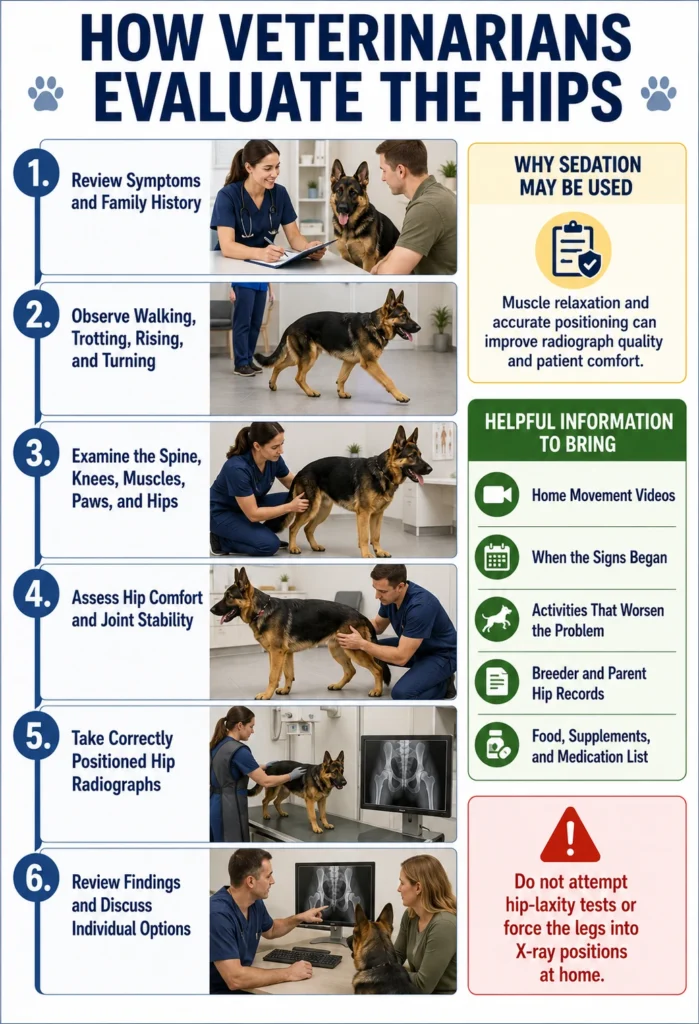
Diagnosis normally combines:
- Medical and family history
- Observation of gait and posture
- Orthopedic and neurologic examination
- Palpation of the hips
- Correctly positioned radiographs
- Sedation or anesthesia when needed for safe positioning and muscle relaxation
The veterinarian may observe the puppy walking in straight lines, turning, rising, and trotting. The physical examination checks the spine, muscles, knees, paws, range of motion, discomfort, asymmetry, and joint s
Hip dysplasia cannot be confirmed by looking at the dog from across the room. Correct positioning matters, and hip-laxity assessment may require special techniques. Sedation is commonly needed for reliable imaging and patient
Do not try to reproduce an Ortolani test or pull the puppy’s legs into screening positions at home. Improper manipulation may cause pain and will not produce a reliable diagnosis.
Early Hip Screening for German Shepherd Puppies
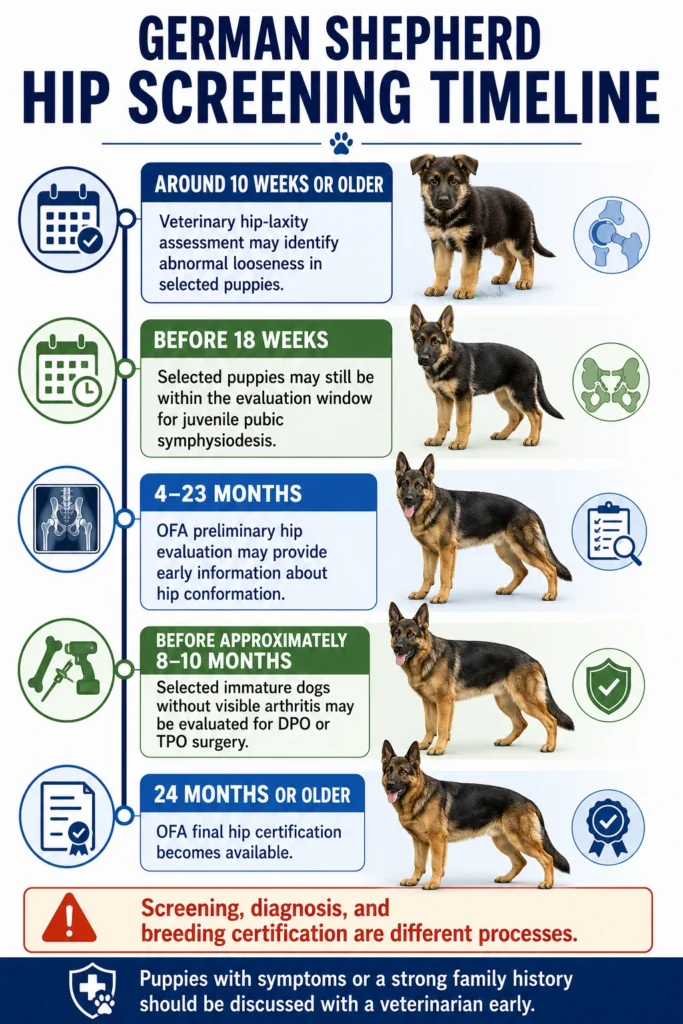
Early screening can be valuable because some surgical options must be considered while the pelvis is still growing.
PennHIP Assessment
PennHIP uses specially positioned radiographs to measure hip laxity. Cornell and ACVS describe the distraction method as an accurate way to quantify laxity in puppies. The procedure must be performed by trained personnel with the appropriate t
ACVS notes that abnormal laxity may be identified in puppies as young as about 10 weeks when early joint-preserving treatment is being co
OFA Preliminary Evaluation
The Orthopedic Foundation for Animals accepts preliminary hip radiographs for dogs from 4 through 23 months of age. These evaluations can provide useful early information, but final OFA certification requires the dog to be at least 24 mo
OFA grades hips as:
- Excellent
- Good
- Fair
- Borderline
- Mild dysplasia
- Moderate dysplasia
- Severe dysplasia
Excellent, good, and fair are considered within normal limits in the OF
Screening and Diagnosis Are Not the Same
A breeding-screening result evaluates hip structure for a particular purpose. A painful or limping puppy still needs a complete veterinary examination because another condition may be causing the symptoms.
Similarly, normal parent certifications reduce risk but do not guarantee that every puppy will have normal hips. Cornell notes that a dog with normal hips can still produce affected offspring, depending on the mate and wider
How to Evaluate a Breeder’s Hip Records
Before buying or adopting from a planned litter, ask for:
- Registered names of both parents
- Permanent identification details
- OFA, PennHIP, or relevant registry results
- The age at which testing was performed
- Information about siblings and previous litters
- Family history of hip or elbow problems
- The breeder’s policy if a developmental orthopedic condition is diagnosed
Do not accept statements such as:
- “The parents run fine.”
- “The veterinarian checked them.”
- “There has never been a problem.”
- “The breed naturally walks that way.”
- “The puppy comes with a joint supplement.”
Visible athletic ability is not a hip certification. Some dysplastic dogs remain highly active despite radiographic abnor
Can German Shepherd Hip Dysplasia Be Prevented?
No method can guarantee prevention in a genetically susceptible puppy.
Risk-reduction steps include:
- Choosing puppies from health-screened family lines
- Maintaining lean body condition
- Avoiding overfeeding
- Supporting steady rather than accelerated growth
- Feeding an appropriate large-breed growth diet
- Avoiding unnecessary calcium and vitamin D supplementation
- Providing controlled, age-appropriate activity
- Preventing repeated high-impact stress
- Seeking early evaluation when signs or family history create concern
Cornell specifically advises against overfeeding fast-growing large-breed puppies and recommends properly formulated large-breed diets without extra calcium or v
Use Furbivo’s German Shepherd puppy feeding chart to plan measured meals and controlled growth. Furbivo’s German Shepherd growth chart can help track the growth trend without treating one online weight number as
Weight and German Shepherd Hip Dysplasia
Extra body weight increases mechanical stress on an unstable or arthritic joint. Fat tissue can also contribute to inflammatory processes involved in osteoa
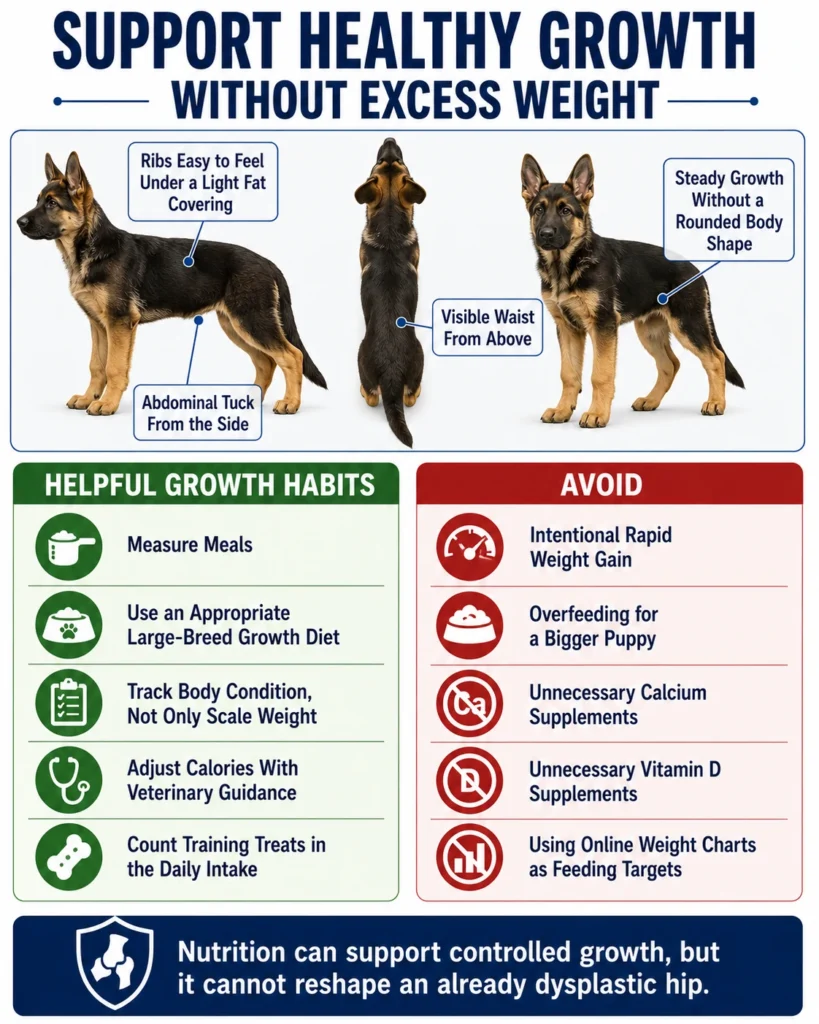
A healthy German Shepherd should generally have:
- Ribs that are easy to feel under a light fat covering
- A visible waist when viewed from above
- An abdominal tuck when viewed from the side
- Steady growth without becoming rounded or bulky
The goal is not to keep the puppy underfed. It is to provide complete nutrition while avoiding excess calories and rapid fat gain.
Furbivo’s German Shepherd height and weight guide explains why body condition matters more than trying to force every puppy into one weig
Safe Exercise for a German Shepherd Puppy
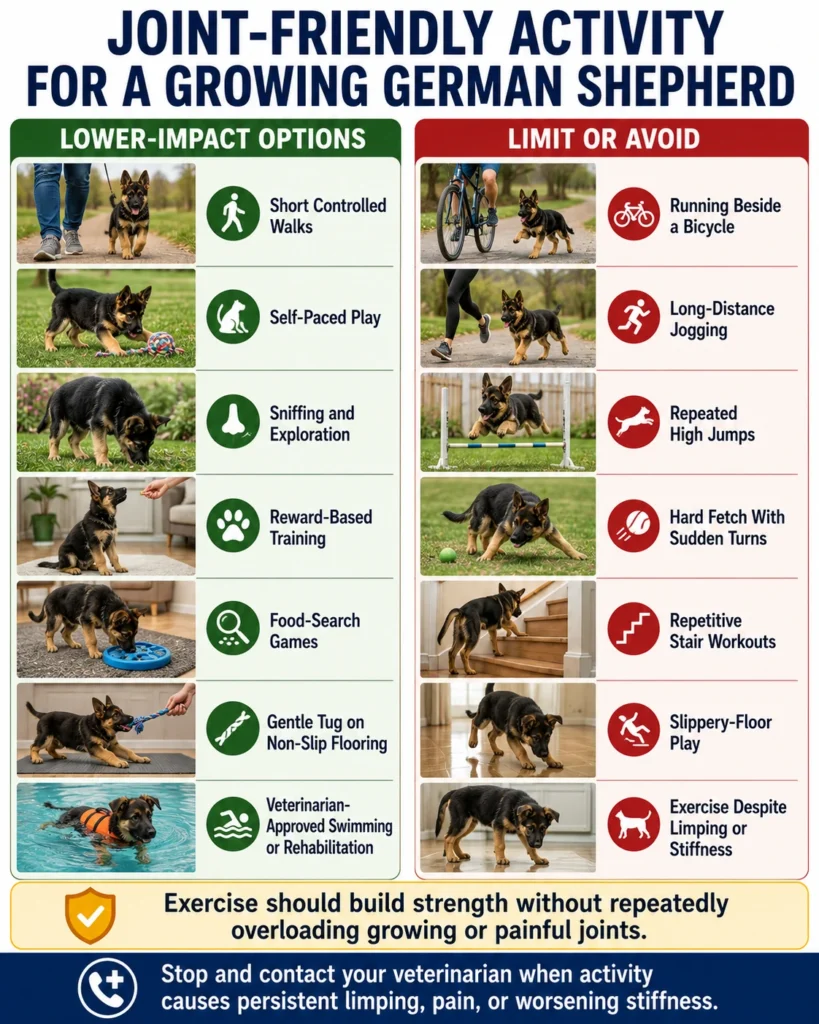
Exercise does not need to stop merely because a breed has a hip-dysplasia risk. Appropriate movement supports muscle, coordination, confidence, cardiovascular health, and joint stability.
Useful activities for a comfortable puppy can include:
- Short, controlled walks
- Self-paced play
- Sniffing and exploration
- Reward-based training
- Gentle tug on non-slip footing
- Food-search games
- Calm social exposure
- Veterinarian-approved swimming
- Rehabilitation exercises prescribed for the individual dog
Avoid turning puppy exercise into forced endurance work.
Activities that may place unnecessary repeated stress on growing joints include:
- Running beside a bicycle
- Long-distance jogging
- Repeated high jumping
- Hard fetch with sudden turns
- Repetitive stair workouts
- Slipping on polished floors
- Forced exercise after the puppy begins lagging
- Intense activity despite limping or stiffness
Furbivo’s German Shepherd puppy daily routine can help balance activity with naps, training, meals, and recovery. Its puppy socialization guide also explains why socialization should not become a forced physical
For a dog already diagnosed with hip dysplasia, exercise must be individualized. OFA recommends beginning with short leash walks and increasing activity only while the dog remains comfortable. Swimming may help maintain muscle without the same concussive force as land
Home Changes That Can Help
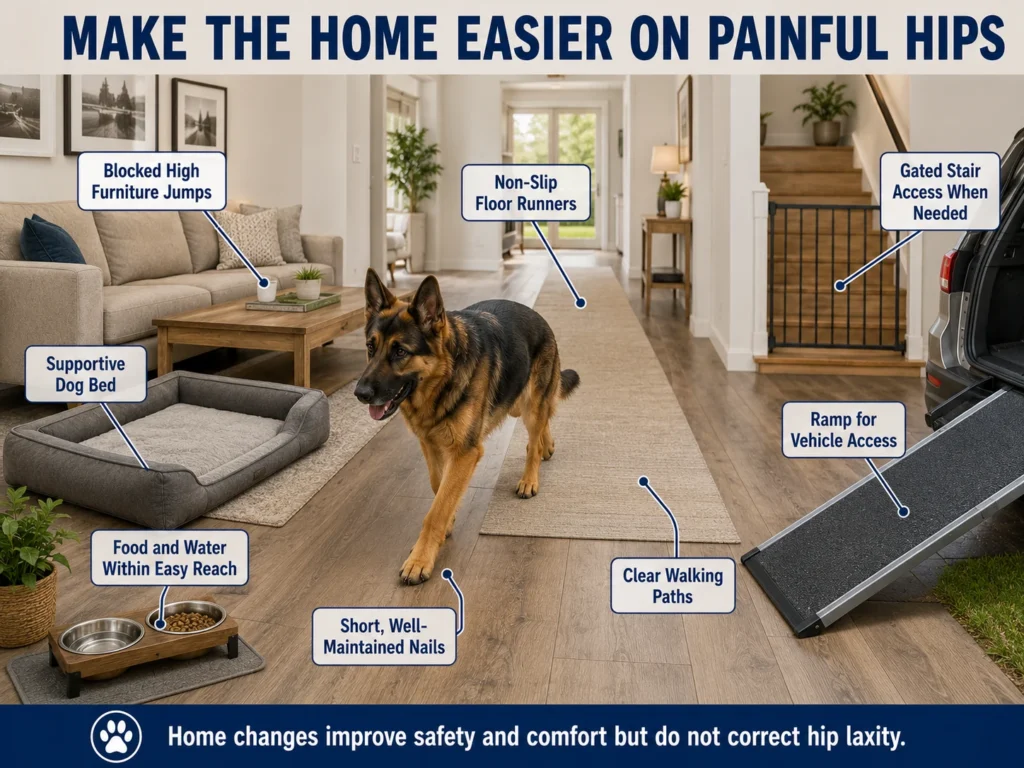
Simple environmental changes may reduce slipping, jumping, and painful transitions:
- Place non-slip runners on smooth floors.
- Use a ramp for vehicles when appropriate.
- Block repeated jumping from high furniture.
- Provide a supportive bed.
- Keep nails and paw hair maintained for better traction.
- Use gates to manage unsafe stair access.
- Keep food, water, and rest areas easy to reach.
- Help the dog maintain a stable footing when rising.
Cornell includes non-slip rugs, ramps, weight control, and low-impact activity among common osteoarthritis-management st
These changes improve safety and comfort but do not tighten a loose hip joint.
German Shepherd Hip Dysplasia Treatment
Treatment depends on:
- Dog’s age
- Severity of hip laxity
- Presence of arthritis
- Level of pain
- Functional limitations
- Body weight
- Response to conservative care
- Owner goals
- Other medical conditions
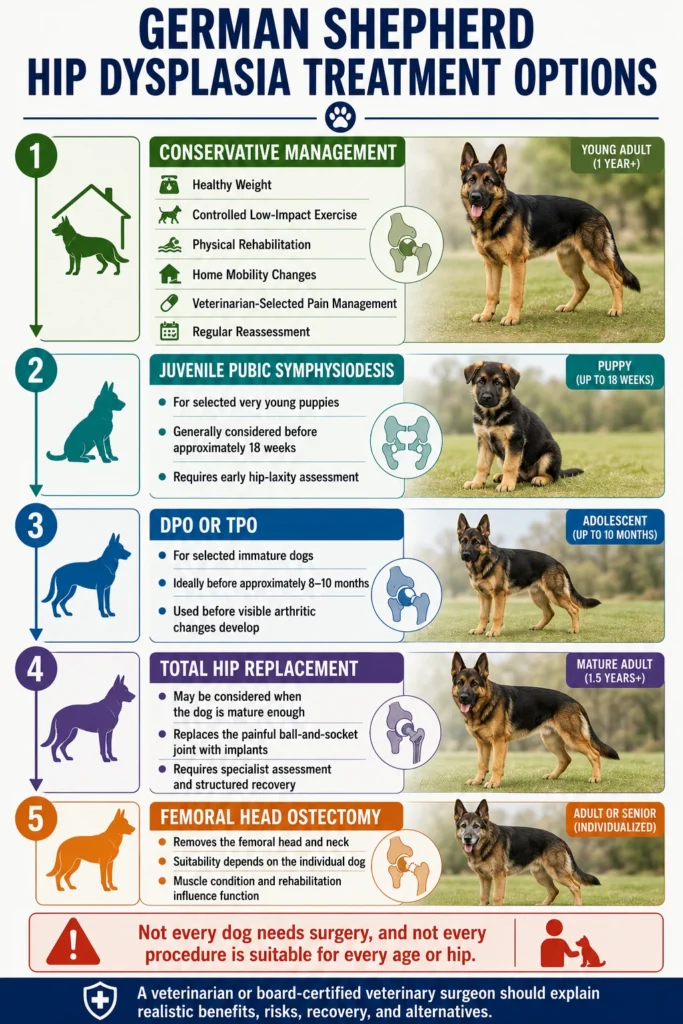
Some dogs need limited support. Others require long-term multimodal treatment or
Conservative or Medical Management
A veterinarian-supervised plan may include:
- Lean-weight maintenance
- Controlled low-impact exercise
- Physical rehabilitation
- Muscle-strengthening exercises
- Environmental modifications
- Prescription anti-inflammatory medication
- Additional pain-control medication
- Selected omega-3 or joint-support products
Regular reassessment
Veterinary NSAIDs require professional selection and may require bloodwork monitoring during long-term use. Never give ibuprofen, naproxen, acetaminophen, aspirin, or leftover pet medication unless a veterinarian has provided instructions for that spec
Do Joint Supplements Fix Hip Dysplasia?
No supplement can reshape the socket or eliminate inherited hip laxity.
Some veterinarians may use selected supplements or omega-3 fatty acids as one part of a wider management plan, but evidence and product quality vary. Cornell recommends identifying the actual orthopedic problem before beginning supplementary t
Do not rely on glucosamine, turmeric, collagen, calcium, vitamin C, or another supplement as a substitute for diagnosis. OFA states that there is no evidence that vitamin C supplementation prevents hip d
Surgery for Hip Dysplasia
Surgery is not automatically required for every affected German Shepherd. The most appropriate procedure depends heavily on age, hip laxity, arthritis, body size, and clinical signs.
Juvenile Pubic Symphysiodesis
Juvenile pubic symphysiodesis, or JPS, is a joint-preserving procedure performed in very young puppies. ACVS describes a limited window before approximately 18 weeks of age, making early detection e
The procedure changes pelvic growth to improve coverage of the femoral head as the puppy matures. It is not suitable for every puppy, and evaluation by a veterinarian or board-certified surgeon is required.
Double or Triple Pelvic Osteotomy
DPO or TPO rotates part of the pelvis to improve coverage of the femoral head. ACVS describes these as options for selected immature dogs, ideally before approximately 8–10 months and before radiographic arthritis is
Total Hip Replacement
A total hip replacement replaces the damaged ball and socket with implants. ACVS describes it as an option for dogs mature enough for the procedure when other approaches are unsuitable or cannot provide acceptable
Femoral Head Ostectomy
A femoral head ostectomy removes the femoral head and neck so a fibrous false joint develops. Its suitability and expected outcome depend on factors that include body size, muscle condition, rehabilitation, and the indivi
A surgeon should explain:
- Why a procedure is being recommended
- Whether arthritis is already present
- Expected recovery
- Exercise restrictions
- Rehabilitation requirements
- Possible complications
- Alternative options
- Realistic functional goals
What to Do While Waiting for the Veterinary Appointment
Until the dog is assessed:
- Stop forced running and jumping.
- Use controlled leash walks for bathroom needs.
- Prevent slipping where possible.
- Record videos of the gait.
- Note when signs started.
- Record whether movement worsens after activity or rest.
- List all food, supplements, and medications.
- Do not repeatedly flex or extend the hips.
- Do not give human pain medicine.
- Seek urgent care if the dog cannot stand or bear weight.
Do not keep testing the puppy by encouraging stairs, jumps, or fast running to see whether the limp returns.
What Most German Shepherd Hip Dysplasia Articles Miss
A Normal-Looking Puppy Can Still Have Hip Laxity
Early hip dysplasia may produce few or no visible signs. This matters because some joint-preserving treatments have ag
Bunny Hopping Is a Clue, Not a Diagnosis
Bunny hopping should prompt observation and veterinary discussion when persistent, but it cannot identify the affected joint or exclude another cause.
Parent Testing Reduces Risk but Does Not Guarantee a Normal Puppy
Hip dysplasia is polygenic. The wider family history and the breeding pair bot
Food Does Not Cure Poor Hip Conformation
Nutrition supports controlled growth and healthy body condition. It cannot reshape an already dysplastic hip.
More Rest Is Not Always the Full Answer
Complete inactivity can reduce muscle support. The goal is comfortable, controlled movement selected for the individual dog—not forced exercise or permanent in
X-Ray Severity and Visible Pain Do Not Always Match
Some dogs with major radiographic changes remain active, while others with less obvious arthritis experience substantial pain. Treatment should address the dog, not only t
Frequently Asked Questions
What Are the First Signs of German Shepherd Hip Dysplasia?
Early signs may include bunny hopping, hind-leg stiffness, difficulty rising, limping, reduced activity, swaying hips, reluctance to jump, or shifting weight to the front legs. Some affected puppies show no obvio
At What Age Does Hip Dysplasia Appear in German Shepherds?
Signs may develop within the first few months, during adolescence, or later after arthritis develops. Hip laxity may be detectable before visible symptom
Does Bunny Hopping Mean My German Shepherd Puppy Has Hip Dysplasia?
No. Bunny hopping may occur with hip discomfort, but gait alone cannot confirm the condition. A veterinarian must examine the puppy and decide whether radiographs or early hip-laxity testing are appropriate.
Can Hip Dysplasia in German Shepherd Puppies Be Cured?
Hip laxity cannot be corrected with food, supplements, or home exercise. Some very young dogs may qualify for joint-preserving surgery, while other dogs are managed with weight control, exercise, rehabilitation, veterinary medication, or later surgical pr
Should a German Shepherd Puppy With Suspected Hip Dysplasia Exercise?
Do not force painful activity. Controlled, low-impact movement may help maintain muscle, but the correct amount depends on symptoms and diagnosis. Stop activity that causes limping, stiffness, or pain and ask a veterinarian for an individuali
Can Overfeeding Cause Hip Dysplasia?
Overfeeding does not create the inherited condition, but excessive calories and rapid growth can worsen its expression in a genetically predispos
How Is a German Shepherd Tested for Hip Dysplasia?
Testing may include a physical and orthopedic examination, hip palpation, and specially positioned radiographs under sedation. PennHIP can quantify hip laxity in puppies, while OFA offers preliminary evaluations from 4 months and final certification from 2
Can a German Shepherd Live a Normal Life With Hip Dysplasia?
Many affected dogs can maintain a good quality of life with appropriate weight, controlled activity, pain management, rehabilitation, environmental support, or surgery when indicated. The outlook depends on severity and the individual dog’s
Final Thoughts
German Shepherd hip dysplasia is an inherited developmental condition, but the severity of its effects can be influenced by growth, weight, muscle condition, activity, and early veterinary care.
Watch for:
- Persistent bunny hopping
- Hind-leg limping
- Stiffness
- Difficulty rising
- Reduced activity
- Swaying hips
- Reluctance to jump or climb
- Rear-leg muscle loss
Do not diagnose the condition from gait, sitting posture, or a social-media video. A veterinary examination and properly positioned imaging are needed.
For hip dysplasia in German Shepherd puppies, early evaluation is particularly important because some joint-preserving options are available only during a limited growth window.
Keep the puppy lean, use a properly formulated large-breed growth diet, avoid unnecessary supplements, provide controlled low-impact activity, and investigate persistent movement changes early.
Have questions about your dog’s health, nutrition, grooming, or daily care? Visit our Contact Us page to reach the Furbivo team. For any medical symptoms, diagnosis, or treatment advice, always consult a qualified veterinarian.