
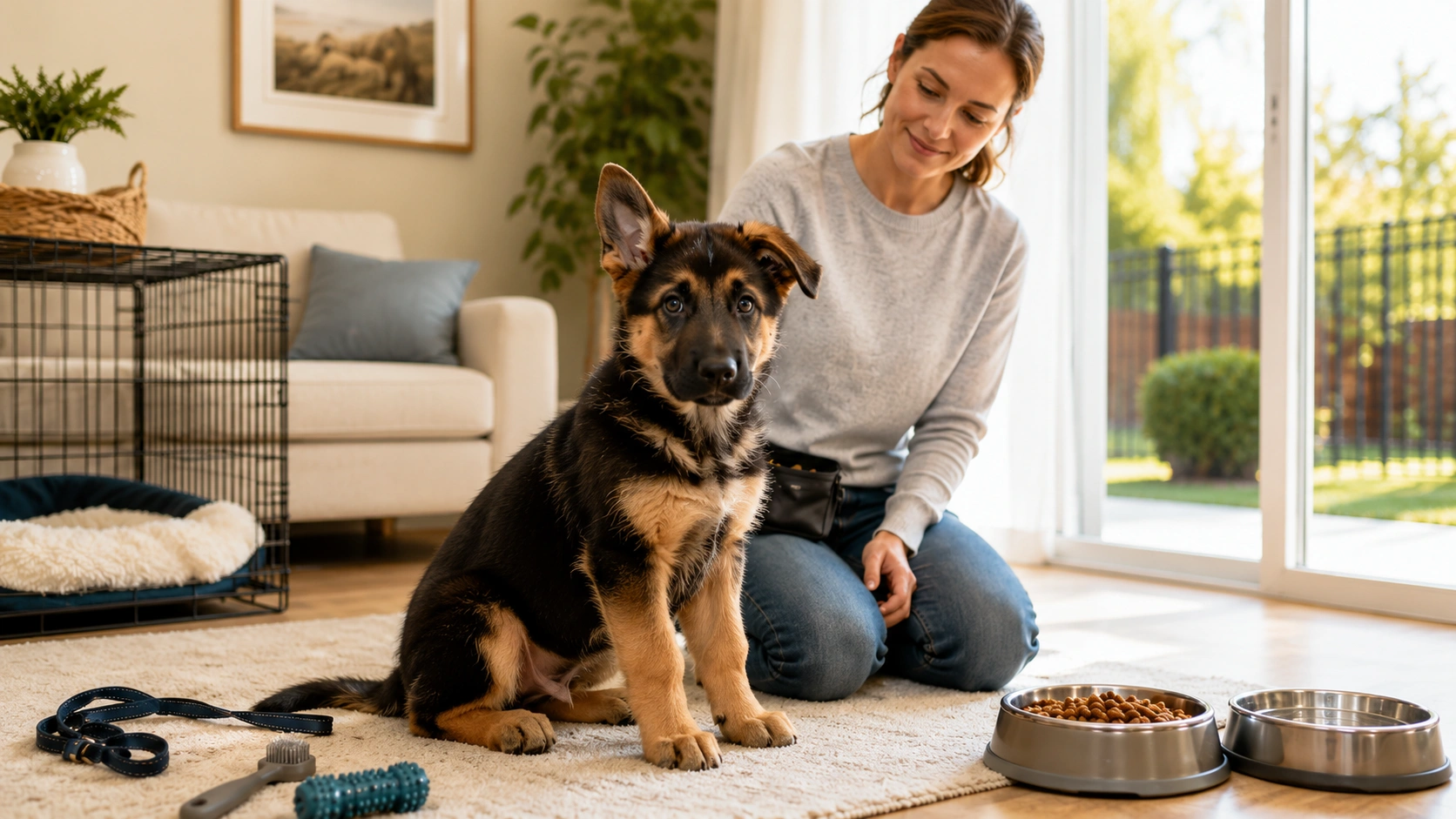
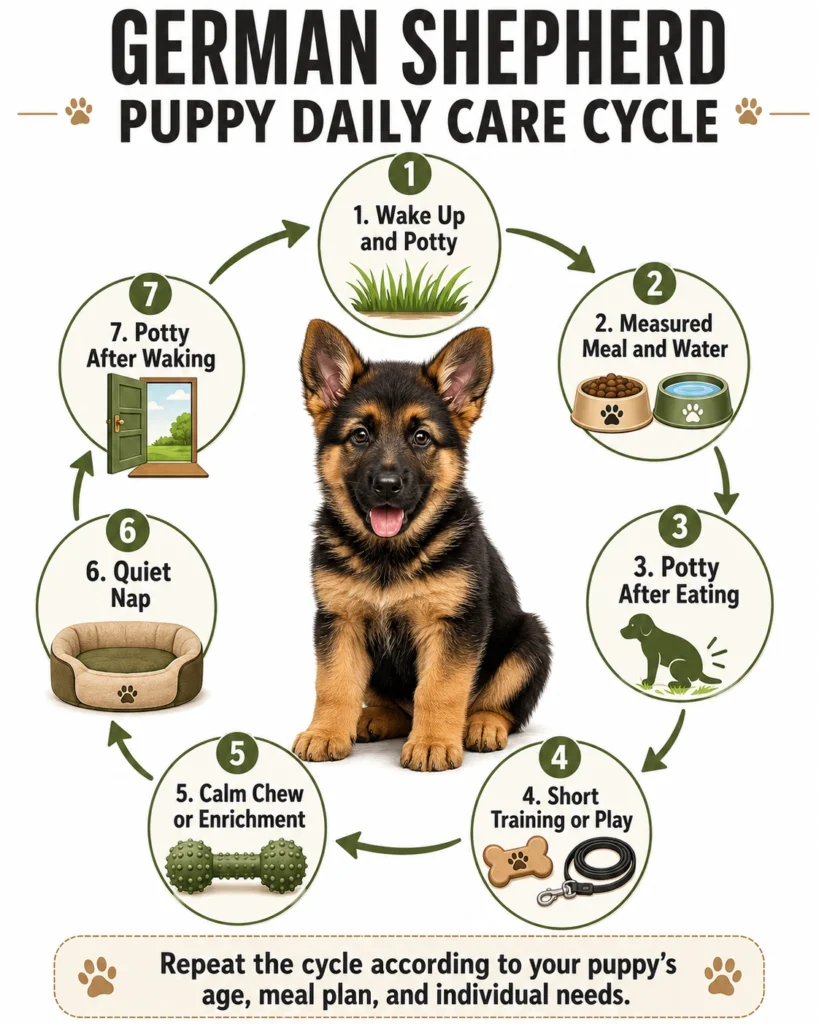
A good German Shepherd puppy daily routine follows a repeating cycle: potty break, measured meal when scheduled, another potty opportunity, brief training or play, calm enrichment, and sleep. The exact clock times depend on your puppy’s age and household, but the order should remain predictable.
The goal is not to keep your puppy busy every minute. It is to balance activity with enough rest, supervision, and quiet recovery.
German Shepherd Puppy Daily Routine: Quick Answer
A practical German Shepherd puppy schedule includes immediate morning potty time, measured meals, outdoor trips after waking, eating, drinking, and play, several short reward-based training sessions, safe socialization, self-paced exercise, calm chewing, and frequent naps. Repeat the same general cycle while adjusting meal frequency, activity, and toilet breaks as your puppy matures.
Daily Routine at a Glance
| Part of the day | Main activities | Main purpose |
|---|---|---|
| Early morning | Potty, water check, breakfast, short training | Start calmly and prevent an early accident |
| Mid-morning | Potty, exploration, handling, nap | Learning followed by recovery |
| Midday | Meal when age-appropriate, potty, play, sleep | Maintain energy without overstimulation |
| Afternoon | Potty, socialization, sniffing, training, nap | Confidence and mental enrichment |
| Early evening | Dinner, potty, family time, gentle play | Meet social and physical needs |
| Late evening | Calm chew, grooming practice, final potty | Lower arousal before sleep |
| Overnight | Sleep with age-appropriate toilet trips | Rest and housetraining support |
This is a framework, not a rigid prescription. Shift the times to fit your household while keeping the sequence predictable.
Why a German Shepherd Puppy Daily Routine Matters
German Shepherd puppies are intelligent, observant, active, and quick to learn patterns. They learn useful routines, but they can also learn that biting starts a game, barking brings attention, or refusing to settle leads to more entertainment.
A consistent routine helps owners:
- Predict when the puppy may need to eliminate
- Notice appetite or stool changes
- Prevent overtired behavior
- Schedule training before the puppy loses focus
- Balance physical and mental activity
- Build calm behavior rather than constant excitement
- Recognize changes that may indicate pain or illness
Routine should create predictability without making the puppy dependent on one exact minute. A dog that receives breakfast at precisely 7:00 every day may become restless when breakfast is ten minutes late. Use general time windows and consistent activity cues instead.
The Basic Puppy Care Cycle
A useful German Shepherd puppy daily routine can be built around this repeatable sequence:
- Take the puppy outside after waking.
- Offer a scheduled measured meal and fresh water.
- Return outside after the meal.
- Add a short training, play, sniffing, or socialization activity.
- Offer a calm chew or settling activity.
- Provide an uninterrupted nap.
- Take the puppy outside immediately after waking.
- Repeat according to age and meal frequency.
The routine works because it follows a puppy’s natural transitions. Waking, eating, drinking, and active play commonly create a need to eliminate.
During housetraining, accompany your puppy to the toilet area, wait calmly, and reward elimination while you are still outside. Do not punish accidents found later. VCA’s housetraining guidance emphasizes supervision, immediate outdoor rewards, and calm cleanup rather than punishment.
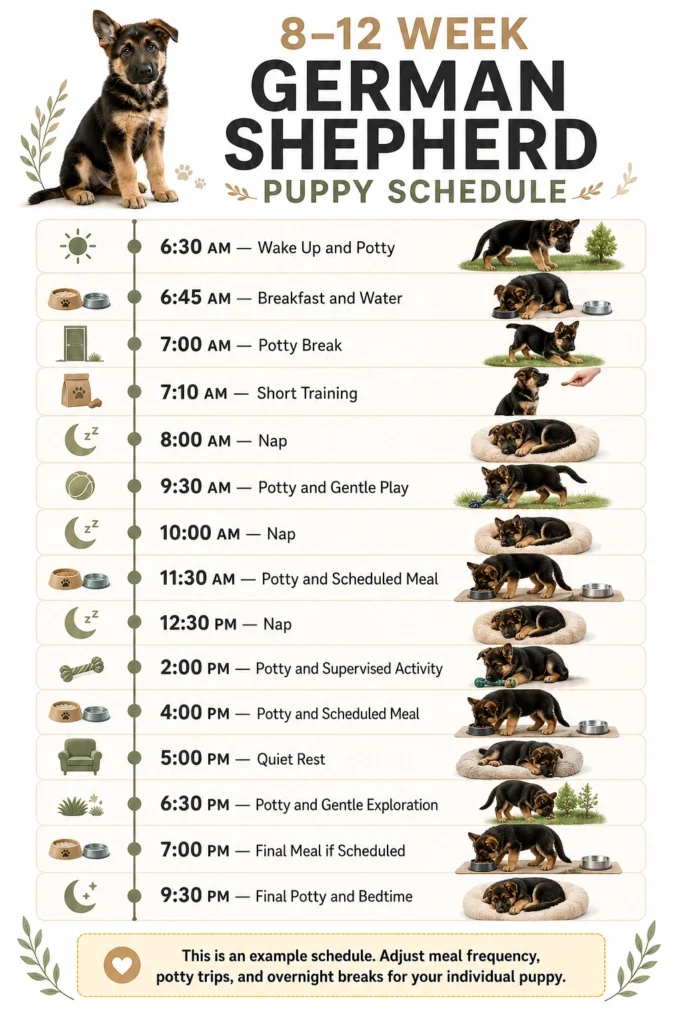
Sample German Shepherd Puppy Daily Routine for 8–12 Weeks
An 8-to-12-week-old puppy has limited bladder control, a small stomach, a short attention span, and a high need for supervision and rest.
The following schedule is an example, not a rule.
| Approximate time | Example activity |
|---|---|
| 6:30 a.m. | Wake up and go directly outside |
| 6:45 a.m. | Breakfast and fresh water |
| 7:00 a.m. | Potty break |
| 7:10 a.m. | Two-minute name, recall, or handling lesson |
| 7:20 a.m. | Calm chew and supervised exploration |
| 8:00 a.m. | Nap |
| 9:30 a.m. | Potty break after waking |
| 9:40 a.m. | Short play, sniffing, or safe social exposure |
| 10:00 a.m. | Nap |
| 11:30 a.m. | Potty and midday meal if following a four-meal plan |
| 11:45 a.m. | Potty, short training, then quiet time |
| 12:30 p.m. | Nap |
| 2:00 p.m. | Potty, supervised play, handling, or grooming practice |
| 2:30 p.m. | Nap |
| 4:00 p.m. | Potty and meal according to the puppy’s feeding plan |
| 4:15 p.m. | Potty and calm family interaction |
| 5:00 p.m. | Nap or quiet crate time |
| 6:30 p.m. | Potty, short sniffing walk, or garden exploration |
| 7:00 p.m. | Final meal when following a four-meal plan |
| 7:15 p.m. | Potty and calm indoor time |
| 8:00 p.m. | Gentle play, chew, or brief grooming practice |
| 9:30 p.m. | Final planned potty break and bedtime |
| Overnight | Additional potty trips according to the individual puppy |
Some 8-to-12-week-old puppies eat three meals, while others may still use four smaller meals. Furbivo’s German Shepherd puppy feeding chart gives an age-based meal framework and explains why portions must be based on the specific food, calories, growth, and body condition.
Very young puppies may need overnight toilet trips. VCA notes that young puppies cannot necessarily remain comfortably crated for the full night and may need to be taken outside several times.
Sample Routine for a 3-to-5-Month-Old Puppy
At this stage, many puppies can remain awake a little longer, but they still need regular rest. Teething, chewing, mouthing, and sudden bursts of excitement may become more noticeable.
| Approximate time | Example activity |
|---|---|
| 6:30 a.m. | Potty immediately after waking |
| 6:45 a.m. | Breakfast |
| 7:00 a.m. | Potty |
| 7:15 a.m. | Short training and sniffing activity |
| 8:00 a.m. | Nap |
| 10:00 a.m. | Potty, play, or controlled socialization |
| 10:30 a.m. | Calm chew followed by rest |
| 12:30 p.m. | Potty and lunch |
| 12:45 p.m. | Potty, brief training, and quiet time |
| 1:30 p.m. | Nap |
| 3:30 p.m. | Potty, short walk, sniffing, or environmental exposure |
| 4:15 p.m. | Rest |
| 5:30 p.m. | Dinner |
| 5:45 p.m. | Potty |
| 6:00 p.m. | Family time, training, or gentle play |
| 7:00 p.m. | Nap or calm settling period |
| 8:30 p.m. | Potty, chew, and calm handling |
| 10:00 p.m. | Final potty break and bedtime |
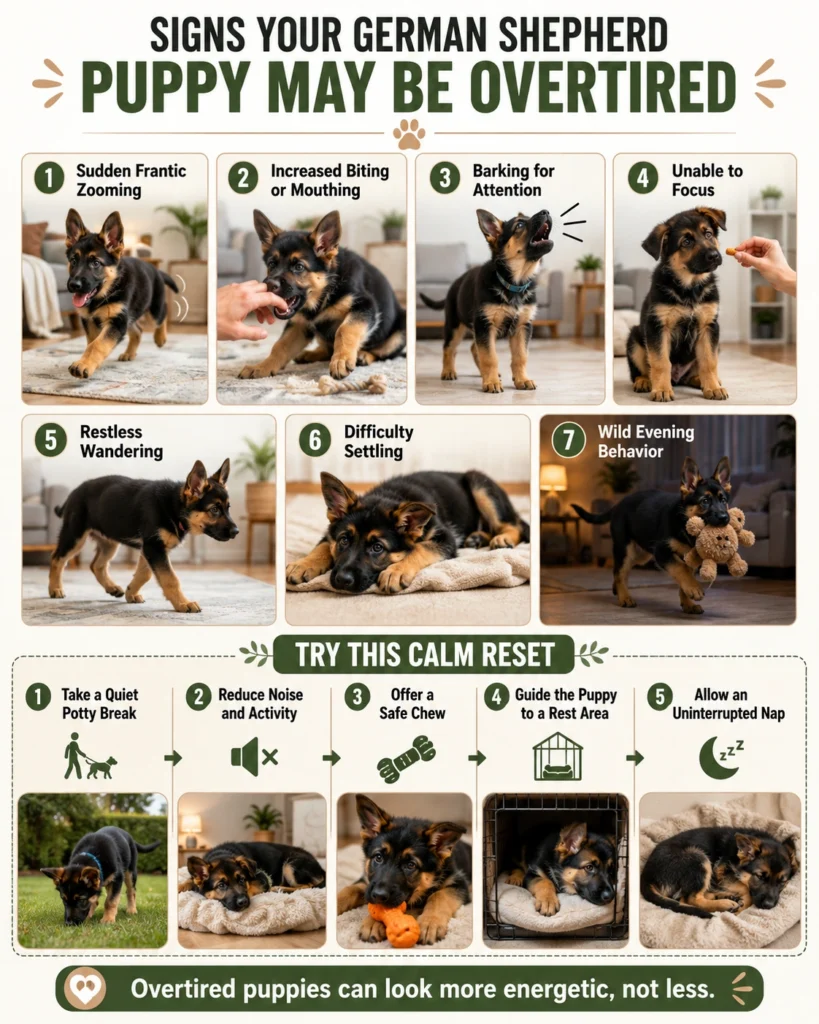
Do not remove naps simply because the puppy appears energetic. An overtired puppy may become more mouthy, frantic, noisy, or unable to respond to cues.
For chewing and mouthiness during this stage, use Furbivo’s guide to German Shepherd puppy teething stages and its separate guide to stopping German Shepherd puppy biting and nipping.
Sample Routine for a 6-to-12-Month-Old German Shepherd
Adolescent German Shepherds often look physically mature before their behavior, coordination, and skeletal development are complete.
A sample schedule may include:
| Approximate time | Example activity |
|---|---|
| 6:30 a.m. | Potty and calm sniffing walk |
| 7:00 a.m. | Breakfast |
| 7:30 a.m. | Quiet recovery |
| 8:00 a.m. | Brief training or food-search activity |
| Morning | Rest while the household works |
| Midday | Potty, short walk, play, or training |
| Early afternoon | Calm rest |
| Late afternoon | Socialization, scent work, or skill practice |
| 6:00 p.m. | Dinner |
| 6:30 p.m. | Quiet recovery and potty |
| Evening | Family time, grooming, enrichment, and settling |
| 10:00 p.m. | Final potty break and sleep |
Adolescents often need more thoughtful enrichment, not simply more intense exercise. Continue teaching recall, loose-leash walking, settling, impulse control, calm observation, and polite greetings.
The AKC’s German Shepherd training timeline emphasizes ongoing, consistent training through the breed’s prolonged adolescent development.
Build Potty Breaks Around Events, Not Only the Clock
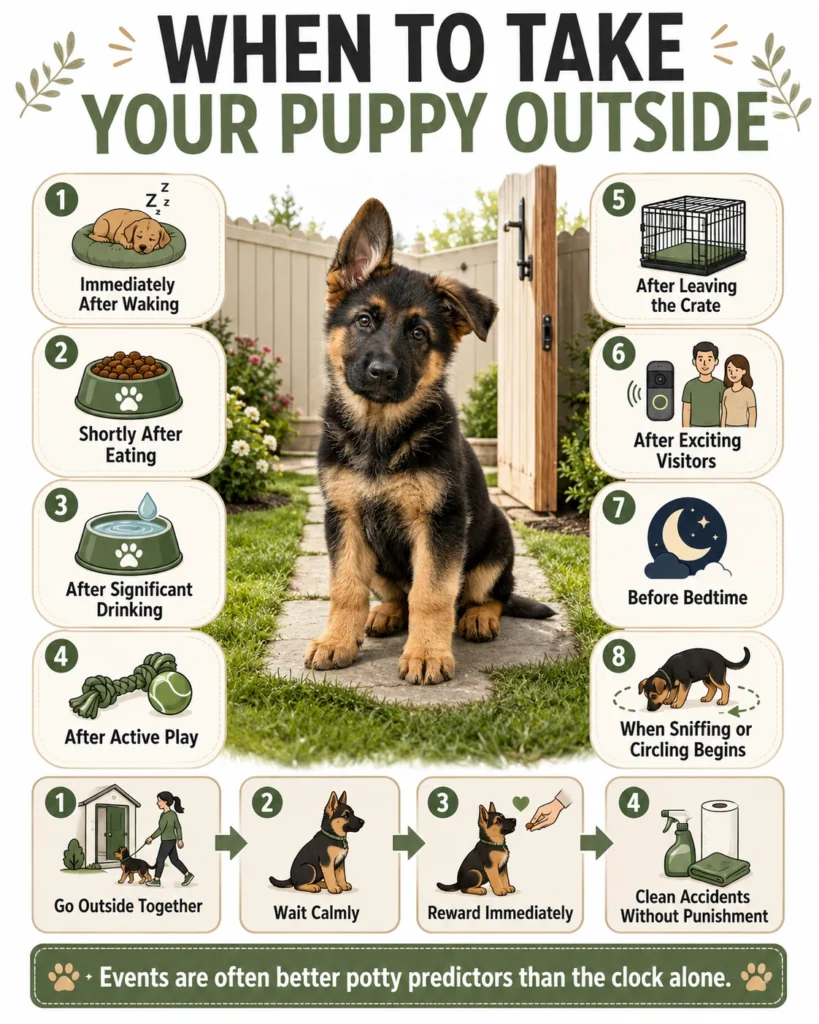
A clock-based plan is useful, but events are usually better toilet predictors.
Take your puppy outside:
- Immediately after waking
- Shortly after each meal
- After significant drinking
- After active play
- After an exciting visitor
- After leaving the crate or pen
- Before a nap when the puppy has been awake
- Before bedtime
- Whenever sniffing, circling, restlessness, or sudden wandering appears
Remain outside with the puppy instead of sending it alone. Quietly reward successful elimination before returning indoors.
If the puppy does not eliminate, return indoors for close supervision and try again soon. Allowing unsupervised freedom immediately after an unsuccessful toilet trip often leads to an accident.
Do not punish accidents. Review what happened before them:
- Was the puppy awake longer than usual?
- Was a potty break delayed after a meal?
- Did active play increase urgency?
- Was the puppy given too much unsupervised space?
- Was a signal missed?
- Has stool or urination changed?
A previously reliable puppy that suddenly begins having accidents may need veterinary assessment.
Schedule Meals Instead of Free-Feeding
Scheduled meals make a German Shepherd puppy daily routine easier to manage. They help owners monitor appetite, divide calories correctly, use part of the ration for training, and predict bathroom patterns.
Furbivo’s feeding guide recommends measured meals rather than leaving a full bowl down all day. Its general schedule is:
- 8–12 weeks: Usually three or four meals
- 3–5 months: Usually three meals
- 6–9 months: Usually two or three meals
- 10–18 months: Commonly two meals
These are planning ranges, not fixed prescriptions. Food calorie density, body condition, growth, digestion, treats, activity, and veterinary advice all affect the actual amount.
Keep mealtimes calm. Avoid intense exercise immediately around a large meal. German Shepherd Dogs are among the deep-chested breeds at risk for gastric dilatation-volvulus, so owners should discuss individual feeding and GDV prevention with their veterinarian.
Use Short Training Sessions Throughout the Day
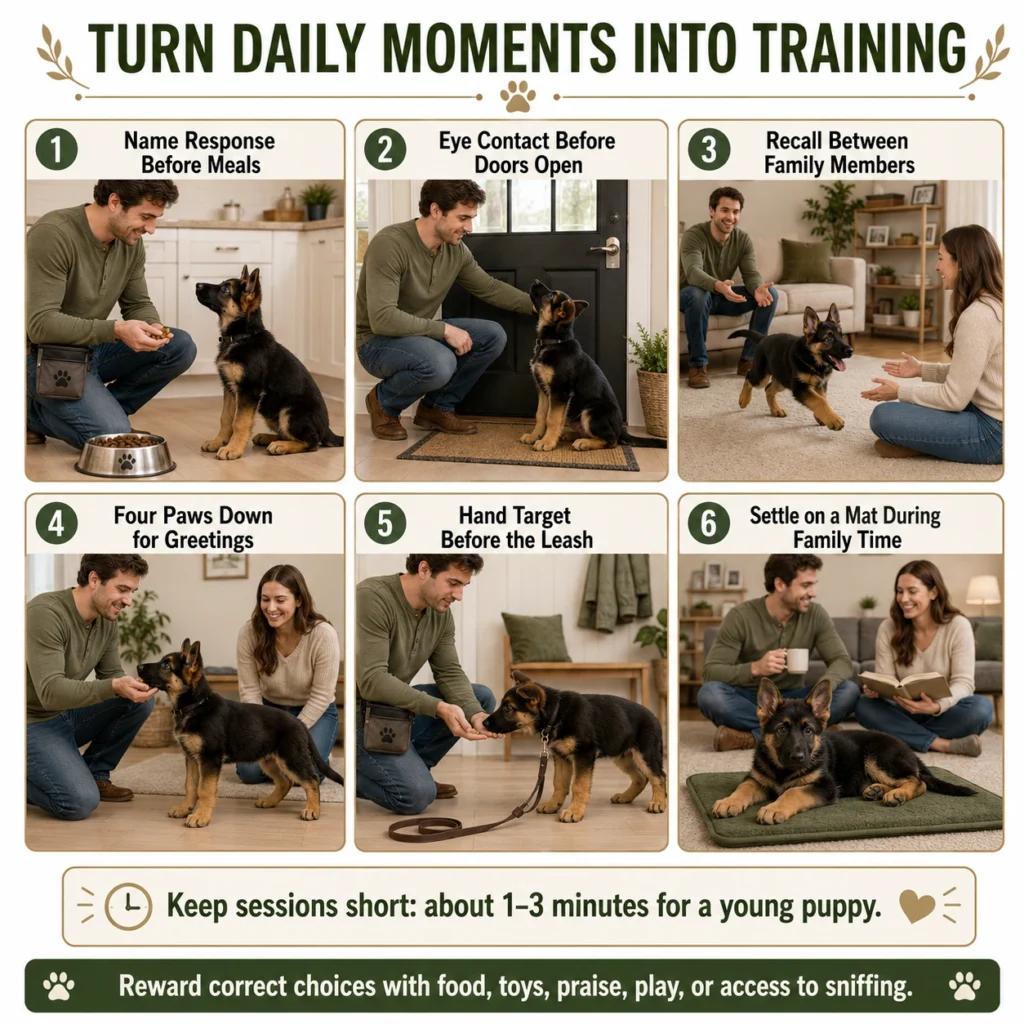
A puppy does not need one long daily obedience lesson.
Add one-to-three-minute sessions to natural parts of the routine:
- Ask for eye contact before opening a door.
- Practice name response before placing the food bowl down.
- Reward four paws on the floor during greetings.
- Practice recall between family members.
- Teach a hand target before attaching the leash.
- Reward settling on a mat while the family eats.
- Practice drop it during supervised toy play.
Training should rely on rewards rather than fear, pain, intimidation, leash corrections, shock collars, or physical punishment. AVSAB recommends reward-based methods for teaching skills and addressing behavior problems.
Begin in a quiet location before adding distractions. VCA notes that puppies learn more effectively when the environment and reward allow them to focus.
For broader skill development, link the routine to Furbivo’s guide on how to train a German Shepherd.
Include Safe Socialization Without Overloading the Day
Socialization should be built into normal life rather than treated as a daily mission to meet as many dogs and people as possible.
Useful experiences include:
- Calm visitors
- People wearing different clothing
- Household appliances
- Car rides
- Veterinary handling practice
- Different safe surfaces
- Bicycles observed from a comfortable distance
- Calm, healthy dogs selected carefully
- Grooming equipment
- New environments with enough space
Watch the puppy’s response. A puppy that can observe, eat, play, and recover is generally handling the experience better than one that freezes, tries to escape, barks continuously, or refuses food.
Furbivo’s German Shepherd puppy socialization guide explains safe exposure, fear signals, recovery, and why calm neutrality is often a better goal than forced greetings.
Balance Physical Exercise With Mental Enrichment
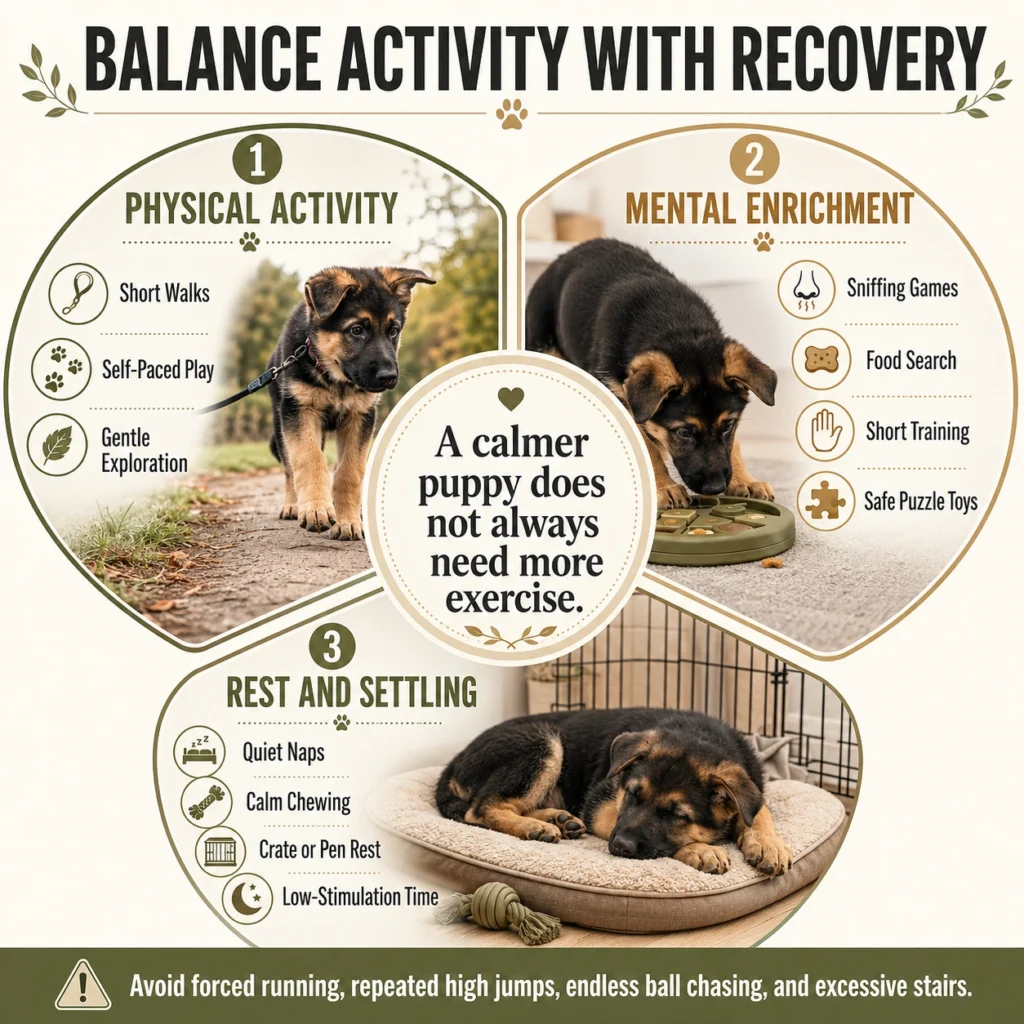
A German Shepherd puppy should move, explore, and play, but owners should not try to create calmness through physical exhaustion.
Appropriate activities can include:
- Self-paced play
- Short walks
- Sniffing
- Food-search games
- Recall practice
- Gentle tug with rules
- Exploring safe surfaces
- Simple scent work
- Calm social exposure
- Puzzle feeders used under supervision
Avoid forcing a growing puppy through:
- Long-distance running
- Jogging beside a bicycle
- Repeated high jumps
- Endless ball chasing
- Long hikes
- Repetitive stair running
- High-impact agility
Puppy growth plates are still developing and may be injured by strenuous exercise. VCA recommends allowing puppies to self-regulate activity and delaying forced high-impact exercise until physical maturity.
Exercise needs cannot be reduced to one universal number of minutes. Consider the puppy’s age, health, heat, surface, body condition, confidence, and recovery after activity.
Stop or reduce activity when the puppy:
- Lags behind
- Lies down repeatedly
- Becomes uncoordinated
- Refuses to continue
- Appears stiff afterward
- Limps
- Becomes excessively frantic rather than calmer
Persistent limping, pain, or stiffness needs veterinary assessment.
Protect Sleep and Teach the Puppy to Settle
Rest is part of training.
Puppies commonly nap throughout the day even after sleeping at night. Individual sleep requirements vary, so judge the routine by the puppy’s behavior, ability to settle, and recovery rather than forcing one universal daily sleep total. VCA notes that substantial variation in puppy sleep duration can be normal.
Create a predictable nap environment:
- Use a quiet crate, pen, or gated room.
- Lower household activity.
- Offer a safe chew when appropriate.
- Keep children from disturbing the puppy.
- Take the puppy outside before and after rest.
- Avoid using the crate only when everyone leaves.
A crate should be introduced gradually as a safe resting area, not used as punishment. Furbivo’s crate-training guide for German Shepherd puppies covers daytime introduction, nighttime care, whining, and confinement limits.
Add Small Grooming and Handling Sessions
Grooming does not need to occupy a large daily block.
Add ten-to-thirty-second handling exercises during calm periods:
- Touch one paw and reward.
- Lift one ear flap briefly.
- Brush a small section of coat.
- Touch the collar.
- Examine the lips.
- Practice standing on a non-slip mat.
- Reward calm cooperation.
Handling exercises help puppies become more comfortable with routine home care and veterinary examinations.
Do not continue until the puppy struggles intensely. Stop earlier, use a valuable reward, and make the next session easier.
Furbivo’s German Shepherd puppy grooming guide provides detailed brushing, bathing, nail, ear, dental, and coat-care guidance.
Create a Calm Evening Routine
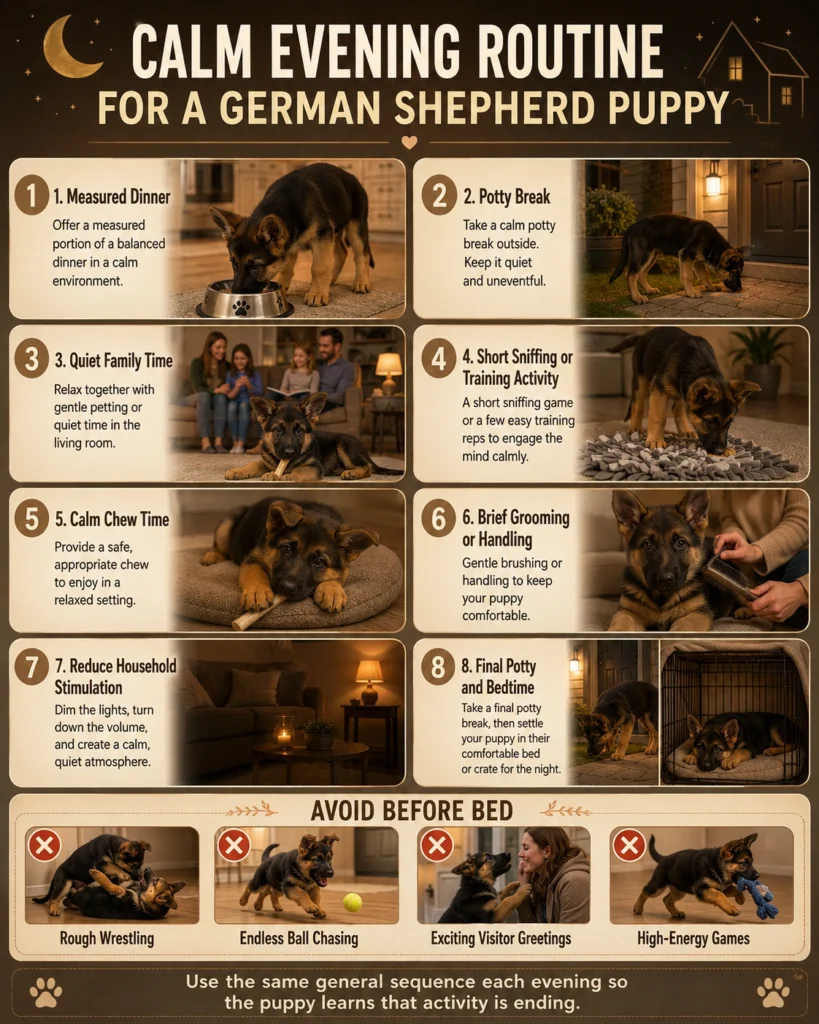
Evening zoomies do not always mean the puppy needs harder exercise. They can appear when the puppy is overstimulated or overtired.
A calm evening sequence might include:
- Measured dinner
- Potty break
- Quiet family interaction
- A short sniffing or training activity
- Calm chew time
- Brief grooming or handling
- Reduced household stimulation
- Final potty trip
- Bedtime
Avoid intense wrestling, repeated ball throwing, or exciting visitor greetings immediately before sleep.
Keep the final part of the day predictable. Dimmer lighting, quieter voices, and the same bedtime sequence can become cues that activity is ending.
Adjusting a German Shepherd Puppy Daily Routine by Age
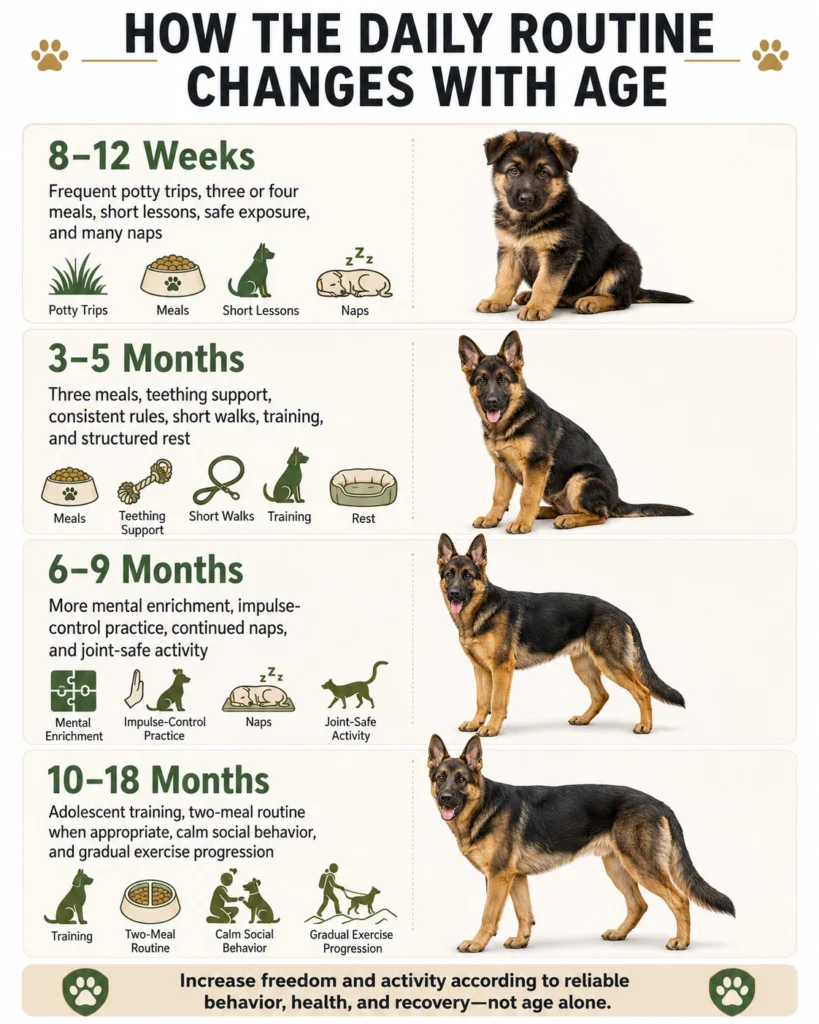
A German Shepherd puppy daily routine should change as the puppy develops.
| Age | Main routine adjustment |
|---|---|
| 8–12 weeks | Prioritize supervision, frequent potty trips, several meals, safe exposure, and many rest periods |
| 3–5 months | Add structured training, teething support, slightly longer exploration, and consistent household rules |
| 6–9 months | Increase mental enrichment and impulse-control work while protecting developing joints |
| 10–12 months | Continue adolescent training, measured meals, calm social behavior, and gradual activity progression |
| 12–18 months | Move toward an adult schedule according to growth, food transition, behavior, and veterinary advice |
Do not increase freedom only because the puppy has reached a particular birthday. Increase it after the puppy repeatedly demonstrates:
- Reliable toileting
- Safe chewing choices
- Ability to settle
- Response to recall
- Calmness around household distractions
- Comfort being briefly separated
- Appropriate behavior around other pets
Freedom should be earned in small areas before the puppy receives access to the entire home.
What Most Routine Articles Miss
A Routine Should Follow the Puppy’s State
Two days do not have to look identical.
After a busy veterinary visit, puppy class, car trip, or social outing, the puppy may need more quiet recovery. After a restful day, gentle exploration may be useful.
Calmness Is a Skill
Waiting for a puppy to become tired does not automatically teach settling. Reward lying down, chewing quietly, watching the environment, and resting near the family.
Activity Can Increase Arousal
More exercise does not always produce a calmer puppy. Fast chasing, rough play, and constant excitement can leave some puppies more frantic.
Behavior Often Reflects an Unmet Need
Mouthing, barking, wandering, and poor concentration may be related to:
- Fatigue
- Hunger
- A toilet need
- Overstimulation
- Boredom
- Frustration
- Teething discomfort
- Pain or illness
Check the pattern before assuming disobedience.
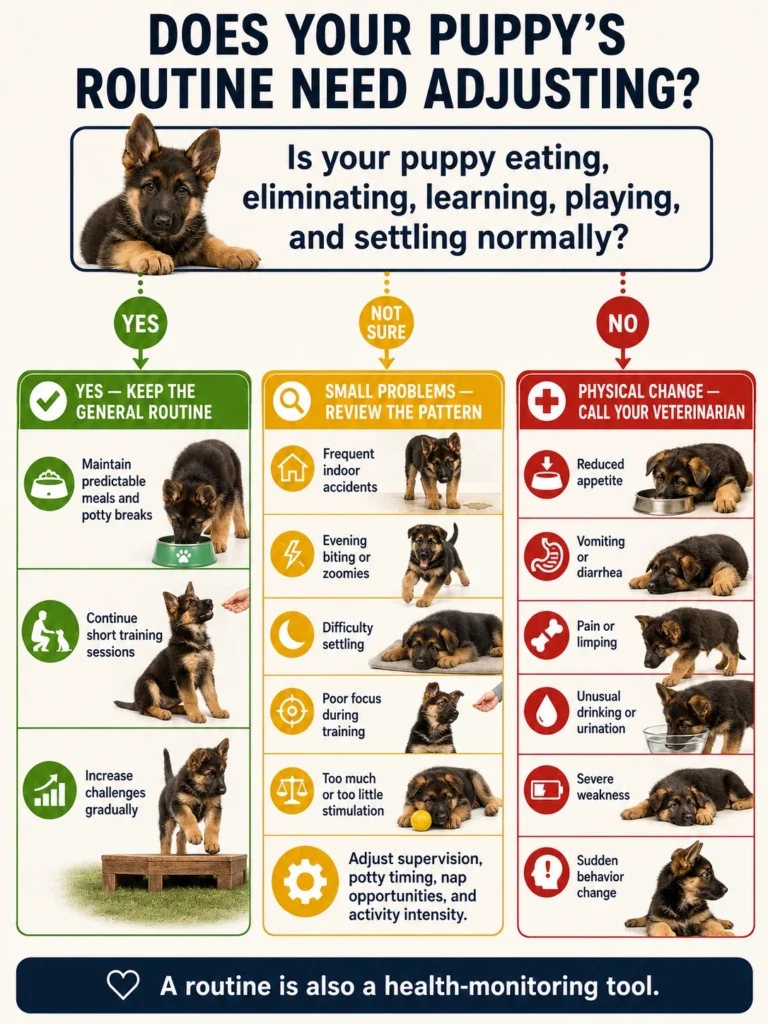
The Routine Is a Health-Monitoring Tool
Scheduled meals, potty breaks, activity, and sleep make changes easier to notice.
A sudden change in appetite, stool, urination, movement, energy, sleep, or behavior may justify veterinary advice.
Common Routine Mistakes
Keeping the Puppy Awake Too Long
Puppies often appear more energetic when overtired. Schedule rest before behavior becomes chaotic.
Trying to Exhaust the Puppy
Excessive exercise can overload developing joints without teaching calm behavior.
Using One Long Training Session
Short sessions spread across the day are usually easier for a puppy to understand.
Changing the Schedule Every Day
Minor flexibility is healthy, but completely unpredictable meals, toilet breaks, and sleep make progress harder to assess.
Giving Too Much Freedom Too Soon
Use gates, a pen, a crate, and active supervision until the puppy demonstrates reliable habits.
Free-Feeding
Leaving food down throughout the day makes intake difficult to measure and may hide an appetite change.
Treating Socialization as Forced Interaction
The puppy does not need to meet every person or dog. Safe observation and recovery are valuable.
Punishing Accidents or Fear
Punishment can create avoidance and does not teach the desired behavior. Manage the environment and reward correct choices.
When a Routine Change Needs Veterinary Attention
Contact your veterinarian when your puppy develops a persistent or sudden change in:
- Appetite
- Drinking
- Urination
- Stool
- Weight
- Movement
- Energy
- Sleep
- Breathing
- Behavior
Seek urgent veterinary care for:
- Difficulty breathing
- Collapse
- Repeated vomiting
- Severe or bloody diarrhea
- Suspected toxin ingestion
- Possible foreign-object ingestion
- Severe pain
- A swollen, painful abdomen
- Repeated retching without producing vomit
- Weakness or reduced responsiveness
Do not try to restore the routine while ignoring physical symptoms. Illness, pain, parasites, infection, dietary problems, or a swallowed object can disrupt a puppy’s normal pattern.
Frequently Asked Questions
What is the best German Shepherd puppy daily routine?
The best routine repeats potty breaks, measured meals, brief training, age-appropriate activity, socialization, calm enrichment, and sleep. Keep the order predictable while adapting the timing to your puppy’s age, health, feeding plan, and response.
How often should a German Shepherd puppy go outside?
Take the puppy outside after waking, eating, significant drinking, active play, leaving confinement, and before bedtime. Very young puppies also need additional trips between these events. Watch behavior rather than relying only on one fixed interval.
How many times should a German Shepherd puppy eat each day?
Many 8-to-12-week-old puppies eat three or four meals, puppies around three to five months often eat three meals, and older puppies gradually move toward two meals. Use the food label, body condition, digestion, and veterinary advice to individualize the plan.
How long should German Shepherd puppy training sessions be?
Begin with sessions lasting approximately one to three minutes. Stop while the puppy remains engaged. Short lessons repeated throughout the day are often more productive than one long session.
How much exercise should a German Shepherd puppy get?
There is no universal daily minute formula. Use short, self-paced walks, sniffing, exploration, play, and mental enrichment. Avoid forced running, repeated jumping, and other strenuous activity while growth plates are developing.
Why does my German Shepherd puppy become wild in the evening?
Evening biting, zooming, barking, and poor focus can reflect fatigue or overstimulation rather than a need for harder exercise. Try a potty break, calm chew, quieter environment, and an earlier nap or bedtime.
Should weekends follow the same puppy routine?
Keep meals, potty opportunities, sleep, and bedtime reasonably consistent. Walks and family activities can vary, but a completely different weekend schedule may make housetraining and settling harder.
Final Thoughts
A successful German Shepherd puppy daily routine does not require filling every hour with activity. It requires a predictable sequence that helps your puppy eat, eliminate, learn, explore, recover, and sleep.
Begin with the basic cycle:
- Potty
- Meal when scheduled
- Potty
- Short activity
- Calm enrichment
- Nap
Add training, grooming, socialization, and exercise in small pieces rather than treating each as a long daily event.
Observe the puppy in front of you. Increase challenges gradually, protect developing joints, reward calm behavior, and adjust the schedule when age, health, or recovery changes.
Have questions about your dog’s health, nutrition, grooming, or daily care? Visit our Contact Us page to reach the Furbivo team. For any medical symptoms, diagnosis, or treatment advice, always consult a qualified veterinarian.