
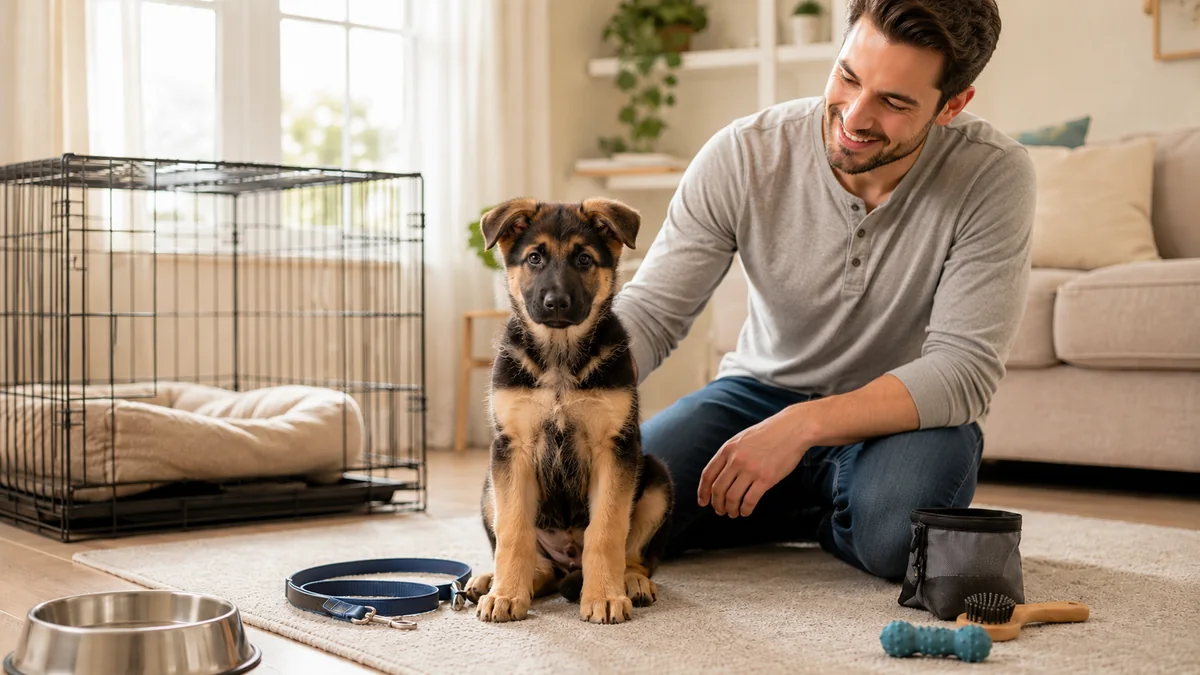
Learning how to take care of a German Shepherd puppy means building a routine that supports steady growth, confidence, good behavior, and preventive health. Meals, potty trips, sleep, training, play, grooming, and quiet time should happen predictably rather than randomly.
This guide gives new owners a complete care framework without repeating the detailed feeding, training, grooming, and health guides linked throughout the article.
How to Take Care of a German Shepherd Puppy: Quick Answer
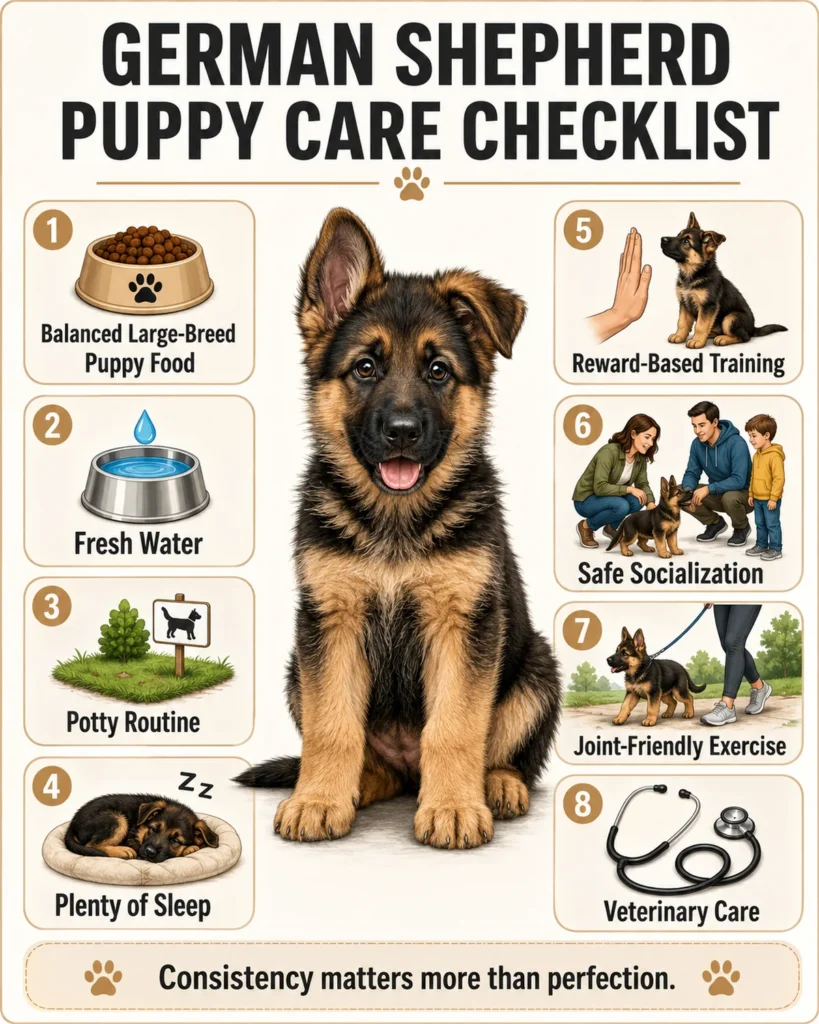
To care for a German Shepherd puppy, feed a complete and balanced large-breed growth diet, keep the puppy lean, follow a predictable daily routine, begin reward-based training and safe socialization early, use joint-friendly play, maintain grooming habits, and follow a veterinarian’s vaccination and parasite-control plan. Watch appetite, stool, energy, movement, and behavior for meaningful changes.
German Shepherd Puppy Care at a Glance
| Care area | Practical routine | Main goal |
| Feeding | Measured meals on a consistent schedule | Controlled, lean growth |
| Water | Fresh water available and monitored | Normal hydration |
| Potty training | Outside after waking, eating, drinking, and play | Prevent accidents and build a habit |
| Sleep | Several quiet naps plus nighttime sleep | Recovery and calmer behavior |
| Training | Short reward-based sessions every day | Attention, communication, and safety |
| Socialization | Calm, positive exposure at a safe distance | Confidence without overwhelm |
| Exercise | Free play, sniffing, and age-appropriate walks | Fitness without joint overload |
| Grooming | Brushing, paw handling, mouth care, and weekly checks | Coat care and cooperative handling |
| Veterinary care | Exams, vaccines, parasite prevention, and growth review | Disease prevention and early detection |
1. Prepare a Safe Home Before Your Puppy Arrives
The first part of how to take care of a German Shepherd puppy is managing the environment. A young puppy explores with its mouth, moves quickly, and cannot yet understand which household objects are dangerous.
Create a puppy-safe area containing:
- A correctly sized crate or exercise pen
- Washable bedding
- Safe chew toys
- Food and water bowls
- A leash and comfortable harness
- Enzymatic accident cleaner
- A quiet place for naps
- Baby gates for controlling access
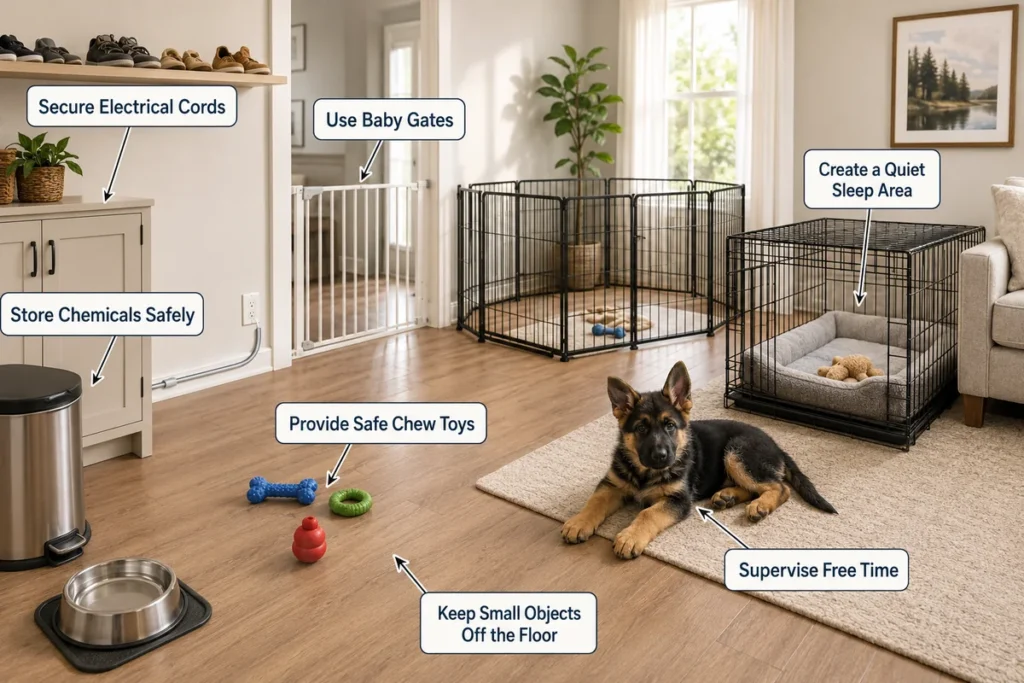
Secure electrical cords, medications, cleaning products, trash, children’s toys, toxic foods, small objects, and anything the puppy could swallow.
Use gates to limit access instead of giving the puppy the entire home on the first day. Supervision prevents mistakes more effectively than punishment after the puppy has already chewed something or eliminated indoors.
Arrange a veterinary examination soon after bringing the puppy home. Take vaccination, deworming, microchip, breeder, shelter, and previous medical records. The veterinarian can examine the puppy, review its diet, check body condition, and create a preventive-care plan based on local risks.
2. Feed for Steady Growth, Not Maximum Size
Nutrition is one of the most important parts of how to take care of a German Shepherd puppy because German Shepherds are large, fast-growing dogs.
Choose food with a nutritional adequacy statement showing that it is complete and balanced for growth. For a puppy expected to become a large adult, check whether the statement includes the growth of large-size dogs.
The Association of American Feed Control Officials’ pet-food guidance identifies the nutritional adequacy statement as a key part of matching food to a pet’s species and life stage.
Do not select food only because the front of the bag says “premium,” “natural,” or “high protein.” Pay closer attention to:
- Life-stage suitability
- Nutritional adequacy
- Calories per cup or serving
- Feeding directions
- Your puppy’s growth trend
- Stool quality
- Body condition
Measure the total daily amount and divide it into age-appropriate meals. Part of the measured ration can be used as training rewards. Treats should be counted rather than added without adjusting the rest of the diet.
Use Furbivo’s German Shepherd puppy feeding chart for meal frequency, portion adjustments, and age-based feeding guidance. The German Shepherd growth chart can help you monitor trends without treating one weight as a mandatory target.
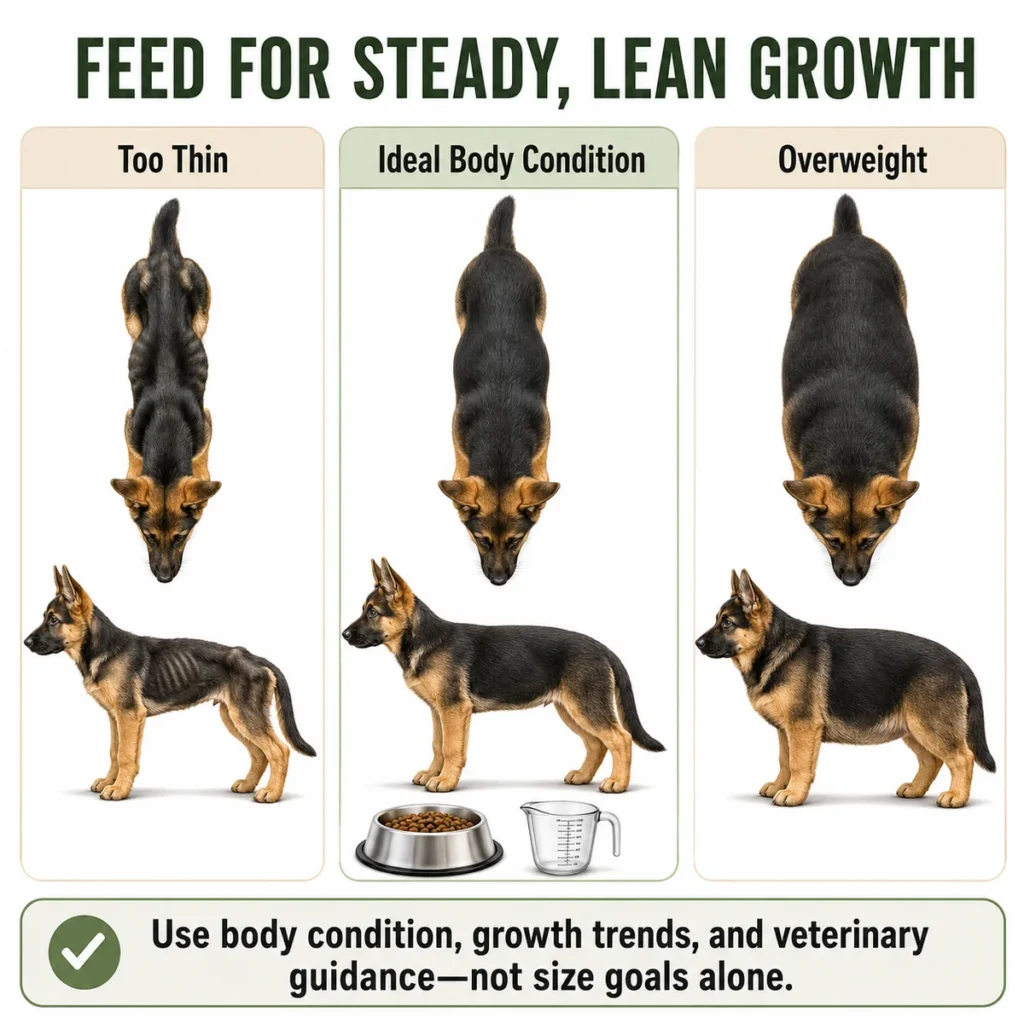
A healthy puppy should grow steadily while maintaining a visible waist and ribs that can be felt beneath a light fat covering. The WSAVA body-condition chart provides a nine-point framework for assessing whether a dog is underweight, at an ideal condition, or overweight.
Rapid weight gain and excess body fat place avoidable stress on a developing large-breed puppy. Ask your veterinarian to demonstrate body-condition assessment rather than relying only on the number shown on a scale.
Avoid adding calcium, mineral powders, vitamins, or growth supplements unless a veterinarian recommends them for a specific reason. A complete growth diet is formulated to provide nutrients in controlled proportions.
3. Build a Predictable Daily Routine
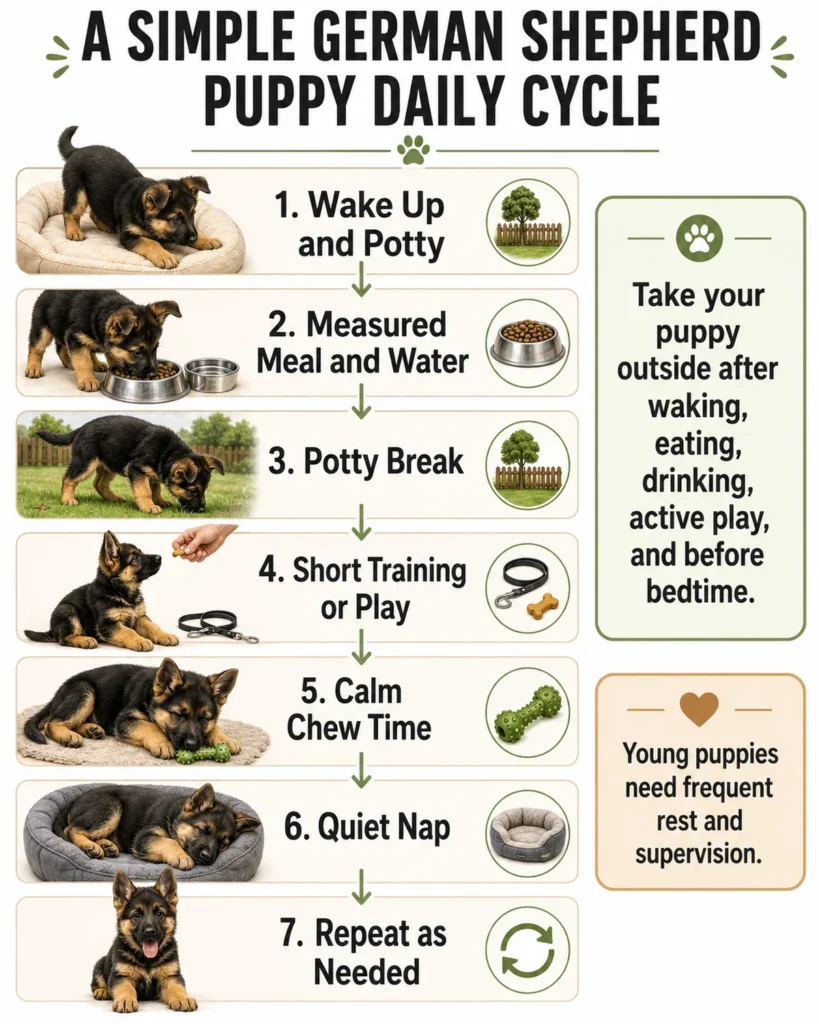
A routine makes how to take care of a German Shepherd puppy easier for both the puppy and the household. Predictable patterns reduce confusion and help you notice changes in appetite, stool, urination, sleep, or energy.
A practical daily cycle can look like this:
- Wake up and go outside.
- Offer a measured meal and fresh water.
- Take the puppy outside again.
- Add a few minutes of training, sniffing, or gentle play.
- Provide a calm chew or settling activity.
- Schedule a quiet nap.
- Repeat the cycle during the day.
Take the puppy to its toilet area:
- Immediately after waking
- Shortly after meals
- After drinking a large amount
- After active play
- After exciting visitors or events
- Before going into the crate
- Before bedtime
Puppy potty-training guidance recommends taking puppies outside after sleeping and active play rather than waiting for them to have an accident.
Reward outdoor elimination immediately. If you find an old accident indoors, clean it with an enzymatic cleaner and improve supervision. Scolding after the event does not teach the puppy where it should go.
Many puppies need around 18–20 hours of total sleep in a day, although the pattern changes with age and activity. Overtired puppies may become mouthy, frantic, noisy, or unable to settle. Protect quiet nap periods and teach children not to disturb a sleeping puppy.
Care Priorities by Age
| Approximate age | Main care priorities |
| 8–12 weeks | Settling in, frequent potty trips, veterinary review, safe socialization, name response, handling, naps |
| 3–4 months | Teething support, bite redirection, leash foundations, broader calm exposure, measured meals |
| 4–6 months | Consistent household rules, impulse-control games, growth monitoring, gradual activity increases |
| 6–12 months | Adolescent training, recall management, calm behavior around distractions, continued joint-safe exercise |
| 12–18 months | Gradual transition toward adult routines, exercise progression, and diet review with a veterinarian |
These ranges are planning guides rather than deadlines. A puppy may mature faster in one area and more slowly in another. Adjust its routine according to health, confidence, recovery, body condition, and veterinary advice. Large breeds may continue developing physically well beyond the early puppy months.
4. Start Training on the First Day
Training is daily care, not a separate activity saved for obedience class. German Shepherd puppies quickly learn patterns, including patterns their owners did not intend to teach.
Begin with:
- Responding to the puppy’s name
- Eye contact
- Coming when called indoors
- Sit, down, and stand
- Gentle leash following
- Leave it
- Drop it
- Relaxing on a mat
- Calm handling
- Waiting briefly at doors
- Settling inside a crate or pen
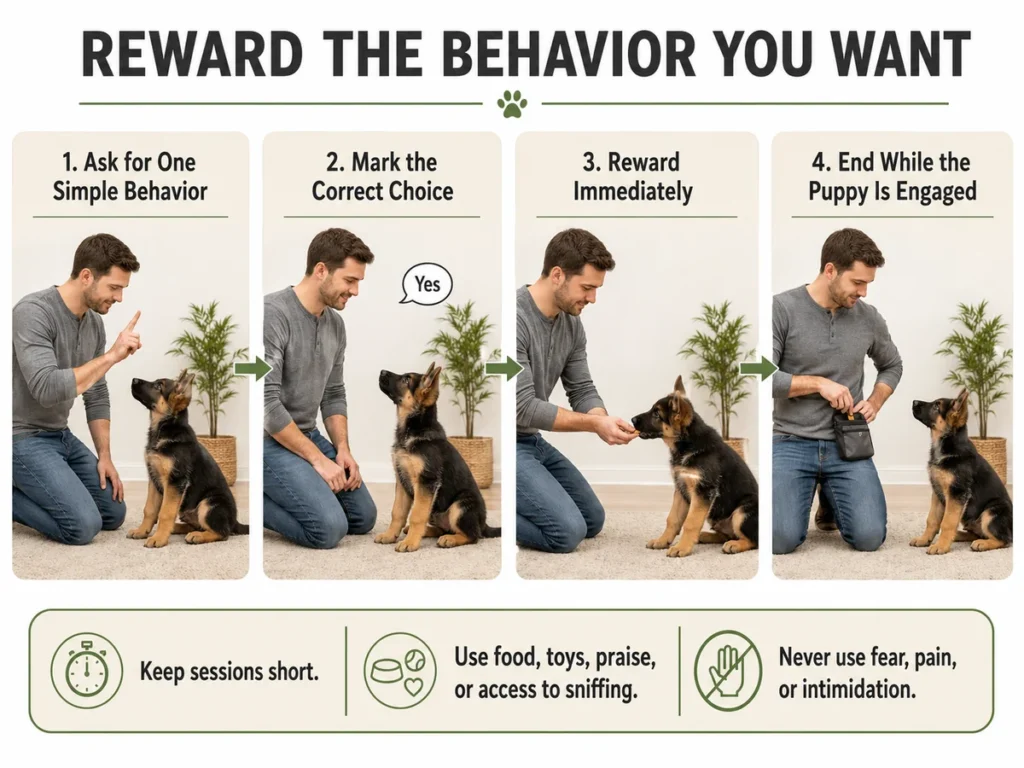
Keep sessions short enough that the puppy stays interested. Several one- to three-minute sessions can be more productive than one long lesson.
Use food, toys, praise, sniffing opportunities, and other rewards the puppy values. Reward the behavior you want and arrange the environment so unwanted behavior is harder to repeat.
The American Veterinary Society of Animal Behavior’s humane training statement supports reward-based methods and advises against training based on fear, intimidation, or pain.
Avoid:
- Yelling
- Alpha rolls
- Muzzle grabbing
- Hitting
- Harsh leash corrections
- Shock collars
- Frightening the puppy into compliance
Never punish a puppy for coming to you, even when it was slow or had picked up an inappropriate object. A reliable recall should predict safety and reward.
For a broader foundation, read how to train a German Shepherd. For nighttime routines and calm confinement, use Furbivo’s crate-training guide for German Shepherd puppies.
Mouthing is normal during puppy development, but it still needs guidance. Redirect teeth toward a suitable toy, pause interaction when biting becomes intense, and check whether the puppy is hungry, overstimulated, frustrated, or overtired.
The guides to German Shepherd puppy teething stages and stopping German Shepherd puppy biting and nipping cover the health and training sides separately.
5. Socialize Without Flooding or Frightening the Puppy
Early socialization is a central part of how to take care of a German Shepherd puppy. The goal is not to make the puppy greet every person or play with every dog. The goal is to help it feel safe and recover well around normal sights, sounds, surfaces, handling, animals, and environments.
Introduce new experiences at an intensity the puppy can handle. Pair calm observation with treats, play, or additional distance.
Allow the puppy to choose whether to approach. Do not drag a worried puppy toward:
- A stranger
- A noisy machine
- A child
- A bicycle
- An unfamiliar dog
- A slippery surface
- A crowded environment
Safe exposure can include:
- People wearing hats or uniforms
- Calm visitors
- Household sounds
- Car rides
- Different floor textures
- Umbrellas
- Wheelchairs viewed from a distance
- Bicycles viewed from a distance
- Gentle body handling
- Healthy dogs with known vaccination status
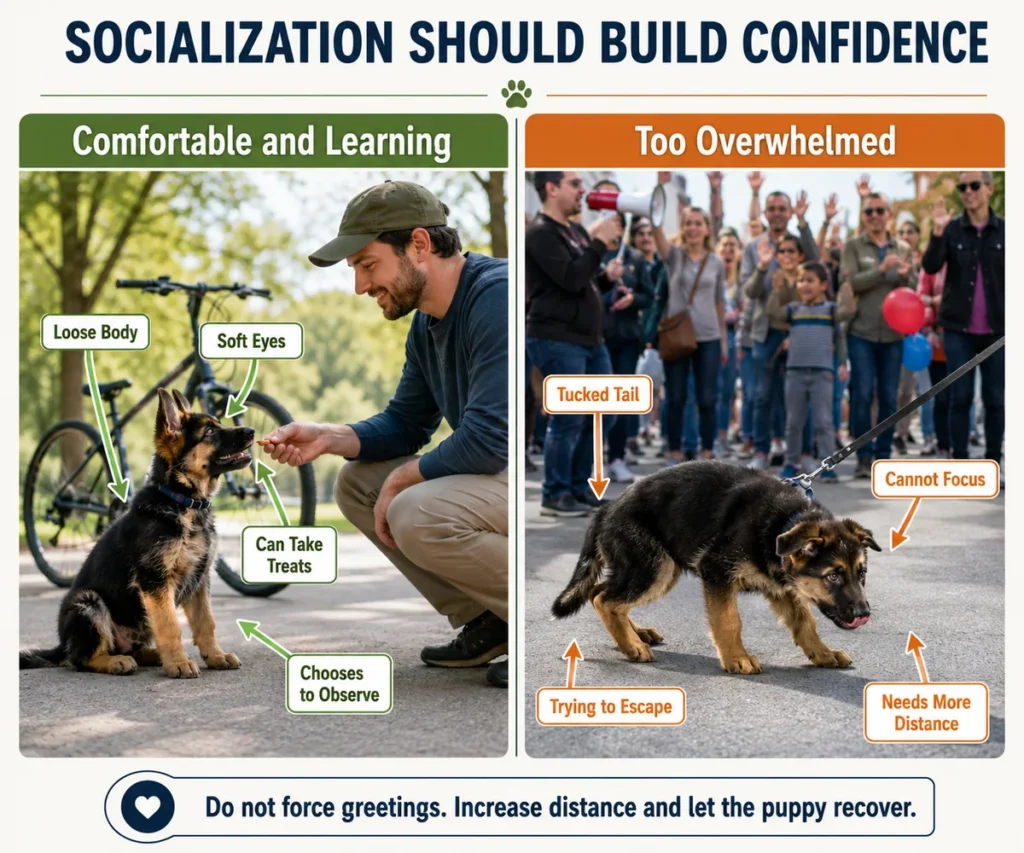
The AVSAB identifies early puppy socialization as an important developmental need while recognizing that disease-prevention planning must be considered.
Ask your veterinarian about local parvovirus risk, safe puppy classes, appropriate locations, and when public-ground exposure is reasonable. Avoid heavily used dog parks and places with unknown dog traffic until your veterinarian advises that the risk is acceptable.
Furbivo’s German Shepherd puppy socialization guide explains body-language checks, fear periods, safe-distance work, handling practice, and recovery after new experiences.
6. Provide Joint-Safe Exercise and Mental Work
Some new owners assume an energetic breed needs long runs or exhausting walks. That is not the safest way to approach how to take care of a German Shepherd puppy.
A growing puppy benefits from:
- Self-paced movement
- Short walks suitable for the individual puppy
- Sniffing
- Gentle free play
- Simple training games
- Food-search activities
- Exploration on safe surfaces
- Calm interaction with its owner
Stop before the puppy becomes exhausted or loses coordination.
Avoid repetitive, high-impact exercise such as:
- Forced running
- Long-distance jogging
- Repeated jumping
- Hard landings
- Excessive stair use
- Endless ball chasing
- Exercise beside a bicycle
- Long hikes before physical maturity
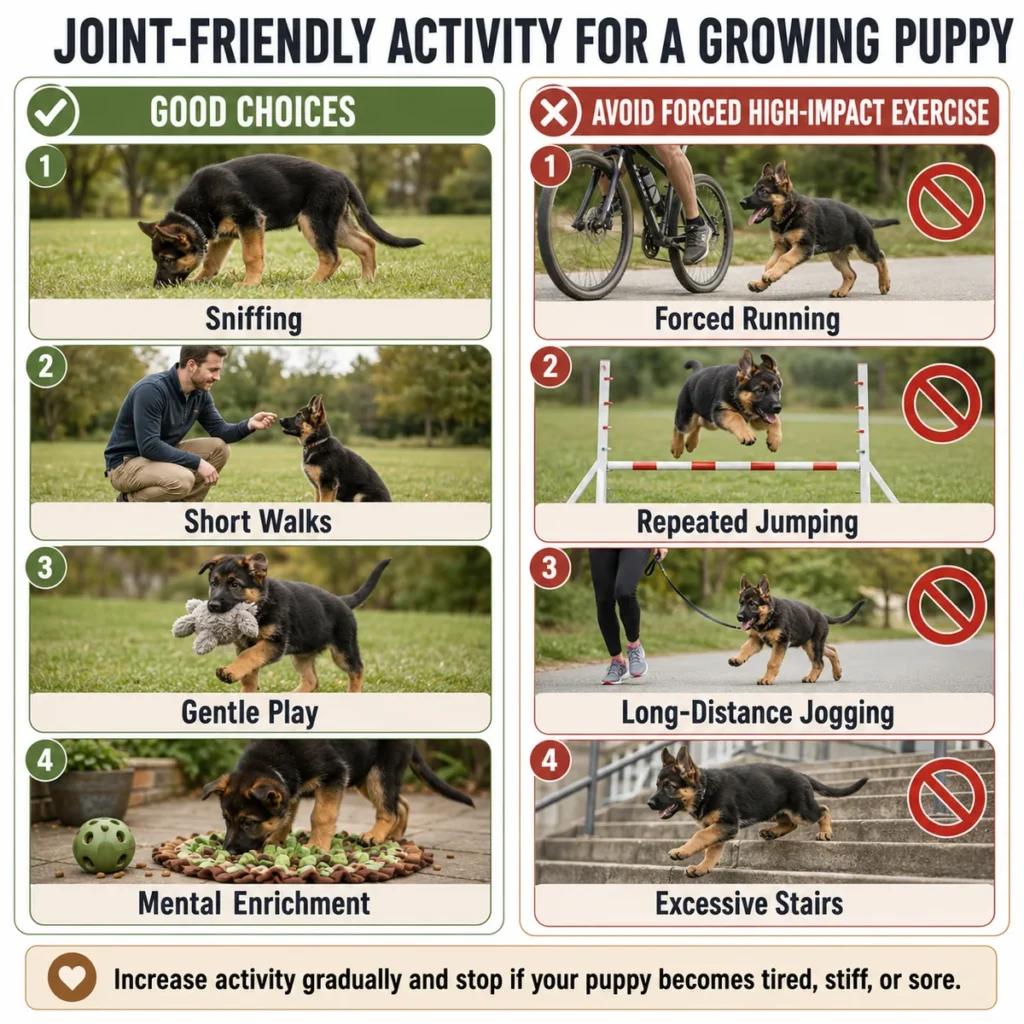
The VCA puppy-exercise guidance explains that puppy growth plates remain sensitive during development and can be injured by strenuous exercise.
Mental work can tire a German Shepherd puppy without overloading its body. Try:
- Scattering part of a meal in clean grass
- Hiding a toy nearby
- Teaching a hand target
- Practicing eye contact
- Rewarding calm observation
- Introducing a new safe object
- Using a food puzzle under supervision
- Teaching the puppy to settle on a mat
Watch the puppy during and after activity. Limping, stiffness, reluctance to rise, repeated bunny-hopping, pain, or a sudden reduction in activity deserves veterinary attention rather than a tougher exercise program.
7. Make Grooming a Cooperative Habit
Grooming becomes easier when it begins as calm handling rather than an occasional wrestling match.
Briefly touch the puppy’s:
- Paws
- Ears
- Tail
- Collar area
- Lips
- Teeth
- Chest
- Legs
- Back
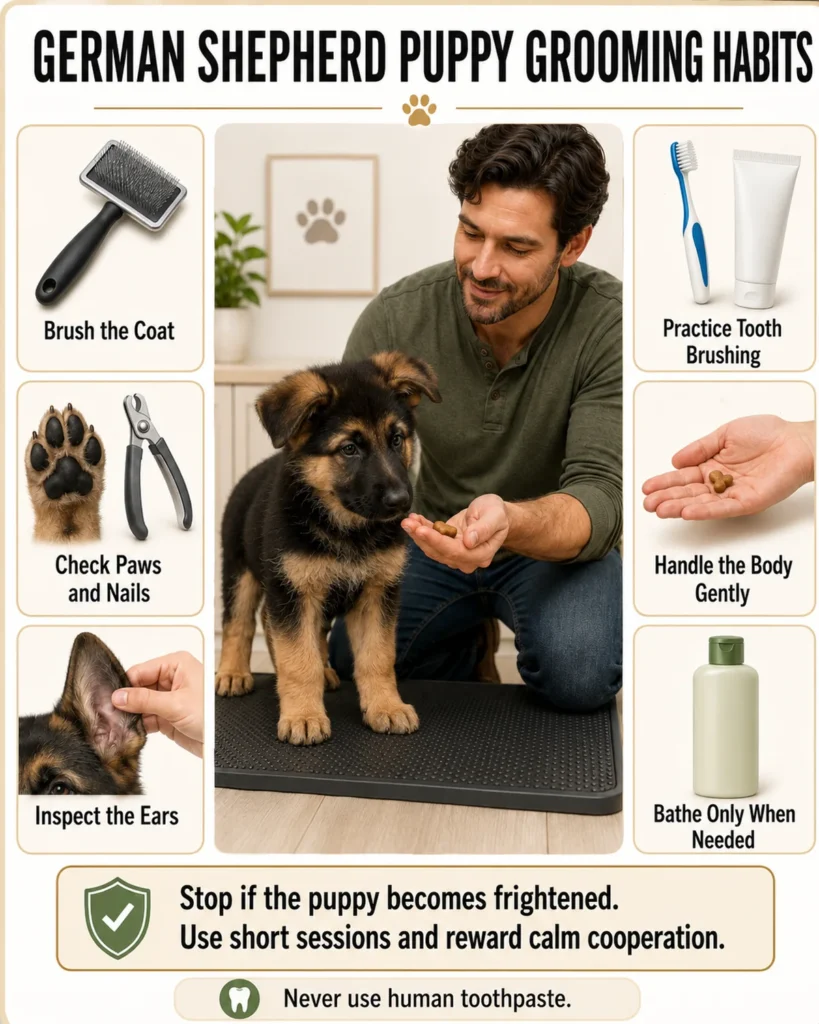
Reward the puppy and release it before it struggles.
Brush the coat regularly to remove loose hair, inspect the skin, and help the puppy accept grooming. Check the nails weekly and trim small amounts when needed.
Inspect the ears without automatically cleaning them. Healthy ears that look clean and do not smell unpleasant may not need cleaning. Redness, swelling, dark discharge, pain, frequent scratching, or head shaking needs veterinary attention.
Begin tooth-brushing practice gradually with toothpaste made for dogs. Never use human toothpaste.
Bathing should be based on dirt, odor, lifestyle, and veterinary advice rather than a rigid weekly schedule. Use dog-safe shampoo, rinse the dense coat thoroughly, and dry it without frightening heat or noise.
For the complete routine, read the German Shepherd puppy grooming guide.
8. Follow a Veterinary Prevention Plan
A veterinarian should individualize vaccinations, parasite control, nutrition review, and other preventive care according to the puppy’s age, health, location, and lifestyle.
The AAHA canine vaccination recommendations recommend at least three doses of a core combination vaccine between six and sixteen weeks of age, generally spaced two to four weeks apart. Rabies timing follows applicable law, while noncore vaccines depend on lifestyle and exposure risk.
Your veterinarian may evaluate risks connected with:
- Wildlife
- Ticks
- Boarding
- Daycare
- Travel
- Standing water
- Local infectious diseases
- Contact with unfamiliar dogs
Bring a fresh stool sample when requested. Puppies can carry intestinal parasites without looking visibly ill.
The Companion Animal Parasite Council’s guidelines recommend frequent parasite testing during the first year and ongoing broad-spectrum parasite prevention based on veterinary guidance.
Use flea, tick, heartworm, and intestinal-parasite products only according to the puppy’s current age, weight, health, and veterinarian’s directions.
Discuss these subjects during puppy appointments:
- Microchipping
- Identification tags
- Dental care
- Growth rate
- Body condition
- Diet changes
- Spay or neuter timing
- Travel plans
- Exercise
- Inherited health risks
Do not choose a surgery date from a generic social-media rule. The decision can involve sex, expected adult size, health, behavior, management, and reproductive risk.
9. Track the Puppy, Not Just the Calendar
Good care depends on trends. Keep a simple weekly record containing:
- Weight
- Body condition
- Food amount
- Appetite
- Stool quality
- Water intake
- Sleep
- Training progress
- New social experiences
- Vomiting or diarrhea
- Itching
- Limping
- Medication and parasite-prevention dates
Photos taken from above and from the side can help reveal body-condition changes.
A short record may show that loose stool began after a food change, nighttime waking followed a schedule disruption, or fearful behavior appeared after an overwhelming interaction.
Do not compare your puppy obsessively with the largest puppy online. Parent size, sex, genetics, nutrition, health, and individual development influence growth. The useful question is whether your puppy is progressing steadily and comfortably.
What Most German Shepherd Puppy Care Articles Miss
The biggest lesson in how to take care of a German Shepherd puppy is that more is not always better.
More food does not produce healthier growth.
More exercise does not guarantee calmer behavior.
More social exposure does not build confidence when the puppy feels trapped.
More correction does not create clearer training.
More supplements do not improve an already complete diet.
The better approach is controlled exposure, measurable routines, gradual progression, adequate sleep, and early response to change.
Another commonly missed point is that puppy problems often overlap.
Biting may increase because of:
- Teething
- Fatigue
- Frustration
- Hunger
- Overstimulation
- Excitement
- Insufficient appropriate chewing
Indoor accidents may reflect:
- Poor timing
- Incomplete training
- Excessive freedom
- Diarrhea
- Fear
- A urinary problem
Reluctance to walk may reflect:
- Caution
- Pain
- Heat
- Fatigue
- An overwhelming environment
- An uncomfortable harness
Look at the whole pattern before labeling a puppy stubborn, dominant, lazy, or aggressive.
When to Call a Veterinarian
Book a routine veterinary appointment when you notice a persistent but non-emergency change in:
- Appetite
- Stool
- Urination
- Growth
- Skin or coat
- Ears
- Movement
- Sleep
- Behavior
- Body condition
Seek urgent veterinary advice for:
- Repeated vomiting or diarrhea
- Blood in vomit or stool
- Marked lethargy
- Refusal or inability to drink
- Suspected toxin ingestion
- Suspected foreign-object ingestion
- Significant pain
- Eye injury
- Weakness
- Reduced responsiveness
Persistent vomiting and diarrhea can lead to dehydration, while blood, weakness, or unproductive retching can indicate a more serious condition.
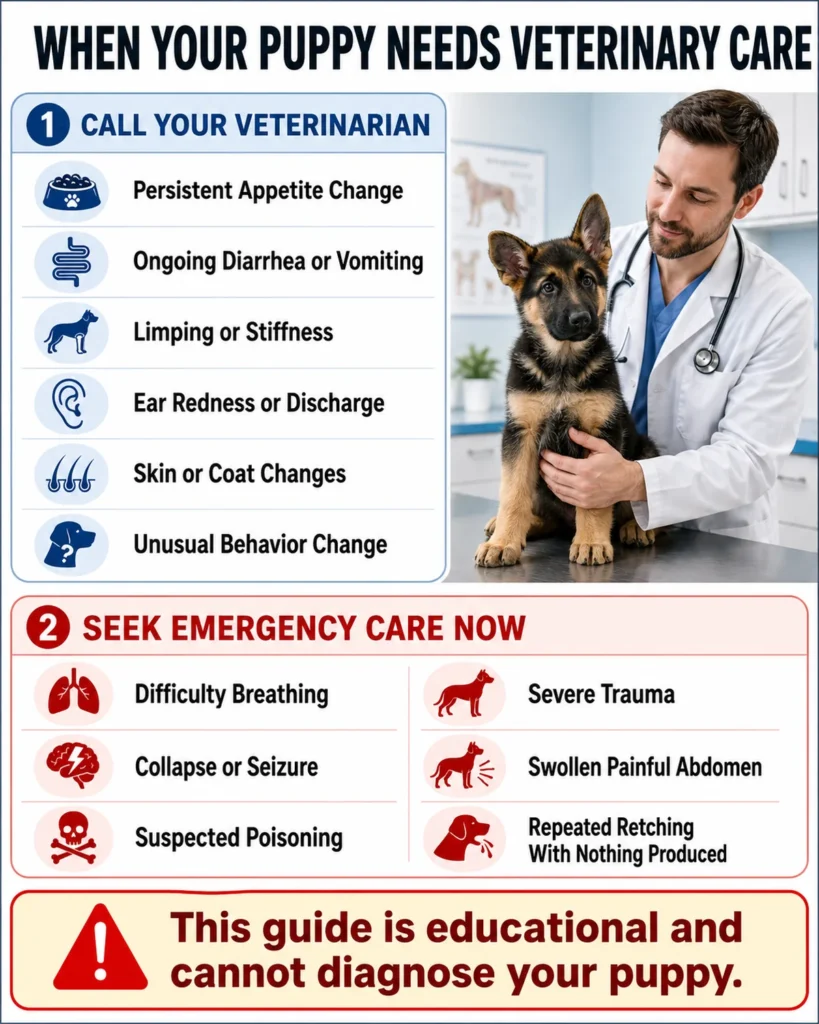
Go to an emergency clinic immediately for:
- Difficulty breathing
- Collapse
- Seizures
- Severe trauma
- A swollen, painful abdomen
- Repeated attempts to vomit without producing anything
German Shepherds are deep-chested dogs, so unproductive retching with abdominal enlargement should never be watched at home. Gastric dilatation-volvulus, commonly called bloat, is a life-threatening emergency requiring immediate veterinary treatment.
Frequently Asked Questions
What is the best way to learn how to take care of a German Shepherd puppy?
Start with a predictable routine covering measured meals, frequent potty trips, sleep, reward-based training, safe socialization, gentle exercise, grooming, and veterinary prevention. Track the puppy’s response and adjust one part at a time instead of changing everything after one difficult day.
How often should a German Shepherd puppy eat?
Meal frequency depends on the puppy’s age, food, health, and veterinary guidance. Young puppies generally need several measured meals rather than one large meal. Follow the food label as a starting point, then adjust according to body condition, growth trend, stool quality, and veterinary advice.
How much exercise does a German Shepherd puppy need?
There is no safe universal minute formula. Use short, self-paced activity, sniffing, free play, training, and age-appropriate walks. Avoid forced running, repeated jumping, and exhaustion while joints are developing. Increase duration and intensity gradually based on recovery and veterinary guidance.
When should training and socialization begin?
Training and socialization should begin when the puppy comes home. Use short reward-based lessons and calm, controlled exposure. Balance social learning with disease prevention by using clean environments, healthy known dogs, and veterinarian-approved puppy classes instead of keeping the puppy completely isolated.
How do I know whether my German Shepherd puppy is doing well?
Look for steady growth, an appropriate body condition, normal appetite and stool, comfortable movement, curiosity, recovery after mild stress, improving household habits, and the ability to rest. A sudden or persistent change matters more than one imperfect day.
Final Thoughts
Understanding how to take care of a German Shepherd puppy is less about following a perfect timetable and more about building a repeatable system.
Feed for controlled growth, protect sleep, train with rewards, socialize at the puppy’s pace, use joint-safe activity, maintain handling and grooming habits, and keep preventive veterinary care current.
Small choices repeated every day shape the adult dog. A puppy that learns to trust people, settle after activity, tolerate handling, communicate safely, and recover from new experiences has a stronger foundation than one that is simply exhausted or tightly controlled.
Have questions about your dog’s health, nutrition, grooming, or daily care? Visit our Contact Us page to reach the Furbivo team. For any medical symptoms, diagnosis, or treatment advice, always consult a qualified veterinarian.