
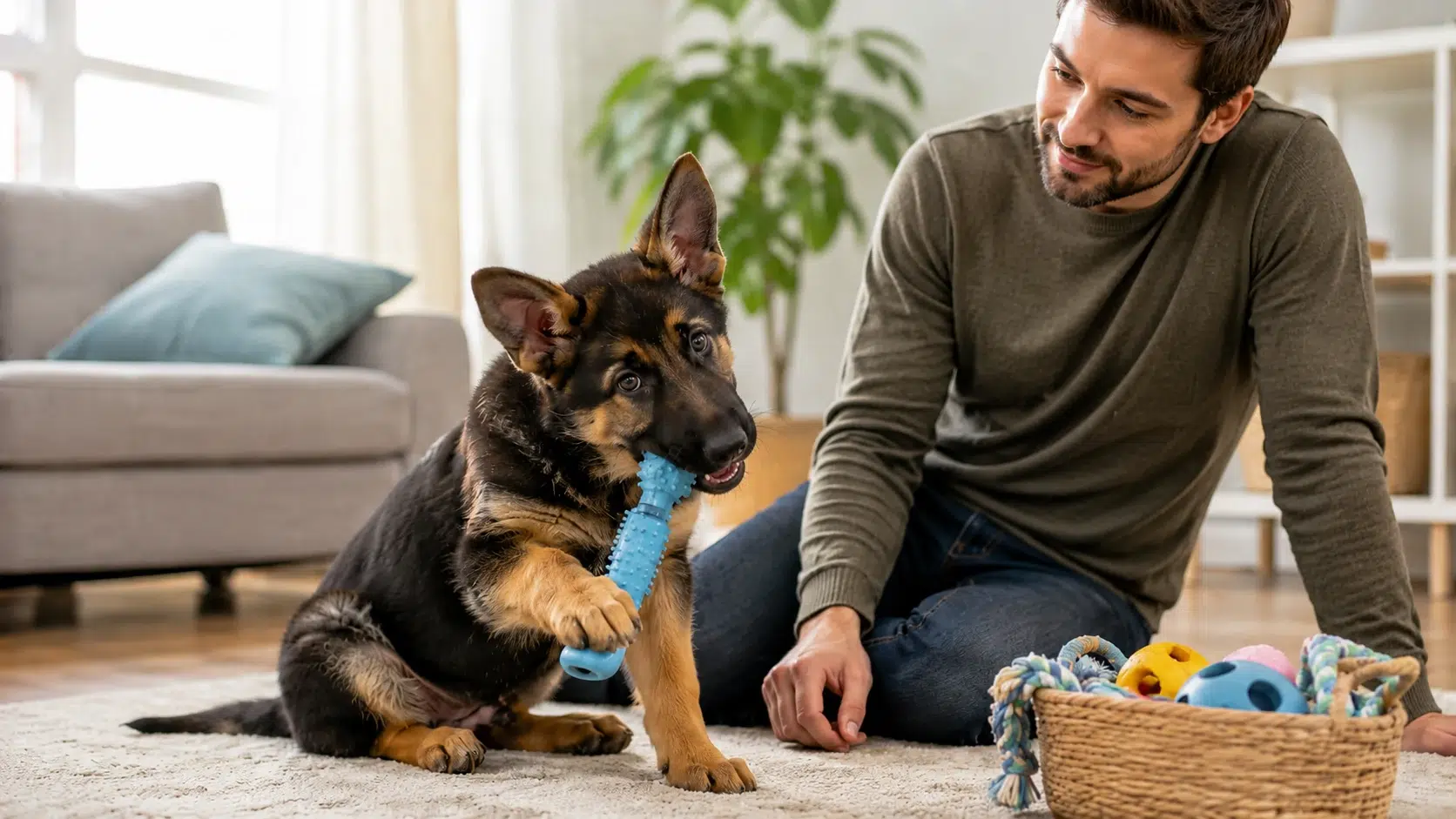
Understanding German Shepherd puppy teething stages helps you separate normal chewing and tender gums from problems that need veterinary attention. Most puppies move from 28 baby teeth to 42 adult teeth within their first seven months, but the process is not perfectly synchronized. One tooth may loosen while another adult tooth is already appearing.
Teething can also increase mouthing, furniture chewing, reluctance to eat hard food, and evening restlessness. For the training side of the problem, use Furbivo’s guide to stopping German Shepherd puppy biting and nipping. This article focuses on tooth development, mouth comfort, safe chewing, retained baby teeth, and the signs that justify a veterinary examination.
German Shepherd Puppy Teething Stages: Quick Answer
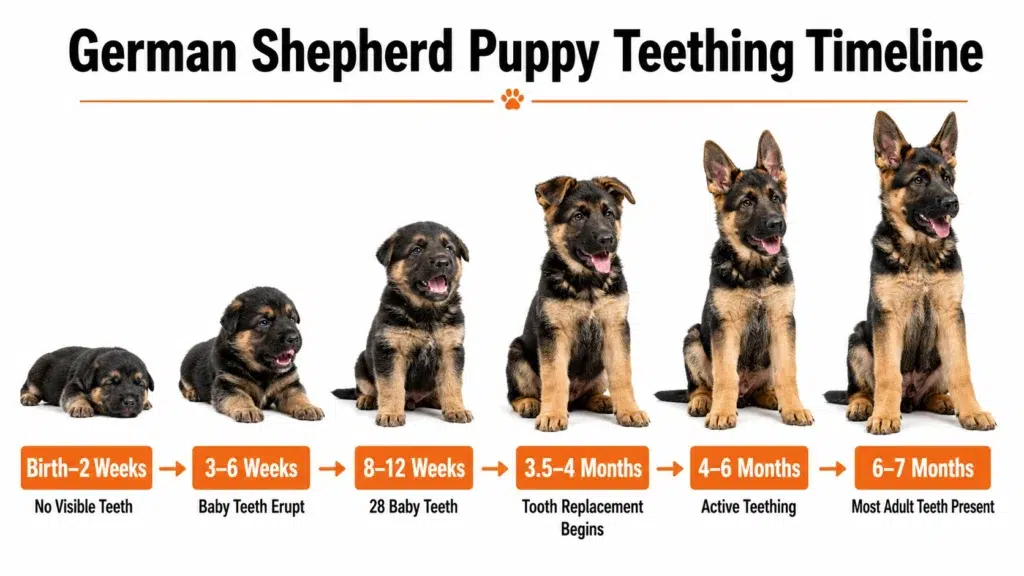
German Shepherd puppies usually develop their baby teeth between about three and six weeks of age. Replacement commonly begins around three-and-a-half to four months, becomes most noticeable from four to six months, and is usually largely complete by six to seven months. A puppy with two teeth occupying one position, significant pain, swelling, or trouble eating needs veterinary assessment.
German Shepherd Puppy Teething Stages by Age
| Puppy age | Typical dental stage | What owners may notice | Main care priority |
|---|---|---|---|
| Birth to 2 weeks | No visible teeth | Nursing only | No mouth intervention |
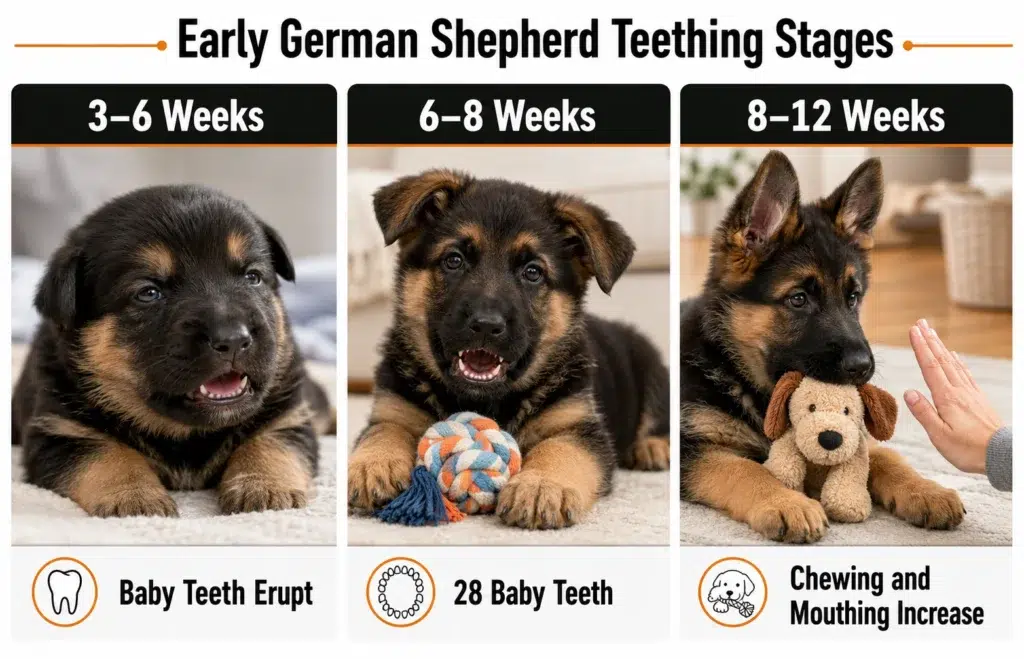
| About 3–6 weeks | Baby teeth erupt | Sharp little teeth and early mouthing | Gentle handling |
| 8–12 weeks | Full baby-tooth phase | Chewing, playful nipping and exploring by mouth | Safe toys and training |
| About 3.5–4 months | Replacement begins | Loose or missing front teeth | Supervised softer chewing |
| 4–5 months | Active teething | More chewing, drooling and tender gums | Inspect toys and monitor eating |
| 5–6 months | Later replacement phase | Adult teeth become more visible | Check for “double teeth” |
| 6–7 months | Adult dentition nearly complete | Chewing may begin easing | Veterinary check for retained teeth |
| 7–8 months | Post-teething review | Adult bite and tooth position become clearer | Continue dental-care training |
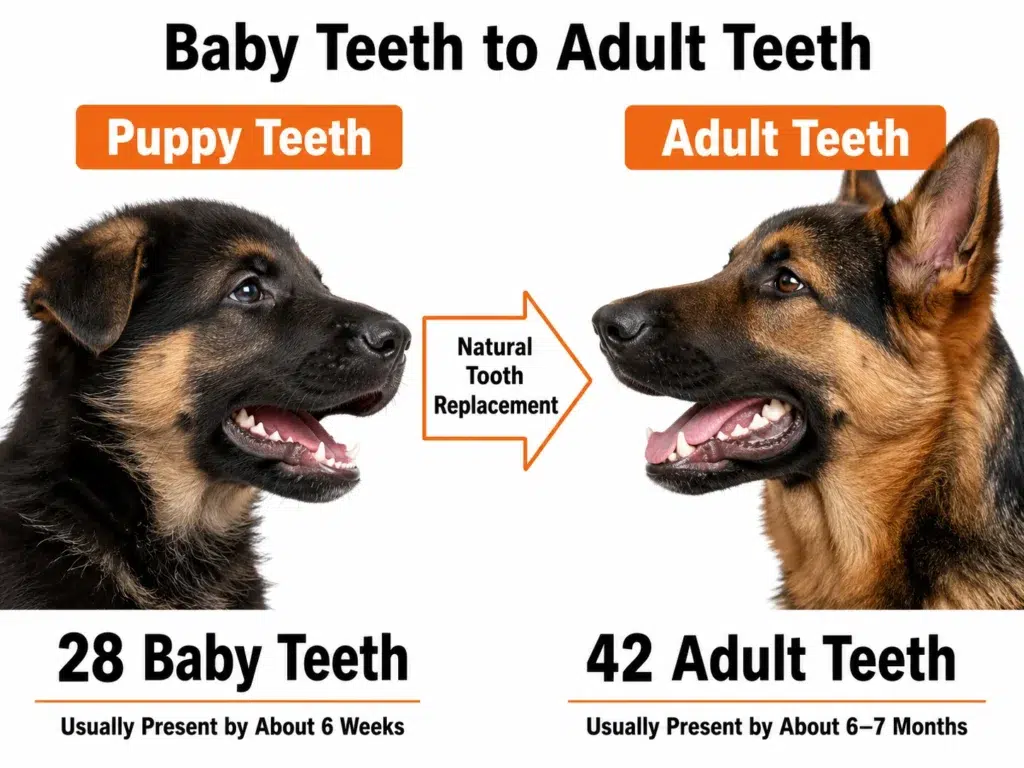
Dogs normally have 28 deciduous—or baby—teeth and 42 permanent teeth. Veterinary references place baby-tooth eruption at roughly three to six weeks, replacement beginning at about three-and-a-half to five months, and completion of adult dentition by around six to seven months. Individual teeth do not always follow the calendar exactly. (Merck Veterinary Manual; VCA Animal Hospitals)
What Happens During Puppy Teething?
Adult teeth develop beneath the gums. As they grow, pressure encourages the roots of the baby teeth to resorb. The loosened baby crowns then fall out, making space for the permanent teeth.
Owners may find a tiny, hollow-looking tooth in bedding or on the floor. Many puppies swallow lost teeth while eating without any apparent problem.
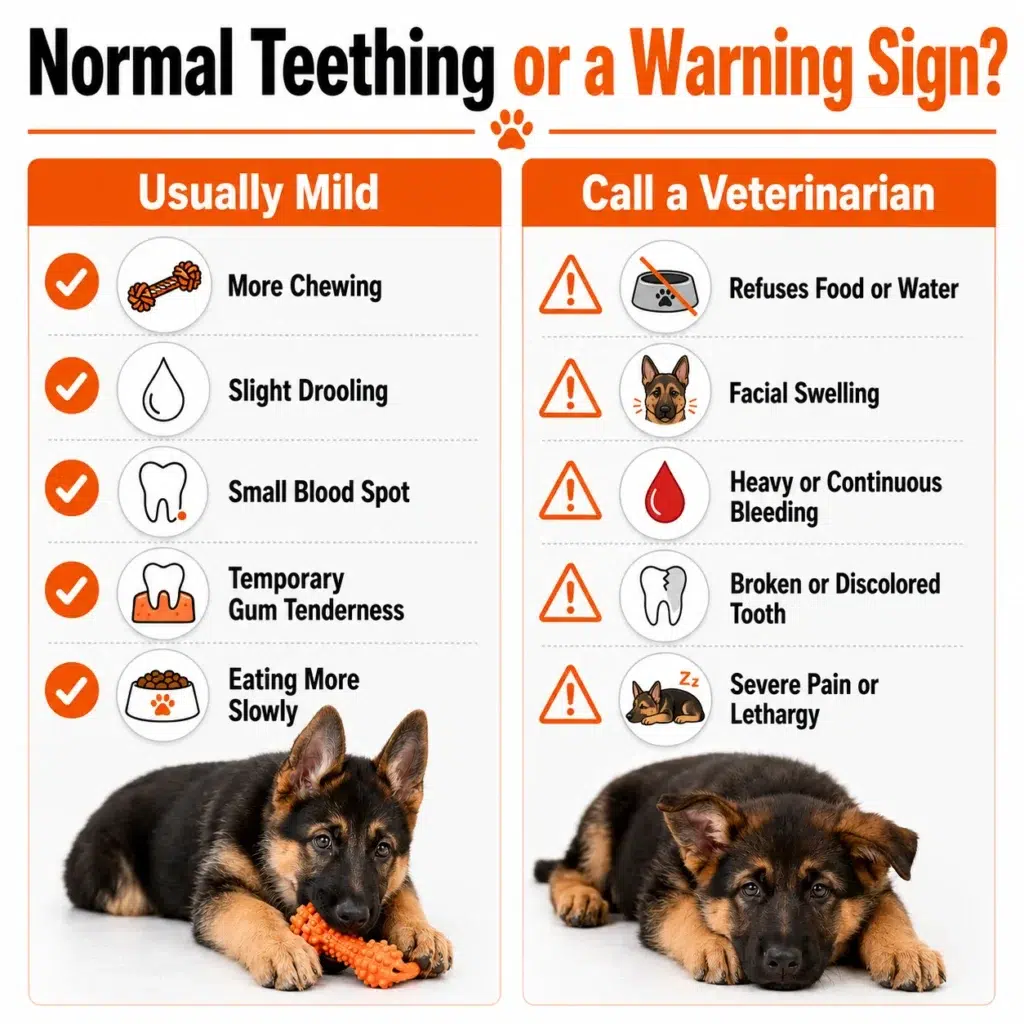
The process can make the mouth tender. A teething puppy may chew more, drool slightly, become temporarily irritable, eat more slowly, or prefer food that is easier to pick up.
Mild changes can be expected. Marked pain or persistent appetite loss should not automatically be blamed on teething.
Stage 1: Birth to About 2 Weeks—No Visible Teeth
German Shepherd puppies are born without visible teeth. During this stage, they depend on their mother’s milk and do not need chew toys or tooth brushing.
Tooth development has already begun beneath the gums even though nothing is visible. Unless a veterinarian identifies a congenital problem, there is nothing owners need to do to make the teeth erupt.
Do not rub, press, or manipulate a newborn puppy’s gums.
Stage 2: About 3 to 6 Weeks—Baby Teeth Erupt
The first visible teeth generally begin appearing at around three weeks. By approximately six weeks, most puppies have their 28 baby teeth. These teeth are thin and sharp, which is why even playful mouthing can feel painful.
At this age, the puppy may still be living with the breeder. Appropriate early care includes:
- Gentle and brief mouth handling
- Suitable puppy food during weaning
- Clean, size-appropriate toys
- Avoiding attempts to pull loose-looking teeth
- Watching for facial swelling, injury or failure to eat
The puppy should not be given extremely hard objects simply because chewing has begun.
Stage 3: About 8 to 12 Weeks—The Full Baby-Tooth Phase
When many German Shepherd puppies enter their new homes, they already have a complete set of baby teeth but have not yet started losing them.
This is often when owners first notice:
- Constant mouthing
- Sharp bites during play
- Stolen shoes
- Chewed furniture corners
- Grabbing sleeves or trouser legs
- Biting during overexcitement
Not every bite during this period is caused by dental discomfort. Puppies also explore through their mouths, initiate play by mouthing, and repeat behaviors that earn attention.
Use Furbivo’s German Shepherd training guide for foundation skills, then direct biting-specific problems to the detailed puppy-biting article.
This is also a useful time to begin calm mouth-handling practice. Furbivo’s German Shepherd puppy socialization guide explains how short “touch, treat, release” sessions can prepare a puppy for future mouth checks, grooming, and veterinary handling.
Stage 4: About 3.5 to 4 Months—Baby Teeth Begin Falling Out
This is the first clearly visible replacement stage in many puppies. The incisors—the small teeth at the front of the mouth—often begin changing first.
You may notice:
- A small gap
- A slightly loose tooth
- A missing front tooth
- A larger adult tooth appearing
- Increased chewing
- Mild gum sensitivity
The puppy may also:
- Rub the mouth on toys
- Drool a little
- Leave a small blood spot on a toy
- Become impatient with hard food
- Mouth hands or clothing more often
A small spot of blood associated with a lost tooth can occur. Ongoing bleeding, a large amount of blood, or bleeding without an obvious loose tooth needs veterinary advice.
The AKC notes that tooth replacement commonly begins around three to four months and should progress toward a permanent adult set as the puppy approaches six months. (American Kennel Club)
Furbivo’s German Shepherd growth chart also identifies the four-month period as a common teething and rapid-development stage.
Stage 5: About 4 to 5 Months—Active Teething and Heavy Chewing
For many owners, this is the most demanding part of German Shepherd puppy teething stages. Several teeth may be loosening or erupting over a short period, and a German Shepherd puppy has enough size and persistence to damage household objects quickly.
Management should make the correct choice easier:
- Keep safe chew toys in several rooms.
- Rotate textures rather than offering every toy at once.
- Use gates or a puppy-proofed area when direct supervision is impossible.
- Protect electrical cords, children’s toys, shoes and furniture edges.
- End rough hand play that encourages harder mouthing.
- Schedule sufficient rest because overtired puppies often become more bitey.
- Inspect toys after every chewing session.
A calm rest area can help prevent destructive chewing when the puppy is tired. Furbivo’s crate-training guide for German Shepherd puppies explains how to build a positive resting routine rather than using confinement as punishment.

Stage 6: About 5 to 6 Months—Later Tooth Replacement
By this stage, many adult incisors are already visible and the mouth may look less uniformly “needle-toothed.” Canines and teeth farther back in the mouth may still be changing.
Because adult teeth are larger, this is when crowding or retained baby teeth can become easier to spot.
Look for:
- Two teeth occupying what appears to be one position
- A narrow baby canine sitting beside a thicker adult canine
- An adult tooth emerging at an unusual angle
- A tooth touching the palate
- A tooth rubbing against another tooth
- Food consistently trapping between closely packed teeth
- Pain when the mouth closes
- Repeated chewing on only one side
Do not pull a retained baby tooth at home. Its root may still be present, and breaking the crown can complicate treatment.
Stage 7: About 6 to 7 Months—Adult Teeth Should Be Present
Most puppies have their adult teeth by six to seven months, although small timing differences occur. The mouth should contain approximately 42 permanent teeth when development is complete.
At this point, chewing may gradually become less frantic. A German Shepherd may still enjoy chewing throughout life, even after teething has ended.
Persistent destructive chewing after this stage can reflect:
- A rehearsed habit
- Boredom
- Stress
- Inadequate supervision
- Lack of appropriate toys
- Overexcitement
- Unmet physical or mental activity needs
This stage deserves a careful mouth check. If a baby tooth remains beside an adult tooth, arrange a veterinary examination instead of waiting indefinitely for it to disappear.
Normal Signs During German Shepherd Puppy Teething Stages
Common, usually mild signs include:
- Increased chewing
- Temporary mouthing or nipping
- Slight drooling
- Tender gums
- A small blood spot on a toy
- Brief fussiness
- Eating more slowly
- A missing front tooth
- Finding a tiny tooth
- Finding no teeth because they were swallowed
- Temporary “puppy breath”
These signs should remain manageable. The puppy should still be able to drink, show interest in food, rest, play, and behave normally between chewing episodes.
Signs That Are Not Safe to Dismiss as Teething
Contact a veterinarian when you notice:
- Refusal to eat or drink
- Marked difficulty chewing or swallowing
- Repeated pawing at the mouth
- Facial swelling
- A broken or discolored tooth
- Continuous or heavy bleeding
- Pus or bad-smelling discharge
- Severe or worsening mouth odor
- A tooth penetrating the gum or roof of the mouth
- Significant lethargy, fever, vomiting or diarrhea
- Sudden severe behavior change
- A baby tooth remaining beside an erupting adult tooth
- An adult tooth growing at an abnormal angle
- Pain when the mouth opens or closes
Teething can coincide with unrelated illness. A puppy who appears generally unwell needs assessment rather than another chew toy.
Safe Chewing Options During German Shepherd Puppy Teething Stages
No chew is completely risk-free. The safest choice depends on the puppy’s size, chewing force, material condition and level of supervision.
| Option | Potential benefit | Limitation | Safety check |
|---|---|---|---|
| Flexible puppy rubber toy | Provides an appropriate chewing outlet | Can be damaged by a determined chewer | Choose the correct size and inspect after use |
| Chilled puppy-safe toy | A cool surface may feel soothing | Excessively hard frozen objects may damage teeth | Chill only as the manufacturer permits |
| Food-stuffed rubber toy | Combines chewing with calm enrichment | Adds calories and may become messy | Count food toward daily intake |
| Soft fabric tug toy | Useful for redirection and controlled play | Fibers or stuffing can be swallowed | Use interactively and remove when damaged |
| Veterinarian-approved edible chew | Can satisfy chewing and occupy the puppy | Choking, digestive and calorie risks vary | Match the size and supervise closely |
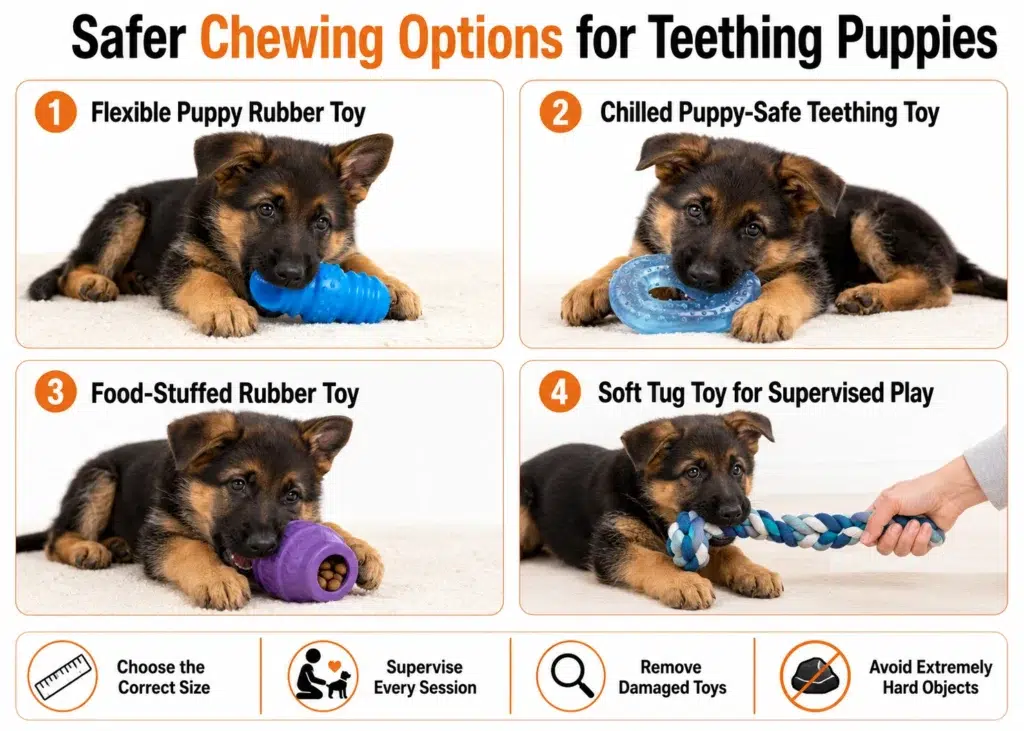
Avoid objects that are extremely hard or easily splintered. VCA specifically warns against hard toys, nylon chews, cow hooves, ice cubes and bones because they can damage teeth. Swallowed bone material can also cause intestinal harm.
A simple owner test is not a medical guarantee. When an object is rock-hard, does not flex at all, or is designed to withstand far more force than a developing puppy tooth, ask your veterinarian before offering it.
Feeding During German Shepherd Puppy Teething Stages
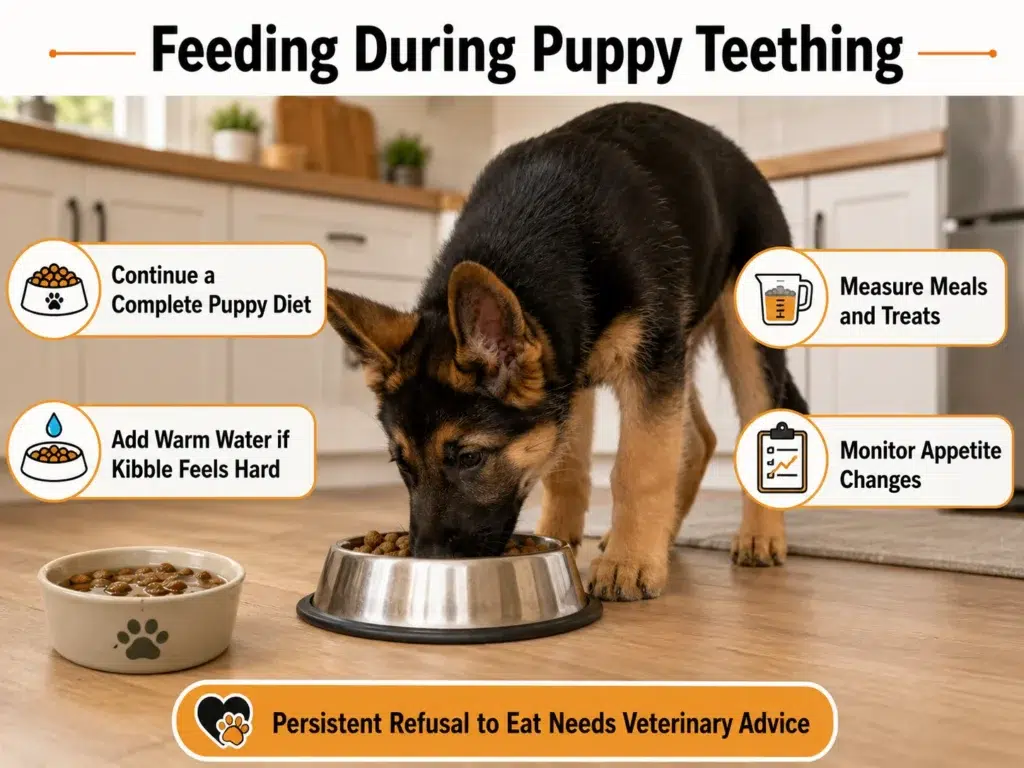
Most puppies can continue eating their normal complete and balanced growth diet. Teething does not automatically require a food change.
When the mouth is tender:
- Add a little warm water to the puppy’s usual kibble.
- Let it soften briefly.
- Serve measured meals so appetite changes are noticeable.
- Avoid repeatedly switching foods because of one slower meal.
- Count edible chews, food toys and training rewards in the daily intake.
- Keep fresh water available.
- Observe whether the puppy chews on both sides of the mouth.
Furbivo’s German Shepherd puppy feeding chart explains age-based meal frequency and why scheduled meals make appetite changes easier to detect.
A puppy that refuses food and seems painful, dull, weak, or unwell needs veterinary advice. Do not assume persistent appetite loss is a normal part of German Shepherd puppy teething stages.
Teething, Biting and Nipping Are Related—but Not Identical
Tender gums can increase the urge to chew, but teething is only one reason a puppy bites.
Other common triggers include:
- Play
- Fast movement
- Excitement
- Fatigue
- Frustration
- Attention-seeking
- Insufficient training
- Overstimulation
Offer a safe toy when your puppy mouths skin or clothing. If teeth return to the person, pause play briefly and resume only when the puppy is calmer.
For the full behavior plan, follow How to Stop a German Shepherd Puppy from Biting and Nipping.
The AKC advises redirecting nipping toward appropriate toys, supervising chewing, removing damaged toys, and ending play when biting continues.
Retained Baby Teeth: The “Double Tooth” Problem
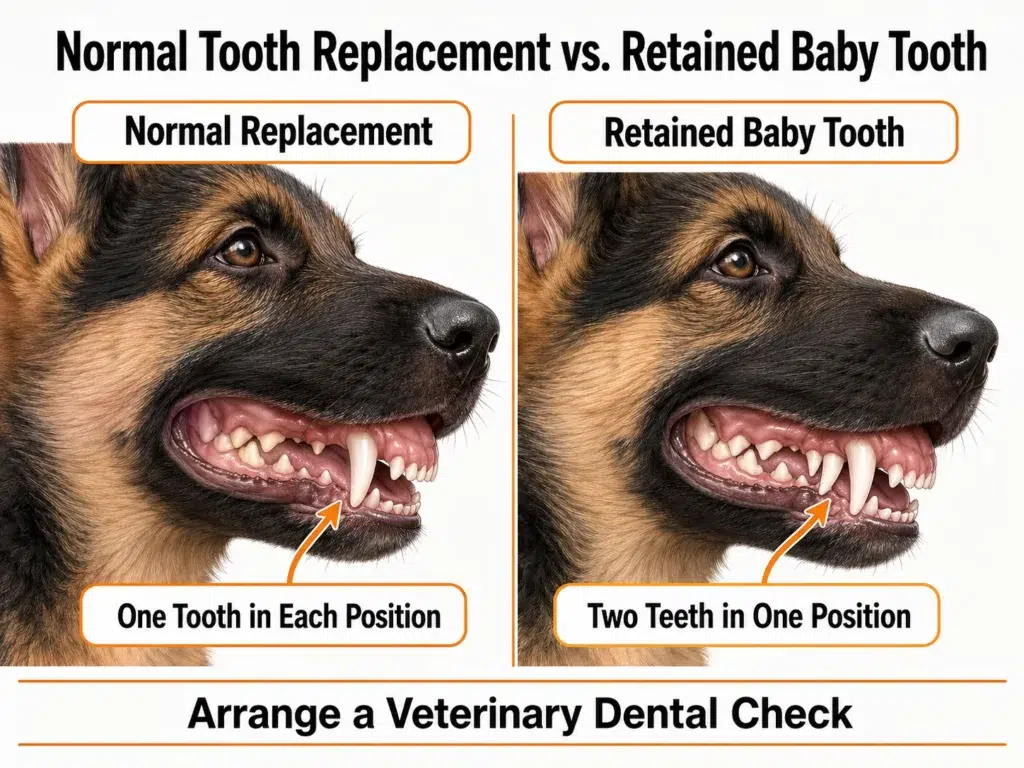
A retained—or persistent—deciduous tooth remains in place after its adult replacement starts erupting.
Owners often notice two canine teeth beside each other:
- One narrow baby canine
- One thicker permanent canine
The extra tooth can force the adult tooth into an abnormal position. Crowding may trap food and plaque, contribute to gum disease, alter the bite, cause painful contact with oral tissue, or interfere with jaw development.
VCA recommends prompt veterinary assessment when two teeth occupy the same position rather than waiting for a later routine procedure.
What to Do
- Do not wiggle or pull the tooth.
- Photograph the area if the puppy allows this calmly.
- Note whether the adult tooth is already visible.
- Arrange a veterinary dental examination.
- Follow the veterinarian’s recommendation about extraction and timing.
German Shepherds are not the breed most commonly associated with retained baby teeth, but any puppy can develop the problem.
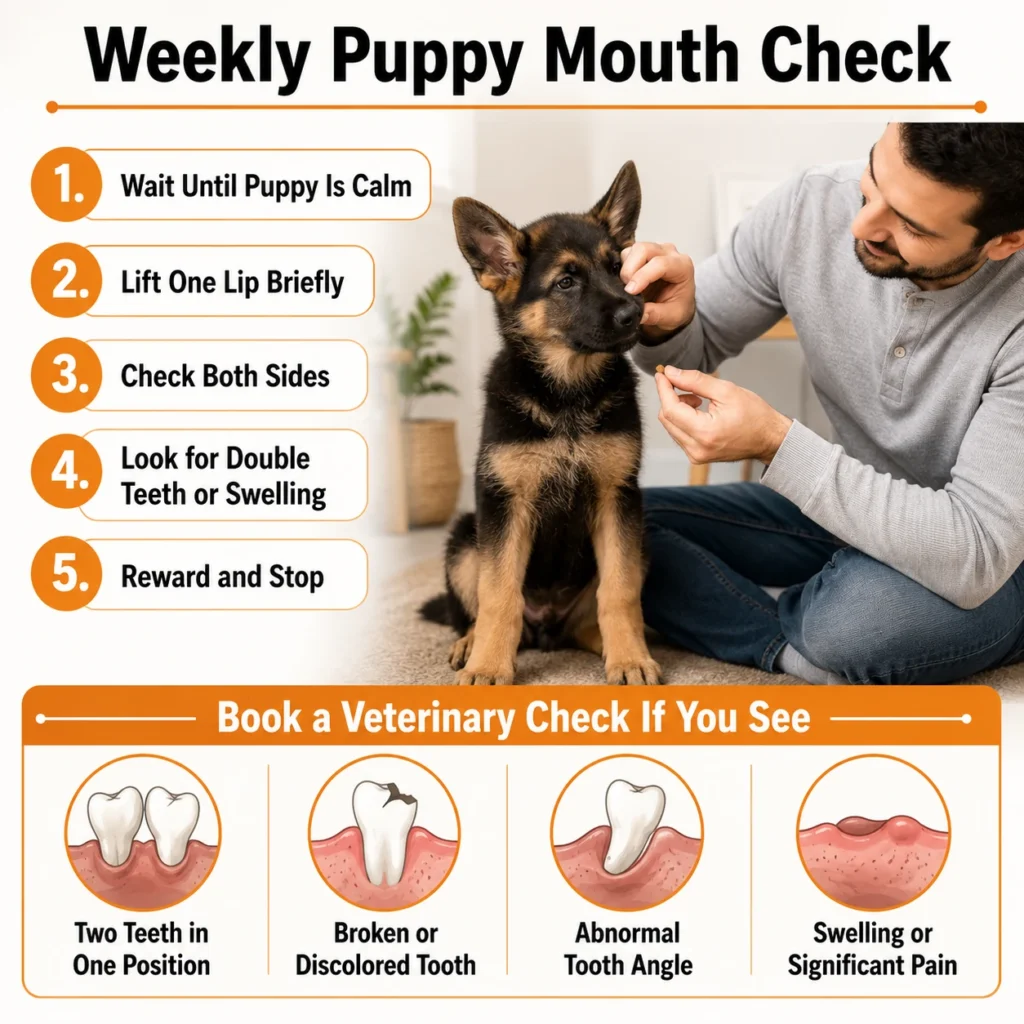
Weekly Mouth Checks During German Shepherd Puppy Teething Stages
Once a week, when your puppy is relaxed:
- Lift one lip briefly.
- Look at the front teeth and canines.
- Check the opposite side.
- Notice redness, swelling, broken teeth, double teeth, or unusual angles.
- Reward and stop.
Do not force the jaws open or turn the check into a wrestling match. Build cooperation through seconds-long sessions.
VCA advises regular mouth checks through roughly seven to eight months so abnormal tooth retention or bite development is identified early.
Track changes with one clear photograph each week. Photographs are more useful when taken from a similar angle and under similar lighting.
Start Dental-Care Training Before Teething Ends
Early mouth handling helps prepare your puppy for lifelong dental care, but tender gums require a gentle approach.
Start with:
- Touching the outside of the muzzle
- Lifting a lip for one second
- Rewarding calm behavior
- Introducing a dog toothbrush gradually
- Using only dog-appropriate toothpaste
- Keeping sessions brief
Do not use human toothpaste. Some human products contain ingredients such as xylitol that are dangerous to dogs. The AKC recommends dog-friendly toothpaste and gradual mouth handling from puppyhood.
A toothbrush does not help a loose tooth fall out faster. The purpose is to create comfortable handling and establish a future hygiene habit.
What Most Teething Guides Miss
The Calendar Is a Range, Not a Deadline
One puppy may start losing incisors before another puppy of the same age. Judge the whole mouth and the puppy’s comfort rather than relying on one date.
Chewing Does Not Prove That a Tooth Is Erupting
Puppies chew because of play, exploration, boredom, fatigue, stress, and reinforcement as well as teething.
The Most Important Check Happens Near the End
Owners often relax when chewing decreases. Six to seven months is exactly when retained baby teeth and abnormal adult-tooth positions may become clearer.
A Missing Tooth May Not Be Lost
A tooth that appears absent may be unerupted, broken, congenitally missing, or hidden because of its position.
Only a veterinary examination—and sometimes dental imaging—can distinguish these possibilities.
Harder Is Not Better
A toy that lasts indefinitely may be too hard for developing teeth. Durability should never be the only selection criterion.
Behavior Can Outlast Dental Discomfort
A puppy that has spent months receiving attention for stealing shoes or biting sleeves may continue the behavior after the gums feel better. Dental development and learned behavior need separate solutions.
When to Call a Veterinarian
Book a routine appointment if:
- Adult teeth are appearing beside baby teeth
- The bite looks asymmetrical
- A tooth is growing toward the palate
- The puppy remains unusually uncomfortable
- Appetite changes persist
- You suspect a broken tooth
- Adult teeth seem incomplete after the expected teething period
- The puppy consistently chews on only one side
- Food repeatedly falls from the mouth
- Mouth odor becomes strong or unpleasant
Seek urgent veterinary care for:
- Uncontrolled bleeding
- Severe facial swelling
- Breathing difficulty
- Inability to close the mouth
- Major oral trauma
- Collapse
- Suspected ingestion of a dangerous object
- Severe pain with inability to eat or drink
Frequently Asked Questions
When Do German Shepherd Puppies Start Teething?
Baby teeth erupt at around three to six weeks, but the replacement phase owners usually call “teething” commonly begins at about three-and-a-half to four months.
When Do German Shepherd Puppies Finish Teething?
Most have their adult teeth by approximately six to seven months. A veterinary examination is appropriate if baby teeth remain beside adult teeth or the bite appears abnormal.
How Many Teeth Does a German Shepherd Puppy Have?
A puppy normally has 28 baby teeth. An adult German Shepherd normally has 42 permanent teeth.
Is Bleeding Normal During Teething?
A tiny spot of blood around a newly lost tooth may occur. Heavy, continuous, unexplained, or recurrent bleeding is not something to dismiss as normal teething.
Why Can’t I Find My Puppy’s Lost Teeth?
Many puppies swallow baby teeth while eating. This commonly causes no apparent problem, although vomiting, choking, pain, or unusual behavior still requires veterinary advice.
Can I Pull Out a Loose Puppy Tooth?
No. Let it fall naturally unless a veterinarian recommends treatment. Pulling can cause pain, fracture the tooth, damage tissue, or interfere with the developing adult tooth.
Can I Give Ice Cubes for Sore Gums?
VCA advises avoiding ice cubes and other very hard objects because they can damage teeth. Use a puppy-safe toy chilled according to its instructions instead.
Does Teething Cause German Shepherd Puppy Biting?
It can increase chewing and mouthiness, but it is not the only cause. Training, sleep, excitement, movement, frustration, and attention also influence biting.
Final Thoughts on German Shepherd Puppy Teething Stages
The most active German Shepherd puppy teething stages usually fall between roughly four and six months, with most adult teeth present by six to seven months.
Give your puppy safe supervised chewing outlets, protect the home from repeated destructive chewing, monitor appetite, and check the mouth weekly.
Do not focus only on when a tooth falls out. Watch where the adult tooth erupts, whether a baby tooth remains beside it, and whether your puppy can eat and close the mouth comfortably.
Early veterinary attention is especially important for double teeth, abnormal bite contact, swelling, broken teeth, or significant pain.
Have questions about your dog’s health, nutrition, grooming, or daily care? Visit our Contact Us page to reach the Furbivo team. For any medical symptoms, diagnosis, or treatment advice, always consult a qualified veterinarian.
