
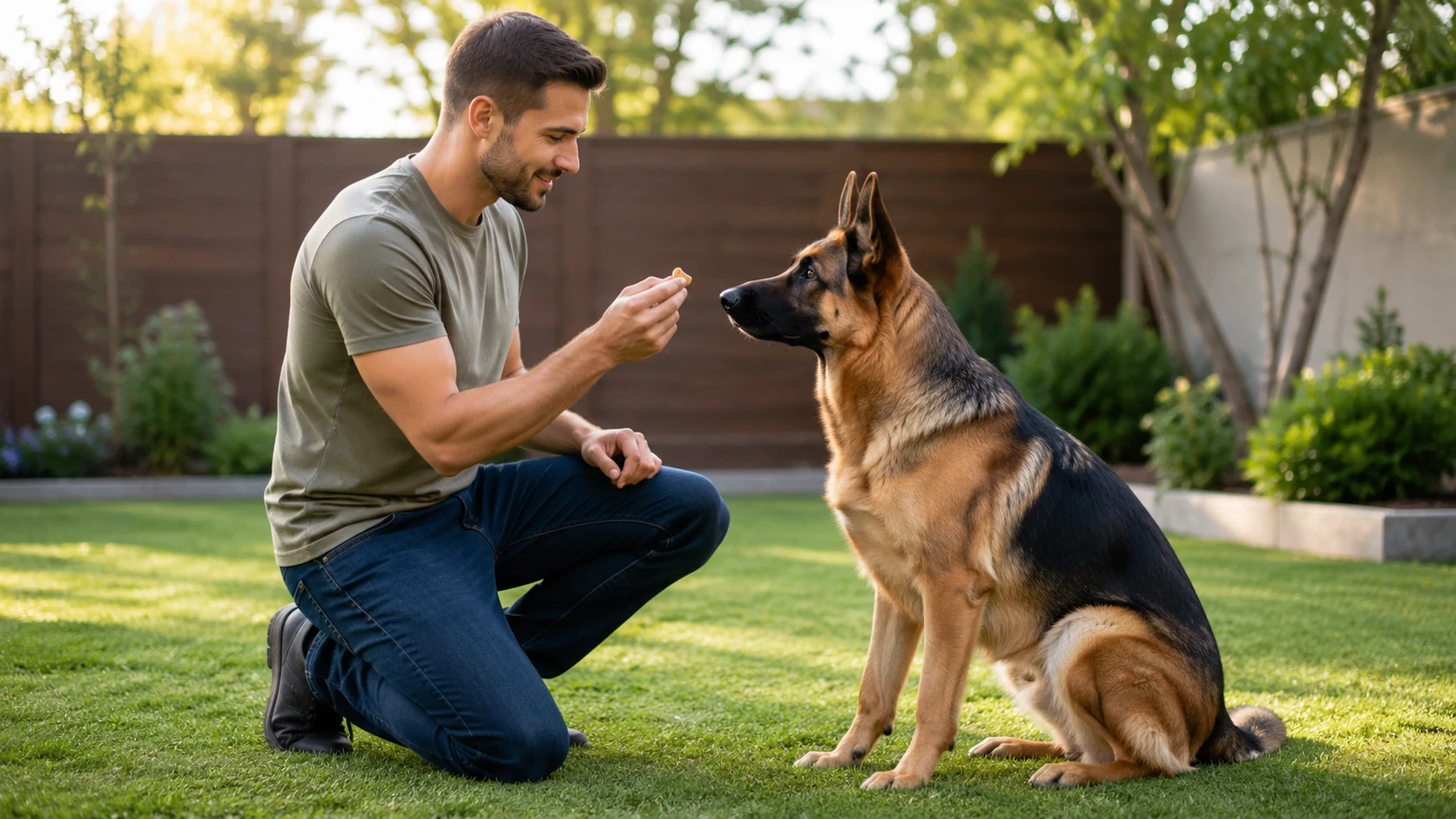
Learning how to train a German Shepherd starts with trust, clear rules, and positive reinforcement. This breed is smart, active, and usually eager to work, but your dog still needs patient teaching. Start with short daily lessons, reward good choices, manage unwanted habits, and build skills slowly in real-life situations.
Are German Shepherds Easy to Train?
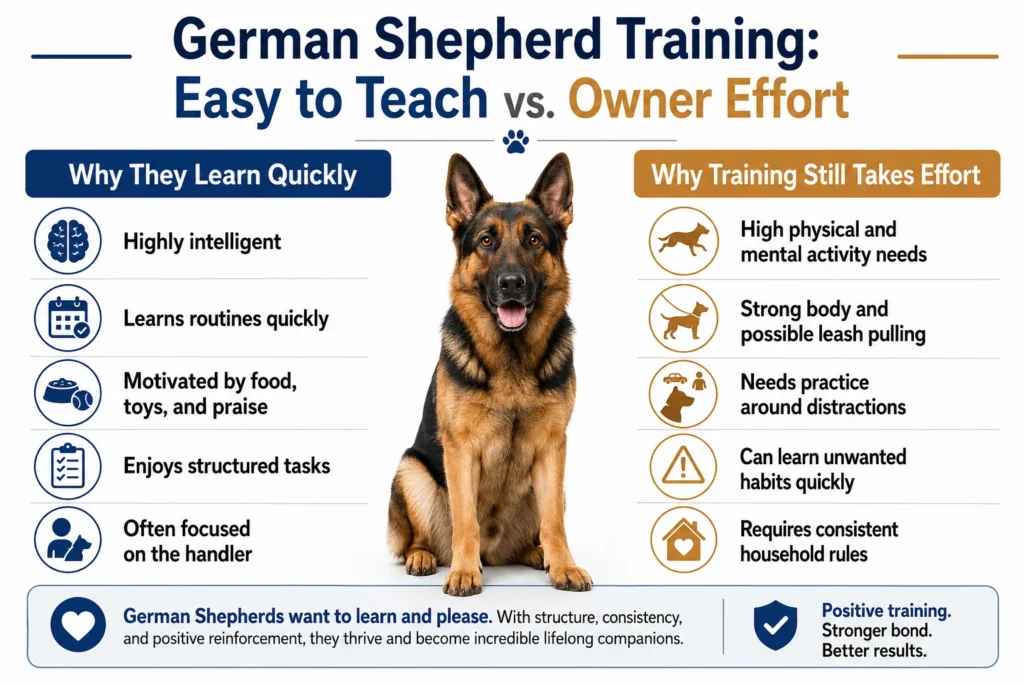
Yes, German Shepherds are generally easy to train because they are intelligent, alert, and motivated to work with people. However, they are not effortless dogs. Their energy, size, confidence, and sensitivity mean they need consistent rules, reward-based training, regular mental activity, and gradual practice around distractions.
Easy to Teach Does Not Mean Easy to Manage
German Shepherds often understand new commands quickly, but fast learning is only one part of successful training. A dog may know what a cue means and still struggle to follow it when excited, nervous, or distracted.
This difference matters for new owners. Teaching a German Shepherd to sit may be simple, while teaching the same dog to stay calm near visitors, other dogs, traffic, or wildlife usually takes more time and practice.
Training is often easier when owners:
- Use clear and consistent commands
- Reward the behavior they want
- Practice in short, focused sessions
- Increase distractions gradually
- Give the dog regular physical and mental activity
- Apply the same household rules every day
Training may become more difficult when the dog receives mixed signals, has too little activity, or is expected to behave reliably without enough real-world practice.
German Shepherds can also learn unwanted behavior quickly. Pulling may continue if it repeatedly helps the dog move forward, while barking may become stronger if it always makes people step away. This is why owners should pay attention not only to commands, but also to what happens immediately after a behavior.
Are They Suitable for Beginner Owners?
A committed first-time owner can train a German Shepherd successfully, but the breed requires more structure than many low-energy companion dogs. New owners should be prepared for daily training, exercise, socialization, and ongoing management during adolescence.
The most accurate answer is that German Shepherds are usually easy to teach, but they require time and consistency to become reliable, calm, and well-mannered family dogs.
How to Train a German Shepherd With Positive Reinforcement
The best way to train a German Shepherd is to reward the behavior you want, practice in short sessions, and make training part of everyday life. Teach basic cues first, then add distractions slowly. Avoid harsh punishment, because fear and confusion can make barking, pulling, guarding, or reactivity worse. For a science-based overview, the AVSAB humane dog training guidance supports reward-based methods for dog training and behavior work.
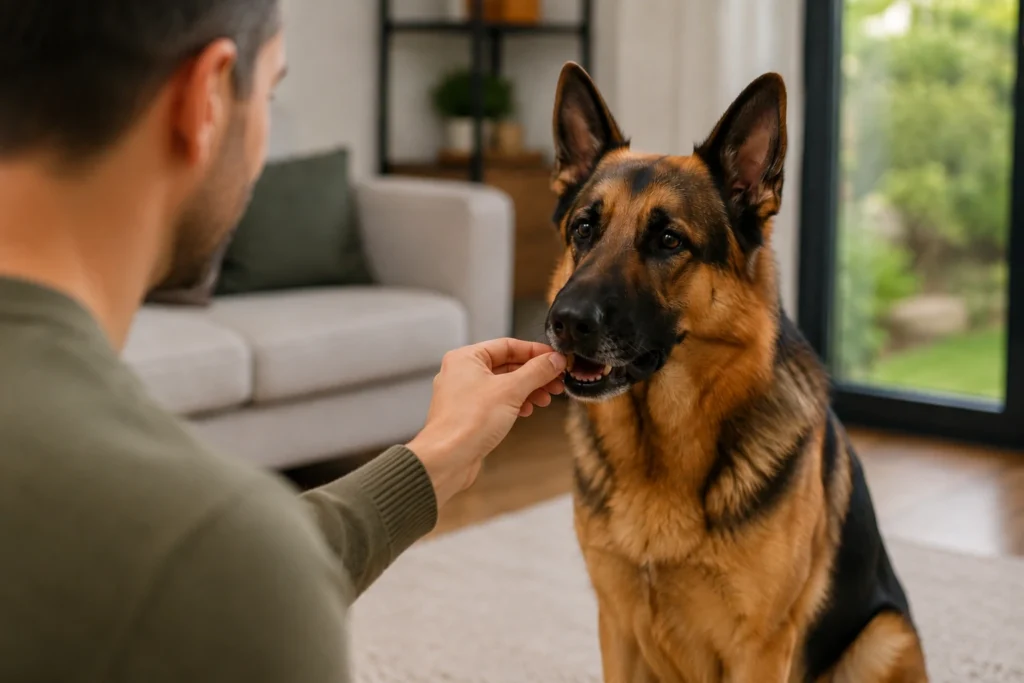
When owners search for how to train a German Shepherd, the safest starting point is usually simple: reward what you want, prevent repeated bad habits, and keep your dog feeling safe enough to learn.
German Shepherds often learn quickly, but quick learning is not the same as finished training. Your dog may understand “sit” in the kitchen and forget it near a squirrel, guest, or another dog. That’s normal.
Training needs to move in small steps. First, teach the behavior in a quiet place. Then practice in the yard. Then try it on a calm sidewalk. Later, use it around mild distractions.
This is how your dog learns that the cue means the same thing everywhere.
Why German Shepherds Need Clear Training
German Shepherds were developed as working dogs. Many have strong focus, high energy, and a natural desire to watch what’s happening around them. According to the AKC German Shepherd Dog breed profile, the breed is known for intelligence, confidence, and working ability. These traits can be wonderful when your dog has guidance.
Without guidance, those same traits can turn into problems.
A German Shepherd may bark at every sound, pull hard on walks, chase moving objects, jump on guests, mouth hands, or guard food and toys. These behaviors don’t mean your dog is “bad.” They usually mean your dog is excited, confused, under-exercised, worried, or rewarded by the behavior.
Your job is to show your dog what to do instead.
For example, instead of yelling when your dog jumps, teach sitting for greetings. Instead of fighting leash pulling, reward walking near you. Instead of letting your dog bark at the window all day, block the view and teach a calm place cue.
Good training gives your dog a job that makes sense.
Start With These Foundation Skills
Before advanced obedience, sports, or protection-style training, your German Shepherd needs everyday manners. These are the skills that make home life safer and calmer.
If you are learning how to train a German Shepherd at home, these foundation skills should come before advanced commands or busy public practice.
| Training Skill | What It Teaches | Where to Practice First |
|---|---|---|
| Name response | Focus on you | Quiet room |
| Sit | Basic self-control | Kitchen or living room |
| Down | Calm body position | Bedroom or mat area |
| Come | Returning to you | Hallway or fenced yard |
| Leave it | Ignoring unsafe items | Indoors with treats |
| Drop it | Releasing objects | Toy play sessions |
| Loose-leash walking | Walking without pulling | Driveway or quiet street |
| Place | Settling on a mat or bed | Living room |
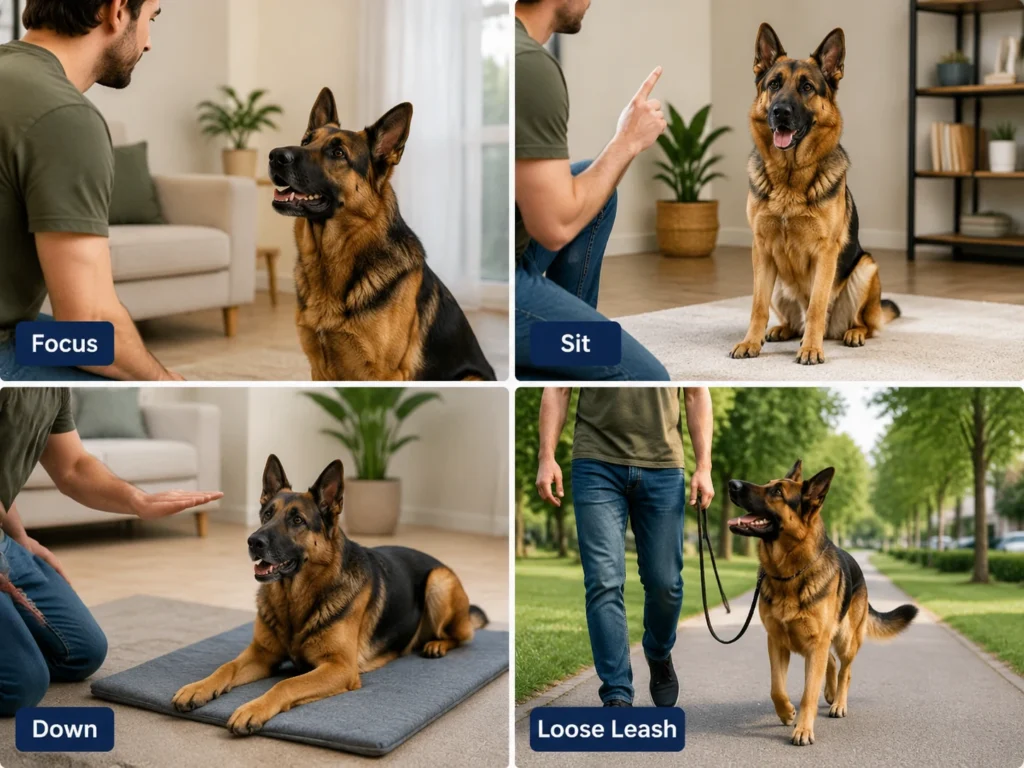
These basics are not boring. They are the building blocks for a well-mannered dog.
A German Shepherd that can focus, come when called, settle on a mat, and walk politely is easier to manage around visitors, children, other pets, and public places.
Step-by-Step German Shepherd Training Plan
This step-by-step plan keeps how to train a German Shepherd practical for beginners, especially if you want calm progress without confusing your dog.
Step 1: Build a Reward System
Start by finding what your dog actually likes. Some dogs love soft treats. Others work harder for a ball, tug toy, praise, or a chance to sniff.
Use small rewards so your dog does not get full too fast. Soft treats often work well because they are easy to chew and quick to deliver.
When your dog does something right, mark it with a short word like “yes,” then reward. This marker helps your dog understand the exact moment that earned the treat.
Keep your tone calm and upbeat. Training should feel like a clear game, not a test your dog is afraid to fail.
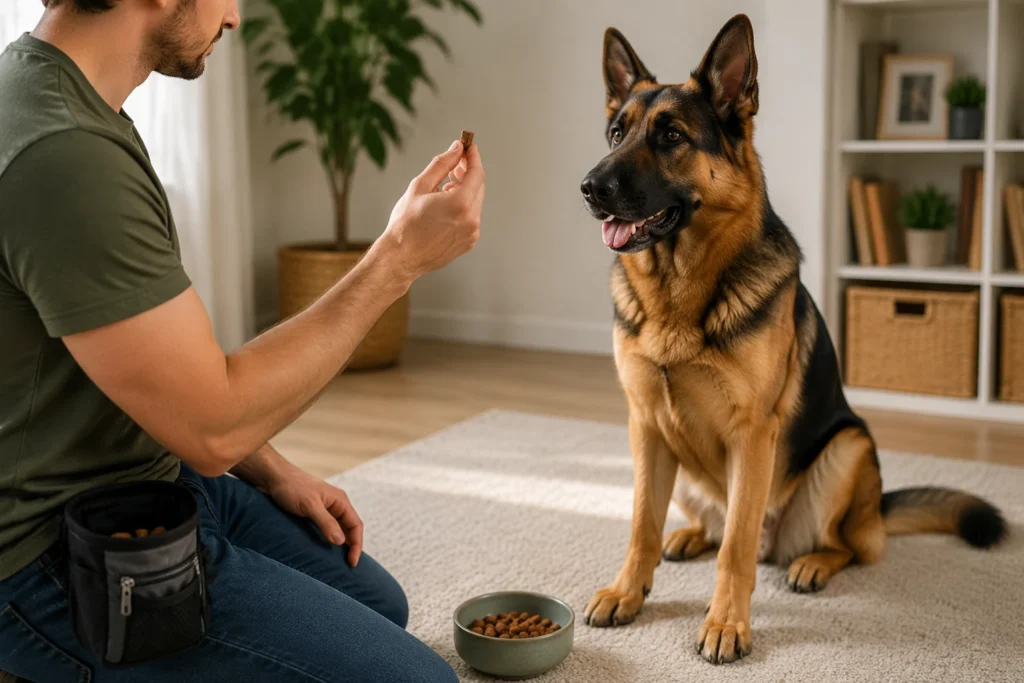
Step 2: Teach Your Dog to Pay Attention
Attention is the first real skill. If your German Shepherd cannot check in with you, every other cue becomes harder.
Say your dog’s name once. When your dog looks at you, say “yes” and reward.
Practice this several times a day. Use it before meals, before walks, and during quiet moments at home.
Do not repeat the name five times. That teaches your dog that ignoring the first few calls is fine. Say it once, help your dog succeed, and reward the response.
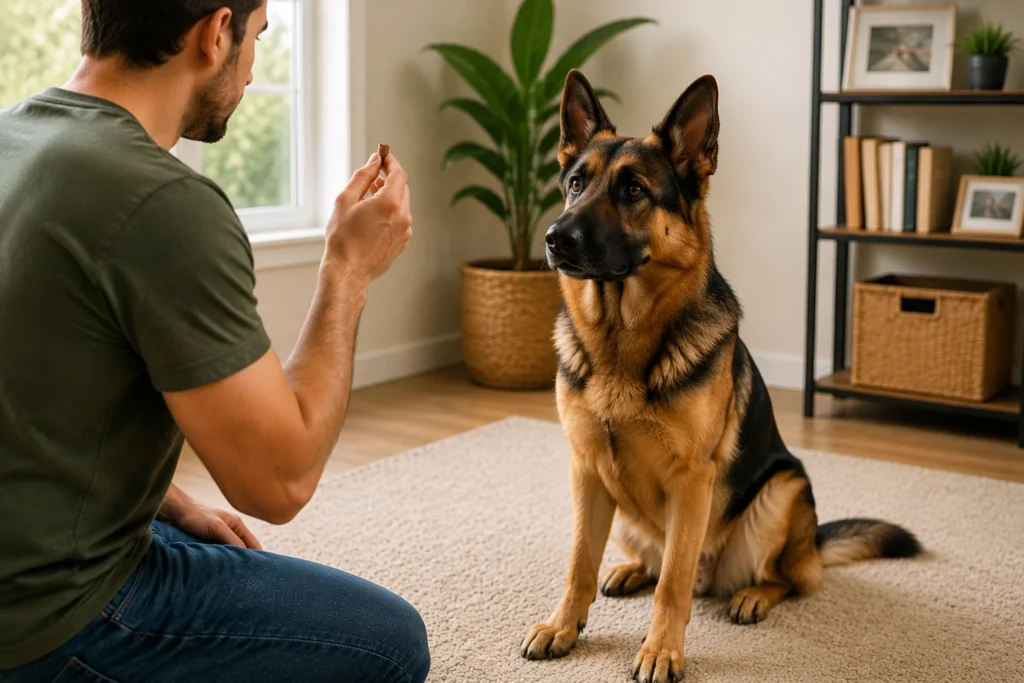
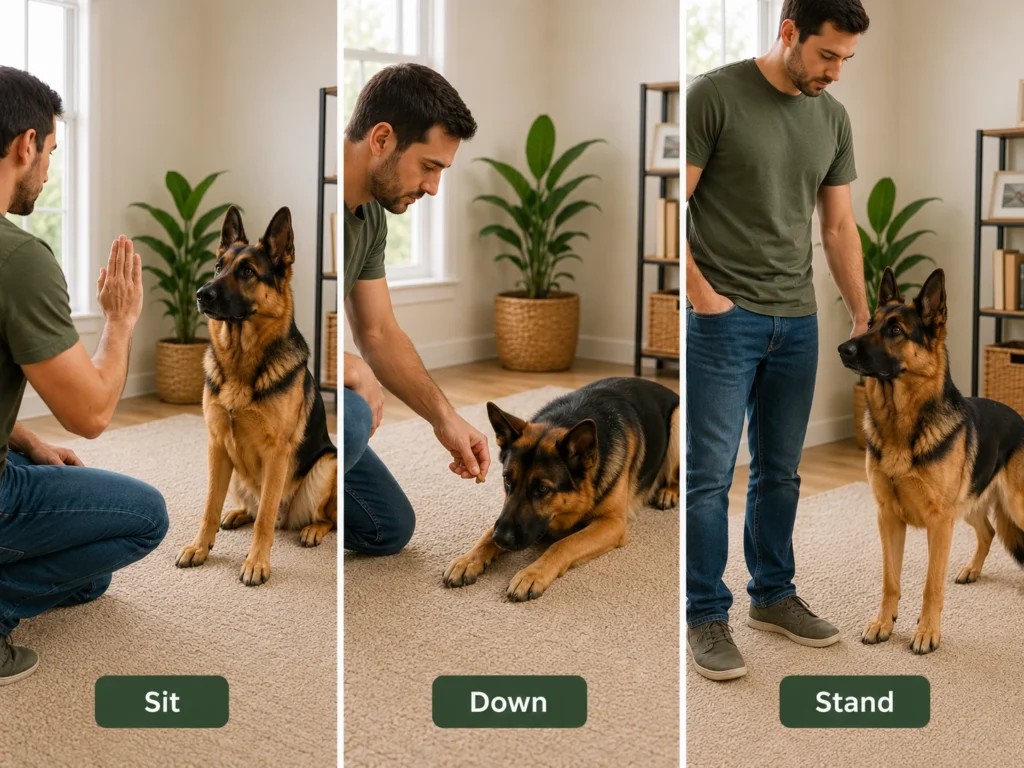
Step 3: Teach Sit, Down, and Stand
These simple body positions help you guide your dog through daily life.
For sit, hold a treat near your dog’s nose and slowly move it upward. As the head follows the treat, the rear usually lowers. Mark and reward when your dog sits.
For down, start with your dog sitting. Move the treat from the nose down toward the floor. Reward when the elbows touch the ground.
For stand, move a treat forward from your dog’s nose while your dog is sitting or lying down. Reward when your dog stands up.
Once your dog follows the hand motion, say the cue before using the hand signal. Over time, make the hand motion smaller.
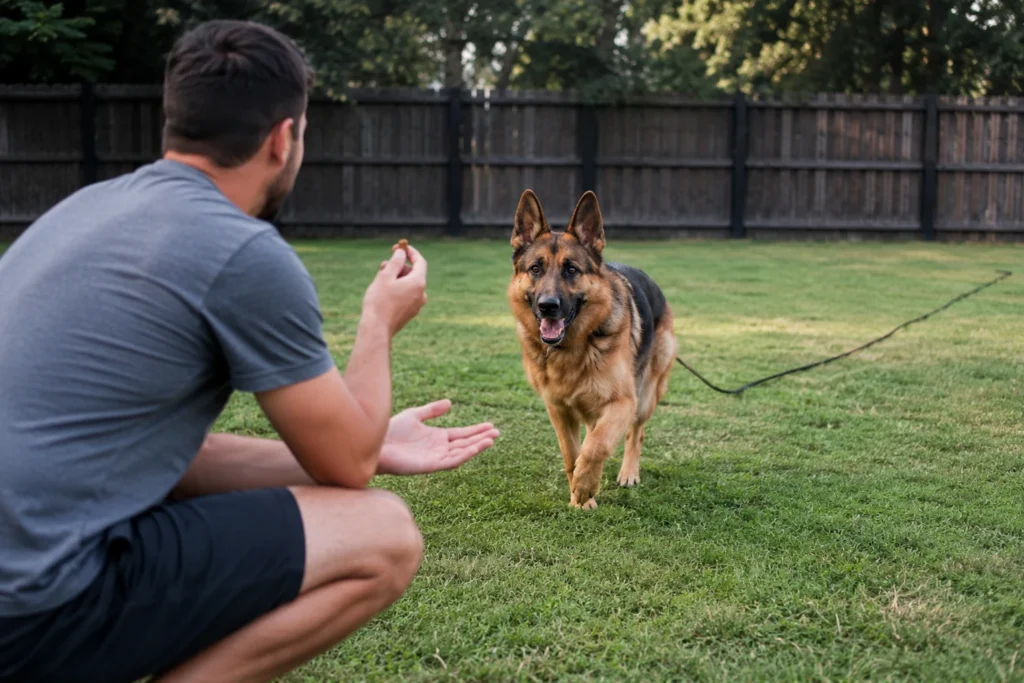
Step 4: Train a Reliable Come Cue
Recall training is important for safety. Even if you never plan to let your German Shepherd off leash in open areas, your dog still needs to come when called at home, in the yard, or during an emergency.
Start indoors. Say “come” in a cheerful voice and move away from your dog. Most dogs naturally follow movement. When your dog reaches you, reward generously.
Never call your dog and then do something unpleasant, especially in the early stages. If “come” predicts bath time, punishment, or the end of fun, your dog may stop responding.
Use a long line for outdoor recall practice. Do not practice off leash near traffic, wildlife, or unknown dogs.
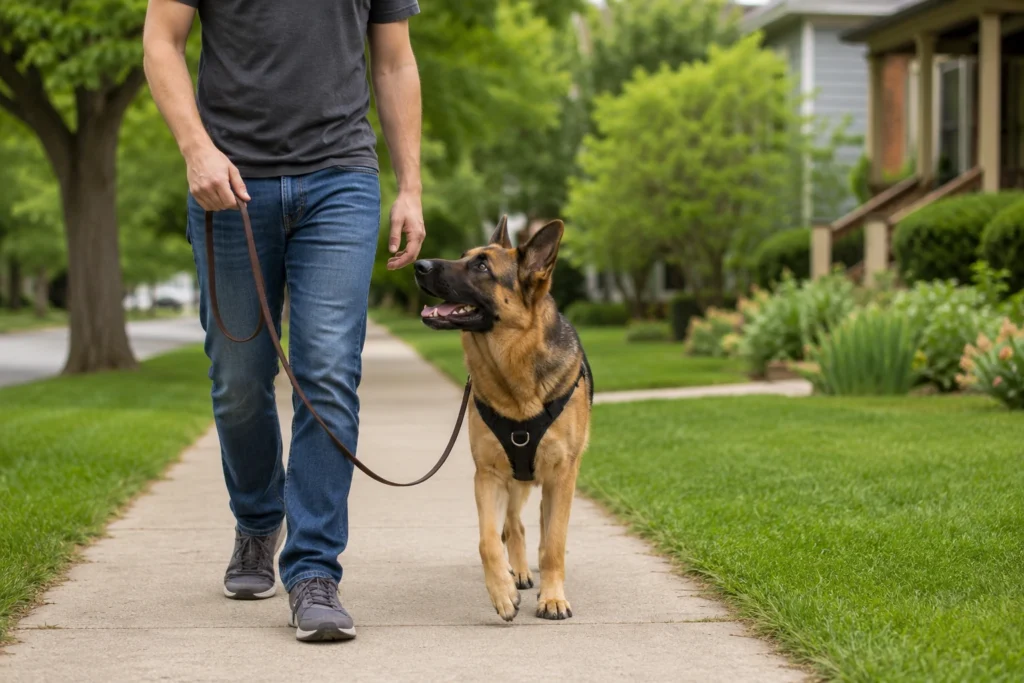
Step 5: Teach Loose-Leash Walking
A full-grown German Shepherd can be very strong, so leash manners should start early.
Begin in a low-distraction area. Reward your dog when the leash is loose and your dog is walking near you. Take a few steps, reward, and repeat.
If your dog pulls, stop walking. Wait for the leash to soften or for your dog to turn back toward you. Then continue.
This teaches a clear rule: pulling stops the walk, and a loose leash moves the walk forward.
Avoid yanking the leash. Jerking can increase frustration and may cause your dog to react more strongly to things in the environment.
Step 6: Add Leave It and Drop It
German Shepherds are curious dogs. “Leave it” and “drop it” can prevent unsafe chewing, stolen objects, and stressful tug-of-war moments.
To teach leave it, place a treat in your closed fist. Let your dog sniff or lick your hand. The moment your dog backs off, mark and reward from your other hand.
To teach drop it, use a toy your dog likes but does not guard. Offer a treat near the nose. When your dog lets go of the toy, mark, reward, and give the toy back.
Returning the toy is useful. It teaches your dog that dropping something does not always mean losing it forever.
Step 7: Teach Place for Calm Behavior
“Place” means your dog goes to a bed, mat, or cot and relaxes there. This is helpful during meals, guest visits, work calls, and busy household moments.
Put a mat on the floor. When your dog steps on it, mark and reward. Toss a treat away so your dog leaves, then let your dog return to the mat again.
After several repeats, add the word “place.” Slowly reward longer stays on the mat.
At first, reward every few seconds. Later, reward calm lying down, relaxed hips, and quiet behavior.
Socialization Without Overwhelming Your Dog
Socialization is not forcing your German Shepherd to meet every person or dog. It means helping your dog feel safe and calm around normal life.
A key part of how to train a German Shepherd is teaching calm observation, not pushing the dog into every greeting.
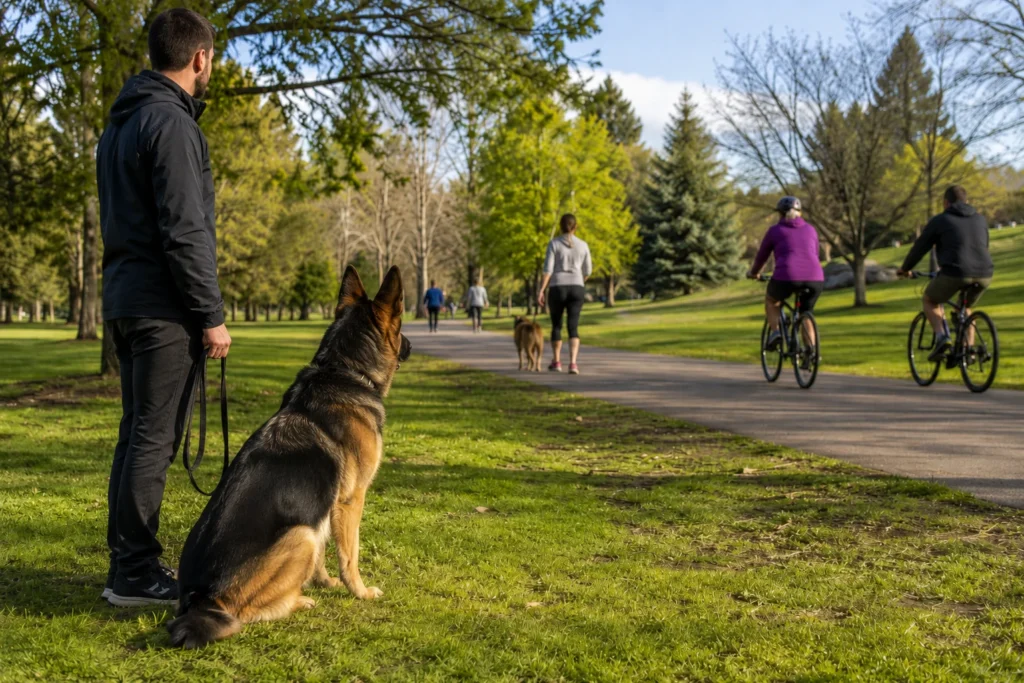
Your dog should learn about different sounds, surfaces, people, animals, vehicles, and environments. But exposure must be controlled.
Good socialization may include watching children from a distance, hearing traffic, seeing bikes, walking on different surfaces, visiting the vet lobby for treats, or calmly observing people in hats and sunglasses.
Distance matters. If your dog can notice something and still take food, respond to cues, and move normally, the distance is probably okay. If your dog freezes, lunges, barks hard, hides, or refuses treats, move farther away.
Do not push your dog into greetings. A German Shepherd can learn confidence without being touched by strangers.
For puppies, ask your veterinarian how to socialize safely while vaccines are still being completed. The CDC also recommends routine veterinary care and safe supervision around dogs, especially around children, in its healthy pets dog guidance.
What Owners Accidentally Reward
Many owners reinforce behavior without meaning to.
If your dog jumps and you talk, touch, or push the dog down, your dog may still see that as attention. If your dog barks at the window and the delivery driver leaves, your dog may think barking worked. If your dog pulls to a smell and gets there, pulling has been rewarded.
Here are common patterns:
Jumping brings attention.
Barking makes outdoor movement go away.
Pulling reaches exciting smells faster.
Stealing items starts a chase.
Pawing makes people pet the dog.
Whining at the table brings food.
Mouthing gets play started.
The fix is not anger. The fix is changing the result.
Reward sitting instead of jumping. Use a leash or baby gate to prevent chasing guests. Close blinds or use window film to reduce barking practice. Reward quiet check-ins on walks. Trade for stolen items instead of chasing your dog.
Training gets easier when unwanted behavior stops paying off.
What Not to Do During Training
Do not use fear, pain, or intimidation to train a German Shepherd. Avoid yelling, hitting, alpha rolls, leash jerks, shock collars, and forcing your dog into scary situations.
These methods can damage trust. They may also make fear, guarding, and aggression harder to manage.
Do not punish growling. A growl is communication. If you punish it, your dog may stop warning and move faster to snapping or biting. Instead, create space and get professional help when needed.
Do not change rules from day to day. If jumping is allowed sometimes but not other times, your dog will stay confused.
Do not expect fast results around distractions. A dog that listens in the living room still needs practice near guests, dogs, food, and outdoor sounds.
Daily Training Routine for a German Shepherd
A simple routine helps your dog learn faster because training becomes part of normal life.
For owners wondering how to train a German Shepherd without long lessons, the answer is to use several small training moments throughout the day.
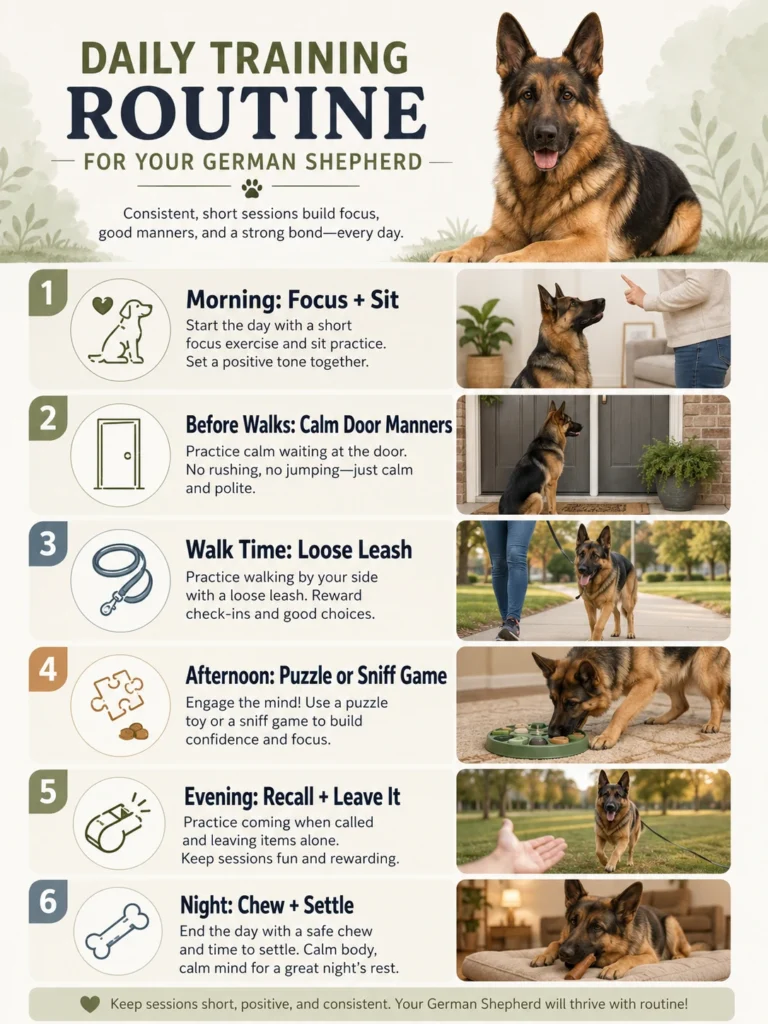
Morning: Practice name response, sit, down, and place before breakfast.
Before walks: Ask for a sit at the door and reward calm behavior before clipping the leash.
During walks: Reward loose-leash walking, eye contact, and calm passing at a distance.
Afternoon: Use a food puzzle, sniffing game, or short obedience session.
Evening: Practice recall, drop it, leave it, and calm greetings.
Before bed: Offer a safe chew and quiet settling time.
German Shepherds need both physical activity and mental work. Long walks may help, but thinking games are also important. Scent games, puzzle feeders, trick training, and short obedience lessons can help your dog use energy in a healthy way.
Food and routine also matter. If you want to support training with better nutrition choices, you can read this guide on German Shepherd dog food and this simple breakdown of what German Shepherds eat.
Rest matters too. A dog that is always busy may become more wired, not calmer. Teach your German Shepherd that quiet time is also part of the routine.
Realistic Training Timeline
Training is not a one-week project. Your dog may learn a cue quickly, but using that cue in real life takes repetition.
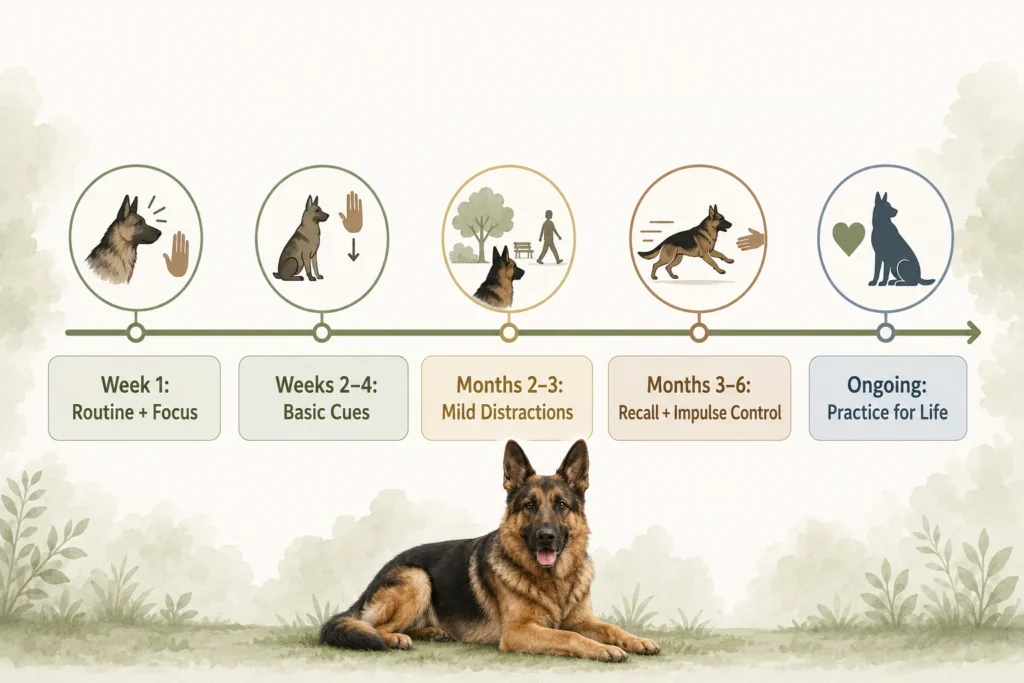
Here is a realistic timeline for many owners:
Week 1: Build routine, reward marker, name response, sit, and simple leash focus.
Weeks 2 to 4: Add down, come, place, leave it, drop it, and polite greetings.
Months 2 to 3: Practice around mild distractions and improve loose-leash walking.
Months 3 to 6: Build stronger recall, better impulse control, and calmer public behavior.
Ongoing: Keep practicing during adolescence and adulthood.
Progress will not always be smooth. Your dog may regress during growth stages, routine changes, stressful events, or health issues. When that happens, go back to easier steps and rebuild confidence.
Because training continues across life stages, it also helps to understand how long German Shepherds live so you can think about behavior, exercise, and care as a long-term routine.
Common German Shepherd Behavior Problems
Leash Pulling
Pulling usually happens because the dog wants to reach something. That may be a smell, person, dog, or open space.
Practice in quiet areas first. Reward your dog before the leash gets tight. Stop when pulling starts. Move again when your dog reconnects with you.
Barking at People or Dogs
Barking can come from alertness, fear, excitement, frustration, or lack of socialization.
Do not drag your dog closer to the trigger. Increase distance and reward calm looking, turning back to you, or walking away.
If barking includes lunging, snapping, or intense body stiffness, work with a qualified trainer.
Jumping on Guests
Jumping often works because it gets attention.
Use a leash, gate, or crate before guests enter. Reward your dog for sitting or standing calmly. Ask guests to ignore jumping and give attention only when paws are on the floor.
Mouthing and Nipping
Puppies may mouth during play. Some German Shepherds also nip when excited by movement.
Redirect to a toy, pause play when teeth touch skin, and reward calm play. Do not wrestle with your hands if your dog is still learning bite control.
Resource Guarding
Guarding food, toys, beds, or stolen items needs careful handling.
Do not grab items or test your dog by taking things away. Teach trades with better rewards. If your dog growls, freezes, snaps, or bites, contact a qualified professional.
Training a German Shepherd Puppy
A puppy needs gentle structure from the first day home. Keep lessons short and easy.
If your main question is how to train a German Shepherd puppy, start with trust, routine, name response, potty training, and calm handling before expecting advanced obedience.
Focus on potty training, crate comfort, name response, handling, bite control, safe socialization, and simple cues. Puppies learn through repetition, not pressure.
Use management tools like baby gates, pens, and a crate when appropriate. These tools prevent accidents, chewing, and unsafe choices while your puppy is still learning.
Remember that puppies are not being stubborn when they chew, nip, or have accidents. They are young and need guidance.
Training an Adult German Shepherd
Adult German Shepherds can absolutely learn new skills. Some may even focus better than puppies.
The same principles apply when you ask how to train a German Shepherd as an adult: build trust first, reward small wins, and avoid rushing into high-distraction situations.
Start by learning your dog’s habits. Notice what causes excitement, fear, pulling, barking, or guarding. Then build a plan around those triggers.
Keep the first sessions easy. Reward attention, calm behavior, and simple cues. Do not rush into busy parks or crowded stores.
If your adult dog has a difficult history, give extra time. Trust can grow, but it cannot be forced.
When to Hire a Qualified Trainer
Get professional help if your German Shepherd shows aggression, serious fear, biting, repeated lunging, resource guarding, or behavior you cannot safely manage.
Choose a trainer who uses reward-based methods and explains the training plan clearly. The RSPCA guide to finding the right dog trainer recommends looking for reward-based methods and avoiding techniques that rely on fear, pain, choke chains, shouting, or hitting.
Be cautious with anyone who says your dog needs pain, fear, or dominance to learn.
You should also contact your veterinarian if behavior changes suddenly. Pain, illness, poor sleep, vision changes, hearing changes, or medication issues can affect behavior.
For severe aggression or anxiety, your veterinarian may suggest a veterinary behaviorist.
What Most Articles Miss
Many training articles focus only on commands. Commands matter, but your dog is learning from the whole environment.
If your German Shepherd spends hours barking at the window, that is training. If pulling gets your dog to every tree, that is training. If jumping makes people laugh, touch, or talk, that is training too.
Your dog practices whatever happens often.
That is why management is part of training. Use gates, leashes, window covers, treat stations, puzzle toys, crates, and calm routines to reduce unwanted practice.
Another missed point is emotional state. A stressed dog may not learn well. A tired but overstimulated dog may still act wild. A fearful dog may need distance before obedience.
Good training asks, “What does my dog need to succeed right now?”
Helpful Training Tools
You do not need expensive gear to start. A few simple tools can make training easier.
Useful items include:
Soft training treats
Treat pouch
Six-foot leash
Long line for recall practice
Flat collar with ID tag
Front-clip harness
Training mat or dog bed
Puzzle feeder
Safe chew toys
Baby gates or exercise pen
Choose tools that help your dog learn safely. Avoid equipment meant to scare, choke, shock, or hurt your dog.
FAQs About How to Train a German Shepherd
1. Is a German Shepherd hard to train?
A German Shepherd is usually not hard to train when you use clear, consistent, reward-based methods. The challenge is that this breed is strong, smart, and energetic, so bad habits can grow quickly without daily structure.
2. What should I teach my German Shepherd first?
Start with name response, sit, down, come, leave it, drop it, loose-leash walking, and place. These skills help with safety, manners, and daily control before you move to advanced training.
3. How long should German Shepherd training sessions be?
Most sessions should be short. Five to ten minutes is enough for many dogs. Puppies may need even shorter lessons. Several small sessions each day usually work better than one long session.
4. How do I stop my German Shepherd from ignoring me outside?
Lower the distraction level first. Practice farther away from people, dogs, cars, and smells. Use better rewards outside, reward eye contact often, and build difficulty slowly instead of expecting indoor obedience to work everywhere right away.
5. Can I train an older German Shepherd?
Yes, older German Shepherds can learn new skills. Start with trust, simple cues, and a predictable routine. Adult dogs with fear, guarding, or aggression may need help from a qualified reward-based trainer or veterinary behavior professional.
Final Thoughts
How to train a German Shepherd is not about being strict or forceful. It is about teaching clearly, rewarding good choices, and helping your dog understand what works.
Start with the basics, practice a little every day, and manage the environment so your dog does not keep rehearsing unwanted habits. With time, patience, and positive methods, your German Shepherd can become a calmer, safer, and more responsive companion.
Have questions about your dog’s health, nutrition, grooming, or daily care? Visit our Contact Us page to reach the Furbivo team. For any medical symptoms, diagnosis, or treatment advice, always consult a qualified veterinarian.