
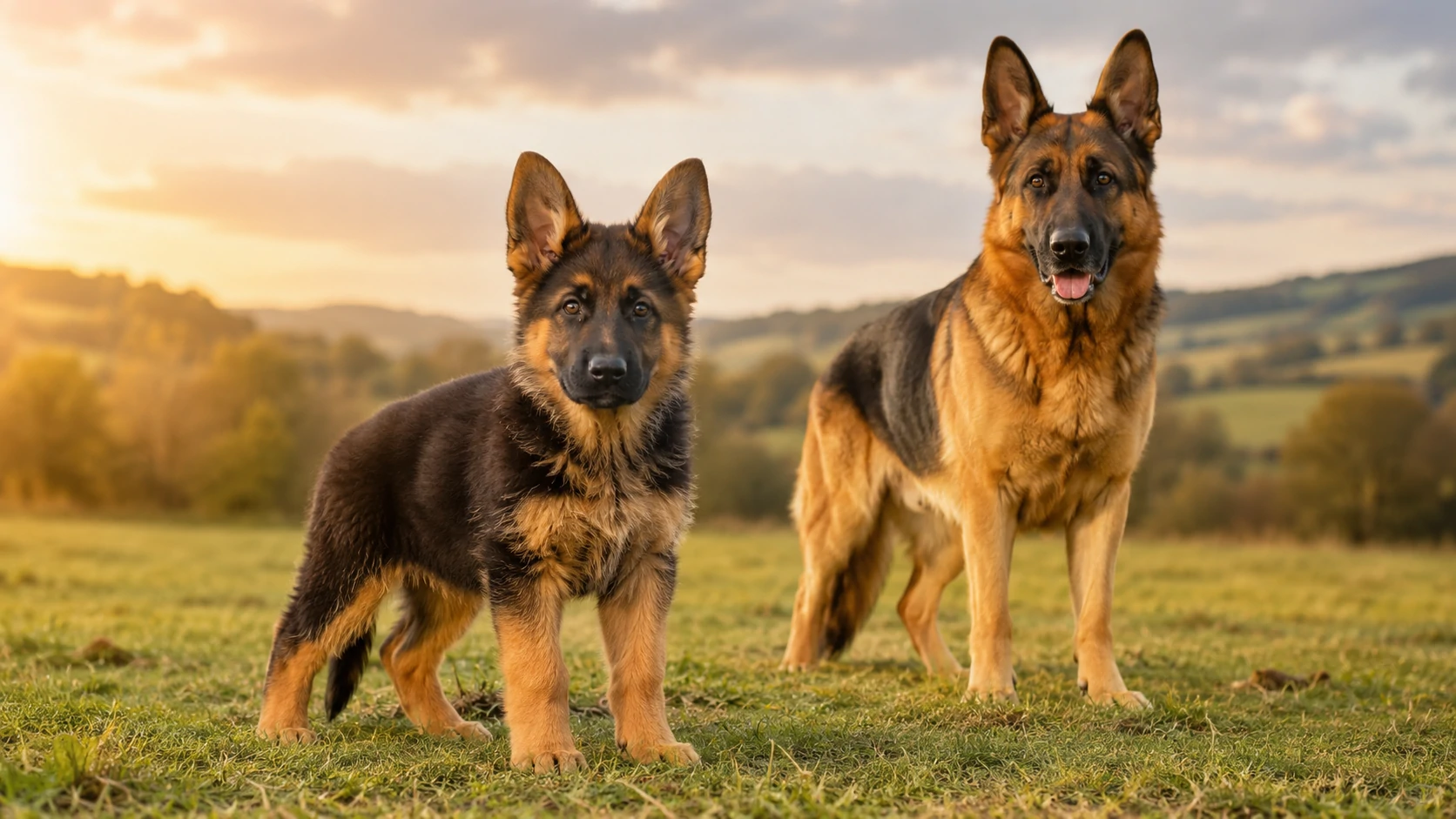
A German Shepherd growth chart can help you see whether your puppy is gaining weight at a steady pace, but it should never be treated as a pass-or-fail test. Sex, genetics, bloodline, nutrition, health history, activity, and body condition can all affect how quickly a puppy grows and how large the dog becomes.
Most German Shepherd puppies grow fastest during the first six months. Many are close to adult height between 12 and 18 months, then continue developing muscle, chest width, and overall body mass until roughly 18 to 24 months.
The healthiest target is controlled, consistent growth—not the highest number on the scale.
Quick Answer: How Much Should a German Shepherd Puppy Weigh?
The German Shepherd growth chart below gives broad estimates for males and females from eight weeks to two years. A puppy may fall outside a listed range and still be healthy, especially when:
- Weight is increasing steadily
- The ribs are easy to feel but not sharply visible
- Appetite and stool remain normal
- Energy and movement are appropriate
- The puppy maintains a visible waist
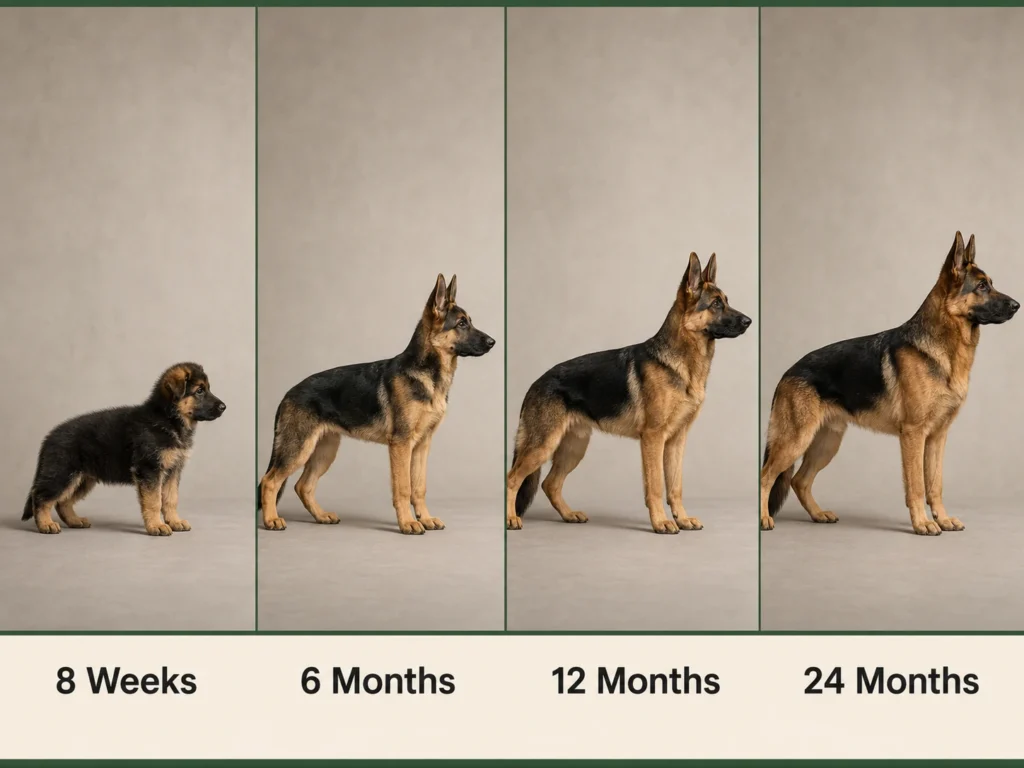
For context, the American Kennel Club describes the German Shepherd Dog as a large, agile, muscular working breed. That athletic build matters because a healthy adolescent German Shepherd often looks leaner than an adult dog with a fully developed chest and shoulders.
German Shepherd Growth Chart by Age
Use this German Shepherd growth chart as a tracking guide rather than an exact breed standard. Monthly puppy weights are not officially fixed, and two healthy puppies of the same age can differ because of sex, parent size, working or show lineage, neuter status, early nutrition, and individual development.
| Age | Male German Shepherd Weight | Female German Shepherd Weight | Typical Development |
| 8 weeks | 13–20 lb (5.9–9.1 kg) | 11–17 lb (5.0–7.7 kg) | Adjusting to a new home; rapid learning and social development |
| 3 months | 22–32 lb (10.0–14.5 kg) | 17–27 lb (7.7–12.2 kg) | Fast growth; legs and paws may look large |
| 4 months | 33–41 lb (15.0–18.6 kg) | 28–36 lb (12.7–16.3 kg) | Teething, longer limbs, and improving coordination |
| 5 months | 40–50 lb (18.1–22.7 kg) | 35–44 lb (15.9–20.0 kg) | A lean or awkward-looking stage is common |
| 6 months | 49–58 lb (22.2–26.3 kg) | 44–50 lb (20.0–22.7 kg) | Often more than half of expected adult weight |
| 7 months | 55–64 lb (24.9–29.0 kg) | 48–54 lb (21.8–24.5 kg) | Growth continues, but the rate may begin slowing |
| 8 months | 60–68 lb (27.2–30.8 kg) | 52–58 lb (23.6–26.3 kg) | Near-adult height in some dogs; body remains immature |
| 9 months | 64–72 lb (29.0–32.7 kg) | 55–61 lb (24.9–27.7 kg) | Muscle and coordination continue developing |
| 10 months | 66–75 lb (29.9–34.0 kg) | 57–63 lb (25.9–28.6 kg) | Growth is slower and less obvious week to week |
| 11 months | 68–78 lb (30.8–35.4 kg) | 59–65 lb (26.8–29.5 kg) | Body may still look narrow through the chest |
| 12 months | 70–82 lb (31.8–37.2 kg) | 60–66 lb (27.2–29.9 kg) | Usually close to adult height, but not always adult build |
| 18 months | 72–88 lb (32.7–39.9 kg) | 60–70 lb (27.2–31.8 kg) | Chest, shoulders, neck, and muscle fill out |
| 24 months | 75–90 lb (34.0–40.8 kg) | 60–70 lb (27.2–31.8 kg) | Many dogs reach mature size and body shape |
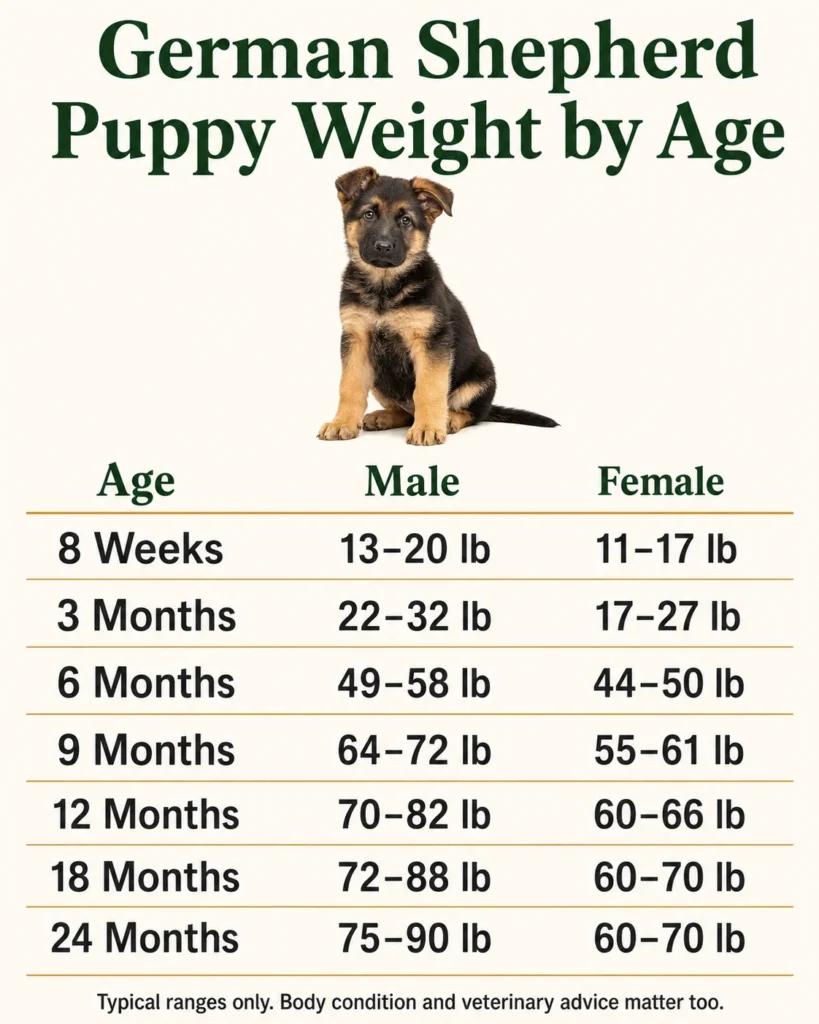
Important: These are broad observational ranges, not a diagnostic standard. Parent size and body condition usually tell you more than one online number.
If your puppy is gaining consistently, moving comfortably, eating well, and maintaining an appropriate body condition, a modest difference from the table may not be a problem.
How Big Do German Shepherds Get?
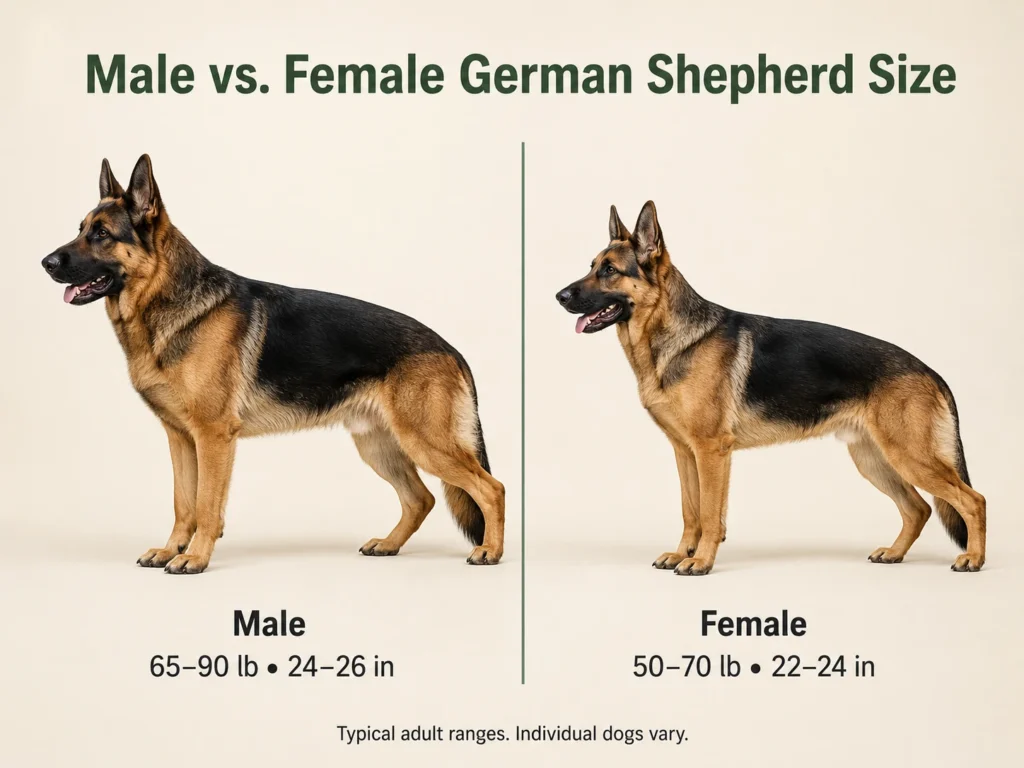
Adult German Shepherds are large, athletic dogs. Many adult males weigh around 65 to 90 pounds and stand approximately 24 to 26 inches at the shoulder. Many adult females weigh around 50 to 70 pounds and stand approximately 22 to 24 inches.
Height and weight should be considered together.
A tall, fine-boned working-line female may be healthy at a lower weight, while a broad, heavily built male may naturally sit near the upper end. The goal is a balanced dog with:
- A visible body shape
- Good muscle tone
- Comfortable movement
- An appropriate waist
- No unnecessary body fat
The Royal Kennel Club classifies the German Shepherd as a large pastoral breed and identifies hip and elbow screening among its breed-health recommendations. This makes controlled growth and sensible weight management more useful than trying to produce the biggest possible puppy.
Male vs. Female German Shepherd Growth
Male German Shepherds usually become taller, heavier, and broader through the neck, chest, and shoulders. They may look tall and narrow between eight and fourteen months, then gain adult width later.
Females are often lighter and slightly shorter. Some appear physically mature earlier, but they can continue adding muscle after their first birthday.
Sex is only one influence. A puppy’s final size also reflects:
- The size and build of both parents
- Working-line, show-line, or mixed ancestry
- Early nutrition and illness history
- Parasites or digestive disease
- Activity level and muscle development
- Spay or neuter timing
- Overall calorie intake
- Body condition throughout growth
A male is not automatically underweight because he is smaller than another male. A female is not automatically overweight because she is heavier than an online average.
When Do German Shepherd Puppies Grow the Fastest?
The fastest visible growth usually occurs from about eight weeks to six months. During this period, a puppy may:
- Gain weight quickly
- Outgrow collars and harnesses within weeks
- Develop noticeably longer legs
- Have oversized-looking paws and ears
- Pass through an uneven or lanky stage
After six months, the rate usually slows. Height may continue increasing, but changes become less dramatic.
By twelve months, many German Shepherds are close to adult height, while their chest, neck, shoulders, muscle, and coordination remain immature.
This explains why a one-year-old German Shepherd can look like an adult but still move, behave, and recover from activity like an adolescent.
When Do German Shepherds Stop Growing?
Most German Shepherds reach much of their height by 12 to 18 months and finish filling out closer to 18 to 24 months. Larger males may take longer to develop a mature chest and heavier adult frame.
Growth does not happen at the same speed every week. Short plateaus can occur, followed by another visible growth spurt. A useful German Shepherd growth chart tracks the overall direction across several measurements, not one isolated weigh-in.
Do not try to speed growth with:
- Extra meals
- Calcium powder
- Bone meal
- Human multivitamins
- Unprescribed mineral products
- Supplements marketed to increase size
The Merck Veterinary Manual’s nutrition guidance explains that nutrient requirements vary by life stage and warns that excessive calcium is especially problematic for growing large- and giant-breed dogs.
How to Tell If Your German Shepherd Puppy Is a Healthy Weight
A scale records total mass. It does not tell you how much of that mass is bone, muscle, fat, food, or fluid.
That is why the German Shepherd growth chart should always be used together with body condition.
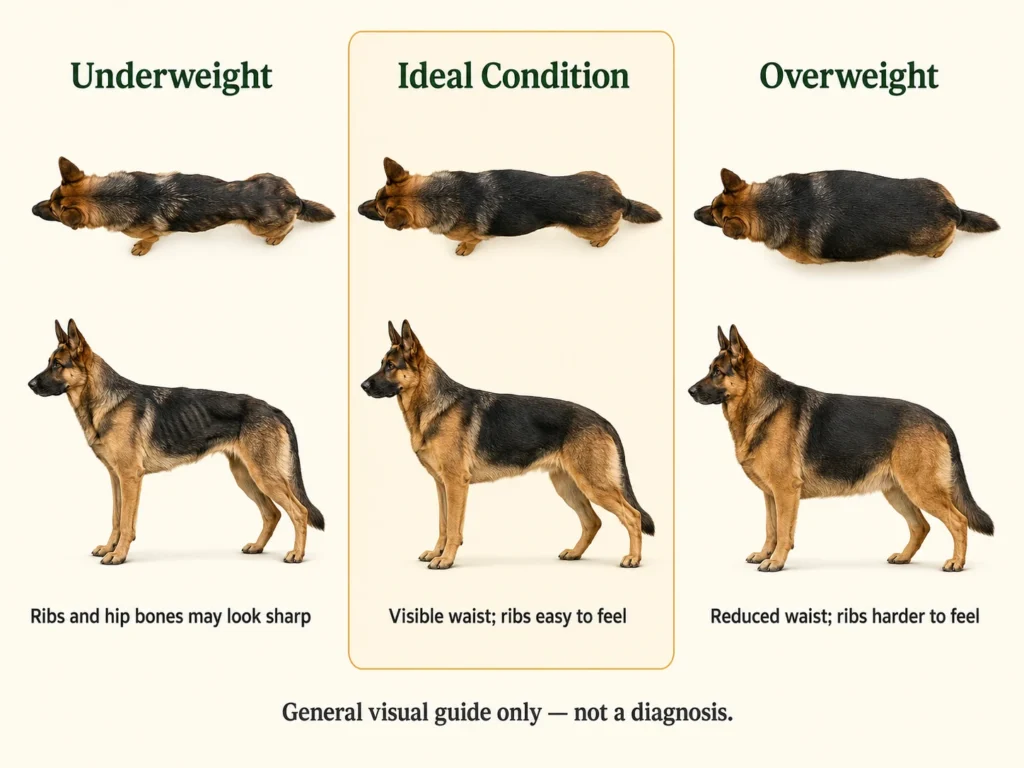
Check Your Puppy From Above
Look for a visible waist behind the ribs. The body should narrow slightly before widening near the hips.
If the body remains equally wide from the ribs to the hips, your puppy may be carrying excess weight.
Check Your Puppy From the Side
A healthy puppy usually has a gentle abdominal tuck behind the rib cage.
A very round underside with no tuck may suggest excess weight. A swollen abdomen can also have medical causes, especially when the rest of the body appears thin.
Feel the Ribs
Run your fingertips lightly across the rib cage. You should be able to feel the ribs without pressing hard, but they should not feel sharp or dramatically protrude.
A German Shepherd’s thick coat can hide body shape, so touch is often more reliable than appearance.
The Merck Veterinary Manual body-condition scale identifies an ideal canine body condition around 4–5 on a nine-point scale. Your veterinarian can show you how to assess your own puppy consistently.
Normal Growth vs. Signs That Need Veterinary Attention
The German Shepherd growth chart is useful for noticing a pattern, but it cannot diagnose disease.
Growth Patterns That May Be Normal
- A lean appearance during adolescence
- Large paws and long legs
- A narrow chest before full maturity
- Short pauses between growth spurts
- Being smaller or larger than littermates
- Gradual weight gain with normal appetite
- Good energy and interest in play
- Temporary awkwardness as coordination catches up with size
Warning Signs to Discuss With a Veterinarian
- Sudden weight loss
- No weight gain across several weeks in a young puppy
- Sharply visible ribs, spine, or hip bones
- A swollen abdomen with a thin body
- Ongoing diarrhea or vomiting
- Poor appetite or difficulty eating
- Weakness or unusual sleepiness
- Reduced interest in normal play
- Persistent limping or stiffness
- Pain during or after ordinary activity
- Rapid weight gain with loss of waist definition
- A sudden change from your puppy’s established pattern
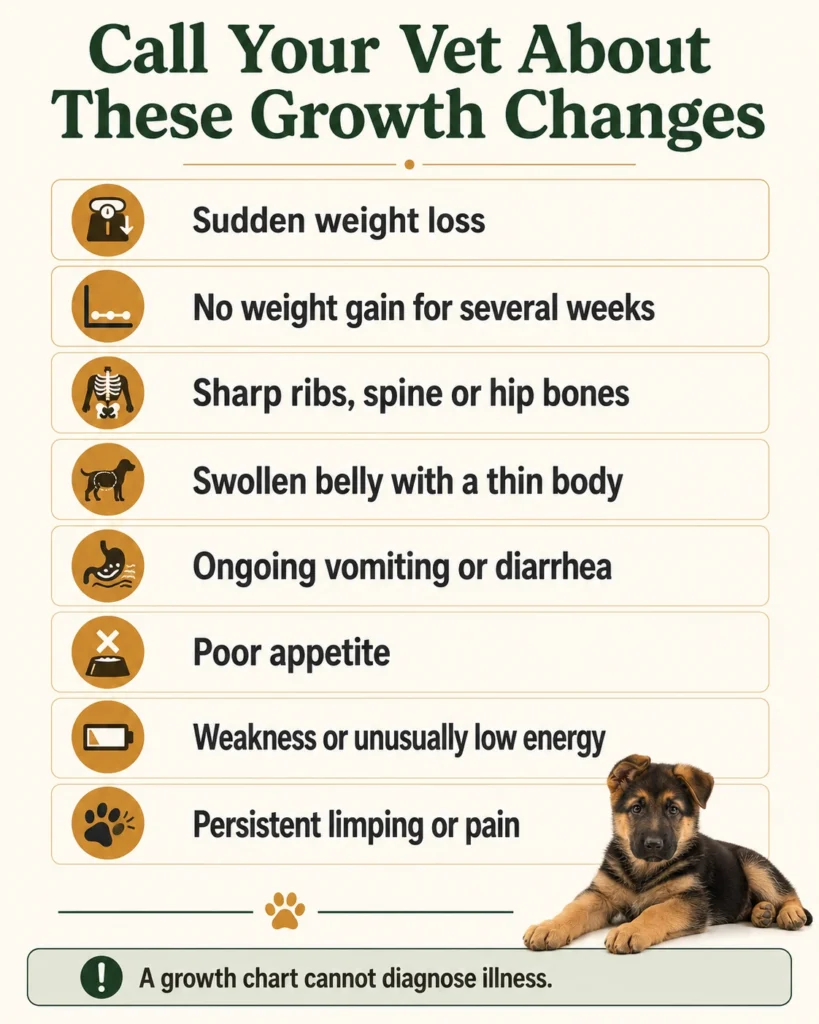
A growing puppy with vomiting, diarrhea, weakness, pain, appetite loss, or rapid weight loss needs medical assessment rather than a feeding experiment at home.
Feeding for Steady, Healthy Growth
German Shepherd puppies need enough energy and nutrients to grow, but more food does not create better development.
Excess calories can add body fat faster than the skeleton and joints are ready to carry it.
Choose food that is complete and balanced for growth and appropriate for a large-breed puppy. For a deeper breakdown of food types, treats, portions, and unsafe ingredients, read Furbivo’s guide to what German Shepherds eat.
You can also compare food-selection factors in our German Shepherd dog food guide.
When checking a package, look beyond words such as “premium,” “natural,” or “high protein.”
The Association of American Feed Control Officials explains that a nutritional adequacy statement identifies the species and life stage for which a food is intended. AAFCO also notes that feeding directions are starting guidelines that may need to be adjusted for an individual animal.
Helpful Feeding Habits
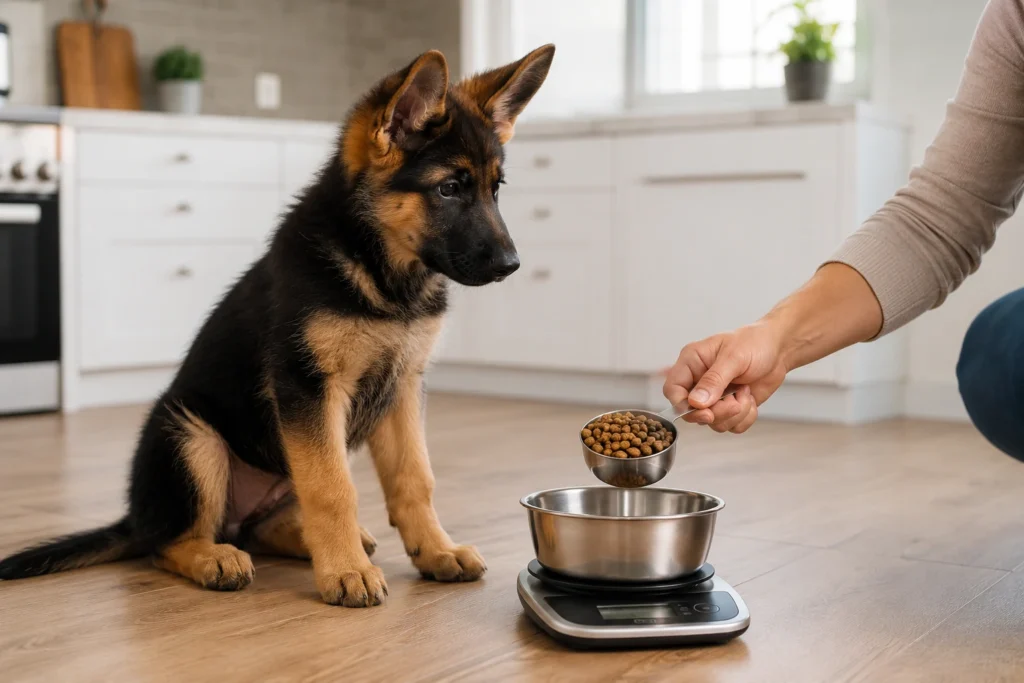
- Measure every meal instead of estimating by eye
- Follow a consistent feeding schedule
- Count training treats as part of daily calories
- Keep table scraps and fatty extras limited
- Monitor appetite, energy, and stool quality
- Adjust portions gradually according to body condition
- Change foods gradually unless your veterinarian advises otherwise
- Keep fresh drinking water available
- Avoid calcium, vitamin, or mineral supplements unless prescribed
Many young puppies eat three measured meals per day before moving to two meals as they get older. The correct schedule depends on the puppy’s age, food, digestion, household routine, and veterinary guidance.
Exercise During Growth: What Is Safe?
German Shepherd puppies need movement for coordination, confidence, muscle development, and mental wellbeing. They do not need repetitive, high-impact conditioning designed for a mature working dog.
Suitable Puppy Activities
- Short, age-appropriate walks
- Sniffing and exploration
- Gentle play on safe surfaces
- Reward-based obedience sessions
- Food puzzles
- Scent games
- Controlled social experiences
- Free movement with regular rest breaks
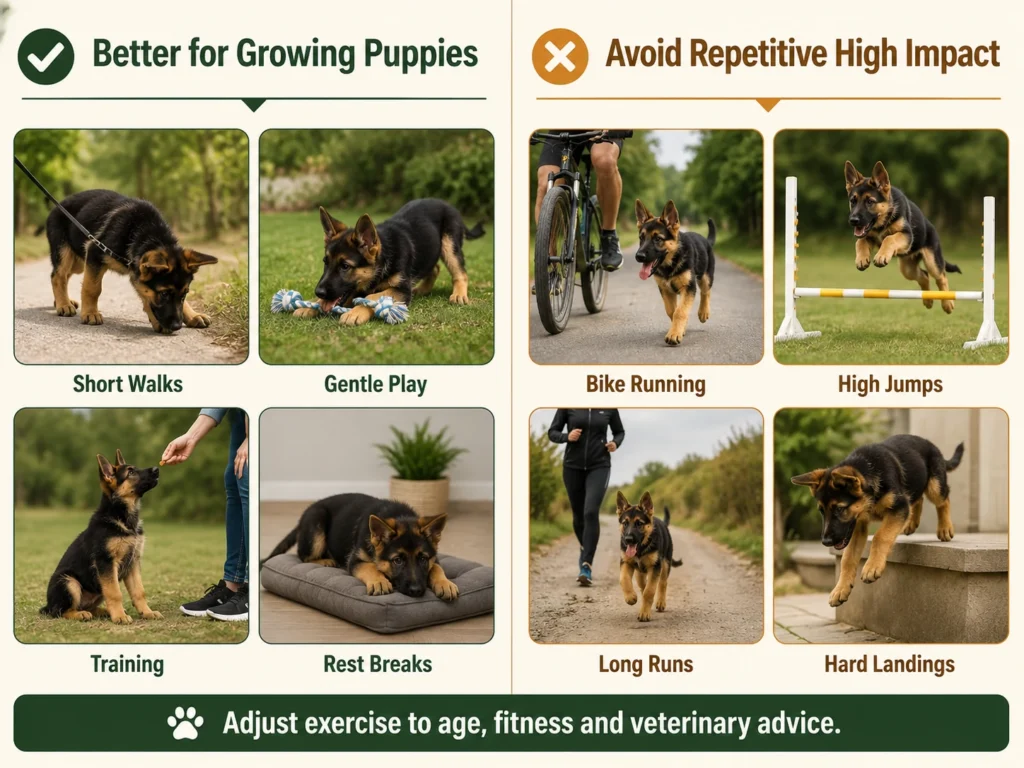
Be cautious with:
- Forced long-distance running
- Running beside a bicycle
- Repeated high jumping
- Hard landings
- Slippery floors
- Repetitive stair climbing
- Intense activity that continues after fatigue
A puppy may still want to chase, jump, or play even when its movement quality is declining. The owner must set sensible limits.
Training can provide useful mental activity without adding excessive physical load. Furbivo’s German Shepherd training guide explains how to build focus, recall, leash skills, and calm behavior through short reward-based sessions.
Stop the activity and speak with a veterinarian if your puppy repeatedly limps, becomes stiff after resting, avoids stairs, cries during movement, or remains sore the following day.
Common Mistakes Owners Make With Growth Charts
A German Shepherd growth chart becomes less useful when owners treat it as a target rather than a reference.
Chasing the Highest Number
A puppy near the top of a weight range is not necessarily healthier.
Extra body fat adds load to the puppy’s developing body without improving bone quality, movement, fitness, or genetics.
Comparing Unrelated Puppies
Photos and social media posts rarely show accurate information about:
- Exact age
- Body weight
- Parent size
- Bloodline
- Camera angle
- Coat thickness
- Medical history
- Body condition
Even littermates can mature at different rates.
Changing Food Whenever Growth Slows
Growth naturally slows after the early puppy stage. Repeated food changes can upset digestion and make it harder to identify what the puppy tolerates.
Ignoring Body Condition
A puppy can fall within a chart range and still carry too much body fat. Another puppy can sit slightly below the range and remain lean, energetic, and healthy.
Adding Supplements Without a Diagnosed Need
Large-breed puppies are sensitive to mineral balance. Random calcium or growth products can disrupt a diet that was already complete and balanced.
Weighing the Puppy Every Day
Daily changes reflect:
- Hydration
- Recent meals
- Bowel contents
- Urination
- Scale variation
- Time of measurement
A consistent measurement every two to four weeks usually shows the growth trend more clearly.
Why Your Puppy May Not Match the Chart
The most common reason is genetics. Smaller parents often produce smaller adults, while larger, heavier parents increase the chance of a bigger mature dog.
Bloodline can also change appearance.
Some working-line German Shepherds are lean, compact, and athletic. Some show-line dogs develop a broader or heavier look. Neither description alone proves that an individual dog is healthy or unhealthy.
Other possible reasons include:
- Mixed-breed ancestry
- A history of intestinal parasites
- Chronic digestive problems
- Poor nutrition before adoption
- Recovery from illness
- Dental or swallowing problems
- Hormonal or metabolic disease
- Differences in neuter timing
- Incorrect age estimates in rescue dogs
If your puppy is far outside the expected range, do not assume that the solution is simply more or less food.
A veterinarian may need to examine the dog, review parasite prevention, assess body condition, and decide whether stool testing, bloodwork, or other investigation is appropriate.
How to Track Your Puppy’s Growth Correctly
A simple record makes the German Shepherd growth chart more useful and gives your veterinarian better information.
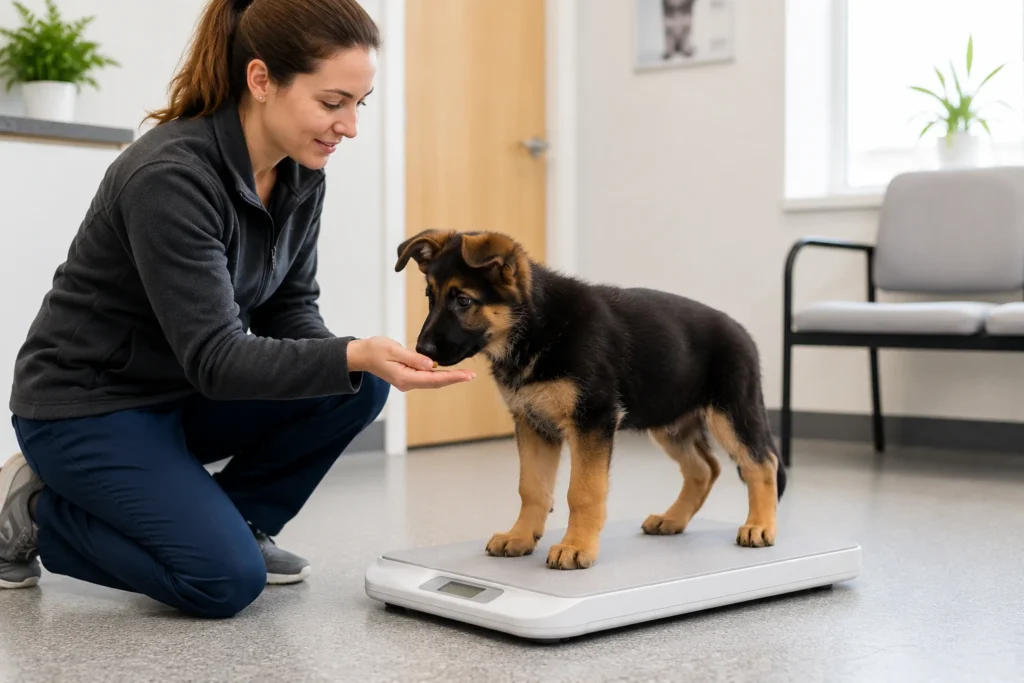
1. Weigh Every Two to Four Weeks
Use the same scale when possible, at a similar time of day, and before a large meal.
For bigger puppies, ask your veterinary clinic whether you can use its walk-on scale.
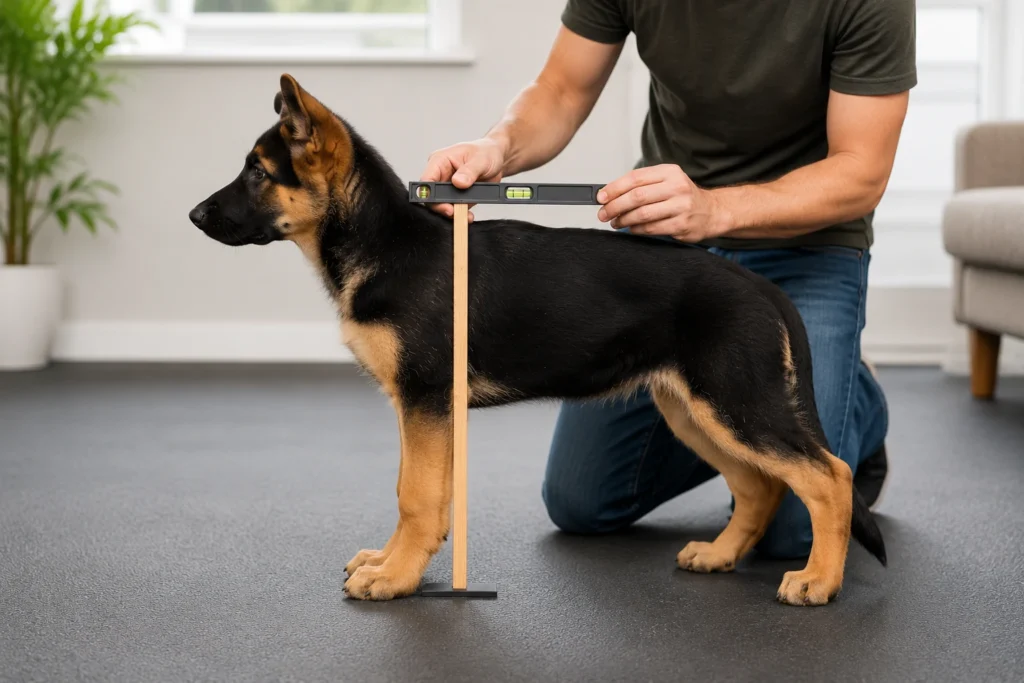
2. Measure Height at the Shoulder
Stand the puppy squarely on a flat, non-slip surface.
Measure from the floor to the highest point of the shoulder blades—not the top of the head or ears.
3. Take Consistent Photos
Once a month, take:
- One side-view photo
- One photo from above
- One standing front-view photo
Use similar lighting, distance, and posture each time.
4. Record More Than Weight
Track:
- Date and exact age
- Weight
- Shoulder height
- Food brand and formula
- Daily food amount
- Treats and chews
- Appetite
- Water intake
- Stool quality
- Energy and activity
- Medication or illness
- Limping or stiffness
- Body-condition score
5. Look for Trends
One measurement may be wrong. A pattern across several measurements is more informative.
If your puppy’s established trend changes sharply, review the record and contact your veterinarian.
What Most Growth Articles Miss
Monthly Charts Are Estimates
Monthly breed charts are not official medical standards. They offer general orientation, but an individual puppy’s growth curve and body condition carry more meaning.
Bigger Does Not Mean Healthier
A German Shepherd needs enough nutrition to develop. Excess calories and unnecessary mineral supplementation do not improve genetics, adult height, or skeletal structure.
Growth Involves More Than Weight
Healthy development also includes:
- Comfortable movement
- Appropriate muscle development
- Normal appetite
- Healthy digestion
- Good sleep
- Steady energy
- Healthy skin and coat
- Absence of pain
Physical Maturity Continues After Height Growth Slows
A young German Shepherd can be close to adult height while still lacking adult muscle, chest depth, coordination, and emotional maturity.
Our guide to German Shepherd lifespan and life stages explains how care needs change from puppyhood through adulthood and the senior years.
What to Do If Your Puppy Seems Too Small or Too Big
If your puppy is slightly outside the chart’s expected range but appears well, begin with accurate measurements and two to four weeks of tracking.
If Your Puppy Looks Too Thin
- Confirm the measured meal amount.
- Check appetite and swallowing.
- Review stool quality.
- Confirm that parasite prevention is current.
- Count how much food is eaten, not just offered.
- Ask your veterinarian to assess body condition before increasing calories sharply.
If Your Puppy Is Gaining Too Quickly
- Measure meals with a proper measuring cup or kitchen scale.
- Reduce uncounted treats and table food.
- Recheck body condition weekly.
- Avoid severe calorie restriction in a growing puppy.
- Ask your veterinarian whether the current food and portion suit large-breed growth.
If your puppy has pain, weakness, persistent digestive upset, appetite loss, or weight loss, arrange a veterinary examination rather than waiting for the next chart entry.
Frequently Asked Questions
How Much Should a Three-Month-Old German Shepherd Weigh?
A three-month-old male often weighs around 22 to 32 pounds, while a female may weigh around 17 to 27 pounds.
These are broad estimates. Parent size, body condition, diet, and health are more important than matching one number exactly.
Is My German Shepherd Puppy Underweight?
A puppy may be underweight when the ribs, spine, or hips are sharply visible or easy to feel with almost no tissue covering them.
Poor appetite, low energy, diarrhea, vomiting, or stalled growth make veterinary assessment more important.
Can a German Shepherd Keep Growing After One Year?
Yes. Many German Shepherds are close to adult height at one year but continue developing muscle, chest width, and adult body mass until approximately 18 to 24 months.
Should a German Shepherd Puppy Eat Large-Breed Puppy Food?
Many German Shepherd puppies do well on a complete and balanced formula intended for large-breed growth.
The right choice depends on the puppy, the product’s nutritional adequacy statement, calorie density, digestion, body condition, and veterinary advice.
Why Does My German Shepherd Look Skinny Even Though It Eats Well?
Adolescent German Shepherds often look lean and leggy, especially while height is increasing faster than chest and muscle development.
If the dog has normal energy, stool, appetite, and steady weight gain, the appearance may be normal. Sharp bones, weakness, digestive problems, or weight loss need a veterinary check.
How Often Should I Weigh My German Shepherd Puppy?
Every two to four weeks is usually enough for routine home tracking.
Use the same scale and similar measuring conditions so the numbers are easier to compare.
What Is More Important: Puppy Weight or Body Condition?
Both matter, but body condition provides essential context.
Weight shows the direction of growth. Body condition helps indicate whether that weight includes an appropriate level of body fat.
Final Thoughts
A German Shepherd growth chart is most helpful when it reduces uncertainty rather than creating pressure.
Track steady progress, keep your puppy lean, feed a complete and balanced diet for growth, provide age-appropriate exercise, and pay attention to appetite, digestion, energy, movement, and pain.
Healthy puppies do not all reach the same number at the same age. Your puppy’s personal trend, parent size, body condition, and veterinary assessment provide the clearest picture.
Have questions about your dog’s health, nutrition, grooming, or daily care? Visit our Contact Us page to reach the Furbivo team. For any medical symptoms, diagnosis, or treatment advice, always consult a qualified veterinarian.