
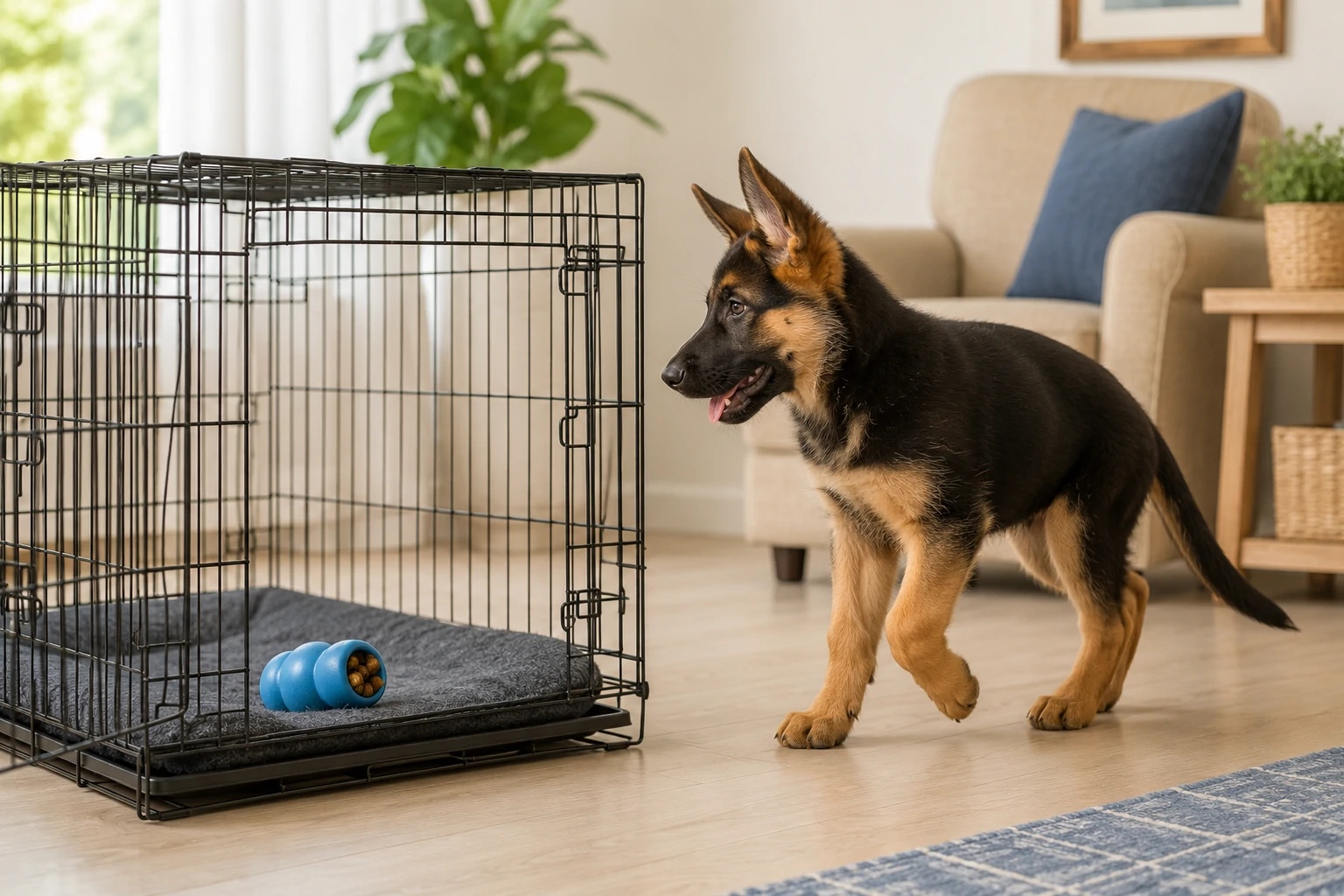
Bringing home a German Shepherd puppy can turn the first few nights into a cycle of whining, potty trips, and second-guessing. A good crate plan should not force your puppy to “get used to it.” It should teach that the crate predicts food, rest, safety, and your return.
For owners searching crate training German Shepherd puppy advice, the most effective approach is gradual, reward-based, and built around the puppy’s bladder, sleep, and emotional limits. Start with seconds, not hours. Practice while you are home before expecting calm when you leave. Humane World, the American Kennel Club, and the American Veterinary Society of Animal Behavior all support gradual, reward-based training rather than force or punishment. (Humane World for Animals)
Crate Training German Shepherd Puppy: Quick Answer
Start by making the crate rewarding, not restrictive. Feed meals near or inside it, reward voluntary entry, close the door for only a few seconds, and increase duration gradually. Pair crate time with potty breaks, naps, and calm departures. Stop and reassess if your puppy shows panic rather than mild protest.
What Crate Training Should Accomplish
A crate can provide a predictable sleeping place, prevent unsafe chewing when direct supervision is impossible, support house-training, and make future travel or veterinary stays less unfamiliar. It should function as a resting area, not as punishment or all-day storage. (Humane World for Animals)
The goal is a puppy who can enter willingly, relax, sleep, and remain comfortable for an appropriate period. German Shepherd puppies may learn routines quickly, but fast learning does not mean emotional readiness for long periods alone. The breed benefits from early, consistent, ongoing training rather than sudden increases in difficulty. (American Kennel Club)
Prepare the Crate Before Training
Choose the Correct Size
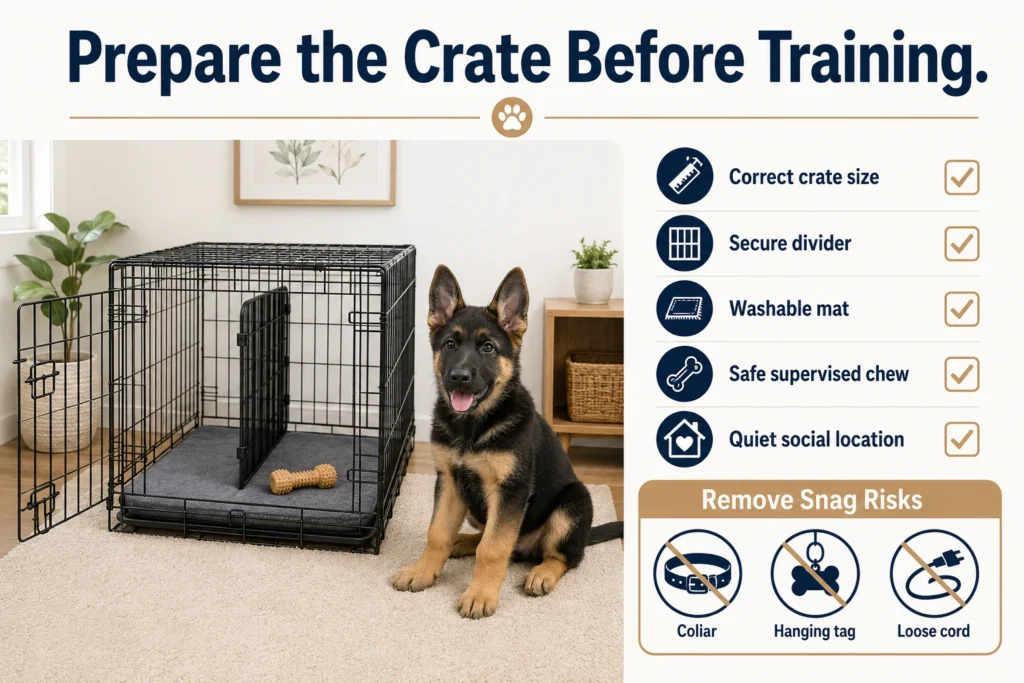
Your puppy should be able to stand naturally, turn around, sit, and lie on either side. Too much unused space may make early house-training harder, while a cramped crate is uncomfortable.
An adult-size wire crate with a secure divider is practical for many growing puppies. Before buying or adjusting one, use Furbivo’s guide to choosing the correct German Shepherd crate size to compare 42-inch and 48-inch options and check the puppy’s usable space. (furbivo.com)
Pick a Calm, Social Location
Place the crate where your puppy can rest without being isolated from normal family life. A bedroom or nearby hallway often works well at night. During the day, a quiet corner of a living area lets the puppy hear ordinary household activity without being in the busiest walkway.
Avoid direct sun, heating vents, cold drafts, electrical cords, blind cords, and places where children may disturb a sleeping puppy. (furbivo.com)
Keep the Setup Safe
Use a correctly fitted crate, secure divider, washable mat, small food rewards, and only chews you have already supervised.
Remove collars, tags, and harnesses if they could catch on bars or hardware. Bedding should match your puppy’s chewing habits. The AKC also recommends considering snagging risks and monitoring what a puppy has inside the crate. (American Kennel Club)
Crate Training German Shepherd Puppy Step by Step
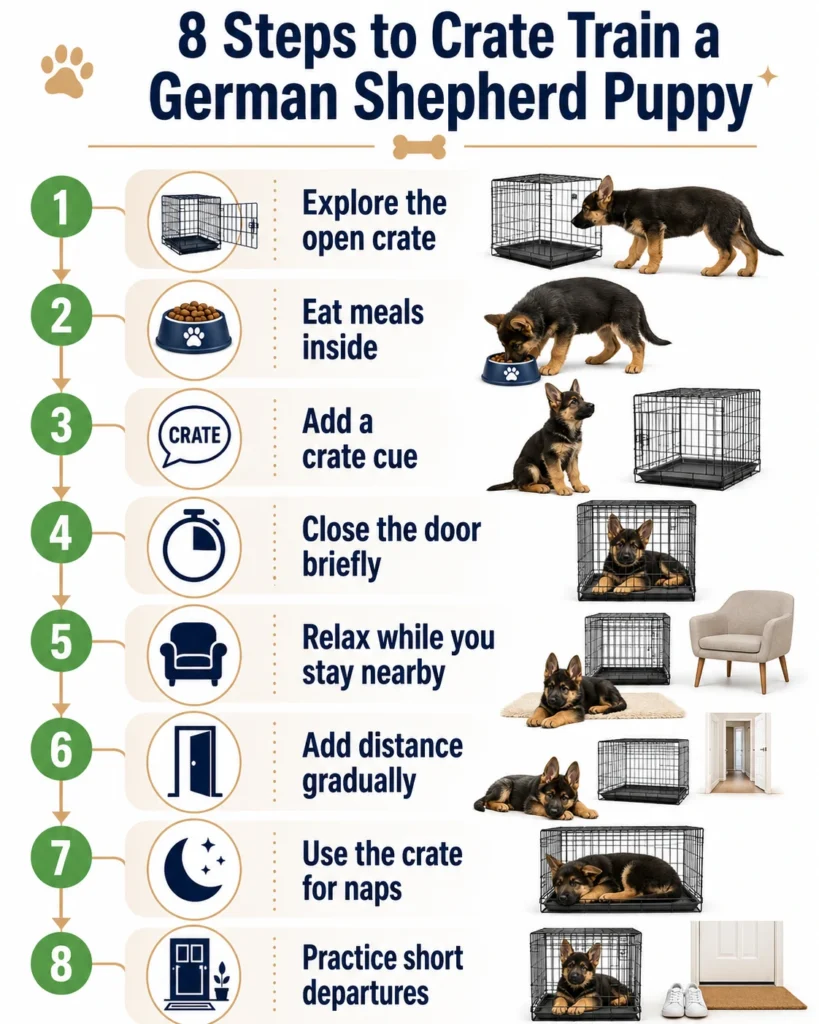
Step 1: Let the Puppy Discover the Crate
Secure the door open so it cannot swing. Toss one treat near the entrance, then another just inside. Let the puppy choose whether to enter.
Do not push the puppy in or close the door during the first successful entry. Repeat several tiny sessions and end while the puppy is still interested.
Step 2: Build a Food Association
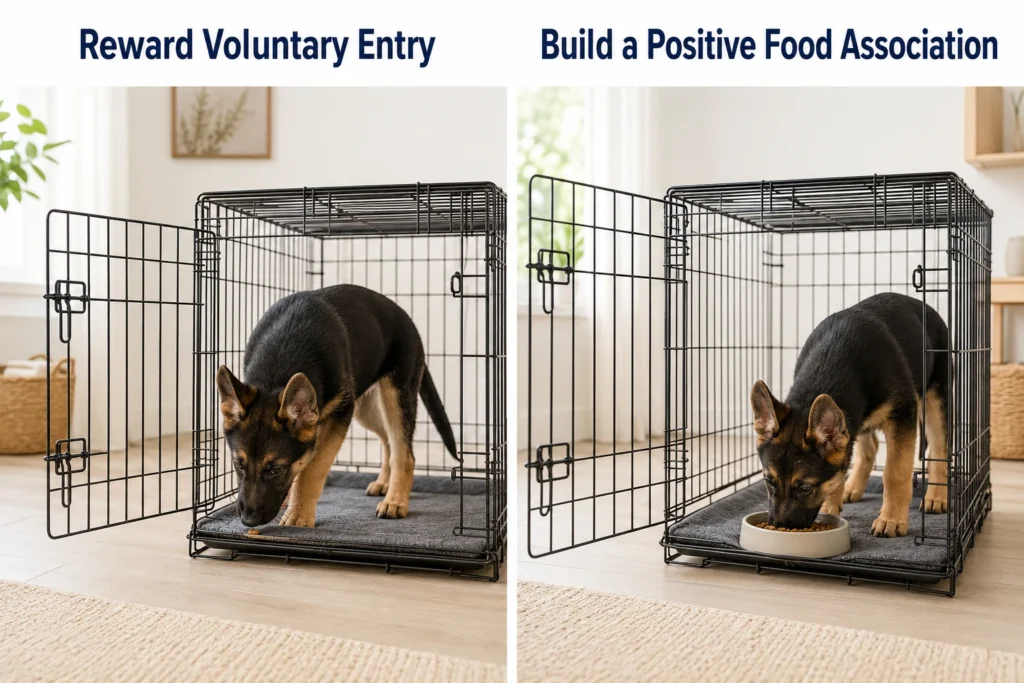
Serve meals near the entrance. If your puppy is comfortable, place the bowl just inside and move it farther back over several meals.
A hesitant puppy may need the bowl outside the doorway at first. You can also scatter part of the puppy’s kibble inside or offer a supervised food-stuffed toy. Count training food as part of the daily intake.
Feeding inside or near the crate can help create a positive emotional association, but the process should move at the individual puppy’s pace. (Humane World for Animals)
Step 3: Add a Crate Cue
When your puppy already enters willingly, say a short cue such as “crate” or “bed” just before entry. Reward inside.
Say the cue once and make the task easy. The word should predict an achievable action, not an argument.
Step 4: Close the Door Briefly
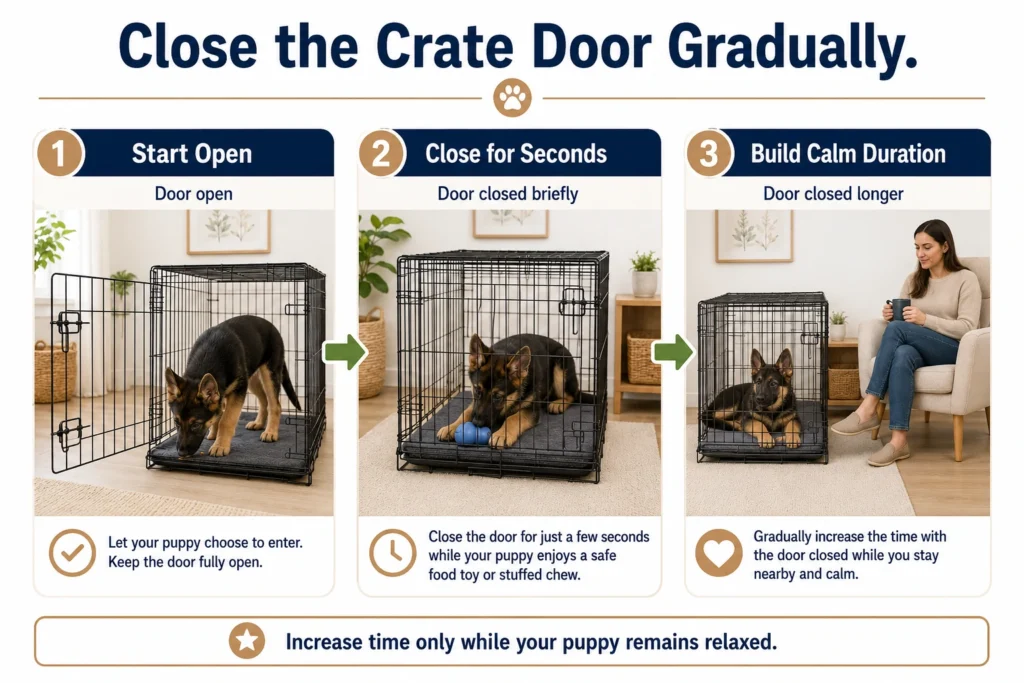
Give your puppy a treat or food activity, close the door for one or two seconds, then reopen it before distress begins.
Repeat until your puppy remains relaxed. Build from seconds to slightly longer intervals, changing only one difficulty at a time.
Step 5: Practice While You Stay Nearby
Sit beside the crate while your puppy works on a safe food activity or becomes sleepy. Reward quiet lying down with calm praise or a small treat placed between the paws.
Then stand up, sit down, take one step away, and return. These small movements teach that your position can change without causing a crisis.
Rewarding relaxed behavior helps the puppy understand that calmness—not barking, pawing, or frantic movement—is the behavior that earns reinforcement. (American Kennel Club)
Step 6: Add Distance and Brief Disappearances
Walk across the room, return, and reward calm behavior. Next, step through a doorway for one second.
Progress through:
- One step away
- Across the room
- Briefly out of sight
- A short household task nearby
- A very short exit through the front door
Do not increase distance, duration, and distraction together. Humane World’s crate-training process similarly recommends increasing crate time through gradual stages. (Humane World for Animals)
Step 7: Pair the Crate With Naps
Use the crate after a potty break and a short calm activity, when your puppy is ready to sleep. Puppies that become wild, mouthy, or unable to focus may be overtired.
Do not rely on intense exercise to exhaust the puppy. A sniffing break, brief training, toilet trip, and quiet transition often support better settling.
Step 8: Practice Real Departures
Before leaving, meet your puppy’s immediate needs:
- Toilet break
- Appropriate movement
- Water
- Calm social contact
- A safe crate activity
Put the puppy inside, leave without a dramatic goodbye, and return before the current duration becomes too difficult.
Keep your return neutral and take the puppy outside promptly if a potty break is due. For owners following this crate training German Shepherd puppy process, a successful first absence may last only seconds.
The AKC’s crate-training guidance also recommends rewarding entry and calm behavior while increasing the challenge gradually. (American Kennel Club)
A Realistic First-Week Progression
Use this table as a decision guide, not a promise. Repeat a stage until your puppy is relaxed before moving forward.
| Stage | Practice goal | Move forward when |
| 1 | Explore an open crate | Puppy enters without being pushed |
| 2 | Eat meals or treats inside | Body remains loose and puppy keeps eating |
| 3 | Door closes for a few seconds | Puppy stays engaged or relaxed |
| 4 | Relax while you sit nearby | Puppy lies down without constant attention |
| 5 | You move around the room | Puppy remains calm as distance changes |
| 6 | You step out of sight briefly | Puppy recovers easily and does not panic |
| 7 | Very short real departure | Puppy remains safe and settled on video |
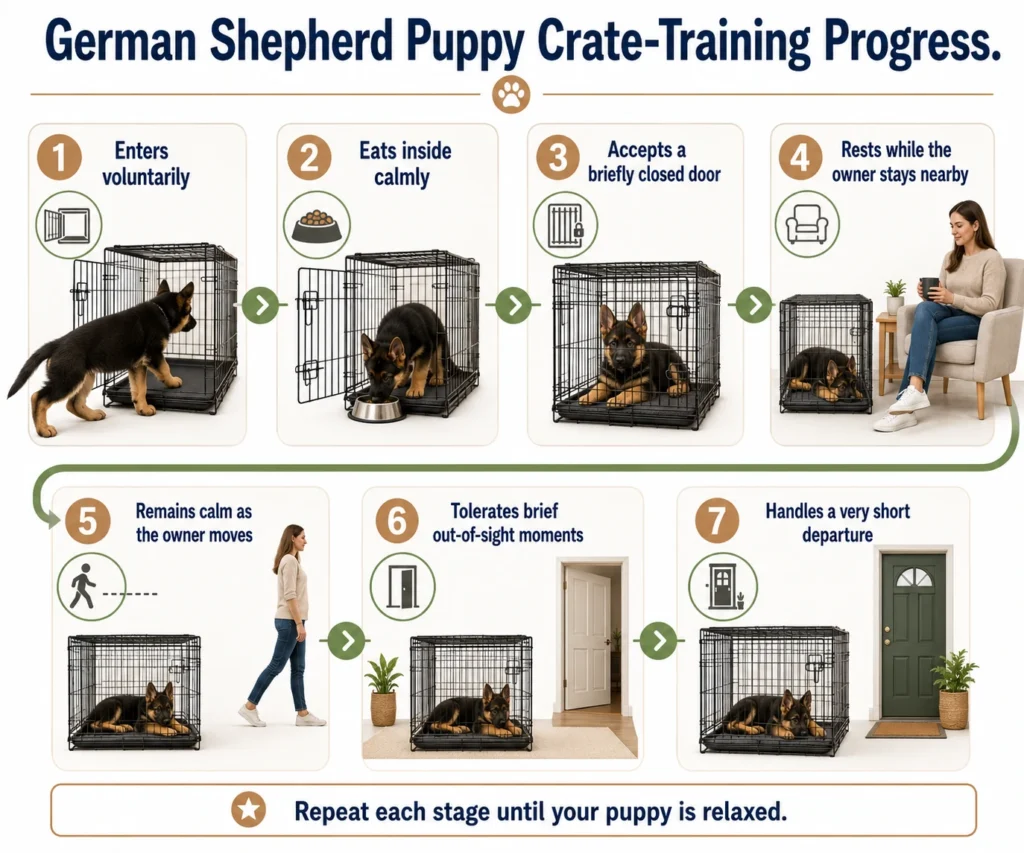
Some puppies move quickly; others need more repetition after a major change of home. Measure progress by relaxation, not the calendar. Authoritative crate-training guidance recommends gradual advancement rather than setting one fixed schedule for every puppy. (Humane World for Animals)
Crate Training a German Shepherd Puppy at Night
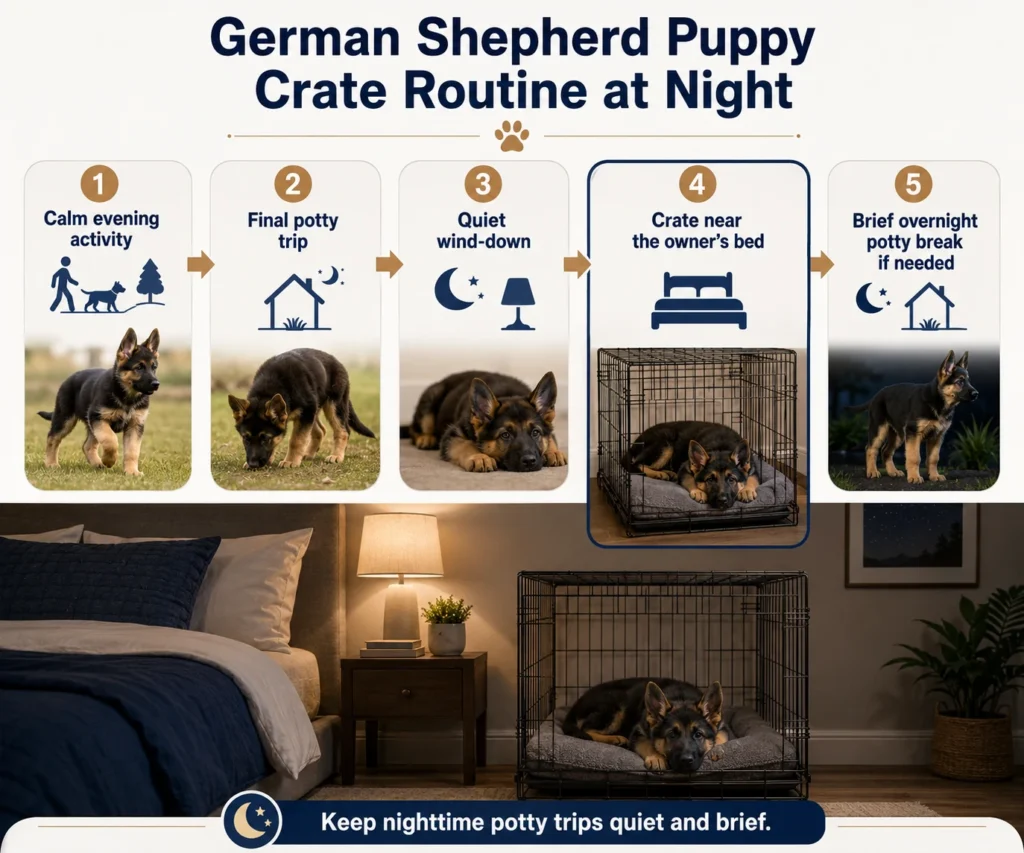
Nighttime is often hardest because a newly separated puppy is tired, in an unfamiliar home, and away from littermates.
Place the crate close enough to hear changes in movement and vocalization. Take the puppy outside immediately before bed. Keep overnight potty trips quiet and brief:
- Go directly outside.
- Give the puppy a toilet opportunity.
- Praise calmly after elimination.
- Return to the crate without starting play.
Avoid turning a late-night potty trip into an event. Use low lights, minimal conversation, and no wandering through the house.
A simple routine is:
- Calm evening activity
- Quiet potty trip
- Short wind-down period
- Crate cue and small reward
- Necessary overnight potty break
- Immediate morning potty trip
Do not expect a very young puppy to follow an adult dog’s overnight schedule. Toilet needs vary with age, health, recent drinking, meals, activity, and house-training progress. Regular trips after waking, meals, play, and confinement are standard parts of puppy house-training. (American Kennel Club)
What to Do When Your German Shepherd Puppy Cries
Crying is information, but it can mean different things:
- A toilet need
- Fear or loneliness
- Frustration with the closed door
- Physical discomfort
- A training step that was too difficult
- A learned request for attention
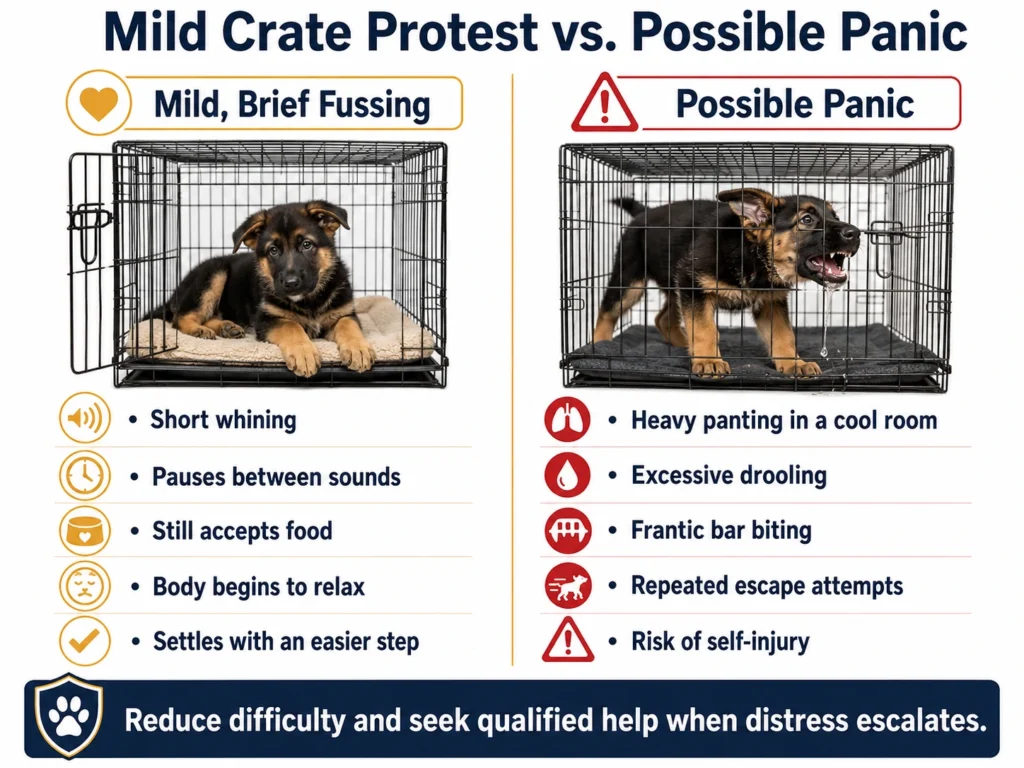
Check whether the puppy toileted recently, the crate is comfortable, the room temperature is safe, or the session progressed too quickly.
Consider illness if crying occurs with vomiting, diarrhea, pain, frequent urination, weakness, loss of appetite, or a sudden behavior change.
If a potty break is plausible, take the puppy outside calmly on leash. Give a brief toilet opportunity without play, then return to the crate.
For mild, brief fussing after needs are met, wait for a small pause before opening the door when possible. This reduces the chance of teaching that barking opens it.
Do not use a rigid “cry it out” rule for escalating distress. Heavy panting in a cool room, frantic biting at bars, drooling, repeated escape attempts, or self-injury suggest more than an ordinary complaint.
Dogs with separation or confinement anxiety may become more distressed inside a crate and can injure their teeth, mouth, or body while trying to escape. (AVSAB)
What Owners Accidentally Reinforce
Opening the Door During Every Bark
If barking always opens the door, barking becomes effective. Build easier sessions and, when the puppy is not distressed, release during a brief quiet moment.
Using Food to Trap the Puppy
If food leads inside and the door then closes for a long period, the treat can become a warning. Include many entries where the puppy eats and comes back out.
Crating Only When Leaving
When the crate always predicts isolation, the puppy notices. Include short daytime sessions while you cook, read, work nearby, or supervise a nap.
Increasing Time Too Fast
One successful 10-minute session does not mean the puppy is ready for an hour. Mix easy sessions with slightly harder ones.
Behavior that produces a useful outcome is likely to be repeated, which is why reinforcement timing matters during crate work. (American Kennel Club)
Crate Training and Potty Training Work Together
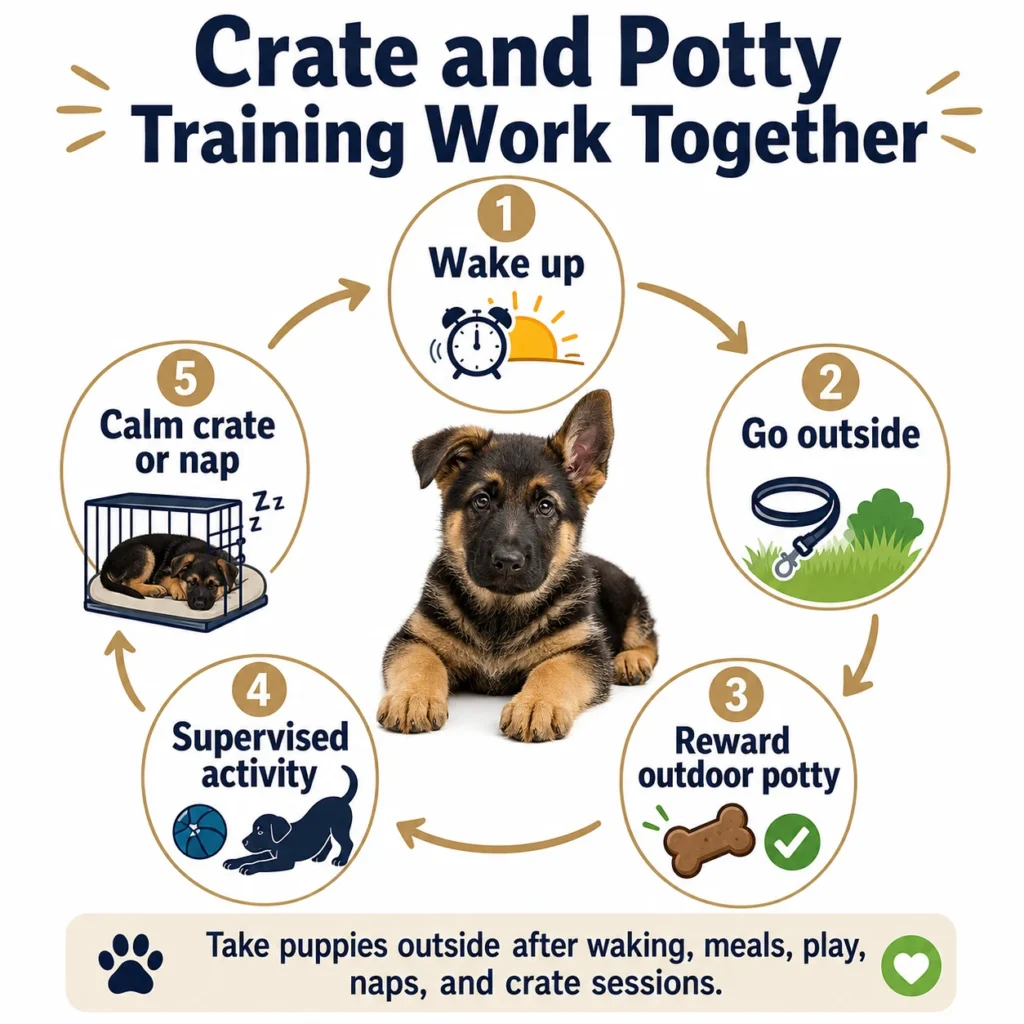
Take your puppy outside after:
- Waking
- Eating or drinking
- Active play
- A crate session
- A nap
- Before bedtime
Reward outdoor elimination immediately.
A crate can support a routine, but it cannot create bladder control. Accidents may mean the interval was too long, the divider leaves excessive space, the puppy did not fully eliminate, or a health issue is present.
Clean accidents with an enzymatic product and review the schedule. Do not scold the puppy, rub their nose in the accident, or use the crate as punishment.
The AKC’s puppy potty-training guide treats crate use as one management tool within a larger routine of supervision, outdoor trips, and reinforcement. (American Kennel Club)
For broader foundation skills such as name response, calm handling, and house rules, use Furbivo’s German Shepherd training guide. (furbivo.com)
Common Crate-Training Mistakes
Avoid:
- Forcing a frightened puppy inside
- Beginning with a long absence
- Skipping potty breaks
- Leaving snag hazards
- Punishing vocalization
- Using the crate after an accident
- Expecting exercise alone to solve panic
- Assuming all crying is manipulation
- Increasing time despite escalating stress
- Using shock collars, prong collars, leash corrections, or intimidation
The crate is not a substitute for exercise, social contact, mental activity, training, or supervision. Reward calm resting, not only entry.
The AVSAB humane dog training position recommends reward-based training and advises against physical or psychological punishment and aversive tools. (AVSAB)
How Long Does Crate Training Take?
There is no universal timeline.
Some German Shepherd puppies begin choosing the crate for naps within days. Comfortable closed-door rest, nighttime sleep, and calm home-alone periods may take several weeks or longer.
Progress may temporarily change during:
- Teething
- Illness
- Schedule changes
- Adolescence
- Travel
- Moving home
- A frightening crate experience
Look for these milestones instead of focusing only on time:
- Voluntary entry
- Relaxed eating inside
- Resting with the door closed
- Calm behavior as you move away
- Recovery after small noises
- Settling after a brief departure
- Entering on a verbal cue
A good crate training German Shepherd puppy timeline follows behavior, not pressure.
What Most Articles Miss
Crate comfort and being alone are related but separate skills.
A puppy may sleep peacefully in a crate beside your bed yet panic when you leave. Another may stay alone in a puppy-proofed room but struggle with a closed crate. Increasing crate duration does not automatically treat separation-related distress.
Use a phone or camera during short practice absences. Video can show whether your puppy chews, settles, and sleeps, or spends the entire absence panting, barking, and trying to escape.
A crate is not mandatory for every dog in every situation. A secure playpen, puppy-proofed room, or gated area may be safer for a puppy with confinement panic while you work with a qualified professional.
AVSAB notes that some dogs with separation anxiety become worse when crated because separation distress and confinement anxiety can occur together. (AVSAB)
Pair crate work with safe socialization and gradual exposure to daily life. Furbivo’s German Shepherd puppy socialization guide explains how to build confidence without overwhelming your puppy. (furbivo.com)
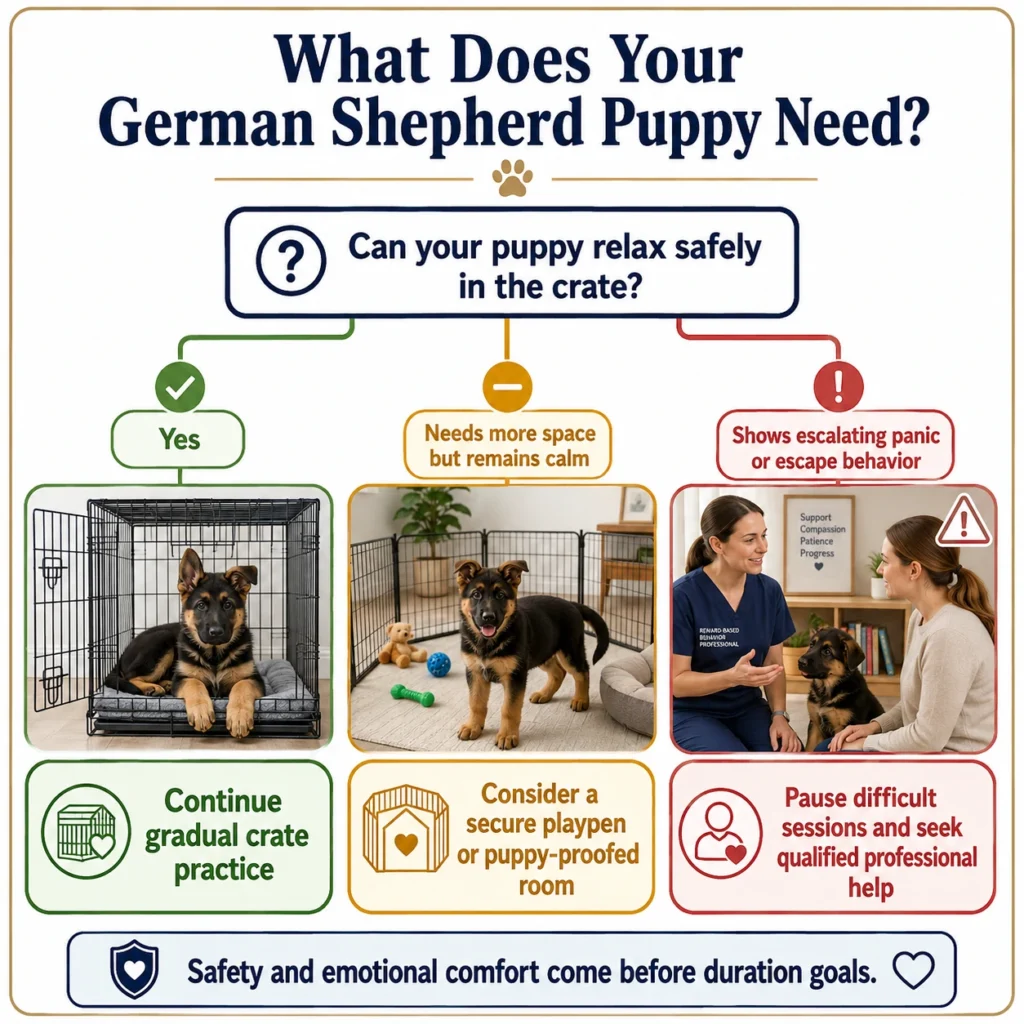
When to Call a Veterinarian or Qualified Trainer
Arrange a veterinary appointment if accidents remain frequent despite suitable breaks, or if you notice:
- Diarrhea
- Vomiting
- Straining
- Excessive thirst
- Frequent urination
- Pain
- Weakness
- Sudden behavior changes
Seek prompt professional help if your puppy:
- Bites or bends crate bars
- Damages the mouth
- Drools heavily
- Panics when you move away
- Cannot eat when alone
- Repeatedly soils only during absences
- Injures the body trying to escape
A reward-based trainer can help with routine and training skills. A veterinarian or veterinary behaviorist is more appropriate when panic, self-injury, possible illness, or severe separation-related behavior is involved.
Trainer and behavior-consultant titles are not always regulated, so owners should ask about education, methods, qualifications, and use of aversive tools before hiring someone. (AVSAB)
FAQs
At What Age Should I Start Crate Training German Shepherd Puppy Routines?
Start gentle practice when your puppy comes home. Keep the door open initially, reward exploration, and use very short sessions. The first goal is comfort, not a long closed-door stay. Positive training can begin as soon as a puppy joins the household. (American Kennel Club)
Should I Ignore My German Shepherd Puppy Crying in the Crate?
Do not automatically ignore all crying. Check for a potty need, discomfort, illness, and panic. For mild brief fussing, avoid opening the door during active barking when possible; reward a quiet pause instead.
Can My German Shepherd Puppy Sleep in a Crate the First Night?
Yes, but keep expectations realistic. Place the crate near you, introduce it calmly before bedtime, take the puppy out immediately before sleep, and expect that a young puppy may need overnight potty trips.
Should I Put Food and Water in the Crate?
Meals can build a positive association. Water access depends on session length, temperature, health, and veterinary guidance. Never restrict water simply to reduce potty trips, and use containers that do not create snag or spill hazards.
How Do I Know Crate Training Is Moving Too Fast?
It is moving too fast if your puppy stops taking food, freezes, pants heavily in a cool room, drools, screams, bites bars, soils despite a suitable potty routine, or tries frantically to escape. Return to an easier stage and seek help if distress continues. (AVSAB)
Final Thoughts on Crate Training German Shepherd Puppy Success
Crate training German Shepherd puppy routines work best when the crate becomes predictable before it becomes necessary. Reward voluntary entry, close the door in tiny increments, practice while you remain nearby, and build departures gradually.
Meet your puppy’s needs before each session and watch body language instead of following a rigid timer. Calm progress may look slow in the first week, but it creates a stronger foundation than forcing silence.
Have questions about your dog’s health, nutrition, grooming, or daily care? Visit our Contact Us page to reach the Furbivo team. For any medical symptoms, diagnosis, or treatment advice, always consult a qualified veterinarian