
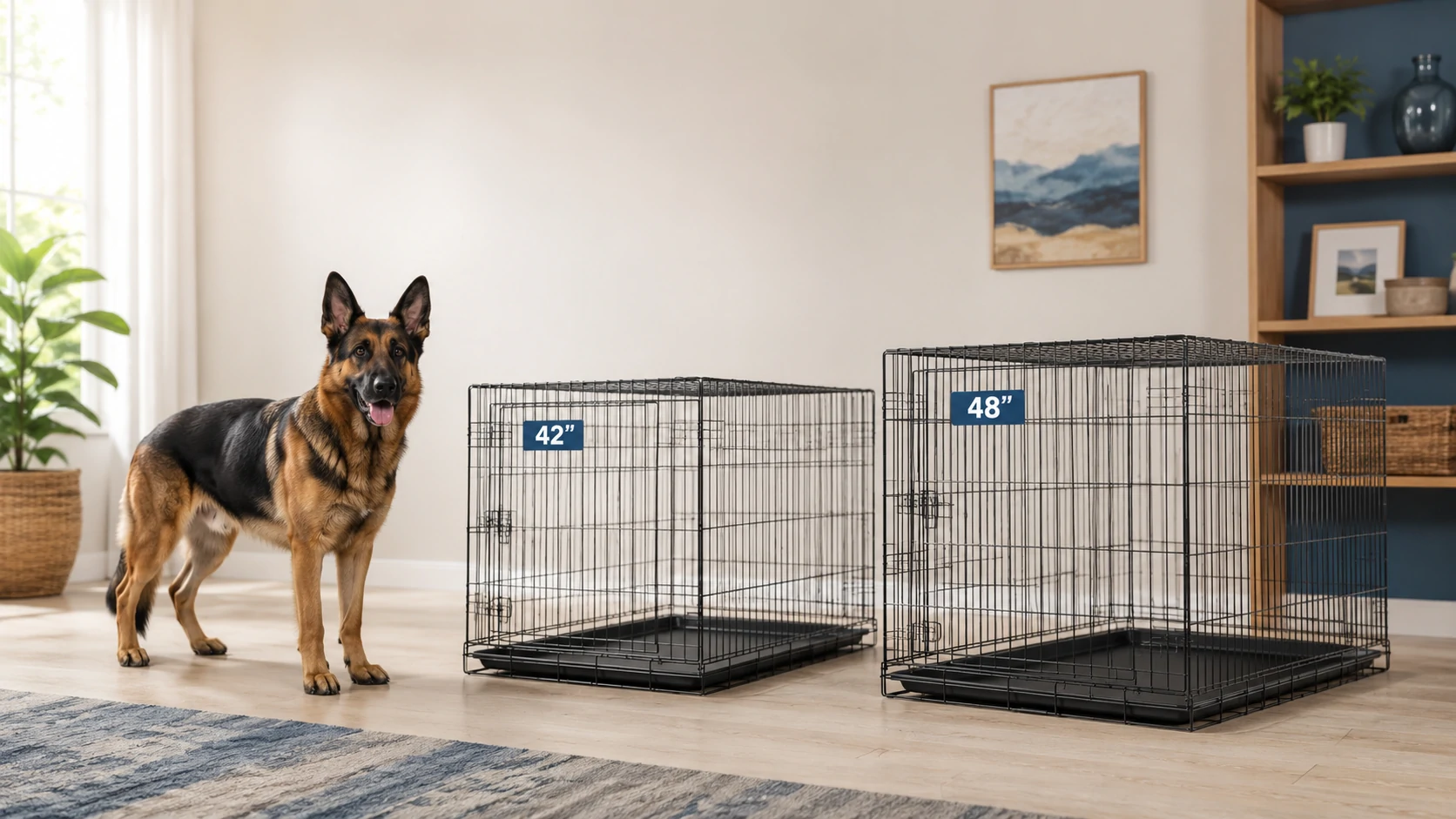
A crate can look enormous in a product photo and still be too low once a German Shepherd stands with upright ears. Choosing the right size can feel confusing because these dogs vary in height, body length, sex, age, and build.
If you are asking what size crate for German Shepherd, a 42-inch crate is a practical starting point for many adults, while taller, longer, or broad-built dogs may need a 48-inch crate. Measurements and fit matter more than the size printed on the box.
What Size Crate for German Shepherd Dogs?
For most adult German Shepherds, begin by comparing 42-inch and 48-inch crates. Many adult females and average-size males fit a 42-inch model, but a tall male, long-bodied dog, or dog that cannot stand naturally in a 42-inch crate may need a 48-inch model.
Always check the crate’s actual interior dimensions before buying.
Quick answer: Most adult German Shepherds should be measured against a 42-inch crate first, while larger or taller individuals may need a 48-inch crate. The correct crate lets your dog stand without ducking, turn easily, sit upright, lie on either side, and rest without the ears, head, or body pressing against the crate.
This 42-inch starting recommendation is a practical guideline rather than a universal breed rule. The final decision should always be based on your individual dog’s measurements and comfort.
The German Shepherd Dog Club of America breed standard lists a desired shoulder height of 24–26 inches for males and 22–24 inches for females. German Shepherds are also longer than they are tall, so weight alone does not show whether a crate will fit properly.
| German Shepherd stage or build | Practical starting size | Best use |
|---|---|---|
| Young puppy | Adult-size crate with divider | Adjust the sleeping area as the puppy grows |
| Typical adult female | 42-inch crate | Confirm full height and body length |
| Average adult male | 42-inch crate | Size up if ears touch or turning is restricted |
| Tall, long, or broad adult | 48-inch crate | Provides more headroom and resting space |
| Senior or mobility-limited dog | Roomy 42-inch or 48-inch crate | Prioritize easy entry and repositioning |
| Air travel | Airline-compliant hard crate measured to the dog | Follow the airline and current IATA requirements |
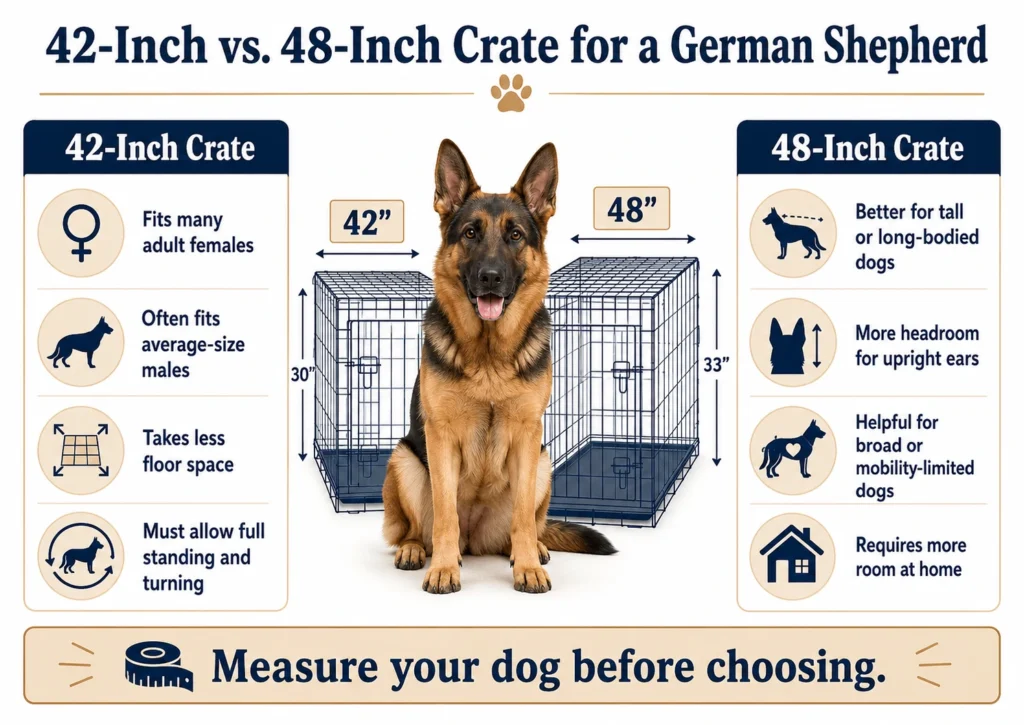
These are starting points, not guarantees. The phrase what size crate for German Shepherd should lead to a fit check, not a blind purchase.
Manufacturers use labels such as “42-inch” and “48-inch,” but interior height, door openings, floor space, and frame thickness can differ between products. Major crate manufacturers offer both size classes, but owners still need to compare the usable interior dimensions.
Is a 42-Inch Crate Big Enough for a German Shepherd?
A 42-inch crate is often big enough for an adult German Shepherd that can stand normally, turn without bumping the sides, and stretch out comfortably.
Still, length is not the only measurement that matters. A long-bodied dog may fit the floor while lacking enough height for the head and upright ears.
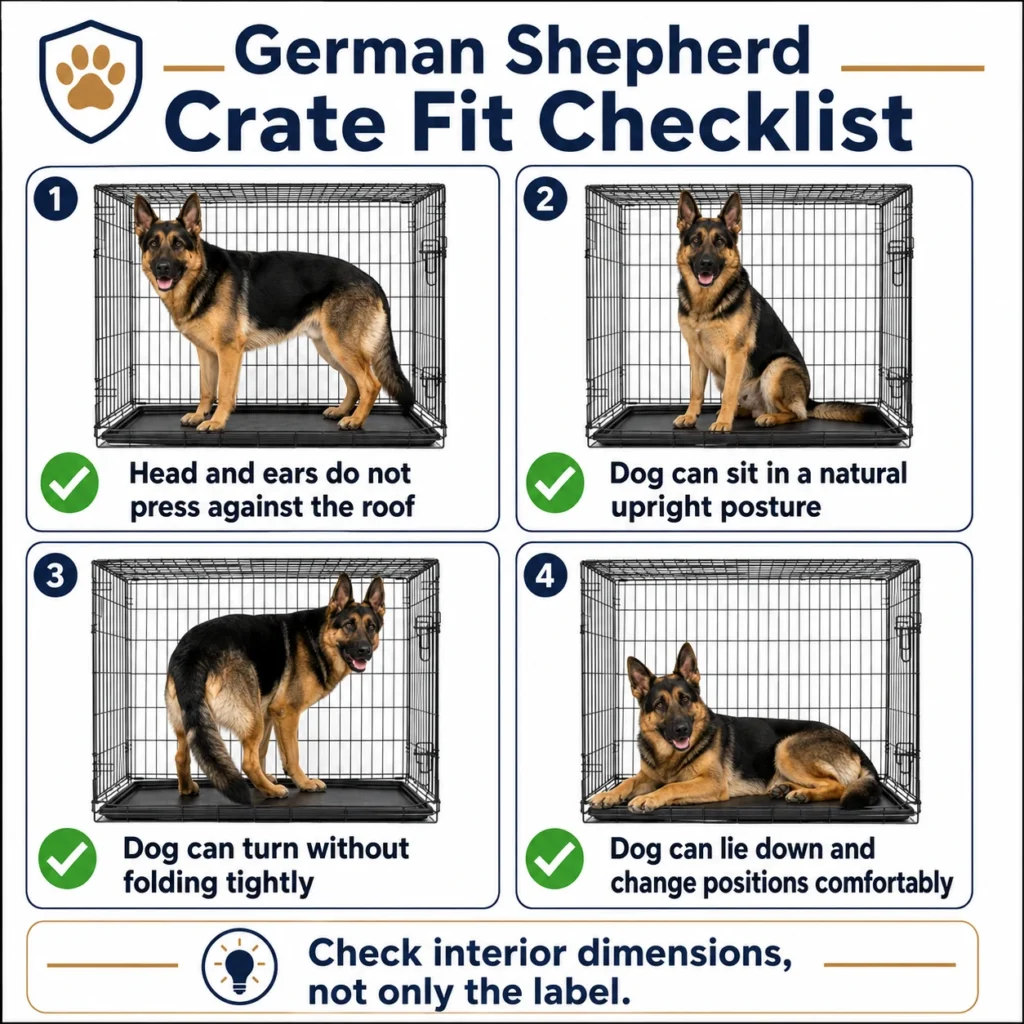
Use this simple fit test:
- Your dog can enter without crouching.
- The ears and top of the head do not press against the roof.
- Your dog can turn around without folding tightly.
- Your dog can sit upright.
- Your dog can lie on either side in a natural position.
- A crate pad does not remove essential headroom.
The American Kennel Club recommends enough room for a dog to sit, stand, and lie down comfortably while warning that excessive space may make puppy house-training harder.
If one or more of these fit checks fail, a 42-inch crate is too small for that particular dog, even when a generic breed chart recommends it.
When Does a German Shepherd Need a 48-Inch Crate?
A 48-inch crate may be better when your German Shepherd is:
- Taller than average
- Long through the body
- Broad or heavy-boned
- Unable to sit upright in a 42-inch crate
- Touching the roof with the head or ears
- Struggling to turn comfortably
- Older and slower when repositioning
Extra space is usually acceptable for a reliably house-trained adult, provided the crate remains secure and comfortable. A puppy may need a divider so the additional floor space does not become a separate toilet area.
When deciding what size crate for German Shepherd, compare the actual interior dimensions of both sizes. A 48-inch crate occupies considerably more floor space and can be heavy to move.
Measure the intended room, doorway, vehicle, and storage area before ordering. A crate that fits the dog but blocks a walkway or cannot pass through the door creates a new problem.
How to Measure a German Shepherd for a Crate
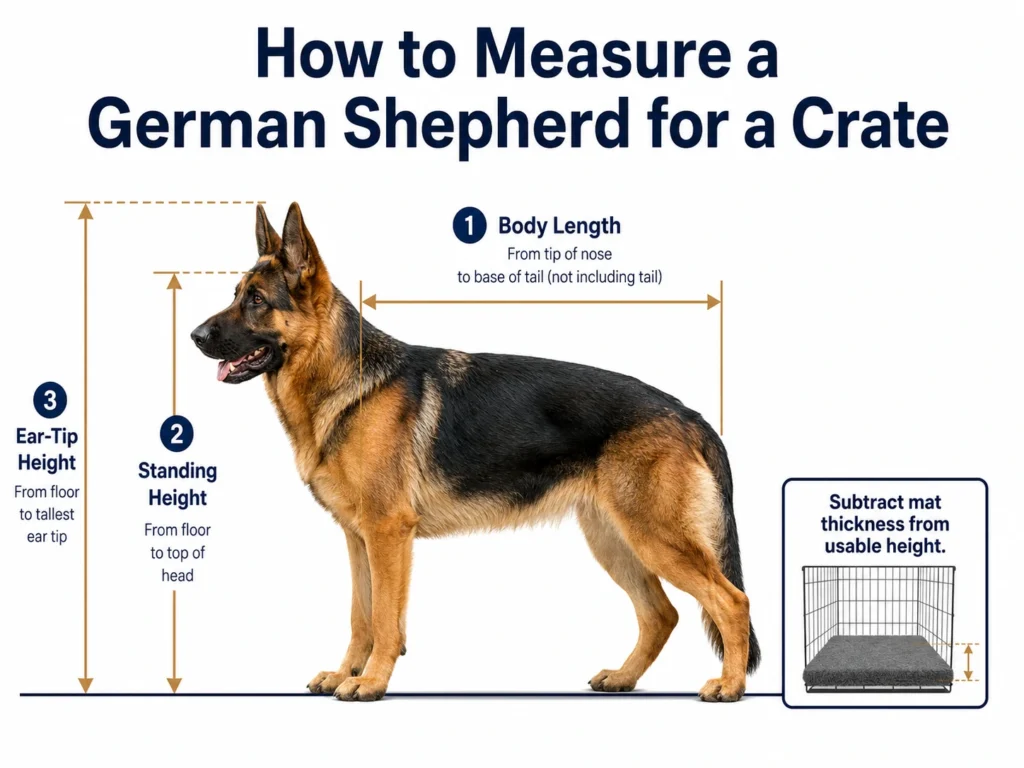
For the query what size crate for German Shepherd, measuring your own dog is more reliable than choosing by age or weight.
You need:
- A flexible measuring tape
- A level floor
- A calm, naturally standing dog
- The interior specifications of the crates you are comparing
1. Measure Body Length
With your dog standing naturally, measure from the tip of the nose to the point where the tail meets the body. Do not include the full tail.
Add a few inches so your dog can lie down, stretch, and change positions without pressing against the crate.
The MidWest crate-sizing guide recommends measuring from the nose to the base of the tail and adding extra clearance for comfortable movement.
2. Measure Standing Height
Measure from the floor to the highest natural point of the head.
Because German Shepherds have upright ears, measure to the tallest ear tip as well. Your dog should not need to lower the head or flatten the ears while standing.
Do not rely only on published breed height. Breed standards measure height at the shoulders, while a crate must accommodate the dog’s entire standing posture.
3. Observe Your Dog’s Sleeping Position
Watch how your German Shepherd normally sleeps.
Some dogs curl tightly. Others stretch onto one side with the legs extended. Choose enough floor length and width for your dog’s natural resting style rather than assuming a curled sleeping position means a smaller crate is acceptable.
4. Account for the Crate Mat
A thick bed reduces usable height.
For example, a three-inch mattress removes roughly three inches of standing clearance. This can turn a crate that looks suitable on paper into a cramped setup for a tall dog.
Measure the mat and subtract its thickness from the listed interior height.
5. Compare Interior, Not Only Exterior, Dimensions
Product listings often highlight exterior dimensions.
Door frames, sloped plastic walls, raised floors, thick panels, and internal hardware can reduce usable space. Before purchasing, check:
- Interior length
- Interior width
- Interior height
- Door-opening dimensions
- Floor-tray dimensions
- Product weight
- Recommended weight limit
Choose the smallest crate that still passes the full standing, sitting, turning, and lying-down comfort test.
Both the AKC crate-selection guidance and Humane World crate-training guide emphasize that the dog must have enough room to stand, turn, and rest comfortably.
What Size Crate for a German Shepherd Puppy?
When owners ask what size crate for German Shepherd puppies, the best answer is usually an adult-size wire crate with an adjustable divider.
A divider lets you provide enough room for the puppy to stand, turn, and lie down without opening the full adult crate on the first day.
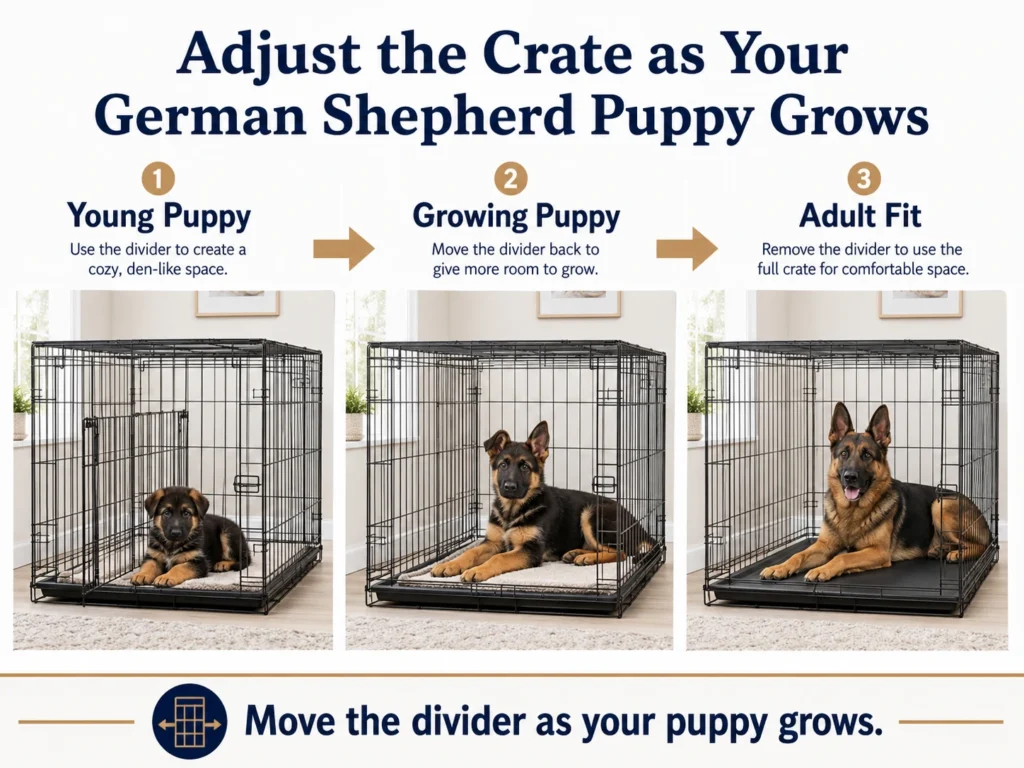
For many puppies expected to reach a typical adult size, a 42-inch crate with a secure divider is a reasonable starting option. A puppy from especially large parents, or one expected to become tall and long, may eventually need a 48-inch crate.
If you know the parents’ adult sizes, use that information alongside your puppy’s expected German Shepherd growth pattern.
Move the divider as your puppy grows. The puppy should never:
- Look compressed
- Struggle to turn
- Need to duck
- Sleep with the body pressed tightly against the walls
- Have ears touching the roof
At the same time, avoid creating a large unused toilet area during early house-training.
Adjustable crates can accommodate a puppy’s growth, and Humane World specifically notes that adjustable models may be helpful for growing dogs.
Crate size does not replace crate training. Introduce the space with food, safe chews, calm rest, and short positive sessions.
Furbivo’s German Shepherd training guide explains how reward-based teaching, predictable routines, and gradual practice support better everyday behavior.
Choosing Between Wire, Plastic, and Furniture-Style Crates
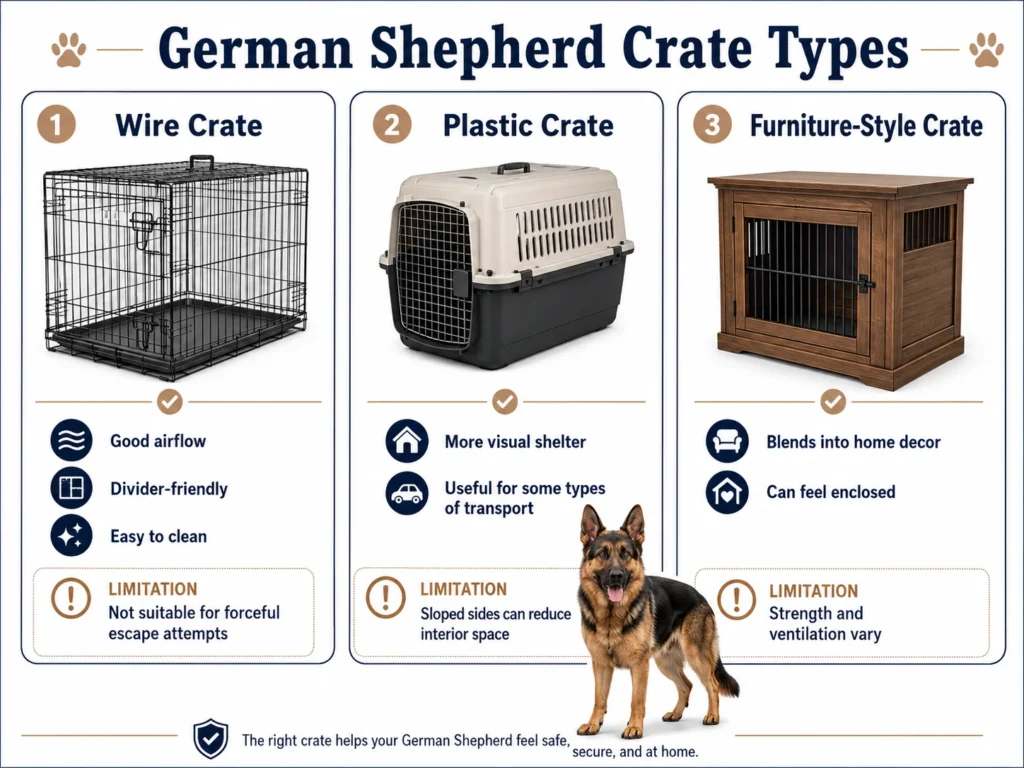
Correct dimensions come first, but crate design affects comfort, cleaning, ventilation, portability, and security.
Wire Crate
A wire crate is often practical for a growing German Shepherd because many models include an adjustable divider.
Common benefits include:
- Strong ventilation
- Good visibility
- Removable cleaning tray
- Folding design
- Multiple door options
- Adjustable puppy space
Check the wire gauge, latch design, sharp edges, door placement, and floor stability.
A standard folding wire crate is not designed to safely contain a dog that panics, bends bars, or repeatedly attempts a forceful escape.
Plastic Crate
A hard plastic crate offers more visual shelter and may feel quieter to some dogs. Plastic kennels are commonly used for transport, but home kennels and airline-compliant travel crates are not automatically the same.
Measure plastic crates carefully because sloped sides can make the usable upper area narrower than the advertised exterior size.
Furniture-Style or Soft-Sided Crate
Furniture-style crates should be judged by ventilation, safe materials, secure construction, and usable space—not appearance alone.
Soft crates are better suited to calm, fully crate-trained dogs. They are poor first choices for strong puppies, anxious chewers, or dogs that scratch and push against barriers.
Does Crate Size Affect House-Training?
Yes. A crate that is much larger than a puppy needs may make house-training harder because the puppy can use one end as a bathroom and sleep at the other.
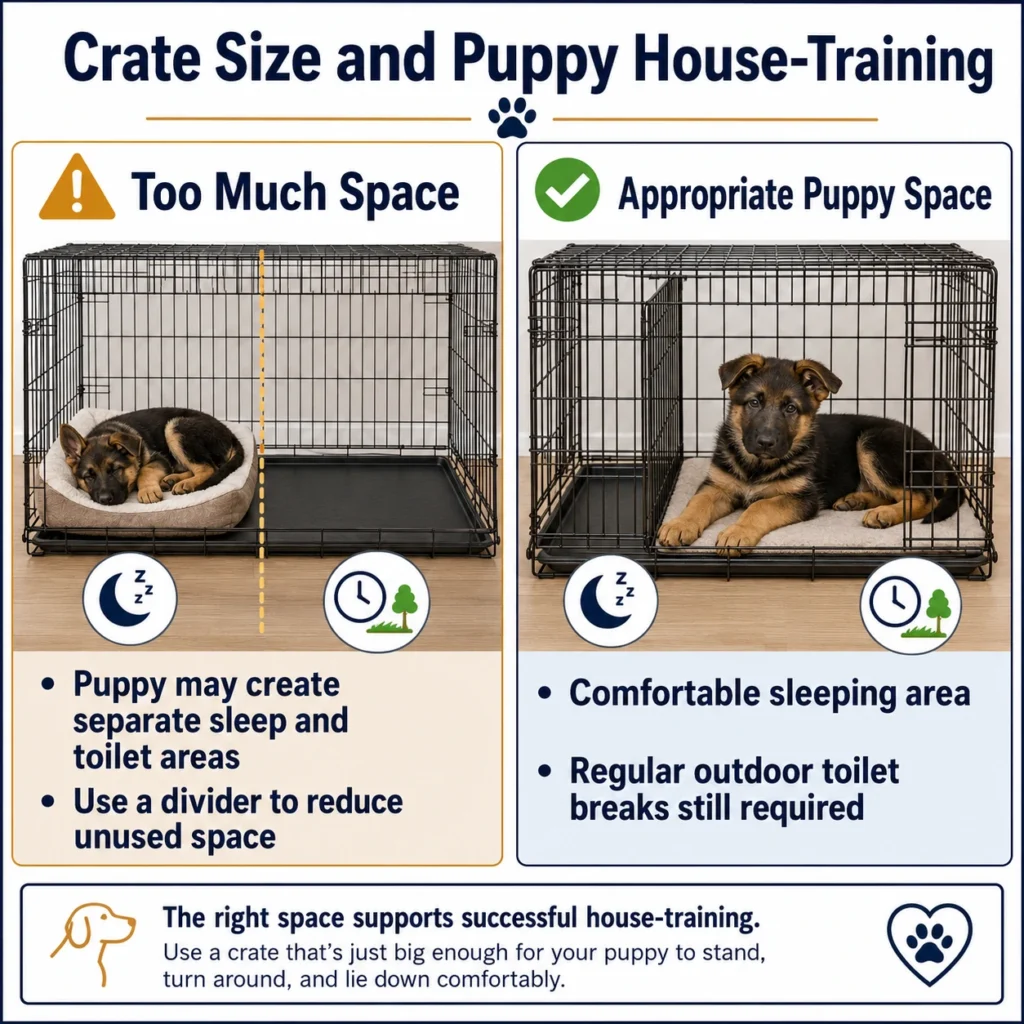
A divider helps match the usable area to the puppy’s current body size.
The opposite problem matters too. A small crate does not improve house-training. If the puppy cannot stand comfortably, turn, change positions, or lie naturally, the setup is inappropriate.
The correct area should feel like a comfortable sleeping space, not a tiny box and not an indoor exercise pen.
Use regular toilet breaks rather than expecting crate size to prevent accidents. Repeated accidents may reflect:
- Poor timing
- Incomplete house-training
- Stress or fear
- Digestive upset
- Urinary problems
- An unsuitable routine
- Asking a young puppy to wait too long
The AKC notes that excessive crate space may allow a dog to eliminate in one area and rest away from it.
How to Tell That the Crate Is Too Small or Too Large
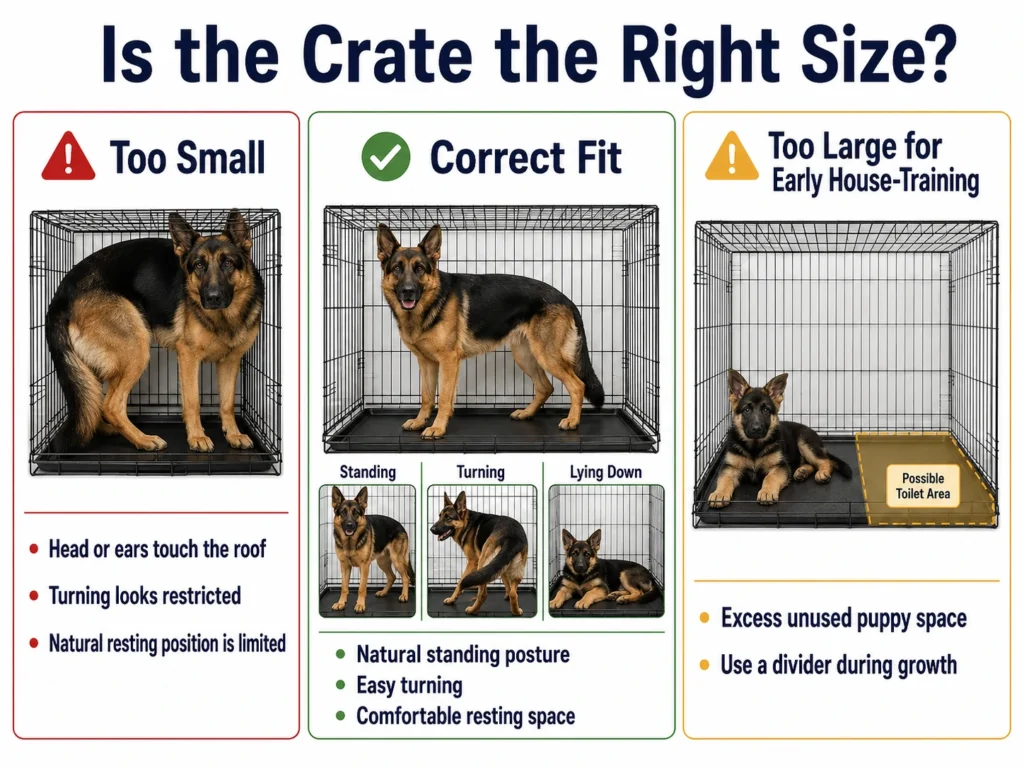
Signs the Crate Is Too Small
- Your German Shepherd ducks when standing.
- The ears or head touch the roof.
- The dog must curl tightly to lie down.
- Turning looks slow or awkward.
- The shoulders rub against the sides.
- The dog struggles to enter through the door.
- A senior dog cannot reposition comfortably.
- Your dog begins avoiding a previously accepted crate.
Sudden reluctance to enter, stiffness, crying, or difficulty lying down can be linked to pain or illness rather than crate preference.
Seek veterinary advice when the change is new, persistent, or accompanied by limping, weakness, unusual panting, appetite changes, or sensitivity to touch.
Signs the Crate May Be Unnecessarily Large
- A puppy eliminates at one end and sleeps at the other.
- The divider leaves far more space than the puppy needs.
- The crate blocks doors or household walkways.
- The crate shifts or feels unstable in its intended location.
- The dog cannot settle because the setup functions more like an open pen.
For a house-trained adult, a roomy crate is not automatically a problem. The important questions are whether the dog is secure, comfortable, and using the space calmly.
Home Crates and Airline Travel Crates Are Not the Same
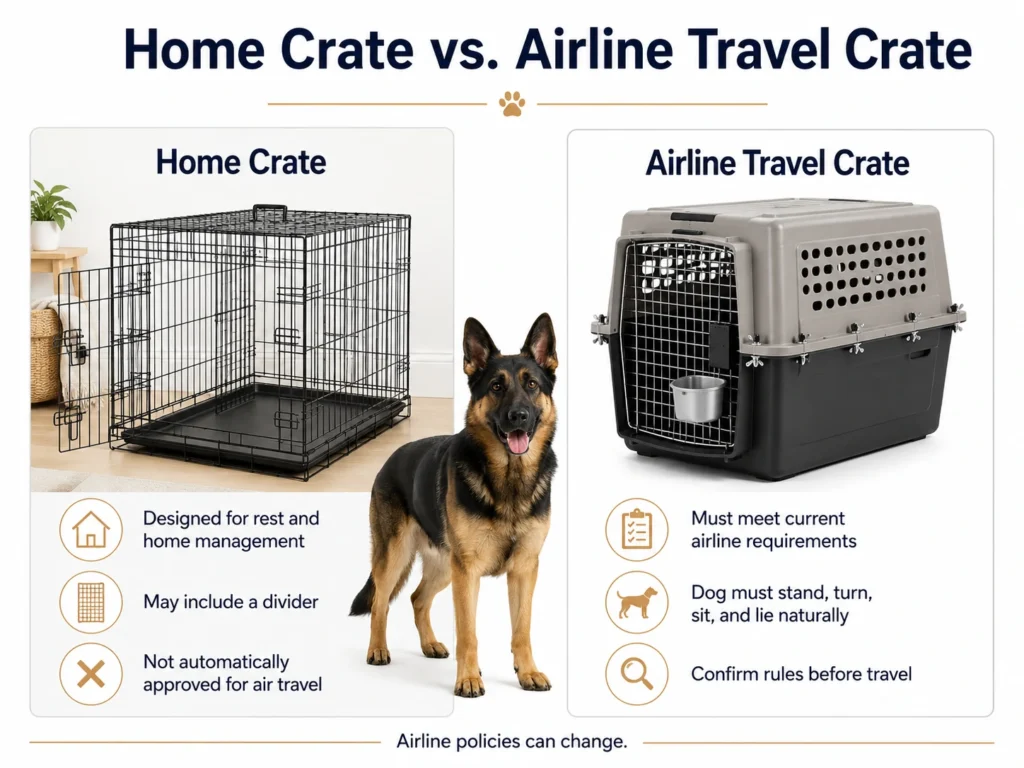
A home wire crate should not be assumed to meet airline requirements.
Airlines may require:
- A rigid container
- Specific ventilation
- Secure metal fasteners
- Water access
- Leak-resistant flooring
- Identification labels
- A particular door design
- Space for natural standing and resting positions
The International Air Transport Association pet-travel guidance says pets need enough space to turn normally while standing, stand and sit fully, and lie in a natural position.
Airline policies, aircraft limits, destinations, routes, and seasonal restrictions can change. Confirm the current rules directly with the operating airline before buying a travel kennel.
For air travel, what size crate for German Shepherd cannot be answered safely with “42-inch” or “48-inch” alone. Follow the airline’s required measuring method and container specifications.
Most adult German Shepherds are too large for an under-seat cabin carrier.
Crate Placement and Safety
Place the crate on a stable, level surface where your dog can rest without being completely isolated from normal household activity.
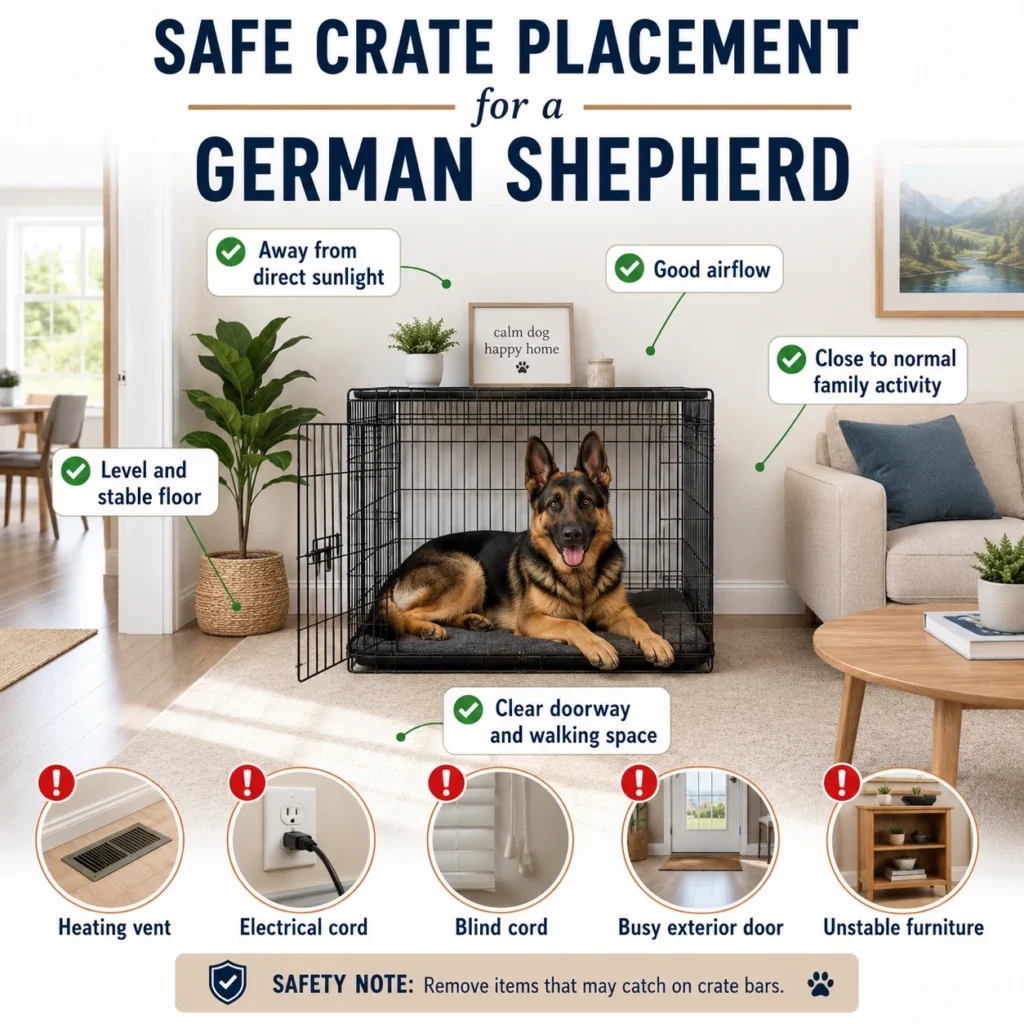
Avoid placing it near:
- Direct sunlight
- Heating vents
- Cold drafts
- Electrical cords
- Blind strings
- Unstable furniture
- Busy doors
- Areas where children may disturb a sleeping dog
Remove collars, tags, harnesses, or loose equipment when there is a risk that they could catch on crate bars or hardware.
Choose bedding based on your dog’s chewing habits and mobility. A thick supportive mat may suit some adults and seniors, while a puppy that shreds and swallows fabric needs a safer setup and closer supervision.
A crate should not be used as harsh punishment or as a substitute for:
- Exercise
- Toilet breaks
- Social contact
- Mental activity
- Training
- Veterinary care
- Supervision
Introduce the crate gradually and keep the association calm. Humane World recommends pleasant associations, food rewards, and small training steps rather than forcing a reluctant dog inside.
Puppies also need confidence-building experiences outside the crate. Furbivo’s German Shepherd puppy socialization guide explains how to introduce people, sounds, surfaces, handling, and new environments without overwhelming a young dog.
What Most Crate-Size Articles Miss
The most common mistake is choosing by breed label alone.
“German Shepherd” describes a breed, not one fixed body shape. A smaller adult female and a large male may need different interior heights, floor lengths, and door openings.
Another missed detail is posture. Published breed height is measured at the shoulders, while crate height must accommodate the head and upright ears.
Bedding also reduces headroom, and the door opening may be smaller than the main interior.
The best answer to what size crate for German Shepherd is therefore a decision process:
- Use 42 inches as the first adult size to compare.
- Measure the dog’s body length and full standing height.
- Add comfortable clearance.
- Check the manufacturer’s interior dimensions.
- Account for the crate mat.
- Test standing, turning, sitting, and lying positions.
- Choose 48 inches when a 42-inch model restricts natural movement.
- Use a divider for a growing puppy.
This method avoids both blind upsizing and forcing a large dog into a crate that technically matches a chart but does not fit comfortably.
FAQs
Is a 42-Inch Crate Suitable for a German Shepherd?
A 42-inch crate suits many adult German Shepherds, especially typical females and average-size males. It is suitable only when your dog can stand without ducking, turn easily, sit upright, and lie naturally. Always check the interior dimensions because brands vary.
Should I Get a 42-Inch or 48-Inch Crate for My German Shepherd?
Choose based on your dog’s measurements. Use a 42-inch crate when it provides full standing and resting clearance. Select 48 inches for a taller, longer, broad-built, senior, or mobility-limited dog that appears restricted in the smaller crate.
What Size Crate for German Shepherd Puppies Works Best?
An adult-size crate with a divider works well for many German Shepherd puppies. A divided 42-inch wire crate is a practical starting point for many puppies, but dogs expected to become unusually tall or large may eventually require 48 inches.
Can a German Shepherd Crate Be Too Big?
Yes, especially during puppy house-training. Excess space may allow a puppy to eliminate at one end and sleep at the other. Use an adjustable divider. For a reliably house-trained adult, extra space is less concerning when the crate remains secure and comfortable.
How Much Room Should a German Shepherd Have in a Crate?
Your dog should be able to enter normally, stand without lowering the head, sit upright, turn around, and lie on either side. Provide comfortable clearance, but do not give a house-training puppy a large unused area that can become a toilet zone.
Final Thoughts
For most owners researching what size crate for German Shepherd, a 42-inch crate is the logical first size to compare. A 48-inch crate is the safer choice for a dog that is tall, long, broad, older, mobility-limited, or visibly restricted by the smaller model.
Do not buy from a breed label or weight recommendation alone.
Measure your dog, compare interior dimensions, account for bedding, and use the standing-turning-lying fit test. For puppies, buy for the expected adult size and use a divider rather than replacing several crates during growth.
Have questions about your dog’s health, nutrition, grooming, or daily care? Visit our Contact Us page to reach the Furbivo team. For any medical symptoms, diagnosis, or treatment advice, always consult a qualified veterinarian.